Last updated 2026-07-26
TL;DR
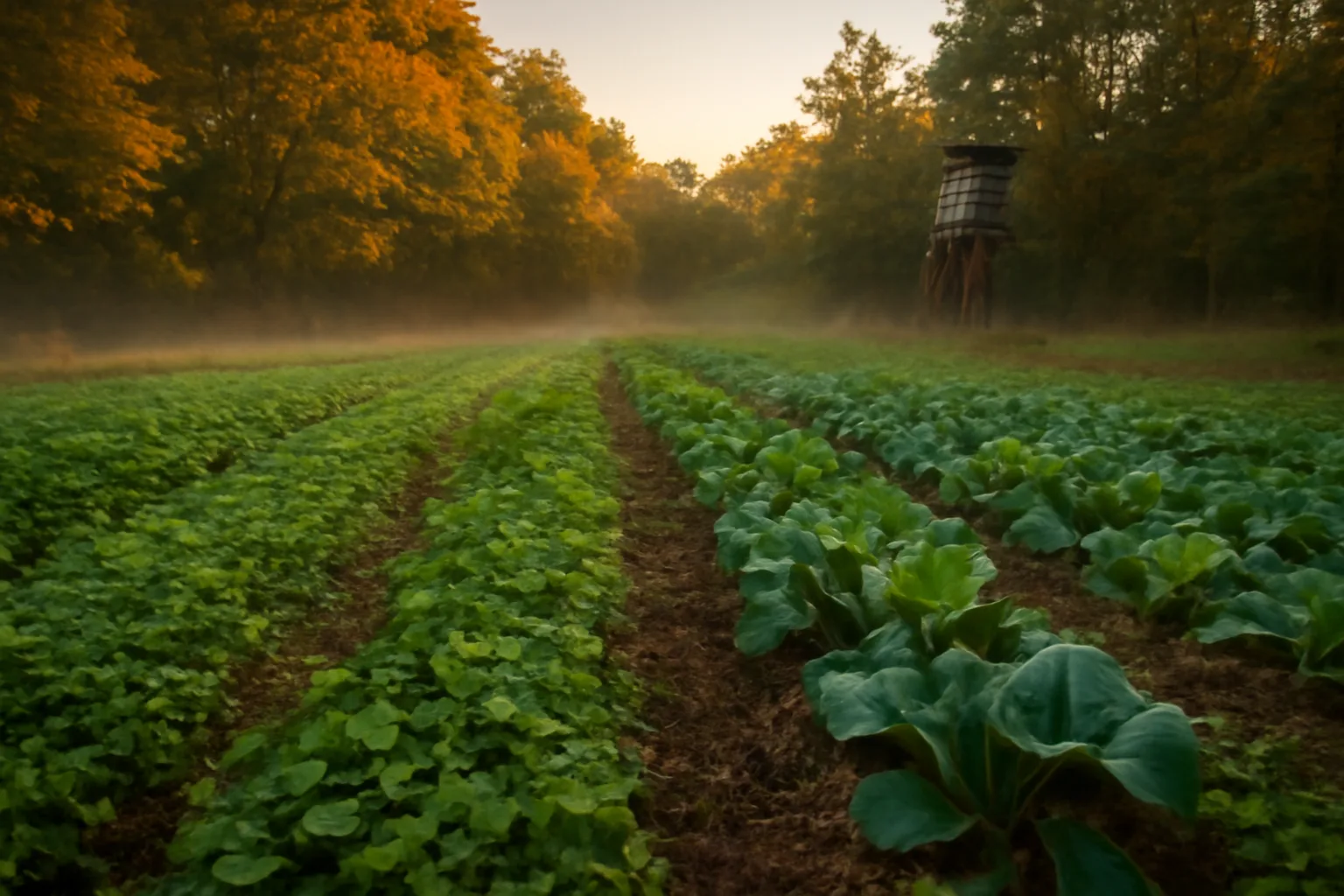
There's no single best bow season food plot species. The strongest setups pair a perennial clover (already up and attracting deer by September) with a fresh brassica/cereal grain blend planted 60-90 days before your opener, so you have green forage attracting deer right when archery season opens in most states.
What is a food plot, exactly?
A food plot is a planted patch of forage on hunting land, usually somewhere between a quarter acre and several acres, put in specifically to feed and hold deer (or attract them to a huntable spot) rather than to harvest a cash crop. Most hunters plant a mix of annuals and perennials: clover, brassicas, cereal grains, chicory, sometimes soybeans or corn on bigger acreage. The USDA Natural Resources Conservation Service treats food plots as a wildlife habitat practice, and NRCS conservation programs in several states cost-share plantings under practice code 645 (Upland Wildlife Habitat Management) when they meet certain criteria [1]. That's a technical definition. For a bowhunter, the practical definition is simpler: a food plot is any planted area you're using to put deer within range of a stand or blind during a specific part of the season. The 'best' plot for bow season isn't the same plot you'd want for late muzzleloader season or for growing deer through summer. Bow season plots need to be attractive and established well before opening day, which in most whitetail states falls in September or early October. That timing constraint drives almost every decision below. If you want a plan built around your specific location and soil test rather than general guidance, that's exactly what the Custom Food Plot Plan is for. It's a $99 one-time build, not a subscription, and it starts from your soil test results and your season goals.
When should you plant food plots for deer?
| North (MN, WI, MI, ME, upper NY) | Late April-May | Late July-mid August | Mid August-early September | |
|---|---|---|---|---|
| Transition (OH, PA, IN, IA, southern NY) | April-May | Early-late August | Late August-mid September | |
| South (TN, AL, GA, TX, AR) | March-April or Sept-Oct | Late August-September | September-October | These windows come from a synthesis of land-grant extension planting guides (Penn State, MSU, University of Tennessee) rather than one single source, so check your own state extension's food plot publication before you buy seed [2]. |
Plant timing depends entirely on what you're growing and what season you're targeting, not a single calendar date. Perennial clover and chicory go in during spring (April-May in the north, March-April in the transition zone) so they're established with a root system by fall. Annual brassicas, cereal grains, and other bow-season plantings go in mid to late summer, roughly 60 to 90 days before your first hard frost or your archery opener, whichever comes first. Penn State Extension's general guidance for food plot annuals is to plant brassicas and cereal grain blends between late July and early September in the Northeast and upper Midwest, adjusting earlier for northern latitudes and later for southern ones. The logic is straightforward: brassicas need 8 to 10 weeks of growth before they're palatable and before tubers (on turnip varieties) bulk up, and you want that window to end right around your season opener, not two months before it. Here's a rough planting window table. Treat it as a starting point, not gospel. Your local extension office and your own frost dates matter more than any national chart. | Zone (rough) | Clover/perennials | Brassicas/turnips | Cereal grains (oats, wheat, rye) |
When to plant oats for deer
Plant oats for deer 60 to 90 days before your first killing frost, which puts most of the country in a late July through September window. Oats are a fast-germinating cereal grain, often up in 5 to 7 days under good moisture, and deer will hit young oat shoots hard the moment they emerge. Oats winterkill in most northern climates once temperatures drop into the teens or lower, which is actually a feature for bow season use: they're bred to peak in September and October, exactly when you're hunting, rather than persist deep into winter like winter wheat or rye does. University of Tennessee Extension recommends oats as part of a fall annual blend planted mid-August to mid-September in Tennessee, paired with cereal rye or wheat for cold tolerance if you want the plot to hold into late season too [2]. One practical note: straight oats alone are a decent bow season plot but not a great one. Blending oats with a brassica (like forage rape or a turnip) or with clover gives you a longer attraction window and hedges against one species getting hammered flat in the first two weeks of hunting pressure.
When to plant turnips for deer
Plant turnips for deer 80 to 100 days before you expect a hard frost, because turnip bulbs need that full window to bulk up and turn sweet. Most hunters in the north plant turnips late July to mid-August; in the transition zone, mid-August to early September; in the deep south, September. Turnips are a two-stage food source. Deer eat the leafy tops first, usually starting 4 to 6 weeks after planting, well before bow season opens in most states. The bulbs themselves don't get attractive until after a frost or two converts starches to sugars, which is why turnip plots often look ignored in October and then get hammered in December. If your goal is strictly bow season attraction, don't count on the bulbs doing the work. Count on the tops, and plan a companion planting (clover, oats, or a brassica blend with faster-maturing leaf growth) for the early weeks of the season. Mississippi State University Extension notes that brassica forage quality and palatability improve significantly after exposure to frost, which is the agronomic reason turnip plots seem to "turn on" for deer in late fall [3].
Do deer eat clover, and do deer like it?
Yes, deer eat clover readily and it's one of the most consistently preferred food plot forages across the whitetail's range. Clover is a preferred forage because of its high crude protein content, typically 20 to 25% depending on variety, maturity, and soil fertility, and because it regrows quickly after grazing, unlike a lot of annuals that get eaten down and don't come back. For bow season specifically, clover's advantage is that it's already established. A clover plot planted the previous spring is green, growing, and attractive from the moment archery season opens, with zero risk of it being too immature to draw deer. That's a real edge over a freshly planted annual plot that might still be in the seedling stage if your planting window slipped. The tradeoff: clover alone tends to get less attractive in the hottest, driest part of late summer, right before bow season opens in the south. It also needs decent soil pH (extension guidance generally targets 6.0 to 6.5 for red and white clover) and periodic mowing or grazing pressure to stay in a vegetative, palatable stage rather than bolting to seed [4]. If your soil test comes back below pH 6.0, expect a clover stand to underperform no matter how good the seed is, until lime brings pH up. Your soil test lab's lime recommendation is the authority here, not a general chart, since lime needs vary by buffer pH and soil type.
Do deer eat sorghum?
Yes, deer eat sorghum, both the grain heads and the young green forage, though it's a secondary food plot choice compared to clover, brassicas, or soybeans for most bowhunters. Grain sorghum (milo) produces a standing seed head that deer, turkeys, and other wildlife feed on into winter, and it's drought-tolerant, which makes it a common choice in the southern plains and parts of Texas where summer annuals struggle. For bow season specifically, sorghum isn't a first pick. It's planted in late spring like corn and matures over a long season, so it's more of a late-season standing crop than an early-archery attractor. Some hunters use it as a screening/cover crop around a clover or brassica plot rather than as the primary bow season forage. If you're in sorghum country already (it's a major regional crop in Kansas, Texas, and Oklahoma), a small block can work as a late-bow-season and gun-season draw, but don't expect it to pull deer in September the way a fresh clover or oat plot will.
Do deer like honey, and does it matter for food plots?
There's no real food plot angle here. Deer aren't drawn to honey the way they're drawn to browse, forbs, or grain, and honey isn't a legal or practical food plot input in any state extension guidance. What people usually mean when they ask this is whether sweet attractants, mineral licks, or scent-based lures work like a mini food plot. They don't function the same way. A more useful version of this question is whether "sweet" annual forages (like certain brassica varieties bred for higher sugar content, or molasses-based mineral supplements) pull deer better than plain forage. Some do show a preference edge in informal field observations, but there's no controlled study we're aware of quantifying it. What is well documented: check your state's baiting and supplemental feeding regulations before you put out any mineral, salt, or attractant product, because many states restrict or ban baiting for deer hunting, and a legally planted food plot is treated very differently from a bait pile under most state law. Michigan, for example, has specific bait and feeding restrictions tied to chronic wasting disease management in parts of the state, enforced by the Michigan DNR [5]. Rules vary widely, so check your own state wildlife agency's current regulations before assuming a plot, mineral site, or feeder is legal where you hunt.
What are deer's favorite foods, overall?
Deer are opportunistic browsers, and their "favorite" food shifts by season, region, and what's locally available, but a few categories show up consistently across research and extension literature as high-preference: soft mast (acorns, apples, persimmons), legumes (clover, soybeans, cowpeas), and tender new growth on woody browse and forbs. Acorns are arguably the single most consistently preferred natural food across the whitetail's range in fall, and a heavy acorn crop can pull deer away from a food plot entirely, which is a common frustration for bowhunters in oak-heavy country. Soybeans, where legal and where deer pressure doesn't wipe out the plot before pods form, are extremely high preference, often rated above clover in comparative browse studies. The Quality Deer Management Association (now the National Deer Association) and multiple state agencies have long recommended a mix of a perennial (clover/chicory) and an annual (brassica/cereal grain/soybean) specifically because deer preference shifts through the season, and a single-species plot leaves gaps [6]. For bow season specifically, the honest answer is: whatever is most available, most palatable, and least abundant elsewhere on the landscape at that moment. If your plot is competing against a bumper acorn crop, don't expect it to out-draw the woods. If it's the only green, high-protein food source around in a dry September, it can be very effective.
What's actually the best food plot setup for bow season?
The strongest bow season setup most hunters land on is a two-part system: a perennial clover or clover/chicory plot that's already mature going into fall, paired with a fresh annual planting (brassica and cereal grain blend) timed to peak right at your opener. This isn't a magic formula, it's just hedging against the two main failure modes: an annual that's not mature yet, and a perennial that's lost its punch in late summer heat. A few sizing and placement notes that matter more than species choice for actual bow season success. Smaller plots (a quarter acre to half acre) tucked into or near timber tend to get used more in daylight by mature bucks than large, open plots, because deer feel more comfortable stepping into a tight space with cover close by. Access and wind matter enormously; a perfect plot with a bad entry/exit route or a stand that gets busted by thermals will underperform a mediocre plot with great access. This is stand-placement and land-use strategy, not seed selection, and it's often the bigger variable in whether a plot produces daylight sightings during bow season. If you're deciding what to actually plant, food plot seed blends built for early season, and deer food plot seed options broken out by species, are good next stops. For a broader look at how plot types differ (perennial vs annual, small vs large), see food plot whitetail and deer food plots.
How do you time planting to your actual bow season opener?
Work backward from your local archery opener and your average first frost date, then pick species based on which window you actually have left. If your opener is September 1 and you haven't planted anything by late July, brassicas are probably too late to be fully mature; a fast cereal grain like oats, or a clover overseed into an existing plot, is a better bet than starting a brassica blend from bare dirt in August. Most state wildlife agencies and extension services publish regional planting calendars. Ohio State University Extension, for instance, publishes fall forage planting date guidance by region of the state, and archery season in Ohio opens the last Saturday in September, giving Ohio hunters a fairly tight window to hit both planting maturity and opener timing [7]. Cross-reference your own state's date; some southern states, like Alabama and Georgia, aren't running gun-season openers until October or November but have archery openers in early October, which changes the calculus on how much lead time you actually have. A rough rule that holds up in most extension literature: 45-60 days minimum for cereal grains and clover to be grazeable, 60-90 days for brassica leaf growth to be attractive, 90-100 days for turnip bulbs to sweeten. Count backward from your opener and pick accordingly, rather than picking a species first and hoping the calendar works out.
What soil prep actually matters before bow season planting?
A soil test is the single highest-value thing you can do before planting, and it costs far less than the seed you're about to put in the ground. Most land-grant universities run soil tests for home and small-acreage growers in the $10-20 range per sample, and results typically come back with a specific lime and fertilizer recommendation for your target crop . pH is the number that determines whether everything else you do matters. Clover, in particular, struggles hard below pH 6.0, and most food plot species want somewhere in the 6.0-7.0 range depending on species. If your test comes back at 5.2, no amount of fertilizer fixes that fast; lime takes months to fully react with soil, which is another reason spring soil testing (ahead of a fall bow season planting) beats testing in August when you're already behind. Your soil test lab's specific lime and fertilizer rate recommendation is the authority for your ground, not a general chart like this one. Soil types, existing nutrient levels, and target crop all shift the actual rate needed, sometimes by a factor of two or more between two fields that look similar from the truck. If you want help turning a soil test into an actual planting plan (species picks, seeding rates, and a rough calendar matched to your zone and your bow season dates), that's the specific problem the Custom Food Plot Plan is built to solve, and it's a one-time $99 charge rather than a recurring service.
What planting mistakes ruin bow season plots most often?
Planting too late is the single most common mistake, by a wide margin. Hunters get busy in July and August, miss the window, and end up with a brassica plot that's still four inches tall on opening day, offering nothing. The second most common mistake is skipping weed control before planting into an existing field. A field that's been mowed but not sprayed or tilled still has a seed bank and existing perennial weeds that will out-compete slow-establishing food plot species, especially clover and brassicas, in the first month. Glyphosate or tillage ahead of planting, timed per your local extension's herbicide guidance, matters more than seed brand. Third is ignoring deer pressure on a small plot. A half-acre brassica plot in an area with a dense deer herd can get grazed to nothing before it ever bulks up, especially if it's the only green food source around during a drought. Fencing off a small "nursery" section, or planting a slightly larger acreage than you think you need, is a common fix recommended in extension brassica guides [3]. Fourth: not checking legal requirements. Some states regulate what counts as a food plot versus supplemental feeding or baiting, particularly in CWD management zones. Check your state wildlife agency's current regulations before you plant anything near a stand you plan to hunt over, since rules vary by state and sometimes by county.
Frequently asked questions
Do deer eat sorghum?
Yes. Deer eat both the grain heads and young forage of sorghum, though it's a secondary choice behind clover, brassicas, and soybeans for most food plot hunters. It's more common as a late-season standing crop in drought-prone regions like Texas, Kansas, and Oklahoma than as a primary bow season attractor.
Do deer eat clover?
Yes, clover is one of the most consistently preferred food plot forages, with crude protein typically running 20-25% depending on variety and soil fertility. It regrows after grazing pressure, unlike many annuals, which makes it a strong perennial base for a bow season plot when it's already established from a prior spring planting.
When to plant deer food plots?
It depends on species. Perennials like clover go in spring (March-May depending on latitude). Annuals like brassicas and cereal grains go in mid to late summer, generally 60-100 days before your area's first hard frost or your bow season opener, whichever comes first. Check your state extension's regional planting calendar for exact dates.
Do deer like clover?
Yes, clover ranks among the highest-preference food plot forages across most of the whitetail's range, thanks to its protein content and regrowth after grazing. It can lose some appeal in the hottest, driest part of late summer, which is why many hunters pair it with a fresh annual planting for bow season.
When to plant oats for deer?
Plant oats 60-90 days before your first hard frost, generally late July through September depending on your zone. Oats germinate fast (often 5-7 days) and deer readily eat young shoots, but oats typically winterkill in cold climates, making them a strong early-to-mid bow season choice rather than a late-season one.
When to plant food plots for deer?
There's no single date. Spring plantings (April-May in most zones) are for perennials like clover and chicory. Summer plantings (late July through September, moving later as you go south) are for fall annuals like brassicas, oats, wheat, and rye. Match your species to your bow season opener and local frost dates.
When to plant turnips for deer?
Plant turnips 80-100 days before your area's first hard frost, roughly late July to mid-August in the north and August to September farther south. Deer eat the leafy tops within 4-6 weeks, but the bulbs don't turn sweet and attractive until after one or two frosts convert starches to sugar.
What is a food plot?
A food plot is a planted area of forage, usually a fraction of an acre up to several acres, established specifically to feed or attract deer rather than for cash-crop harvest. Common species include clover, brassicas, cereal grains, and soybeans, often planted in a rotation of perennials and annuals to cover multiple seasons.
What are deer's favorite foods?
Preference shifts by season and region, but acorns and other soft mast rank among the highest-preference natural foods in fall, and among planted forages, legumes like clover and soybeans are consistently high-preference. A heavy natural acorn crop can pull deer away from even a well-established food plot.
Do deer like honey?
There's no meaningful food-plot connection. Deer aren't naturally drawn to honey the way they're drawn to browse or legumes, and it isn't a legal or practical planting input. If you're thinking of sweet attractants or mineral supplements, check your state's baiting and feeding regulations before using them near a hunting stand.
How big should a bow season food plot be?
Smaller plots, roughly a quarter acre to half acre, tucked near timber or cover, often produce more daylight deer activity during bow season than large open plots, because deer feel more comfortable using tight, covered spaces. Bigger acreage matters more for late-season and herd-holding goals than for early bow season hunting.
Can you plant a food plot too late for bow season?
Yes, and it's the most common mistake hunters make. Brassicas typically need 60-90 days to become attractive, turnip bulbs need 90-100 days to sweeten, and even fast-germinating oats need several weeks. If you're within 30 days of your opener, an established clover overseed is a better bet than a brand-new annual planting.
Sources
- USDA NRCS, Conservation Practice Standard 645 - Upland Wildlife Habitat Management: Food plots fall under NRCS upland wildlife habitat management practice standards and cost-share eligibility
- University of Tennessee Extension, Establishing Wildlife Food Plots: Recommended oats and cereal grain fall planting windows and blending with rye/wheat for cold tolerance
- University of Kentucky/Cooperative Extension, Establishing Clover for Wildlife: Target soil pH range of 6.0-6.5 for red and white clover establishment
- Michigan Department of Natural Resources, Baiting and Feeding Regulations: Michigan restricts baiting and supplemental feeding of deer in parts of the state tied to CWD management
- National Deer Association, Food Plot Planning Recommendations: Recommendation to combine a perennial and an annual food plot species to cover shifting deer forage preference through the season
- Ohio State University Extension / Ohio Department of Natural Resources archery season dates: Ohio archery deer season opening date reference used for bow-season planting timing example
- Penn State Agricultural Analytical Services Laboratory, Soil Testing Fees: Typical land-grant university soil test cost range for growers