Last updated 2026-07-25
TL;DR
A food plot is a planted opening that gives deer concentrated forage, usually clover, brassicas, cereal grains, or sorghum, planted late summer through fall in most whitetail country. Early successional plants (native forbs, brambles, young woody growth) fill in the rest of the year and often matter more to deer nutrition than the plot itself.
what is a food plot, exactly
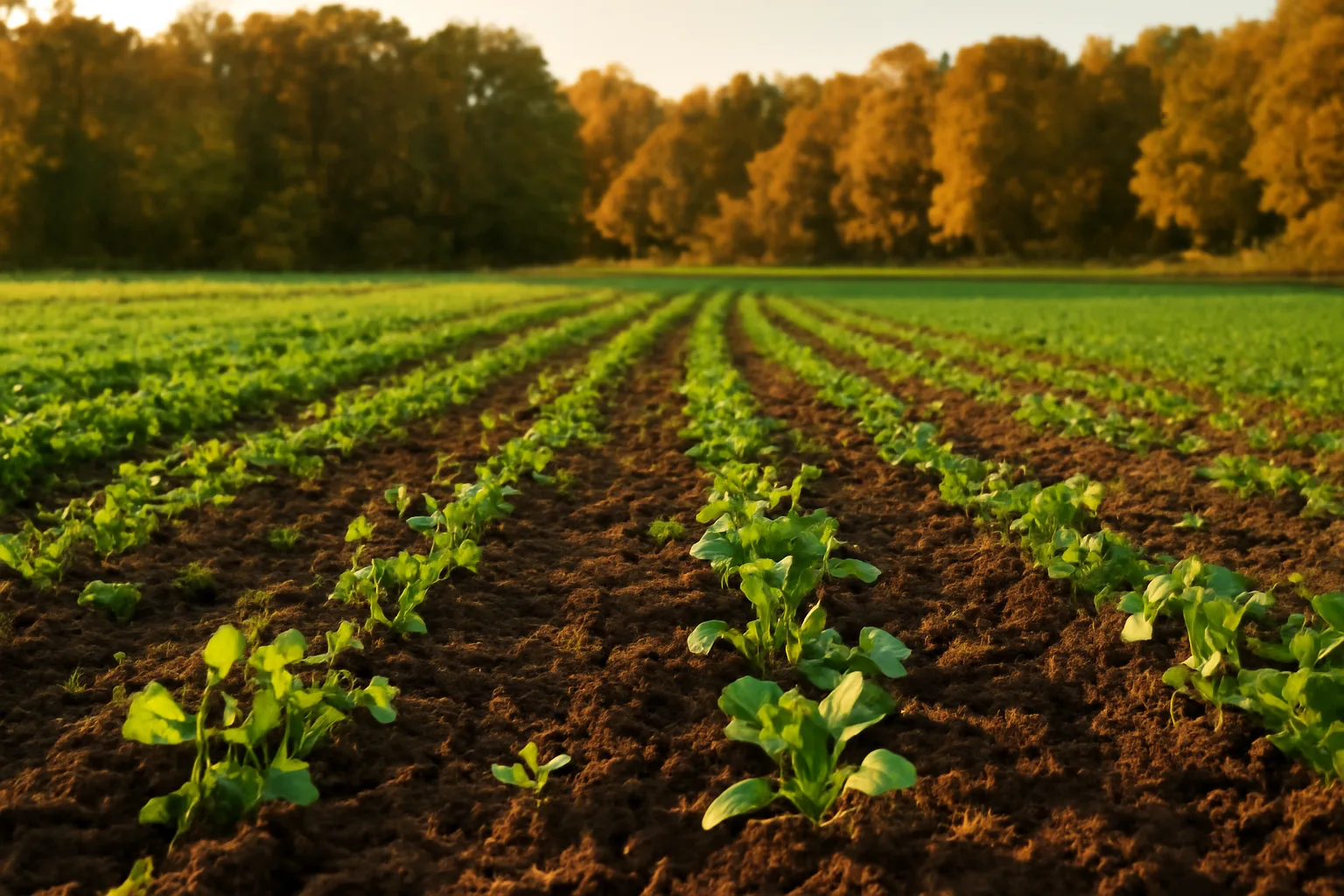
A food plot is a small planted field, usually somewhere between a quarter acre and five acres, seeded specifically to attract and feed deer or other wildlife. It's not a crop field in the farming sense. Nobody is trying to maximize bushels per acre for a grain elevator. The goal is tonnage of digestible forage at the times of year deer need it most, plus a spot that pulls deer into bow range or gives you a place to glass from a distance. Most plots fall into two rough categories. Annuals like brassicas (turnips, radishes, rape), cereal grains (oats, wheat, rye), and sorghum get planted fresh each year and burn out fast. Perennials, mainly clover and chicory blends, get planted once and can produce for three to five years with maintenance mowing and fertilizer. The USDA NRCS treats food plots as a wildlife habitat practice (Code 640, Wildlife Habitat Planting) that state and federal cost-share programs sometimes help fund [1]. A food plot is not a substitute for actual habitat. It's a supplement. Deer in most of the whitetail's range eat far more native browse, forbs, mast, and agricultural crops over a year than anything you plant on two acres. Plots work because they concentrate a preferred food source in a place you control, not because they replace the deer's diet. If you're building your first plot plan and don't know where to start, a soil test and a species list built for your region beats guessing. Plotseason's $99 Custom Food Plot Plan builds a planting plan around your soil test results and your zone, though your soil lab's lime and fertilizer recommendations are still the final word on your dirt specifically.
when to plant food plots for deer
Timing depends entirely on what you're planting and where you live, but the short answer is: perennials and brassicas go in from late July through September in most of the whitetail range, and spring plantings (clover, some annual grains) go in April through May. Cooperative extension services break the country into planting zones based on average first frost date, and that date drives everything. For fall brassicas like turnips and radishes, most extension guides recommend planting 60 to 90 days before your first killing frost, because the plants need that runway to bulb out and reach peak palatability [2]. In the Midwest that often lands in late July to mid-August. In the Deep South you can push into September. Perennial clover can go in spring or late summer/early fall (a "dormant" late fall seeding also works in northern climates). Fall seeding avoids the weed pressure that spring plantings fight all summer, which is one reason a lot of experienced plotters favor it. Cereal grains like oats, wheat, and rye are typically planted in early fall too, 6 to 8 weeks before frost, so they establish enough leaf growth before winter to pull deer hard once other food sources dry up. The one universal rule: don't plant by the calendar date alone. Watch your local frost data and soil temperature. A university extension planting calendar for your state (most land-grant schools publish one) is a better guide than a national blog post that assumes you live in Iowa.
when to plant oats for deer
Oats go in the ground 6 to 8 weeks before your area's average first fall frost, which for most of the whitetail belt means a window from late August through mid-September. Oats germinate fast, often in 7 to 10 days in warm soil, and deer will hit young oat shoots almost as soon as they emerge. Oats are a cool-season annual grass. They can't handle hard freezes the way winter wheat or cereal rye can, so in far northern states oats planted for fall attraction usually die back with the first sustained hard freeze, while wheat and rye persist and green back up in spring. That's a real tradeoff: oats often taste better to deer early (higher sugar content, softer leaf), but they don't offer the late-winter and spring regrowth that rye does. A lot of successful fall plot blends mix oats with wheat or rye specifically to get the best of both worlds: oats pull deer in during September and October, while the wheat or rye carries the plot through winter and into green-up. Spring oat plantings are less common for deer attraction specifically, but some plotters use a spring oat planting as a nurse crop for a new clover seeding, since it grows fast and shades out competing weeds while the clover establishes.
when to plant turnips for deer
Turnips go in 60 to 90 days before your first fall frost, generally late July through mid-August across most of the Midwest and Northeast, and into September in the Southeast. That timing lets the bulb size up before the ground freezes, and it matters because deer often ignore turnip tops in early fall and switch hard to the bulbs after a few frosts convert starches to sugars. This frost-triggered sugar conversion is well documented in brassica agronomy and it's the reason a lot of hunters see almost no deer use on a turnip plot in October, then watch it get hammered in December. Patience is the whole game with turnips. If you plant too late, you get small bulbs and thin tonnage. If you plant into a drought without irrigation, germination can fail outright, which is one of the more common turnip-plot failures reported by extension wildlife specialists [2]. Turnips are usually seeded shallow, a quarter inch or less, into a firm, weed-free seedbed. Broadcasting onto a disked and cultipacked field works fine; you don't need a grain drill for a seed this small. Extension agronomists consistently flag seeding brassica too deep as a leading cause of poor stands in food plot plantings [2].
do deer eat sorghum
Yes, deer eat sorghum, primarily the grain heads in fall and winter, though it's rarely their first choice compared to soybeans, corn, or acorns. Sorghum works best in food plot programs as a standing winter grain source and as cover, since the tall stalks (often 4 to 7 feet) provide screening and thermal cover that a clover field never will. Grain sorghum is planted like a warm-season row crop, generally after soil temperatures hit 60 degrees F, which is typically May through June depending on latitude. It's drought tolerant compared to corn, which makes it a reasonable substitute on sandy or dry ground where corn struggles. Deer tend to use sorghum heavier once the grain matures and drops or once snow covers other food sources. In the Southeast and parts of the Midwest, sorghum plots also double as quail and turkey habitat, so it's a common choice on properties managing for multiple species rather than deer alone. One practical note: birds (especially blackbirds and doves) can strip a lot of sorghum grain before deer season even opens, so plan for some loss if you're relying on sorghum as a late-season food source.
do deer eat clover and do deer like clover
Yes, deer eat clover readily, and it's one of the most consistently preferred food plot species across the whitetail's range. Clover is high in protein (often 25 to 30 percent crude protein in young, well-fertilized growth) and it's available for a long season, spring through fall, which is part of why it shows up in nearly every food plot recommendation list from state wildlife agencies and universities [3]. White clover (Ladino type) and red clover are the two most common food plot species. Ladino white clover tends to hold up better to close, repeated grazing pressure, which matters on smaller plots getting hit hard by a concentrated deer herd. Red clover grows more upright and can tolerate slightly wetter or more acidic soils, but it doesn't recover from heavy browsing quite as well. Clover needs a soil pH close to neutral, generally 6.0 to 7.0, to fix nitrogen efficiently through its rhizobia bacteria relationship [3]. This is exactly the kind of thing a soil test tells you and a fertilizer bag label can't. If your pH is low, lime takes months to fully react in the soil, so get that test done well before your planting window, not the week before. Once established, a well-limed, well-fertilized clover plot can produce for three to five years with just annual mowing and a fertilizer top-dress, which makes it one of the better cost-per-year options in a food plot program despite a higher seed cost up front. For species selection and blend comparisons, see food plot seed and deer food plot seed.
what are deer's favorite foods (and do deer like honey)
Deer preference shifts by season, region, and what's available, but across most of the whitetail range, acorns, soybeans, and clover consistently rank at or near the top of preference studies, along with agricultural corn and standing forage crops. There's no single universal "favorite," because deer are opportunistic browsers responding to what's most nutritious and available at that moment. Acorns are a heavyweight because of fat content. White oak acorns in particular are low in tannin and high in fat and carbohydrate, and deer will often abandon a food plot entirely during a heavy white oak mast drop. Soybeans, when available as standing forage or waste grain after harvest, are another top preference because of high protein and fat content during the growing season. As for honey: deer do not seek out honey in any meaningful, documented way in the wild, and there's no wildlife agency or extension guidance recommending it as an attractant. Deer are herbivores; while there are rare anecdotal reports of deer investigating sweet substances, honey isn't part of any recognized deer diet study or extension forage recommendation. If you've heard this as a folk tip for scent-based attractants, treat it as exactly that: unverified anecdote, not agronomy. Skip it and spend the money on a soil test instead. Check your state wildlife agency's baiting and feeding regulations before adding any supplemental attractant to a plot or stand site. Many states restrict or ban baiting for deer hunting purposes even though food plots themselves are legal and treated differently under most state codes; the rules vary a lot state to state and by whether you're on public or private land [4].
what are early successional plants, and why do they matter as much as food plots
Early successional habitat is the messy, weedy, brushy stage of plant growth that follows a disturbance, a clearcut, a burned field, an old fallow crop field, before it grows back into mature forest. It's full of native forbs, brambles, young saplings, and grasses, and it produces more deer browse per acre in its first several years than almost any other habitat stage, including a planted food plot. This matters because a lot of hunters obsess over their two-acre clover plot while ignoring 40 acres of mature closed-canopy timber that produces almost no deer forage at ground level. Mature forest with a closed canopy blocks sunlight from reaching the forest floor, and without sunlight there's no browse layer. Early successional habitat, by contrast, is essentially all browse layer, and it's why prescribed fire, timber stand improvement, and hinge-cutting show up so often in serious habitat management plans alongside food plots. The USDA Forest Service points to the loss of early successional forest habitat as a significant driver of declining habitat quality for a range of wildlife species across much of the eastern United States, largely because of forest maturation and decades of fire suppression [5]. Practically, this means a serious food plot plan should include some acreage devoted to disturbance: a controlled burn, a strip of disked ground left to grow up in native forbs, a timber cut that opens the canopy. Food plots feed deer for a few months a year. Good early successional habitat feeds them, covers them, and gives fawns a place to hide from predators, year-round.
how food plots and early successional habitat work together
The strongest properties combine both: planted plots for concentrated, high-value forage at specific times of year, and early successional cover for the volume of natural browse, security cover, and fawning habitat that no plot can replace. Think of the food plot as dessert and the early successional habitat as the actual meal. A reasonable acreage target that shows up often in habitat management literature is devoting food plots to somewhere around 1 to 5 percent of total property acreage, with the rest managed through a mix of timber management, native warm-season grass restoration, and disturbance-based practices for the majority of the remaining land [6]. That ratio isn't a hard rule, it's a starting point, and it shifts a lot depending on your region and existing habitat quality. On a property that's mostly mature closed-canopy hardwoods with no plot potential, a well-placed one-acre clover plot next to good bedding cover can outperform a five-acre plot on a property with poor surrounding habitat, because the deer already have a reason to be nearby. Plot placement relative to bedding and travel corridors often matters more than plot size or species choice. If you're weighing where to spend your first dollars, on seed or on habitat work, most public land managers and extension foresters will tell you habitat work (timber stand improvement, prescribed fire, or even just letting a field edge grow up rough for a season) produces a bigger return per dollar than food plot seed, especially on properties under 100 acres where plot space is inherently limited.
soil testing and fertility basics before you plant anything
Before planting any food plot, pull a soil test. It costs $10 to $20 through most land-grant university soil labs and it tells you exactly what your pH, phosphorus, and potassium levels are, which determines how much lime and fertilizer you actually need rather than guessing off a bag label. Most food plot species, clover especially, want a soil pH between 6.0 and 7.0 [3]. If your test comes back at 5.0 or 5.5, which is common on a lot of wooded, previously unfarmed ground, lime is not optional. Lime takes months to fully neutralize soil acidity because it has to physically react and move through the soil profile, which is why extension agronomists recommend applying lime the season before planting whenever that's possible. Your soil test report is the actual authority here, not a fertilizer bag, not a blog post, and not a general plan. Labs calibrate recommendations to your state's soil types and crop targets specifically. A general food plot plan, including the one we build at Plotseason, works from your test results and your zone to suggest species and rates, but the lab's specific lime and fertilizer numbers for your field are the final word. For readers building out a full plot rotation across multiple fields, comparing perennial versus annual strategy is worth doing before you buy seed. See deer food plots and food plot whitetail for broader planning frameworks.
food plot species quick reference
| Species | Planting window (most of whitetail range) | Type | Notes | |
|---|---|---|---|---|
| Clover (white/red) | Spring (Apr-May) or late summer/early fall (Aug-Sep) | Perennial | 3-5 year stand life, needs pH 6.0-7.0 | |
| Oats | 6-8 weeks before first frost (late Aug-mid Sep) | Cool-season annual | Fast germination, dies back hard freeze | |
| Wheat/rye | 6-8 weeks before first frost | Cool-season annual | Winter-hardy, spring regrowth | |
| Turnips/brassicas | 60-90 days before first frost (late Jul-Aug) | Annual | Frost sweetens bulbs, shallow seeding | |
| Grain sorghum | After soil hits 60°F (May-Jun) | Warm-season annual | Drought tolerant, standing winter grain and cover | |
| Soybeans | Late spring after frost risk passes | Warm-season annual | High protein, needs deer-exclusion on small acreage while young | This is a starting reference, not a substitute for your zone's extension planting calendar or your soil test results. Every one of these windows shifts by two to four weeks depending on your specific latitude and elevation. |
common mistakes that ruin a food plot before it starts
Planting too early or too late relative to frost dates is the single most common failure point, and it's an easy one to fix with a five-minute search for your county's average frost dates on your state extension website. Skipping the soil test is the second most common mistake, and it's the most expensive one to skip, because a $15 test tells you exactly what a $200 bag of fertilizer might be wasting if your pH is wrong and nothing is getting absorbed anyway. Planting brassica seed too deep is a specific, well-documented failure mode; extension agronomists flag improper seeding depth as a leading cause of poor brassica stands [2]. Turnip and radish seed wants to sit at a quarter inch or shallower. Overestimating what a small plot can do is another one. A quarter-acre plot surrounded by heavy deer density and no other food source will get grazed to dirt in weeks. If that's your situation, either fence it temporarily while it establishes, plant a bigger acreage, or accept that it's a hunting plot (a small, sacrificial draw near a stand) rather than a herd-health nutrition plot, and plan the seed rate and species accordingly.
how to build a planting calendar for your specific property
Start with your average first fall frost date, which your state's land-grant extension office publishes county by county, then count backward from there for every fall planting. Add your average last spring frost date for anything you're planting in spring. From there, layer in your species list. Fall brassicas go in 60-90 days before frost. Cereal grains go in 6-8 weeks before frost. Perennial clover can go in either window. Warm-season plantings like sorghum and soybeans wait until soil temperature is reliably above 60 degrees F in spring. Write the actual calendar dates down, don't just remember "late summer." A lot of missed plantings happen because the planting window is only two to three weeks wide and life gets in the way. If you want a planting plan already built around your zone and soil test, that's the specific problem the Custom Food Plot Plan is built to solve, a one-time $99 tool that turns your soil test and location into a species list and planting calendar rather than you cross-referencing five extension PDFs on a Sunday night. For a deeper look at species selection by region, deer food plots and domain food plot seed cover regional blend choices in more depth.
Frequently asked questions
Do deer eat sorghum?
Yes, deer eat sorghum, mainly the grain heads in fall and winter, though it usually ranks behind corn, soybeans, and acorns in preference. It's more valuable as standing winter cover and a late-season grain source than as a primary attractant, and it's commonly planted alongside quail and turkey habitat programs in the Southeast.
Do deer eat clover?
Yes, clover is one of the most consistently preferred food plot species for deer across the whitetail range. It's high in protein, often 25 to 30 percent crude protein in healthy growth, and available spring through fall, which is why it appears in nearly every state wildlife agency and university food plot guide.
When should I plant food plots for deer?
Timing depends on species and your region's frost dates. Fall brassicas and cereal grains go in roughly 60 days to 8 weeks before first frost (often late July through September). Perennial clover can go in spring or late summer. Check your state land-grant extension's planting calendar for your specific county's frost dates.
Do deer like clover?
Yes, clover ranks near the top of deer forage preference in most regional studies and extension guides, largely because of its high protein content and long growing season. White (Ladino) clover tolerates heavy grazing better than red clover, which matters on smaller, high-pressure food plots.
When should I plant oats for deer?
Plant oats 6 to 8 weeks before your area's average first fall frost, typically late August through mid-September across most of the whitetail range. Oats germinate in about 7 to 10 days and pull deer fast, but they die back hard in freezing temperatures, unlike winter-hardy wheat or cereal rye.
When is the best time to plant food plots overall?
There's no single best date nationally; it depends on your zone and species. Most fall plantings (brassicas, cereal grains, fall clover) go in 6 to 12 weeks before your area's first frost. Spring plantings (clover, soybeans, sorghum) wait until frost risk has passed and soil has warmed.
When should I plant turnips for deer?
Plant turnips 60 to 90 days before your first fall frost, generally late July through mid-August in the Midwest and Northeast, later into September in the Deep South. Frost converts starches to sugars in the bulbs, which is why deer often ignore turnip tops early and hit the bulbs hard after a few hard frosts.
What is a food plot?
A food plot is a small planted area, typically a quarter acre to five acres, seeded with forage species to attract and feed deer or other wildlife. It supplements natural habitat rather than replacing it, and is recognized by USDA NRCS as a wildlife habitat planting practice under conservation program guidelines.
What are deer's favorite foods?
Preference shifts by season and region, but acorns (especially white oak), soybeans, and clover consistently rank near the top across most whitetail range studies. Acorns are especially preferred in fall because of high fat content, and deer will often abandon a food plot entirely during a heavy acorn drop.
Do deer like honey?
There's no credible wildlife agency or extension research supporting honey as a deer attractant. Deer are herbivores and honey isn't part of any documented deer diet study. Anecdotal claims exist but should be treated as unverified folklore, not agronomy; a soil test and proper species selection will do far more for your plot.
What's the difference between a food plot and early successional habitat?
A food plot is a planted, managed opening seeded with specific forage species. Early successional habitat is the natural, weedy, brushy stage of plant regrowth after a disturbance like a clearcut or burn. Early successional areas often produce more total deer browse per acre than a plot, and add year-round cover a plot can't provide.
How much of my property should be food plots versus habitat work?
A commonly cited starting range in habitat management literature is roughly 1 to 5 percent of total acreage in food plots, with the remainder managed through timber work, native grass restoration, and disturbance practices. It's a starting point, not a hard rule, and shifts based on your region and existing habitat quality.
Do I really need a soil test before planting a food plot?
Yes. A soil test costs $10 to $20 through most university soil labs and tells you exact pH and nutrient levels, which determines how much lime and fertilizer you need. Skipping it means guessing, and clover in particular needs pH 6.0 to 7.0 to fix nitrogen efficiently through its root bacteria.
Are food plots legal, and does baiting apply to them?
Food plots are legal in all states and are treated differently from baiting under most state wildlife codes, but baiting and supplemental feeding rules vary widely by state and sometimes by public versus private land. Check your state wildlife agency's current regulations before adding any bait or mineral supplement near a plot or stand.
Sources
- USDA NRCS, Conservation Practice Standard 640 (Wildlife Habitat Planting): Wildlife habitat/food plot plantings are recognized as a formal USDA NRCS conservation practice (Code 640)
- University of Tennessee Extension, "Establishing Wildlife Food Plots," PB1746: Fall brassica plantings are typically timed 60-90 days before the first killing frost
- Pennsylvania Game Commission, Baiting and Feeding Regulations: State wildlife agencies regulate baiting and feeding of deer separately from food plot planting, and rules vary by state
- USDA Forest Service, Treesearch record 22252 (early successional habitat literature review): Loss of early successional habitat from forest maturation and fire suppression is a significant driver of wildlife habitat decline in the eastern US
- Iowa State University Extension and Outreach, PM 2089, "Agricultural Lime and Liming": Lime should be applied well ahead of planting because it takes months to react and raise soil pH
- University of Georgia Extension Bulletin 1347, "Clover and Other Cool-Season Perennial Food Plots": White and red clover for food plots need soil pH in the 6.0 to 7.0 range and can produce protein content around 25-30 percent