Last updated 2026-07-25
TL;DR
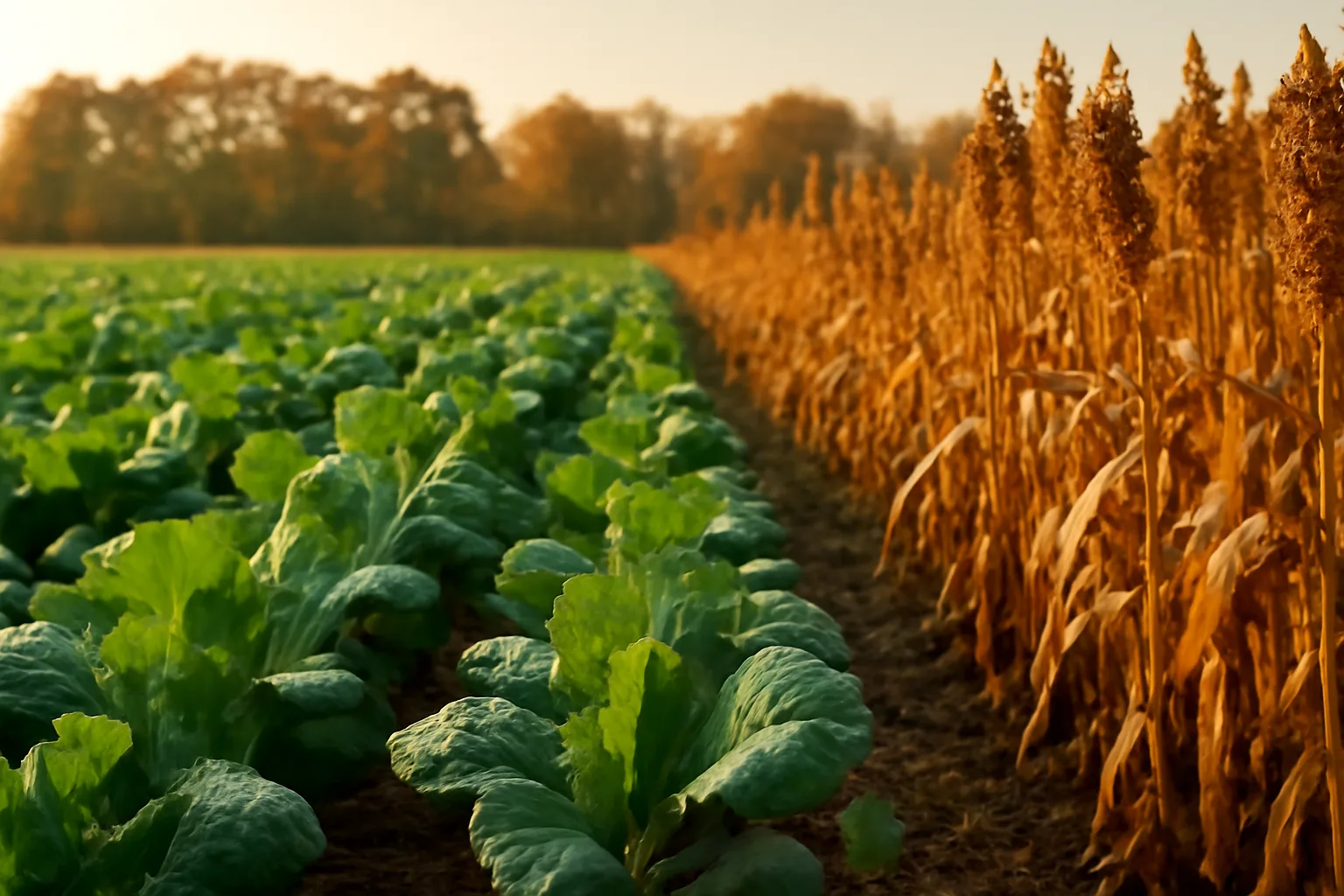
A year-round deer food plot system pairs a perennial clover or chicory field (planted spring or late summer) with rotating annual plots of oats, brassicas, and cereal grains planted in late summer for fall/winter, plus warm-season annuals like soybeans or sorghum for summer. No single plot feeds deer 12 months; you need at least two plot types working together.
what is a food plot, exactly?
A food plot is a planted area of forage, usually somewhere between a quarter acre and a few acres, put in specifically to feed and hold deer or other wildlife on a piece of hunting ground. It's not the same as a farm field, even though a lot of the same equipment and agronomy applies. The goal is nutrition and attraction, not yield per bushel for market. Most food plots fall into two buckets: perennials that come back for 3 to 5 years (clover, chicory, alfalfa) and annuals you replant every year (brassicas, cereal grains, soybeans, sorghum). A serious property usually runs both, because no single planting covers spring green-up, summer growing season, and the fall/winter stress period all by itself. State wildlife agencies and land-grant universities generally treat food plots as one habitat management tool among several, not a substitute for natural forage and mast. Most extension guidance recommends plots cover somewhere around 1 to 5 percent of a property's total acreage, with the rest left in timber, native browse, and cover. Overplanting acreage you can't maintain well is one of the most common mistakes landowners make. For a broader rundown of plot styles and how they fit different properties, see food plot whitetail.
when to plant food plots for deer (the short answer)
| Zones 3-4 (Upper Midwest, Northern Plains) | Late July to mid-August | Mid-May to early June | |
|---|---|---|---|
| Zones 5-6 (Mid-South, Mid-Atlantic, Corn Belt) | Mid-August to mid-September | Late April to late May | |
| Zones 7-8 (Deep South, Southern Plains) | September to early October | April | For species-specific picks by zone, deer food plot seed breaks down blends by region. |
Timing depends on your USDA plant hardiness zone and whether you're planting a cool-season or warm-season crop. As a rule: warm-season annuals (soybeans, sorghum, cowpeas) go in after your last frost date, typically April through June depending on latitude. Cool-season plots (clover, brassicas, cereal grains) go in 60 to 90 days before your first fall frost, which usually lands somewhere between mid-July and early September across most whitetail range. The single biggest planting mistake extension agronomists point to is planting brassicas too late. Turnips, radishes, and other brassicas need a real growing window to bulb up and build sugar content before frost; rush it and you get small plants with little tonnage. Here's a simplified planting window by region. Treat these as starting points; your local extension office and a soil test are the real authority on your ground. | Region (USDA zones) | Cool-season plot window | Warm-season plot window |
when to plant oats for deer
Oats are a cool-season cereal grain, and they go in the ground 60 to 90 days before your first killing frost, same general window as brassicas. That usually means mid-August in the northern half of whitetail range and September into early October in the Deep South. Oats germinate fast, often within a week in warm, moist soil, and put on a lot of leafy growth quickly, which makes them a good nurse crop mixed with clover or brassicas. Deer hit oats hard in early fall while the leaves are still tender, then again in late winter after a hard freeze converts starches to sugars, similar to what happens with brassicas. One caution: oats are not frost-hardy the way winter wheat or winter rye is. In zones 3-5, oats will often winterkill completely after a hard freeze, so if you want green forage into late winter, pair oats with a hardier cereal grain like winter rye. Cereal rye is widely recognized as one of the most cold-tolerant small grains grown in North America, remaining green through winter conditions that would kill oats or wheat outright, which is why it's a standard pick for wildlife plots that need to stay green through snow cover [1].
when to plant turnips for deer
Turnips are a brassica, and they follow the same clock as other fall brassica plantings: 60 to 90 days ahead of your first fall frost. In practice that's late July to mid-August for zones 3-5, and August into early September for zones 6-7. Turnips need that full runway because the plant spends the first several weeks building leaf mass, then shifts energy into bulb development as days shorten and temperatures drop. A hard frost or two actually improves palatability, because the plant converts starch to sugar as a cold-tolerance response. That's why deer often ignore a turnip plot in October and hammer it in December and January. Soil pH matters more for brassicas than almost any other food plot species. This is exactly why a soil test before planting isn't optional. It tells you how much lime you actually need, not a guess off a bag label.
do deer eat sorghum?
Yes, deer eat sorghum, both the grain heads and the young leafy growth. Grain sorghum (milo) and forage sorghums are planted as warm-season annuals, usually alongside or in rotation with soybeans, and they do well in drought and heat where corn struggles. Sorghum's biggest food plot value isn't necessarily as a preferred summer forage (deer often prefer soybeans or cowpeas when both are available) but as standing winter grain. Once the heads mature and dry down, sorghum holds its seed on the stalk well into winter, giving you a food source that survives snow cover better than most row crops. It's also a solid screening and bedding cover option because of its height. Plant sorghum after soil temperatures hit 60°F consistently, which for most of the whitetail's range means mid-May to early June. It's more drought-tolerant than corn, which makes it a reasonable substitute on sandy or thin soils where corn yields are unreliable.
do deer eat clover, and do deer like it?
Yes. Deer eat clover, and it's consistently one of the most preferred food plot forages available, cited across wildlife extension literature as a top choice for spring and summer nutrition. White clover (Dutch, ladino) and red clover are the two most common food plot varieties, and both are perennial, meaning a well-maintained stand can produce for 3 to 5 years before needing replanting. Clover's advantage is protein. Quality clover forage commonly tests in the 25 to 30 percent crude protein range during active growth, which lines up well with antler growth in bucks and lactation demands in does during late spring and summer [2]. That's higher protein than most cereal grains and comparable to or better than alfalfa in managed stands. Clover does have a maintenance cost. It needs mowing 3 to 4 times a growing season to keep it from going to seed and getting shaded out by weeds, and it's sensitive to drought in its first year before the root system establishes. Perennial clover also needs a pH close to neutral (6.0 to 7.0) to fix nitrogen efficiently through its root nodules; a soil test will tell you if lime is needed before you waste a bag of clover seed on acidic ground. For a rundown of clover varieties and blend options, check deer food plots.
what are deer's favorite foods overall?
There's no single universal answer, because preference shifts by season, region, and what's available naturally. But across food plot studies and browse surveys, a few categories consistently rank at the top: soybeans and clover during the growing season, acorns (especially white oak family) in early fall, and brassicas plus cereal grains after the first hard frosts of winter. Natural browse still makes up the majority of a deer's diet on most properties even where food plots exist. State agency and university research generally finds food plots supplement, rather than replace, natural forage and mast. If you're trying to build a plan around what deer actually prefer through the year, spring and summer favorites (clover, soybeans, cowpeas) differ almost completely from fall and winter favorites (brassicas, cereal grains, standing corn or sorghum). That's the whole argument for planting more than one plot type. A property running only spring clover has nothing new to offer once hunting season stress period arrives in late fall.
do deer like honey (honey-based attractants, not the plant)?
If you mean literal honey, deer aren't drawn to it the way bears are; it's not a natural or significant part of their diet, and there's no wildlife research suggesting it functions as attractant forage. Deer are herbivores built around browse, forbs, mast, and agricultural crops, not sugar sources like honey. What this question is often really asking about is honey locust, a native tree whose seed pods deer do eat readily, especially in fall when pods drop. Honey locust pods carry decent sugar and protein content and deer will travel to a producing tree the same way they travel to a white oak dropping acorns. If honey locust trees exist naturally on your property, they're worth marking and protecting rather than planting new, since they take years to mature and produce. A few commercial mineral and attractant products use "honey" branding or scent, but check your state's baiting and feeding regulations before using any scent or mineral attractant near a stand. Baiting rules vary a lot by state, and some states classify mineral licks or scented attractants as bait under their hunting regulations even outside of grain or feed piles.
how do you actually build a year-round plot system?
The honest framework is: pick one perennial anchor plot, then rotate annuals around it to cover the gaps. A single-species plot, no matter how good, leaves months of the year uncovered. A workable layout for most properties in zones 5-7 looks like this. Run 30 to 50 percent of your plot acreage in perennial clover or clover/chicory blend as your spring and summer base. Put the rest into a fall rotation of brassicas and cereal grains (oats, winter rye, or wheat) planted in August, which becomes your hunting-season and winter plot. If you have the acreage and warm-season capacity, add a soybean or sorghum plot for summer growing season nutrition and standing grain into winter. The rotation matters for soil health too. Continuous clover can build up nitrogen but also lets grass weeds creep in over years; rotating a section into brassicas or cereal grain periodically and tilling it resets weed pressure and lets you correct pH and fertility based on a fresh soil test. Most extension agronomists recommend testing soil every 2 to 3 years per plot, more often if you're seeing poor growth or unexplained yield drops [3]. For a look at annual seed blends built around this kind of rotation, see food plot seed and domain food plot seed.
what soil and fertility work actually matters before planting?
A soil test is the cheapest insurance you can buy in this whole process, usually $10 to $20 through your state land-grant university's soil testing lab, and it tells you two things that matter more than seed choice: pH and nutrient levels (phosphorus, potassium, sometimes micronutrients). Most food plot species want a pH between 6.0 and 7.0. Below that range, phosphorus and other nutrients become less available to the plant even if your fertility numbers look fine on paper, which is why a field can get fertilized correctly and still underperform. Lime takes months to fully react in soil, so if your test comes back needing lime, get it applied as early as possible, ideally the season before you plant, not the week of. Your soil test report is going to give you specific lime and fertilizer recommendations in pounds per acre based on your actual soil chemistry and the crop you tell them you're planting. That report, from your state or a private ag lab, is the real authority here, not a blanket number from an article or a bag label. Follow what your test says over generic advice every time. This is also where a lot of landowners get stuck: they have a soil test in hand but aren't sure how to turn those numbers into an actual planting plan across multiple plots and seasons. That's the specific gap a service like PlotSeason's $99 Custom Food Plot Plan is built to fill, taking your soil test results, region, and goals and turning them into a written planting plan. It's general guidance built around your inputs, not a replacement for your soil lab's specific lime and fertilizer recommendations. If you want to build one, start at /plot-plan-builder.
what equipment do you actually need to run this system?
For a basic annual rotation on a plot under an acre, you can get by with a hand seeder, a rented or borrowed disc or tiller, and a way to spray or mow. Once you're managing multiple plots or perennial clover that needs regular mowing, a small tractor or ATV with an implement package starts paying for itself in time saved. The non-negotiables are something to break ground (disc, tiller, or no-till drill), something to spread seed and fertilizer evenly, and something to pack the seed in afterward (a cultipacker or even a drag harrow works). Brassica and clover seed especially need good seed-to-soil contact and shallow planting depth; broadcasting onto rough, unpacked dirt is one of the most common reasons a plot fails to germinate evenly. A no-till drill is worth the rental cost if you're planting into an existing clover stand you don't want to fully till up, or into a cover crop residue. It's more expensive per acre to rent than a simple disc pass but it saves the stand. For more on matching equipment to your specific plot size and rotation, see deer for food.
Frequently asked questions
Do deer eat sorghum?
Yes. Deer eat both grain sorghum heads and young sorghum leaves. It's most valuable as a standing winter grain source since dried sorghum heads hold seed through snow better than corn, and it's more drought-tolerant, making it a good pick on thin or sandy soils.
Do deer eat clover?
Yes, and clover is one of the most preferred food plot forages available. Quality clover stands commonly test at 25 to 30 percent crude protein during active growth, supporting antler growth in bucks and lactation in does through spring and summer.
When should you plant food plots for deer?
Warm-season annuals (soybeans, sorghum) go in after your last frost, typically April through June. Cool-season plots (clover, brassicas, cereal grains) go in 60 to 90 days before your first fall frost, usually mid-July through September depending on your zone.
Do deer like clover?
Yes, clover ranks among the top preferred food plot species in wildlife extension research, especially during spring and summer growth. It offers high protein content and, as a perennial, can produce for 3 to 5 years with proper mowing and fertility maintenance.
When should you plant oats for deer?
Plant oats 60 to 90 days before your first fall frost, typically mid-August in northern zones and September into early October farther south. Oats aren't very cold-hardy, so pair them with winter rye if you want green forage surviving hard freezes.
When should you plant turnips for deer?
Plant turnips 60 to 90 days before first fall frost, generally late July through mid-August in northern regions and into early September farther south. Turnips need that runway to bulb up, and frost actually improves palatability by converting starches to sugar.
What exactly is a food plot?
A food plot is a planted area, usually a quarter acre to a few acres, established specifically to provide supplemental nutrition and attraction for deer or other wildlife on hunting land. Most extension guidance suggests plots cover roughly 1 to 5 percent of total property acreage.
What are deer's favorite foods?
Preference shifts by season: clover, soybeans, and cowpeas rank high during the growing season; acorns, especially white oak, dominate early fall; brassicas and cereal grains take over after hard frosts in winter. No single food source covers the whole year.
Do deer like honey?
Not literal honey; it's not a natural or meaningful part of a deer's diet. This question often confuses honey with honey locust, whose seed pods deer readily eat in fall. Check state baiting rules before using any scented or honey-based attractant near a stand.
Can one food plot feed deer year-round?
Not really. No single planting covers spring green-up, summer growth, and the fall/winter stress period equally well. Most successful setups pair a perennial clover or chicory plot with a rotating annual plot of brassicas and cereal grains for fall and winter.
How much lime does a food plot actually need?
It depends entirely on your soil test results and target crop; there's no universal number. Most food plot species want pH between 6.0 and 7.0, and your soil lab's report will give a specific lime rate in pounds per acre based on your actual soil chemistry.
How often should you soil test a food plot?
Most extension agronomists recommend testing every 2 to 3 years per plot, or sooner if you notice poor growth, stunted forage, or unexplained yield drops. A basic test typically costs $10 to $20 through your state land-grant soil lab.
Sources
- USDA Natural Resources Conservation Service, Plant Guide: White Clover (Trifolium repens): White clover is widely used in wildlife plantings as part of habitat management supplementing natural forage
- USDA NRCS Plant Guide: Forage Turnip / Brassica species management notes: Brassica plantings need adequate time before frost to develop leaf mass and bulb tissue
- USDA NRCS Plant Guide: Cereal Rye (Secale cereale): Cereal rye (winter rye) is among the most cold-tolerant small grains grown in North America and remains green through cold winter conditions
- Oklahoma State University Extension, "Soil pH and Nutrient Availability" (PSS-2239): Brassicas and most food plot crops need soil pH between 6.0 and 6.8 for best nutrient uptake, with yield dropping sharply below 5.8
- University of Missouri Extension, "Soil Testing for Lawns, Gardens, and Wildlife Food Plots" (G9112): Soil testing every 2 to 3 years is recommended to track pH and nutrient changes over time