Last updated 2026-07-26
TL;DR
Most of Texas plants fall food plots between mid-September and early November, timed to 60-90 days before first frost with fall rain. The Panhandle starts as early as late August; South Texas can wait until November. Cool-season species like oats, wheat, and clover need soil temps under 85°F and consistent moisture to establish.
when to plant food plots for deer in texas
Texas spans four USDA plant hardiness zones (7a in the Panhandle to 9b down near Brownsville), so there's no single date that works statewide. The rule that actually matters more than the calendar: plant your cool-season fall plot 60 to 90 days before your area's average first frost, and only after you've got a real chance of rain in the forecast. For most of the state, that means a window from early September through early November. The Texas A&M AgriLife Extension deer and wildlife program frames fall plantings around getting seed in the ground while there's still enough soil warmth for germination but early enough that plants have time to establish root systems before winter dormancy. Don't plant on the calendar. Plant on the forecast. A lot of Texas hunters get burned every year because they drilled seed into bone-dry August dirt just because a chart said 'plant now.' If your soil is dust and there's no rain in the ten-day forecast, wait. Seed sitting in dry ground for three weeks doesn't germinate, it just gets eaten by ants and birds.
what's the fall planting window by region in texas
| Panhandle / High Plains | Aug 25 - Sep 20 | Late Oct to early Nov | Cold comes early, don't wait too long | |
|---|---|---|---|---|
| North/Central Texas | Sep 1 - Oct 15 | Early to mid-Nov | Watch for late-summer drought before planting | |
| East Texas (Pineywoods) | Sep 15 - Oct 31 | Mid to late Nov | More reliable fall rain, better clay soils hold moisture | |
| South/Coastal Texas | Oct 1 - Nov 15 | Late Nov to Dec | Warm soils longer, can plant later and still catch a cool season | These windows are general guidance built around average frost dates tracked by NOAA climate normals for Texas stations [1]. Your specific county could run a week or two either direction. Check your county's frost data through your local Texas A&M AgriLife county extension office before locking in a date. One thing that trips people up: 'first frost' isn't the planting deadline, it's the finish line. You want seedlings with 4 to 6 true leaves and some root depth by the time frost hits, which is why you count backward 60 to 90 days depending on species. |
Texas breaks into roughly four food-plot regions for planning purposes: Panhandle/High Plains, North/Central Texas, East Texas (Pineywoods), and South/Coastal Texas. Each has a different frost timeline and rainfall pattern. | Region | Typical planting window | First frost (avg) | Notes |
when to plant oats for deer in texas
Plant oats in Texas from mid-September through late October in most regions, with the Panhandle starting as early as September 1 and South Texas able to push into early November. Oats are one of the fastest-germinating cool-season grains, often up in 5 to 7 days with decent soil moisture, which makes them forgiving for hunters who get a late start. Oats do have a real weakness in Texas: they're not as cold-hardy as wheat, rye, or triticale. A hard freeze below about 20°F can kill oats outright, while winter wheat and cereal rye shrug off much colder temps. If you're in the Panhandle or North Texas and expect a genuinely cold winter, oats make a great early-season attractant but you might want to blend them with wheat or rye so you have standing forage after the first freeze. Seeding rate for oats runs 60 to 100 lbs/acre broadcast, or 50 to 90 lbs/acre drilled, per standard forage-oat guidance from Texas A&M AgriLife Extension small grains program. Drill depth is 1 to 1.5 inches. Broadcasting works fine if you can drag a section harrow or culti-packer over it afterward to get seed-to-soil contact.
when to plant turnips for deer in texas
Plant turnips and other brassicas (radish, rape) in Texas from early September through mid-October, giving them 80 to 90 days before a killing frost to bulb out properly. Turnips are slower than oats to reach peak attraction. Deer often ignore the leafy tops early in the season and don't hit the bulbs hard until after a couple of frosts convert starches to sugars, which is typically late November into December or January in most of Texas. That delayed-attraction pattern is well documented in extension brassica guidance: deer preference for turnip bulbs increases sharply after frost sweetens the plant, which is exactly the late-season timing most Texas hunters are planting for anyway. If you're planting turnips specifically to have a food source standing through the late rifle season, back-time your planting so the frost-sweetening happens 3 to 5 weeks before you expect to hunt it hard. Seeding rate for turnips alone runs 4 to 6 lbs/acre broadcast on a firm, prepared seedbed, at a shallow depth of 1/4 to 1/2 inch. They're commonly blended with oats, wheat, or clover in a mix rather than planted pure, since a pure brassica stand can look thin early and gives deer nothing until the frost hits.
do deer like clover, and when do you plant it
Yes, deer readily eat clover, and it's one of the most consistently preferred forages across whitetail research. In Texas, plant perennial clovers like white clover or red clover in early fall (September to mid-October) in the northern half of the state, or in spring (February to March) in the southern half where fall seedings often struggle against heat stress before roots establish. Clover's problem in much of Texas isn't deer preference, it's soil and rainfall. Clover needs consistent moisture and a soil pH close to neutral (6.0 to 7.0) to persist [2]. Large parts of Central and West Texas run alkaline, caliche-heavy soils or straight-up drought most years, and clover stands in those conditions thin out fast without irrigation or unusually good rain years. If your soil test comes back with a pH under 6.0 or over 7.5, or if your property gets under 25 inches of annual rainfall, arrowleaf clover or crimson clover (both annuals, more drought-tolerant and more forgiving of marginal pH) are a safer bet than white or red clover. For a rundown on clover varieties and how they stack up in a Texas mix, see deer food plots.
do deer eat sorghum
Yes, deer eat sorghum, both the grain heads and the young leafy growth, though it's usually planted more as a warm-season screening and grain crop than a primary deer attractant. Grain sorghum (milo) is planted in Texas in late spring through early summer, typically May through June once soil temps hit 65°F or higher, not in fall. Where sorghum fits a fall food plot conversation is as standing cover and a late-season grain source: a summer-planted sorghum plot left standing into fall and winter gives deer a grain source after other plots have been grazed down, plus screening cover for stand access. It's not something you'd drill in September expecting germination, since sorghum needs warm soil and won't tolerate an early frost. If your plan is fall hunting season food, sorghum works better as a leftover standing crop from a summer planting than a true fall-planted species.
what is a food plot, exactly
A food plot is a planted area, usually a fraction of an acre up to several acres, seeded with forage crops specifically to attract, hold, or supplement nutrition for deer and other wildlife on a property. Unlike a hay field or pasture, a food plot's whole purpose is wildlife management and hunting access, not commercial yield. Food plots generally fall into two categories: annual plots (planted fresh each season, like oats, wheat, brassicas, or soybeans) and perennial plots (planted once and managed for multiple years, like clover or alfalfa stands). Most Texas hunters run a mix. Food plots aren't a substitute for habitat management. AgriLife wildlife specialists are consistent on this point: native browse and natural forage availability drive deer body condition and antler development far more than a one-acre plot ever will. A well-placed food plot supplements natural forage, concentrates deer for observation and harvest, and can carry a herd through a stress period like late summer drought or deep winter, but it doesn't replace habitat work. If you're new to the concept, food plot whitetail covers the basics of plot placement and species choice in more depth.
what are deer's favorite foods, and does that change by season
Deer preference shifts by season and by what's naturally available, but across food-plot species specifically, clover, soybeans, and brassicas (after frost) consistently rank as top preferred forages in university feeding-preference trials. Acorns and other hard mast, when available, often out-compete planted forages entirely in fall, since deer prioritize high-fat mast for winter fat reserves. Research from the Mississippi State University Deer Lab ranks legumes (clover, soybeans, cowpeas) and brassicas near the top of preferred food-plot forages, with cereal grains like oats and wheat rated as good but secondary attractants, especially valuable for early-season green-up before a hunt. In practice this means: if you can only plant one thing and have decent soil and rain, clover or soybeans typically pulls more consistent deer use than a straight grain plot. That said, 'favorite food' is regional and situational. A deer herd in East Texas pine country with heavy acorn drop may barely touch a food plot in a mast year. A herd in West Texas brush country with almost no mast and sparse native forage will hammer any plot, including grains, hard.
do deer like honey, and is that a real food plot question
Deer don't eat honey and it has no place in a food plot conversation; this is a common search mix-up, likely confused with 'honeysuckle,' which deer do browse heavily, or with the idea of sweetening feed piles (a practice that runs into state baiting rules in some contexts). Japanese honeysuckle (Lonicera japonica) is a preferred native browse for whitetail deer across much of the Southeast and East Texas, and it's often managed as a natural forage source rather than planted as a food plot crop, since it can become invasive. If you're seeing honeysuckle growth on your property, it's generally a good sign for deer browse availability, not something you need to plant intentionally. On the baiting question broadly: Texas Parks and Wildlife regulates baiting and feeding differently than many states. Texas Parks and Wildlife Department guidance on hunting over bait notes that baiting is legal for deer hunting in most of the state, though it is regulated or restricted in specific counties and situations, particularly around Chronic Wasting Disease management zones . Always check current TPWD regulations for your county before assuming bait or supplemental feed rules that apply elsewhere in Texas apply to your lease.
how does soil testing change your fall planting date and species choice
A soil test won't change your planting calendar much, but it changes what you plant and how well it performs once it's up. Texas soils vary wildly, from acidic East Texas sandy loams to alkaline caliche in the Hill Country and West Texas, and a $10 to $20 soil test through your county extension office tells you exactly what you're working with before you spend money on seed . Texas A&M AgriLife Extension's soil testing lab provides pH, phosphorus, potassium, and lime recommendations for a standard routine test, and results typically turn around in about a week during the fall rush . If your pH comes back below 5.5, clover and most legumes will struggle regardless of when you plant them; you'd need lime applied months ahead, ideally in spring or summer, to have it neutralize in time for a fall legume planting. Your soil test lab's specific lime and fertilizer recommendations are the real authority here, not a generic blog number. Every county's baseline fertility looks different, and the lab report you get back is calibrated to your actual sample, not a statewide average. If you want a starting point pulled together from your soil test and property details before you commit to seed, that's exactly what the $99 one-time Custom Food Plot Plan is built to do, it's general planning guidance based on your zone and soil numbers, not a site visit or a guarantee of deer activity.
what equipment do you actually need to hit these planting windows
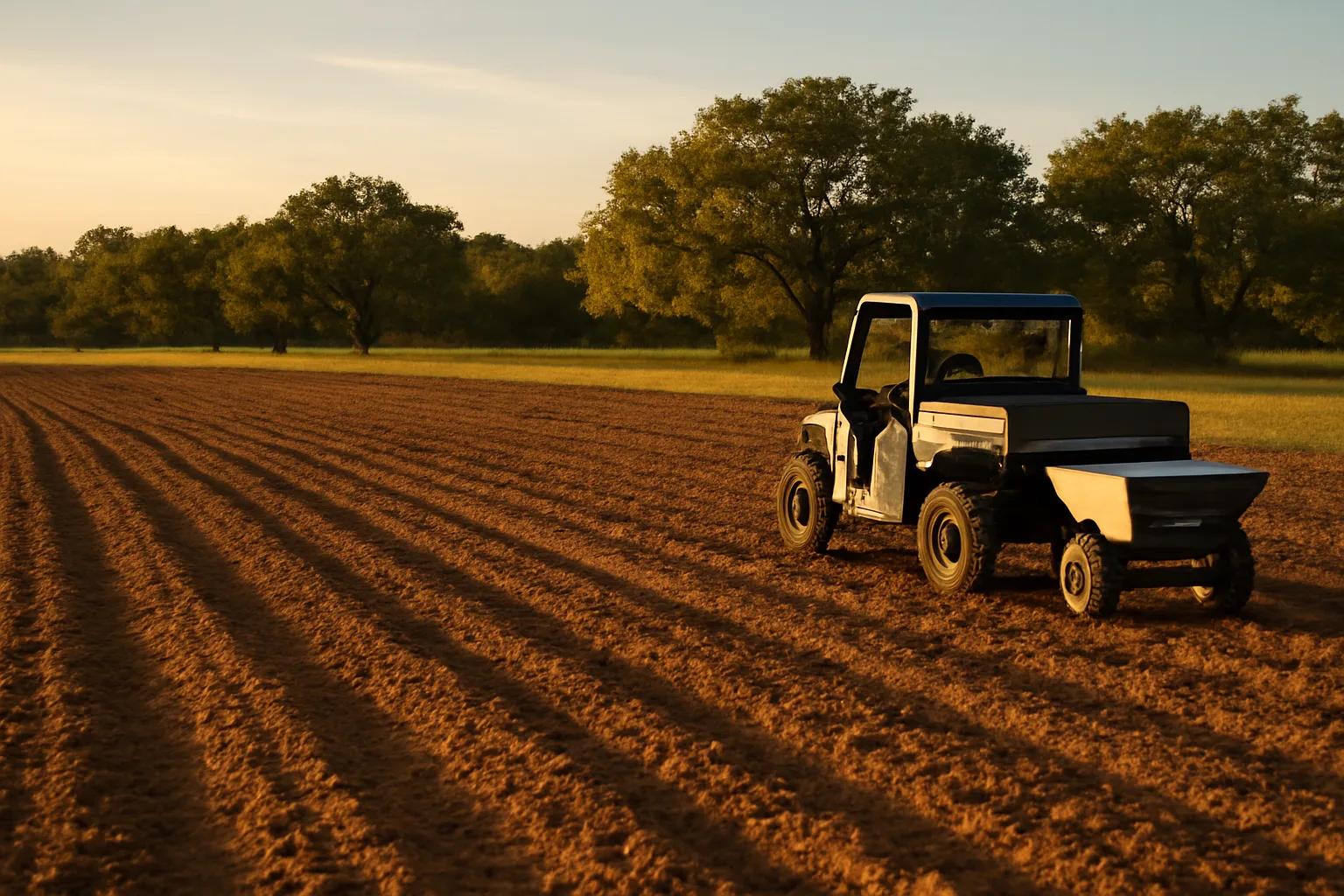
You need a way to prepare a seedbed, get seed in at the right depth, and pack it down, and in Texas's often-dry fall conditions, timing your equipment pass to actual soil moisture matters more than having fancy gear. A disk or tiller to break ground, a broadcast spreader or drill, and a drag harrow or culti-packer cover 90% of Texas food plot situations. No-till drills are worth the rental or investment if you're planting into existing sod or CRP-type ground, since they cut disturbance and hold moisture better in a dry fall, which in Texas is often the difference between a plot that comes up and one that doesn't. Small plots (under 2 acres) are very doable with an ATV/UTV and a tow-behind spreader and harrow. Larger acreage generally needs a tractor with a PTO-driven disk and drill. Either way, don't skip the packing step. Seed-to-soil contact is what separates a thick stand from a thin, spotty one, and it's the step most rushed fall plantings skip.
what happens if you miss the window
If you miss your region's ideal fall window by a couple weeks, you can usually still get a plot up, just expect slower growth and less tonnage before frost. If you miss it by a month or more, especially in the Panhandle or North Texas, switch your plan to a more cold-tolerant, fast-germinating species or push to a late-fall/winter feeding strategy instead. Cereal rye is the forgiving late option statewide. It germinates in cool soil down to about 34°F and tolerates being planted later than oats or wheat, which is why a lot of experienced Texas plotters keep a bag of rye on hand as a backup when September gets away from them. If you've truly missed the window (say, you're looking at this in December), the honest move is to wait for a spring planting and use late winter to get your soil test done, lime applied, and equipment ready, so you're not scrambling again next September.
Frequently asked questions
When should I plant fall food plots in Texas?
Most of Texas plants fall food plots between September 1 and November 15, timed 60 to 90 days before the local average first frost. The Panhandle starts earliest (late August into September), South Texas can wait until October or November. Always confirm with a current 10-day rain forecast before planting; dry soil is the most common reason fall plots fail.
Do deer eat sorghum?
Yes, deer eat both grain sorghum heads and young sorghum leaves, but it's a warm-season crop planted May through June in Texas, not a fall planting. Left standing into fall, a sorghum plot provides grain and screening cover after other plots are grazed down, but it won't germinate if drilled in cool fall soil.
Do deer eat clover, and do they actually like it?
Yes, clover is one of the most consistently preferred food-plot forages for whitetail deer in university feeding studies. In Texas, plant perennial white or red clover in early fall in the northern half of the state, or use more drought-tolerant arrowleaf or crimson clover if your soil test shows low pH or your property gets under 25 inches of rain a year.
When should I plant oats for deer in Texas?
Plant oats from mid-September through late October across most of Texas, with the Panhandle able to start as early as September 1. Oats germinate fast (5 to 7 days) but aren't very cold-hardy; a hard freeze below about 20°F can kill them, so blend with wheat or rye if you expect a cold winter.
When should I plant turnips for deer in Texas?
Plant turnips from early September through mid-October, giving them 80 to 90 days to bulb out before a hard frost. Deer usually ignore turnip bulbs until after a couple of frosts sweeten the starches into sugars, so peak attraction often doesn't hit until late November through January.
What is a food plot?
A food plot is a planted area seeded specifically to attract, hold, or supplement nutrition for deer, not a commercial crop field. Plots are either annual (oats, wheat, brassicas, replanted yearly) or perennial (clover, alfalfa, managed for multiple seasons). They supplement natural forage and habitat, they don't replace it.
What are deer's favorite foods overall?
In feeding-preference research, legumes (clover, soybeans, cowpeas) and brassicas after frost rank as top food-plot forages, with cereal grains like oats and wheat rated good but secondary. Naturally available hard mast, especially acorns, often out-competes any planted forage in a good mast year, since deer prioritize fat reserves for winter.
Do deer like honey?
No, deer don't eat honey; this search is usually a mix-up with honeysuckle, a shrub whitetail deer browse heavily across much of Texas and the Southeast. Honeysuckle is generally managed as natural forage rather than planted intentionally, since some varieties can become invasive.
When is the best time to plant food plots for deer in Texas overall?
There's no single statewide date. Fall plots go in from late August (Panhandle) through mid-November (South Texas), always timed to 60-90 days before first frost and matched to actual soil moisture, more than a calendar date. Spring plots for warm-season species like sorghum or soybeans go in May through June once soil hits 65°F.
Is it legal to bait or feed deer in Texas while running food plots?
Baiting for deer hunting is legal in most of Texas, but rules are stricter or different in certain counties, particularly Chronic Wasting Disease management and containment zones. Food plots themselves are not regulated the same way as bait piles, but always confirm current county-specific rules with Texas Parks and Wildlife before combining supplemental feed with a plot.
How much does a soil test cost in Texas and is it worth it before planting?
A standard routine soil test through Texas A&M AgriLife Extension's soil testing lab costs roughly $10 to $20 and typically returns pH, phosphorus, potassium, and lime recommendations within about a week. It's worth it every time; guessing on lime and fertilizer wastes far more money than the test costs, especially on Texas's variable soils.
Can I plant food plots without a tractor in Texas?
Yes, for plots under about 2 acres, an ATV or UTV with a tow-behind spreader, disk, and drag harrow handles seedbed prep, seeding, and packing just fine. Larger acreage generally needs a tractor with a PTO disk and drill to prepare ground efficiently within a tight fall planting window.
Sources
- NOAA National Centers for Environmental Information, Climate Normals: Average first frost dates used to back-time regional Texas planting windows
- Texas Parks and Wildlife Department, Hunting Regulations: Baiting for deer hunting is broadly legal in Texas but restricted in specific counties/CWD zones
- USDA PLANTS Database: Provides botanical and planting information on turnips (Brassica rapa) used in fall food plots
- USDA PLANTS Database: Provides planting and growth information on clover species used in deer food plots
- Texas A&M AgriLife Extension: Explains how soil test results affect timing and fertilization for fall plantings
- USDA National Agricultural Statistics Service: Provides regional Texas planting and climate data relevant to determining fall food plot windows