Last updated 2026-07-26
TL;DR
Pull 8-12 soil cores per plot at 4-6 inch depth, mix them in a clean bucket, and send one composite sample per distinct field or soil type. Test 3-4 months before planting so lime has time to work. Most land-grant extension labs charge $6-20 per sample and turn results around in 1-2 weeks.
what is a food plot and why does soil sampling matter
A food plot is a planted opening on hunting land, usually a half-acre to a few acres, seeded with forage or grain to feed deer and pull them into range of a stand or blind. It's not a garden and it's not a lawn. It's agriculture on a small scale, and like any agriculture, the dirt underneath decides most of the outcome before a single seed goes in the ground. Soil sampling is the first real step of that process, ahead of species selection, ahead of equipment, ahead of anything. You can buy the best clover blend on the market and it will still struggle if your soil pH sits at 5.0 and you never limed it. Soil testing is the only reliable way to know the actual fertility status of your ground instead of guessing. Everything else, drainage, sunlight, deer pressure, matters less than getting the base chemistry right first. Most guys skip this step because it feels like a delay. It isn't. A soil test costs less than a bag of seed and tells you exactly how much lime and fertilizer to buy instead of guessing and either wasting money or underfeeding the plot.
how do you actually take a soil sample from a food plot
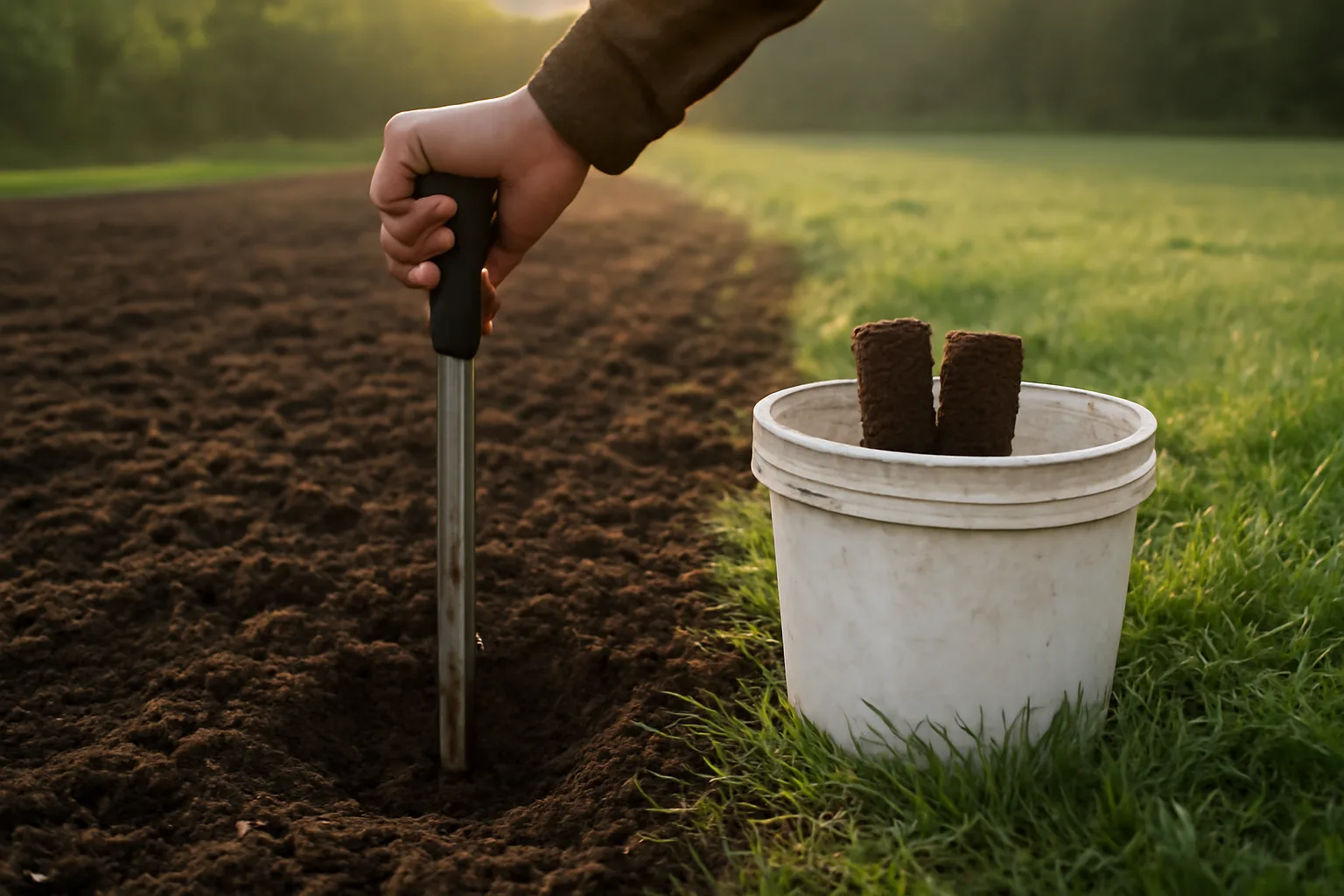
Pull multiple cores from across the plot, mix them together in a clean plastic bucket, and send that one mixed sample to the lab. Never send a single scoop of dirt from one spot and call it done. Soil variability across even a one-acre plot can be significant, and one core tells you about six square inches of ground, not your whole field. Here's the actual process. Use a soil probe, a spade, or a hand trowel. Walk the plot in a zigzag or W-pattern and pull 8 to 12 cores at each stop, going down about 4 to 6 inches for row-crop and forage plots. A 0 to 6 inch sampling depth is standard guidance for most row crops and forages from university and USDA agronomy programs, with deeper sampling sometimes used for no-till fields [1]. Toss each core into the same clean bucket. Once you've walked the whole plot, break up any clumps, remove rocks, roots, and debris, and mix the cores together by hand until it looks uniform. Pull about a pint to a quart of that mixed soil and that's your composite sample. Let it air dry if it's wet before boxing it up. Wet soil in a sealed bag can mold in transit and mess with results. Don't sample right after fertilizing, liming, or right next to a mineral lick or feeder. Avoid gateways, fence lines, and old logging roads where soil gets compacted or contaminated differently than the rest of the field.
how many soil samples do you need per plot
For a food plot under 2 to 3 acres, one composite sample (built from 8-12 cores) is usually enough, as long as the field looks and drains uniformly. Larger plots, or ground with visible differences (a wet low corner, a sandy ridge, an old logging deck), need to be split into separate zones and sampled separately. Treat any area with a distinct soil type, slope, or past management history as its own sampling zone, rather than blending it into one average. If half your plot is a heavy clay bottom and the other half is a sandy bench, mixing those together gives you a number that's wrong for both halves. Better to send two samples and get two fertilizer recommendations than one blended number that undershoots one half and overshoots the other. A rough rule some agronomists use: one composite sample per 2 to 5 acres of relatively uniform ground. For most food plotters that means one sample per plot, unless you're running a plot over 3 acres or one with obvious soil breaks.
when should you take a soil test before planting
Take your soil sample 3 to 4 months before you plan to plant, which for most food plotters means late winter or early spring for fall plots. Lime takes time to react with soil and raise pH, often 6 months or more for full effect, so testing early gives you a window to apply lime and let it work before seed goes in the ground. Lime should ideally go down several months ahead of planting because the neutralizing reaction with soil is slow, not instant. If you test in August and plant in September, you'll get a fertilizer number that helps, but any lime you spread won't have moved the needle on pH by planting day. That's the single biggest timing mistake plot owners make: testing too late to act on the lime recommendation. A practical calendar: test in late winter (February-March) for fall plots planted in August-September, and test in late summer for spring plots. Testing yearly isn't necessary once your pH and nutrient levels stabilize; most extension offices recommend retesting every 2 to 3 years unless you're actively correcting a problem.
what does a soil test actually tell you and what do you do with the results
A soil test report gives you pH, buffer pH (used to calculate lime rate), and levels of phosphorus, potassium, and sometimes secondary nutrients like calcium, magnesium, and sulfur. Most university labs translate those raw numbers into a plain-language recommendation: pounds of lime per acre, pounds of nitrogen-phosphorus-potassium per acre, tailored to whatever crop you tell them you're planting. This is the step where the lab, not this article, is the authority on your specific field. Every soil is different, and your test results are the only accurate source for how much lime and fertilizer your plot actually needs. Anything you read online, including this piece, is general guidance until you have that report in hand. Most land-grant university labs charge somewhere in the $6 to $20 per sample range and turn results around in one to two weeks, sometimes faster during off-peak months. Check your state's extension office for exact current pricing, since it varies by state and sometimes by county. Private ag labs can run higher, often $15-40, but usually with faster turnaround and more detailed micronutrient panels. Once you get the report, buy lime and fertilizer to match the recommendation, not a flat "one bag per acre" guess off the seed bag label. Pelletized lime works faster than ag lime (aglime) if you're short on time, though it costs more per ton.
do deer eat sorghum and other food plot species questions
Yes, deer eat sorghum, particularly grain sorghum heads in fall and winter, and it's a common component in fall/winter blend plots because it holds up well and provides a starchy food source late in the season when other forages have died back. It's not usually a deer's first choice compared to something like standing corn or soybeans, but it gets used, especially under snow cover or after other options are grazed down. Sorghum's real value in a plot is often as cover and a slow-release food source through winter, rather than as the primary attractant species. Many food plot blends pair it with a legume or brassica to cover both early and late season attraction.
do deer like clover and is it a favorite food plot species
Yes, deer readily eat clover, and it's one of the most consistently used food plot species across the whitetail range. White clover and red clover both show up in deer diet studies as a preferred, high-protein forage, especially during spring green-up and through summer when does need protein for lactation and bucks need it for antler growth. Clover's advantage over annual grains is that a well-maintained stand can produce for 3 to 5 years before needing to be reseeded, which makes it one of the better cost-per-year options for a perennial plot. It does need decent soil fertility and a pH close to neutral (roughly 6.0-6.5) to really perform, which loops right back to why the soil test matters before you plant it. If you're deciding what to put in the ground this season, it's worth comparing clover against annual options like brassicas or cereal grains for your specific plot goals; see food plot whitetail and deer food plot seed for species breakdowns.
when should you plant food plots for deer
Timing depends on your region and whether you're planting a spring/summer plot or a fall/winter plot, and it should always follow your soil test and lime application, not the other way around. Spring plots (clover, soybeans, alfalfa) generally go in after the last frost date for your area, often April through May in much of the whitetail range. Fall plots (brassicas, cereal grains, clover overseed) usually go in 60-90 days before your area's first hard frost, so growth finishes before killing cold hits. Most state wildlife agencies and extension services publish regional planting windows because frost dates and growing seasons vary a lot state to state. As a general anchor, the USDA plant hardiness zone map is useful for figuring out your average first and last frost windows, though it's built for ornamental and crop planting broadly, not deer forage specifically. A practical rule many extension agronomists use for brassicas and cereal grains: plant so the crop has 60 to 90 days of growth before the ground freezes hard, which for much of the Midwest and Southeast lands somewhere in August through early September.
when to plant oats for deer food plots
Oats are typically planted in late summer to early fall, roughly August through September in most of the whitetail's range, so they establish before cold weather and provide green forage through fall and into early winter. In warmer, southern climates, oats can also be planted in early spring as a cool-season option. Oats germinate fast and deer hit them hard as soon as they emerge, which makes them a good early-season draw in a blend, though a hard freeze will eventually kill the plant back in most northern climates. They're commonly mixed with brassicas or cereal rye to extend the plot's usefulness later into winter after the oats die off.
when to plant turnips for deer and why timing matters so much for brassicas
Turnips need roughly 80 to 90 days to mature and are best planted in late summer, typically late July through August depending on your latitude, so the bulbs and leaves are ready right as deer shift toward high-carb foods in late fall and winter. Plant too late and the turnips won't bulb out before frost; plant too early in hot, dry conditions and germination suffers. Brassicas including turnips are famous for a flavor shift after the first hard frost, when starches convert to sugars and palatability jumps. That's not folklore. It's a documented plant response to cold stress, and it's the reason turnip plots often sit untouched in October and get hammered in December. Getting this window right depends heavily on your specific frost dates, so check your state extension's fall planting calendar or your state wildlife agency's food plot guidance for local dates rather than a generic national date.
what are deer's favorite foods and do deer like honey
Deer are generalist browsers, and their "favorite" food shifts by season, region, and what's available: acorns and soft mast in fall, forbs and agricultural crops in summer, woody browse in winter when little else is left. Legumes (clover, soybeans), acorns, and standing corn or soybeans consistently rank as high-preference foods where available, based on browse and habitat research compiled by the USDA Forest Service Fire Effects Information System [2]. Deer do not eat honey in any meaningful, documented way as part of their natural diet. Deer are herbivorous browsers; honey isn't a forage source they seek out, and there's no wildlife research or extension source describing honey as a deer attractant. If you've heard of hunters using sweet substances near feeders or plots, be aware that many states restrict or ban baiting and supplemental feeding of deer entirely. Michigan, for instance, restricts baiting and feeding of deer statewide with specific limited exceptions for hunting purposes, under regulations enforced by the Michigan Department of Natural Resources [3]. Check your own state wildlife agency's current regulations before using any bait, mineral, or feed additive, since rules vary sharply state to state and even county to county in some places.
what equipment do you need to take a soil sample yourself
A soil probe is the fastest tool, but a garden spade or hand trowel works fine for a plot under a few acres. You'll also want a clean plastic bucket (metal buckets can skew micronutrient readings), a sample bag or box from your extension office or lab, and a permanent marker to label each sample by plot name and date. Most state extension offices provide soil sample boxes and submission forms for free or a small fee, and mailing a sample to your state's land-grant university lab is usually cheaper than a private lab. Check your state land-grant extension's soil testing page for current forms, mailing addresses, and fee schedules, since these details change and vary state to state. If you'd rather have someone build the fertility and species plan around your specific test results instead of piecing it together yourself, that's exactly what a $99 one-time Custom Food Plot Plan is built to do: you send in your soil test numbers and plot details, and get back a general planting plan matched to your zone and results. It's general guidance built from your data, not a replacement for your lab's specific lime and fertilizer recommendation.
soil test cost, turnaround, and depth by common source (comparison)
| Sampling detail | Typical range | Source | |
|---|---|---|---|
| Sample depth (row crop/forage) | 0-6 inches | USDA NRCS agronomy guidance [1] | |
| Cores per composite sample | 8-12 | Land-grant extension guidance | |
| University lab cost per sample | $6-$20 | Varies by state land-grant lab [4] | |
| Turnaround time | 1-2 weeks | Varies by lab and season | |
| Lime reaction time before planting | 3-6+ months | USDA NRCS soil chemistry guidance | |
| Retest frequency | Every 2-3 years | General extension guidance | These numbers move around depending on your state and which lab you use, so treat this as a planning reference, not a quote. Call your local extension office or check their soil testing page for exact current pricing before you mail a sample. |
Frequently asked questions
How deep should I sample soil for a food plot?
Most extension guidance recommends 4 to 6 inches deep for forage and row-crop plots, matching the depth where seed roots will actually grow. A 0-6 inch depth is standard for most agronomic sampling. Go slightly shallower, around 3-4 inches, only if you're specifically testing a no-till surface layer.
How many soil samples do I need for a small food plot?
For most plots under 2 to 3 acres, one composite sample made from 8-12 cores pulled across the whole plot is enough, as long as the ground looks uniform. Split the plot into separate samples only if you see clear differences in soil type, drainage, or slope.
Do deer eat sorghum?
Yes. Deer eat grain sorghum, especially in fall and winter, though it's usually secondary to corn, soybeans, or clover in preference. It works well in blends as a late-season, cold-hardy food source that holds up under snow.
Do deer like clover?
Yes, clover is one of the most consistently preferred food plot forages, offering high protein for lactating does and antler-growing bucks. It also persists for 3 to 5 years as a perennial stand, making it a strong long-term plot investment once soil pH and fertility are corrected.
When should I take a soil sample before planting a food plot?
Test 3 to 4 months ahead of your planting date so lime has time to react and adjust pH. For most fall plots that means testing in late winter or early spring; for spring plots, test the previous late summer or fall.
When should I plant oats for deer?
Plant oats in late summer to early fall, typically August through September in most whitetail range, so they establish before frost. In warmer southern zones, oats can also work as a spring planting.
When should I plant turnips for deer?
Plant turnips roughly 80-90 days before your area's first hard frost, usually late July through August depending on latitude. Turnips need that window to bulb out before cold weather hits, and their palatability improves sharply after the first frost.
What is a food plot?
A food plot is a planted area on hunting land, usually a fraction of an acre up to several acres, seeded with forage crops or grains to attract and feed deer. It functions as both a nutrition source and a hunting setup point near stands or blinds.
What are deer's favorite foods?
Deer preference shifts by season: acorns and soft mast in fall, clover and soybeans in summer, and woody browse in winter. Legumes and standing grain crops consistently rank high in browse and food plot studies where available.
Do deer like honey?
No. Honey isn't part of a deer's natural diet, and there's no wildlife research documenting it as an attractant. Deer are herbivorous browsers focused on forbs, mast, and browse; sweet bait products near plots or feeders may also violate your state's baiting regulations.
When is the best overall time to plant food plots for deer?
It depends on the species and your region: spring plots go in after your last frost date (often April-May), fall plots go in 60-90 days before your first hard frost (often August-September). Always base timing on your soil test and lime application schedule first.
How much does a soil test cost for a food plot?
University land-grant extension labs typically charge $6 to $20 per sample, with results back in one to two weeks. Private ag labs run higher, often $15-40, sometimes with faster turnaround or more detailed nutrient panels. Exact pricing varies by state, so check your local extension office.
Can I use a garden trowel instead of a soil probe?
Yes. A soil probe is faster for pulling multiple cores, but a hand trowel or spade works fine for a small plot. Just make sure you're sampling to a consistent 4-6 inch depth across all 8-12 pull points and mixing them in a clean plastic bucket.
Do I need to retest my food plot soil every year?
No, most extension offices recommend retesting every 2 to 3 years once pH and nutrient levels are corrected and stable. Retest sooner if you're actively working to raise pH with lime or if plant performance suddenly changes.
Sources
- Michigan State University Extension, Soil sampling to develop nutrient recommendations: Soil testing is the only way to know for certain the fertility status of your soil, and retesting every 2-3 years is generally recommended
- USDA Natural Resources Conservation Service, Soil Quality Test Kit Guide: Recommended sampling depth of 0-6 inches for most agronomic and forage crops
- University of Missouri Extension, Soil Testing: Typical per-sample cost range of roughly $6-$20 at university labs
- USDA Forest Service, Fire Effects Information System, White-tailed Deer: Legumes, acorns, and agricultural crops rank as high-preference deer foods
- Michigan Department of Natural Resources, Baiting and Feeding Regulations Summary: Many states restrict or ban baiting and supplemental feeding of deer