Last updated 2026-07-26
TL;DR
Planting a food plot means testing soil, clearing and fertilizing ground based on that test, picking species suited to your zone and season (clover, brassicas, oats, sorghum), and drilling or broadcasting seed at the right depth and window, usually late summer for fall plots or spring for summer plots.
What is a food plot?
A food plot is a planted patch of forage or grain, usually somewhere between a quarter acre and a few acres, put in specifically to feed and hold deer or other game on a piece of ground. It's not the same as a farm field left standing for wildlife, though the line gets blurry. Most hunters plant plots for two different jobs: some are "destination" plots meant to hold deer for the season (clover, chicory, alfalfa), others are "annual" plots timed to peak right before or during hunting season (brassicas, cereal grains, sorghum). The idea isn't new. State wildlife agencies and university extension programs have published food plot guidance for decades because well-placed plots can improve nutrition and concentrate deer sign on a property, which matters a lot on smaller parcels where deer might otherwise range off onto neighboring land. Mississippi State University Extension guidance on supplemental forage and deer nutrition frames food plots as one piece of a broader habitat management plan, not a replacement for natural browse [1]. A food plot is only as good as the ground under it. Skipping the soil test and just throwing seed at a field is the single most common way people waste money on this hobby. More on that below.
When to plant food plots for deer?
| Upper Midwest / Northeast | Mid-May to mid-June | Late July to late August | |
|---|---|---|---|
| Mid-South / Transition Zone | Mid-April to late May | Mid-August to mid-September | |
| Deep South | March to April | September to early October | If you only have time to plant once a year, most hunters and biologists lean toward the fall plot because it lines up with the season you're actually hunting. But a spring clover plot doubles as summer fawning and antler-growth nutrition, which matters if you're managing for whole-year deer health, more than a hunting spot. |
There are two main windows, and which one you use depends on what you're planting and what job the plot needs to do. Spring plantings (April through June in most of the country) are for warm-season annuals and perennials like clover, chicory, soybeans, and cowpeas. Late summer plantings (mid-August through September in the North, September into early October in the South) are for cool-season annuals like brassicas, cereal grains, and winter peas that you want peaking during hunting season. Soil temperature and first-frost dates drive almost everything. Brassicas need roughly 90 to 100 days to reach a good bulb or leaf stage before a hard frost sweetens them up, so most extension guides recommend planting turnips and other brassicas from mid-July to late August depending on latitude [2]. Clover, by contrast, is frost-tolerant and can go in early spring or even in late summer as a dormant seeding in colder zones. Here's a rough national breakdown, but check your local extension office because microclimates and elevation shift these dates by two or three weeks easily. | Region | Spring plot window | Fall plot window |
How do I test and prep the soil before planting?
Pull a soil sample four to six weeks before you plan to plant, not the week before. Extension labs typically take a few days to two weeks to turn results around, and you need that time to buy and apply lime or fertilizer. Take samples from six to eight spots across the plot at a 4 to 6 inch depth, mix them in a clean bucket, and send a composite sample to your state extension lab or a private ag lab. University of Tennessee Extension soil testing guidance recommends sampling well ahead of planting specifically so lime has time to react with the soil, since a lime application can take several months to fully adjust pH [3]. Most food plot species want a soil pH between 6.0 and 7.0. Below that, nutrients like phosphorus become less available to plants no matter how much fertilizer you dump on. Your soil test report is the actual authority here, not a blog post or a bag label. It will tell you the exact lime rate in tons per acre and the N-P-K fertilizer rate for your specific dirt and target crop. Follow that number over any generic recommendation, including the ranges in this article. Once you have your results, clear the plot: mow or spray existing vegetation, let it die back (7 to 14 days after a glyphosate application is typical), then till or drill depending on your equipment and soil type. No-till drilling into a dead sod is faster and better for erosion control on sloped ground; conventional tillage works fine on flat, rock-free ground and can bury lime and fertilizer where roots can reach it.
Do deer eat clover?
Yes, and it's one of the most reliable food plot plantings in the country. Clover is a perennial legume, meaning a good stand can last three to five years with proper mowing and fertilization, and it's high in crude protein, often in the 20 to 30 percent range depending on variety and growth stage. Do deer like clover? By most accounts yes, it's consistently one of the top-used food plot forages across whitetail range, alongside soybeans and alfalfa. It's also a great choice for hunters who want a low-maintenance plot after year one, since established clover mainly needs mowing and a topdress of fertilizer rather than a full replant. White clover (ladino types) tolerates shade and mowing well and suits smaller plots. Red clover grows taller, tolerates poorer drainage, but doesn't handle heavy shade as well. Plant clover in spring or late summer at roughly 6 to 8 pounds per acre for ladino varieties, shallow, about a quarter inch deep, because clover seed is tiny and easily buried too deep to germinate. If you're building a plot plan around perennial clover as your anchor plot, it pairs well with a brassica or cereal grain annual plot elsewhere on the property so you've got both season-long tonnage and a late-season attractant. That kind of pairing is exactly the sort of thing a food plot whitetail strategy should account for.
When to plant oats for deer?
Oats are a cool-season cereal grain and one of the fastest, cheapest ways to get green growth on the ground in early fall. Plant oats from mid-August through September in most of the whitetail's range, aiming for 6 to 8 weeks before your first hard frost so plants can establish before growth slows. Oats germinate fast, often in 5 to 10 days under good soil moisture, and deer will hit young oat shoots hard because they're tender and high in sugars compared to older forage. The tradeoff is that oats are an annual and will winterkill in true cold climates, though in the Deep South they can persist and even head out if left long enough. Seeding rate for a food plot planting (broadcast) runs about 100 to 130 pounds per acre; drilled rates can be lower, around 60 to 90 pounds per acre, because drilling gets better seed-to-soil contact and less waste. Oats are often mixed with brassicas or cereal rye in a blend, since oats provide fast early cover and tonnage while the slower brassicas bulk up for late season. One real limitation: oats alone don't hold up as well to hard frost as wheat, rye, or triticale, so in northern zones a lot of plot managers mix oats with a hardier grain so something is still green in December.
When to plant turnips for deer?
Turnips need roughly 80 to 90 days from planting to a good bulb, and they get noticeably sweeter after a couple of hard frosts convert starches to sugars, which is exactly why deer often ignore turnip plots in October and hammer them in December. Plant turnips from mid-July in northern states to late August in the transition zone, and into early September in parts of the Deep South, always counting backward from your average first frost date. University of Georgia Extension guidance on brassica forages notes that deer use of turnips and other brassicas often increases after a hard frost due to a shift toward more soluble carbohydrates in the leaves and bulbs, so a plot that looks ignored in early fall isn't necessarily a failure [2]. Seeding rate for turnips alone is light, around 4 to 6 pounds per acre broadcast, because seeds are small and a thick stand actually reduces bulb size. Most food plot blends combine turnips with radishes, rape, or a cereal grain to get both leaf tonnage early and bulb/root food value later. Don't plant too deep. A quarter inch is plenty; turnip seed buried an inch down often won't emerge at all. If turnips get eaten to the ground the moment they emerge, that's often a sign the surrounding property doesn't have enough other food, and a single small plot is taking all the pressure. Larger acreage or multiple smaller plots spread across a property tend to spread that browse pressure out.
Do deer eat sorghum?
Yes, deer eat sorghum, particularly the grain heads once they mature, but sorghum's biggest food plot value is often as cover and a late-season standing grain source rather than a primary summer forage. Grain sorghum (milo) produces a heavy seed head that stands through much of the winter, providing both food and screening cover, which is valuable on plots near bedding areas or in states where standing corn isn't practical. Sorghum is planted like corn, in late spring once soil temps hit around 65 degrees F, at roughly 6 to 10 pounds per acre depending on row spacing and whether you're drilling or broadcasting. It's more drought-tolerant than corn, which makes it a reasonable substitute on sandy or marginal ground in the South and parts of the Midwest. One real caution: sorghum, especially young or stressed plants, can contain compounds that convert to cyanide (prussic acid) under certain stress conditions like frost or drought, a known issue in livestock grazing that extension livestock programs warn about closely. University of Nebraska-Lincoln Extension notes that prussic acid poisoning risk in sorghum-family forages rises sharply after a frost damages plant cells and releases the toxic compound [4]. This is mainly documented as a livestock grazing risk rather than a deer food plot risk, and there's no strong wildlife-specific data showing it's a common problem for browsing deer, but it's worth knowing the mechanism exists if you're mixing sorghum with grazing on the same ground. Most plot managers use sorghum as one piece of a larger fall plot, not the whole plot, precisely because it's more valuable as a standing grain and screen than a lush green attractant.
What are deer's favorite foods?
There's no single "favorite" because it shifts by season, region, and what's locally available, but research and extension data point to a consistent short list. Acorns, soybeans, clover, and other legumes rank at or near the top almost everywhere deer are studied. Acorns in particular are a huge natural driver of deer movement and body condition in fall, and in years with a heavy acorn crop, deer will often walk past a planted food plot to hit the woods instead. Mississippi State University Extension's deer nutrition and forage work has repeatedly found that legumes, including clover, soybeans, and cowpeas, rank as high-preference, high-protein forages compared to many grasses and browse species [1]. Agricultural crops like soybeans and corn also draw heavy deer use where they're grown near timber, which is part of why plots often mimic those same crops at a smaller scale. So if you're picking a "can't miss" species for a new plot, soybeans (in areas without heavy deer pressure early) and clover are about as close to a safe bet as this hobby offers. Brassicas and cereal grains round out a fall lineup for the late season when deer key in on high-carb, high-sugar food sources ahead of winter. Worth saying plainly: no food plot guarantees you'll see deer, let alone harvest one. Plots improve odds and improve deer nutrition on a property; they don't control deer movement on any given evening.
Do deer like honey?
Not in any meaningful food plot sense. "Honey" here usually means Honey Locust trees or the misconception around "honey hole" spots, not literal honey. Deer aren't documented as seeking out honey (the bee product) in the wild, and there's no wildlife agency or extension guidance suggesting it as an attractant. Some hunters do use liquid deer attractant products with a sweet, molasses-like scent to draw deer to a mineral site or trail camera location, and Honey Locust pods (long, sweet seed pods from the tree) are a real, well-documented deer food in fall. If your search brought you here wondering about liquid attractant sprays, know that many states heavily regulate or ban baiting and feeding of deer, including sprays and mineral licks in some jurisdictions, so check your state wildlife agency's current baiting and feeding regulations before using any attractant product, scent drip, or mineral station [5]. Rules vary a lot by state and can change year to year, especially in response to chronic wasting disease concerns.
What equipment do I actually need to plant a food plot?
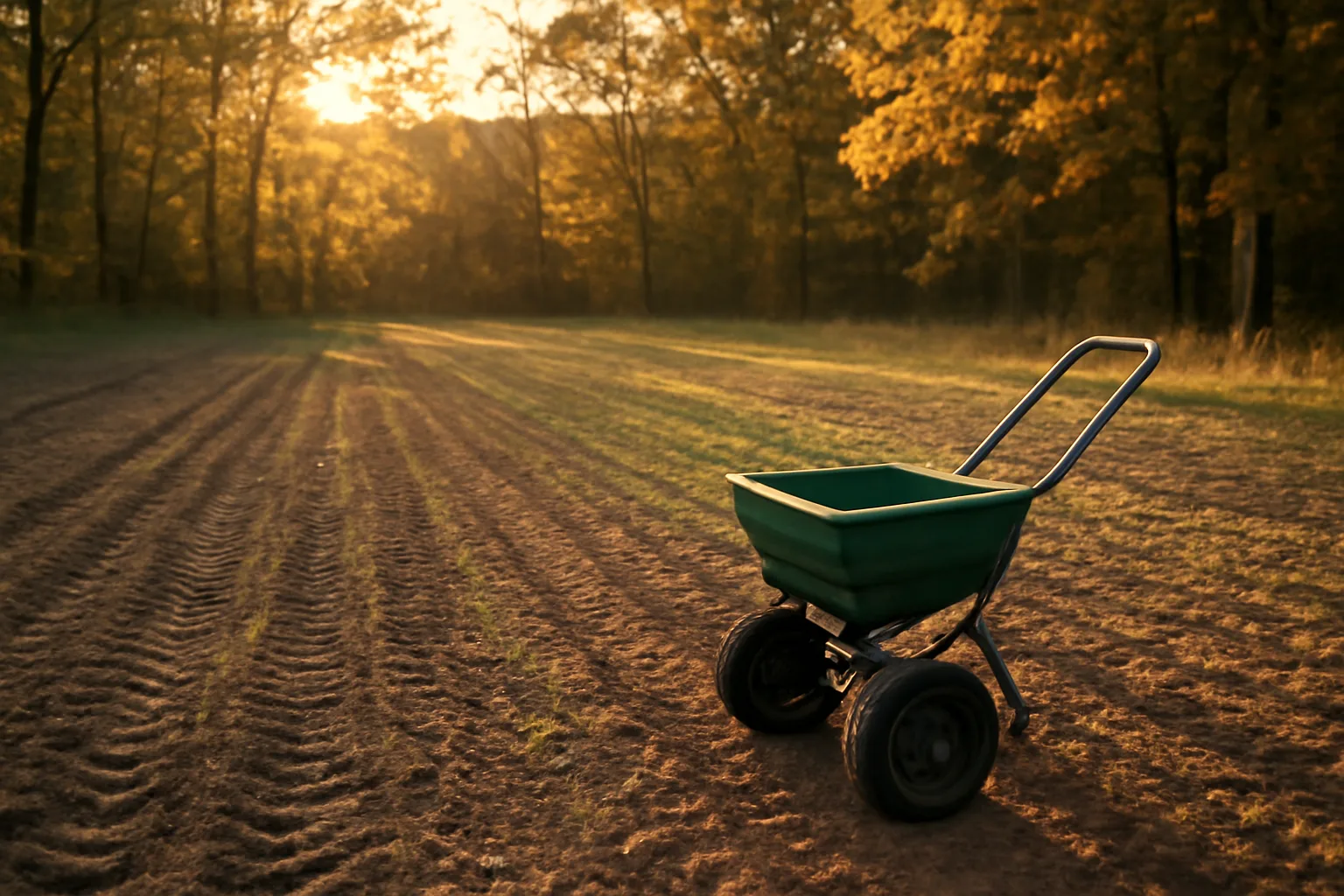
You can plant a food plot with almost nothing (a rented tiller, hand broadcaster, and a lawn roller) or with a full tractor, disc, drill, and sprayer setup. What you need depends on plot size and how many years you plan to keep planting. For plots under an acre, a decent ATV or UTV with a tow-behind disc, a pull-behind cultipacker, and a hand-crank or ATV-mounted broadcast spreader will get the job done. Add a sprayer (even a 25-gallon ATV sprayer) for herbicide burn-down before planting; skipping burn-down and just discing into existing weeds is a common reason plots fail in year one. For plots over 2 to 3 acres, a compact tractor (25 to 45 horsepower) with a box blade or disc, a drag harrow, a broadcast or drill seeder, and a boom sprayer earns its keep fast in time saved. A no-till drill is the single biggest upgrade for consistent germination because it controls seed depth, which matters enormously for small seeds like clover and brassicas. Don't overspend on your first plot. A lot of first-year plotters buy a tractor before they've even confirmed the ground drains well or gets enough sun. Start small, get a soil test, get one plot right, then scale equipment up as acreage grows.
How do I actually plant the plot, step by step?
Here's the order that works, in roughly every extension guide and every experienced plotter's routine, whether you're going big or small. 1. Soil test, 4 to 6 weeks ahead. Send it to your state extension lab. 2. Clear existing vegetation with mowing, tillage, or a glyphosate burn-down; wait 7 to 14 days after spraying before working the ground. 3. Apply lime and fertilizer per your soil test results, worked into the top few inches if tilling, or applied on the surface ahead of a no-till drill. 4. Prepare a firm, smooth seedbed. Loose, fluffy soil buries small seeds too deep and dries out fast. 5. Plant at the right depth for your species. Small seeds (clover, brassicas) go a quarter inch deep or less; larger seeds (soybeans, sorghum, oats) go three-quarters of an inch to an inch and a half. 6. Cultipack or roll after planting to firm the soil around the seed, especially for small-seeded broadcast plantings. 7. Time it to rain if you can. Planting into a forecasted rain within a few days of seeding beats guessing on irrigation you don't have. That's genuinely most of it. The mistakes that sink plots are almost always steps 1 and 2: skipping the soil test, or not killing existing grass and weeds before planting into them.
How do I pick the right species and plan for my property?
Match species to your goals, your soil test, your zone, and how much time you have. A single-species clover plot is low-maintenance and season-long. A brassica-and-cereal-grain blend peaks for hunting season but needs replanting yearly. A mix of both across different plots on the same property, sometimes called a plot rotation, gives you spring nutrition and fall hunting value in the same season. If you're new to this and want a plan built around your actual soil test, zone, and acreage rather than a generic seed bag recommendation, that's the exact gap a Custom Food Plot Plan is built to fill: a $99 one-time plan based on your soil test results, property location, and goals, not a one-size-fits-all mix. Your soil lab is still the final word on lime and fertilizer rates; a plan works alongside that report, not instead of it. For species selection specifically, browse options by category: check out guidance on deer food plot seed choices, general food plot seed picks, or broader deer food plots strategy if you're planning your first multi-plot layout. If you're deciding between a dedicated wildlife blend and a straight agricultural crop like soybeans, the deer for food comparison and domain food plot seed options are worth a look before you buy seed.
Frequently asked questions
Do deer eat sorghum?
Yes. Deer eat sorghum grain heads once mature, and sorghum also provides standing winter cover. It's usually planted as part of a fall plot mix rather than alone, since its main value is late-season food and screening, not early attraction.
Do deer like clover?
Yes, clover is one of the most consistently used food plot forages nationwide. It's high in crude protein (often 20 to 30 percent), perennial, and tolerant of mowing, which makes it a reliable low-maintenance anchor plot for spring through fall.
When should I plant food plots for deer?
Spring (April through June depending on zone) for perennials like clover and warm-season annuals like soybeans; late summer (mid-August through September) for fall annuals like brassicas, oats, and cereal grains timed to peak during hunting season.
When should I plant oats for deer?
Plant oats mid-August through September in most whitetail range, about 6 to 8 weeks before your first hard frost. Oats germinate in 5 to 10 days and are often mixed with a hardier grain since they winterkill easily in cold climates.
When should I plant turnips for deer?
Plant turnips mid-July to late August in northern and transition zones, or into early September in the Deep South, counting back 80 to 90 days from your average first frost. Turnips get sweeter and more attractive to deer after a couple of hard frosts.
What is a food plot exactly?
A food plot is a planted area, typically a quarter acre to a few acres, established specifically to feed and hold deer or other wildlife. It supplements natural forage and habitat rather than replacing it, according to extension wildlife guidance.
What is deer's favorite food?
There's no single favorite; it shifts by season and region. Acorns, soybeans, and clover consistently rank as top-preference, high-value foods in deer nutrition research, with legumes offering the highest protein content among common food plot options.
Do deer like honey?
There's no evidence deer seek out honey specifically. The confusion usually comes from Honey Locust trees, whose sweet seed pods are a documented natural deer food in fall, distinct from honey the bee product.
How big should a food plot be?
Anywhere from a quarter acre to several acres works, depending on property size, deer density, and goal. Small hidden plots (a quarter to half acre) tend to work well as hunting plots; larger plots (1 to 5 acres) work better as season-long nutrition sources.
How do I know what to plant based on my soil test?
Your soil test report will list a target pH and specific lime and fertilizer rates for the crop you tell the lab you're planting. Follow those numbers directly; they're calculated for your actual soil, not a generic bag recommendation.
Can I plant a food plot without a tractor?
Yes, for plots under an acre. An ATV or UTV with a tow-behind disc, a hand or ATV-mounted broadcast spreader, and a cultipacker or roller can handle small plots. A sprayer for herbicide burn-down is worth adding regardless of equipment size.
Is baiting or using attractants legal for food plots?
Food plots themselves are legal in every state, but separate baiting and feeding regulations (piles of grain, mineral licks, scent attractants) vary widely and change often, especially around chronic wasting disease. Check your state wildlife agency's current rules before using any attractant product.
What's the difference between a fall plot and a spring plot?
Fall plots use cool-season annuals (brassicas, oats, cereal rye) planted in late summer to peak during hunting season. Spring plots use warm-season annuals or perennials (clover, soybeans, cowpeas) planted in spring for summer nutrition and season-long growth.
How long does it take a food plot to grow in?
Fast growers like oats germinate in 5 to 10 days; clover and brassicas take a bit longer to establish visible cover, roughly 2 to 3 weeks. Full maturity varies a lot: turnips need 80 to 90 days to bulb, brassicas overall roughly 90 to 100 days before a hard frost.
Sources
- Mississippi State University Extension, Publication 2111: Nutrition and Deer Management: Food plots supplement native forage and legumes rank as high-preference, high-protein deer foods
- University of Georgia Extension, Brassica Forages for Deer (Circular 1046): Brassicas need about 90 to 100 days to reach good maturity before a hard frost and become more attractive after frost
- University of Tennessee Extension, Soil Sampling Best Practices (W 315): Soil samples should be taken well ahead of planting so lime has time to adjust soil pH
- University of Nebraska-Lincoln Extension, Prussic Acid Poisoning (G1954): Sorghum species can develop prussic acid (cyanide) risk under frost or drought stress
- Michigan Department of Natural Resources, Baiting and Feeding of Deer and Elk regulation summary: Baiting and feeding regulations for deer vary by state and are subject to change