Last updated 2026-07-26
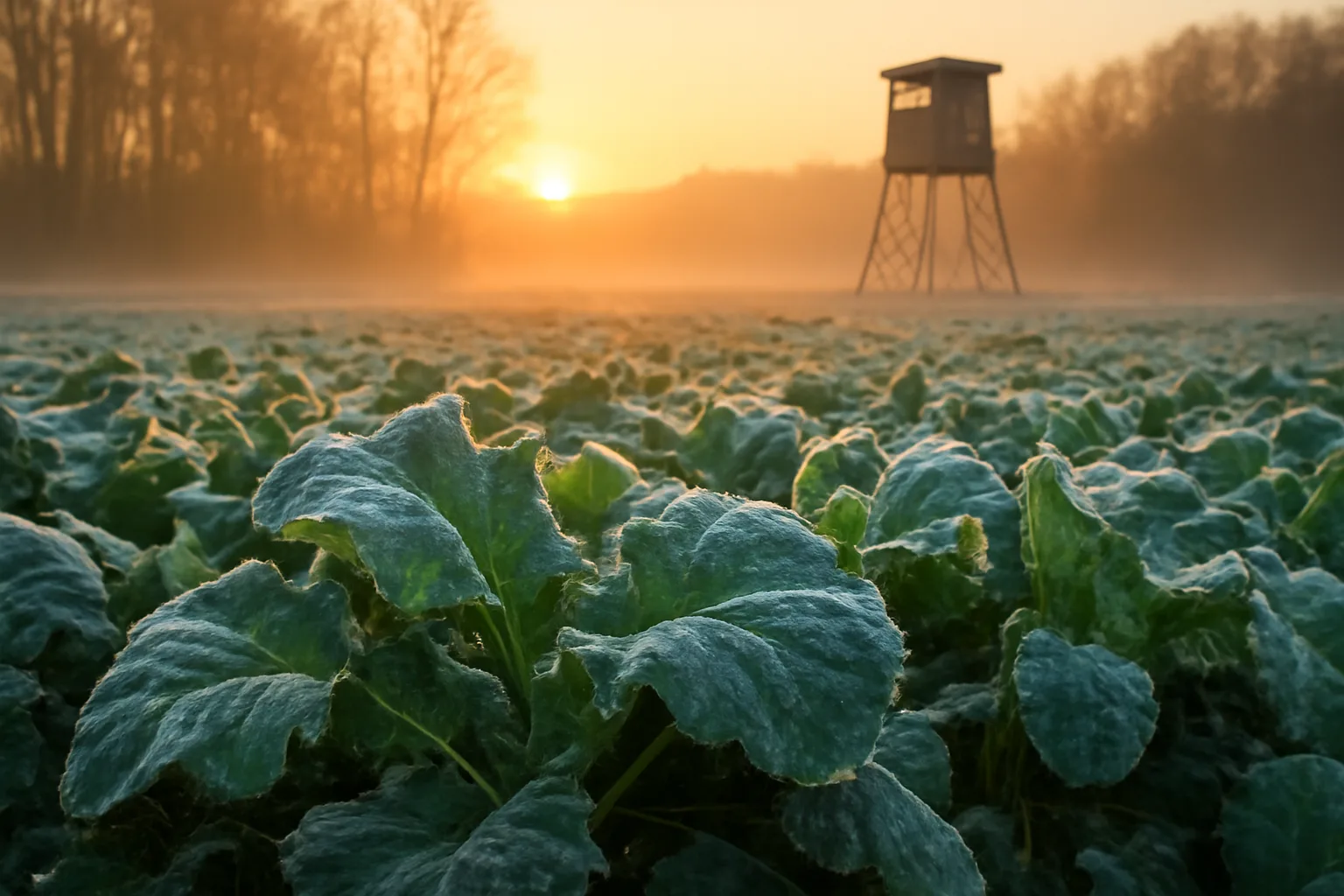
TL;DR
Plant brassica food plots 60 to 90 days before your area's first killing frost, which for most whitetail country falls between mid-July (northern zones) and early September (Deep South). Brassicas need cool nights and a hard frost or two to convert starches to sugars, which is what actually pulls deer onto the plot in late fall.
When should you plant brassicas for deer?
Count backward from your area's average first killing frost date and plant 60 to 90 days ahead of it. That's the single rule that matters more than the calendar date on a bag of seed. Most brassica blends (forage rape, turnips, radishes, kale) need somewhere between 60 and 90 days to reach full maturity, and a killing frost (usually defined as 28°F or lower) is actually good for them, not bad. Frost triggers the plant to convert stored starches into sugars, which is why deer often ignore a brassica plot in September and hammer it in December. Penn State Extension notes that brassica forage quality and palatability improve after a hard frost because of this starch-to-sugar conversion. In practice this means: northern tier states (Minnesota, Wisconsin, Michigan, upstate New York, most of New England) should plant mid-July through early August. Transition zone states (southern Iowa through Kentucky, Virginia, most of Missouri) plant late July through late August. Deep South and coastal plots (Georgia, Alabama, South Carolina, Mississippi) can wait until late August into mid-September because frost comes so much later there, if it comes at all. A quick way to check your own dates: NOAA's climate normals and most state extension offices publish average first-frost maps by county [1]. That's a better source than a seed bag's generic "plant in late summer" advice, because a bag sold in Georgia and a bag sold in Minnesota need completely different actual calendar dates even though the days-to-maturity math is the same.
When to plant food plots for deer, in general
Food plot timing splits into two seasons: spring/summer plots (clover, chicory, soybeans, cowpeas) planted after your last spring frost, and fall plots (brassicas, cereal grains, annual clovers) planted 60 to 90 days before your first fall frost. Brassicas and most fall annuals fall firmly in the second category. Spring plots are about season-long nutrition, antler growth, and fawn rearing. Fall plots are about concentrating deer on food during hunting season and getting them through winter. If you're only planting one plot type this year and you hunt over it, fall brassicas or a brassica/cereal grain mix is usually the higher-value choice for a hunting property, because the timing lines up with when you're actually in the stand. Soil temperature matters too. Brassica seed germinates best in soil that's already warmed from summer heat, generally 55°F to 75°F at planting depth, so you're not fighting cold, wet soil the way you might with an early spring planting [2]. That's part of why the late-summer window works: the ground is warm, moisture from late summer rain (in most regions) gets seedlings up fast, and the plant has a full season of warm days before it needs to shift into cold tolerance mode.
When to plant turnips for deer specifically
Turnips follow the same window as other brassicas: 60 to 90 days before your first expected killing frost, planted 1/4 to 1/2 inch deep into a firm, weed-free seedbed. Purple top and other forage turnip varieties are actually a bit faster to bulb than some rape or kale blends, often reaching usable size in 60 to 70 days, so they tolerate a slightly later planting date better than radish-heavy blends do. Deer typically eat the leafy tops first, starting a few weeks after emergence, then switch to digging up and eating the bulbs after a couple of hard frosts have sweetened them. If you've ever walked a turnip plot in December and found nothing but craters where bulbs used to be, that's normal, and it's the sign the frost did its job. One mistake worth flagging: planting turnips too early. In hot, dry August conditions in the transition zone and south, turnips planted too soon can bolt or get bitter before the season's cold ever arrives, and deer will walk right past them until temperatures drop. If your summer has been unusually hot, lean toward the later end of your 60 to 90 day window rather than the early end.
When to plant oats for deer
Oats plant on roughly the same late-summer to early-fall calendar as brassicas, generally 6 to 8 weeks before your first fall frost, and they're one of the fastest-establishing fall food plot crops available, often showing green growth in 5 to 10 days under good moisture [3]. That fast germination makes oats a great partner crop for brassicas: oats give deer something to eat within two to three weeks while the turnips and radishes are still building root mass. Oats are also more cold-tolerant early on than most people think, tolerating temperatures into the low 20s before serious damage, though they'll eventually die back after repeated hard freezes in the teens or below, depending on variety [3]. That means a straight oat plot in the upper Midwest is really more of an early-to-mid season food source, while in the South, where winters stay milder, oats can provide green forage well into January. A common blend that works well across most zones is a mix of forage oats, one or two brassica species, and sometimes winter peas or a cereal rye component for late-season durability after the oats are gone.
Do deer eat sorghum?
Yes, deer eat grain sorghum (milo), both the standing seed heads and, to a lesser extent, the foliage, though it's generally considered a lower preference food than corn, soybeans, or brassicas in most whitetail research and extension trial data [3]. Sorghum's real value on a hunting property is usually as cover and a slow-release winter grain source rather than a primary attraction crop. Grain sorghum is planted in late spring to early summer (after soil hits about 60°F), not in the same window as brassicas, so if you're building a food plot rotation that includes sorghum, it belongs in your spring/summer plot decisions, not your fall brassica timing. Some hunters use sorghum as a screening strip around a brassica or clover plot. It grows 4 to 8 feet tall, blocks sightlines and wind for approaching deer, and still gives them something to nibble on when the seed heads mature in fall. That dual-purpose use is arguably a better fit for most plot plans than trying to make sorghum a stand-alone attraction plot.
Do deer like clover, and how does it fit around brassica timing?
Deer strongly prefer clover, and white clover and red clover both rank consistently high in forage preference studies and are considered among the most reliable perennial food plot species for whitetail deer [4]. Clover is planted in a different window than brassicas though: either early spring (as soon as soil can be worked) or late summer/early fall alongside your brassica planting date, since clover also handles a light frost fine and germinates in cool soil. A lot of experienced plotters run clover and brassicas as neighboring plots rather than mixed together in the same seed blend, because clover is a perennial that you're managing for 3 to 5 years and brassicas are annuals you're replanting yearly. Clover gives you spring and summer nutrition; brassicas give you a fall and winter draw. Planted next to each other, or in a rotation across a larger field, they cover almost the entire calendar. If you want the two in one blend anyway, a low rate of clover seed added to a brassica mix can work, but expect the brassicas to shade out the clover seedlings some in year one. You'll get a better stand of clover in year two once the brassicas are grazed down or have died back.
What is a food plot, exactly?
A food plot is a planted area of land, typically somewhere between a quarter acre and several acres, established specifically to grow forage that attracts and feeds deer or other wildlife. Food plots are a wildlife habitat management tool used on private and leased hunting land, and state wildlife agencies generally treat them as a form of habitat improvement distinct from baiting, though the legal line between the two varies significantly by state [5]. Most food plots fall into two rough categories. Perennial plots (clover, chicory, alfalfa) get planted once and managed for several years. Annual plots (brassicas, cereal grains, soybeans) get replanted every season, timed around the crop's specific growing window and your goals for that plot (spring nutrition versus fall hunting attraction). Because baiting and supplemental feeding laws differ so much state to state, and some states regulate feed piles and mineral sites but exempt properly planted and unharvested standing crops, it's worth checking your state wildlife agency's current regulations before assuming a food plot is automatically legal to hunt over in your state [6]. A few states restrict hunting over food plots planted within a certain time frame of the hunt, or have specific rules about what counts as a plot versus a feed station.
What are deer's favorite foods, and where do brassicas rank?
Deer preference studies and extension forage trials consistently rank agricultural crops like soybeans, corn, and high-quality clover among the top whitetail food sources, with brassicas ranking as a strong seasonal preference specifically in fall and winter once frost has sweetened them [4]. Acorns, where available, often outcompete planted forages entirely in years with a heavy mast crop, which is one reason a food plot can look ignored in an acorn boom year. Brassicas are unusual in that their preference ranking changes hard across the season. In August and September, freshly emerged brassica plots often get light use, sometimes almost none, while deer are still keyed on natural browse, soybeans, or acorns. By November and December, after a few freezes, that same plot can become one of the most heavily used food sources on the property, because the sugar content has risen and because natural browse has thinned out. That seasonal shift is exactly why brassica planting date discipline matters. Plant too late and you never get the frost-sweetening effect before the season ends. Plant too early and the plants may bolt, get woody, or get grazed down to nothing before the good cold-weather window even arrives.
Do deer like honey, and does it matter for food plots?
There's no research or extension data supporting deer being drawn to honey specifically, and it isn't a recognized food plot or attractant ingredient in any wildlife agency or university forage guidance. Deer are herbivores built around browse, forbs, mast, and agricultural forage, not sugars or nectar products like honey [7]. Some commercial deer attractant sprays include sweet or fruity scent compounds unrelated to real honey, but that's a scent-based mock scrape or trail camera product category, not a food plot strategy, and it has nothing to do with brassica planting timing. If you're trying to boost fall attraction to a brassica plot, the better lever is frost timing and variety selection, not additives. A blend of forage rape or kale (leaf-heavy, earlier to be palatable) with turnips or radish (bulb-heavy, better late season) covers more of the season than a single-species stand.
How do you build a brassica planting calendar for your zone?
| Upper Midwest / Northeast (MN, WI, ME, upstate NY) | Late Sept to early Oct | Mid-July to early August | |
|---|---|---|---|
| Transition zone (southern IA, IL, IN, OH, PA, VA, KY, MO) | Mid to late Oct | Late July to late August | |
| Mid-South (TN, NC, AR, southern MO) | Late Oct to mid-Nov | Mid to late August | |
| Deep South / coastal (GA, AL, SC, MS, LA) | Mid-Nov to early Dec | Late August to mid-September | These dates are general starting points, not a guarantee for your exact property. Local frost dates shift with elevation, north or south facing slopes, and proximity to water, sometimes by two or three weeks within the same county. Cross-check against your extension office's specific frost tables before locking in a date [1]. If you want a plan built around your specific coordinates, soil test results, and equipment, that's exactly the kind of thing a Custom Food Plot Plan is built to handle: you get a zone-specific calendar and species mix instead of a generic bag-label date. Your soil test lab is still the authority on your actual lime and fertilizer rates; the plan works from that report, it doesn't replace it. |
Start with your county's average first killing frost date, which you can find through your state's land-grant extension office or NOAA climate data, then count back 60 to 90 days [1]. That gives you a planting window, not a single date, because rainfall and soil moisture in that window matter as much as the calendar. Here's a rough regional guide based on typical first-frost dates across whitetail range: | Zone | Typical first frost | Brassica planting window |
How do you prep soil and seed a brassica plot correctly?
Brassicas want a firm, fine seedbed, a pH close to neutral (6.0 to 7.0), and shallow planting depth of 1/4 to 1/2 inch, since the seed is tiny and easily buried too deep to emerge [2]. A soil test 60 to 90 days ahead of planting gives you time to apply lime if your pH is low, since lime can take months to fully adjust soil chemistry. Most university extension guidance recommends 40 to 60 pounds of actual nitrogen per acre for brassica forage plots, with phosphorus and potassium rates set by your specific soil test results rather than a blanket number, since P and K needs vary a lot by existing soil fertility [2]. This is the point where your soil test lab's recommendation should override any generic rate you read online, because your field's actual nutrient levels are the only thing that matters here. Drill seeding at a shallow, consistent depth beats broadcast seeding for stand uniformity, but broadcasting followed by a light cultipacking pass works fine too, especially on smaller plots without drill access. Whatever method you use, seed-to-soil contact is the thing that makes or breaks germination, more than the specific tool.
What mistakes wreck brassica plots most often?
Planting too early is probably the single most common mistake, because bag labels often say "late summer" without giving a frost-based date, and hunters in warm regions plant a month before they should. The plant bolts, gets tough, or gets grazed to nothing before the season's cold weather ever shows up. Planting too deep is the second big one. Brassica seed is small, roughly the size of a mustard seed, and burying it more than half an inch often means poor or spotty germination. Skipping the soil test is the third. Brassicas are heavy nitrogen feeders and respond hard to correct pH, and guessing at fertility rates instead of testing usually means either wasted fertilizer money or a stunted, thin stand. A basic soil test through your state extension lab typically costs somewhere in the $10 to $20 range and takes one to two weeks for results, which is cheap insurance against a wasted planting season [2].
How does brassica timing compare to other fall food plot species?
| Forage oats | 5-10 days to emerge, grazable in ~3 weeks | Moderate (into low 20s°F) | Early fall through first hard freeze | |
|---|---|---|---|---|
| Forage turnips | 60-70 days | High, improves with frost | Mid to late season, after 1-2 frosts | |
| Forage rape/kale | 80-90 days | High, improves with frost | Late season through winter | |
| Cereal rye | 7-14 days to emerge | Very high, survives hard freezes | Late season and into spring | |
| Annual clover (crimson, arrowleaf) | 60-90 days | Moderate to high | Fall through spring in mild zones | A blend that layers a fast crop (oats) with a mid-speed crop (turnips) and a slow, cold-hardy crop (rape or cereal rye) gives you food from early fall all the way through late winter, instead of one narrow peak window. That's the logic behind most commercial fall blends, and it's also easy to replicate buying separate bags if you want to control your own ratios. If you're comparing specific food plot seed options or looking at pre-mixed deer food plot seed blends built around this layered approach, matching the mix to your actual frost date matters more than the brand on the bag. |
Brassicas, cereal grains (oats, wheat, rye), and annual clovers all get planted in roughly the same late-summer to early-fall window, but they mature and peak at different speeds, which is why a lot of successful fall plots are blends rather than single species. | Species | Days to usable maturity | Frost tolerance | Peak deer use |
Frequently asked questions
When is the best time to plant a brassica food plot?
Plant brassicas 60 to 90 days before your area's average first killing frost. For most of the whitetail's range that lands somewhere between mid-July (upper Midwest, Northeast) and mid-September (Deep South). Check your county's frost date through your state extension office or NOAA climate normals rather than relying on a seed bag's generic date.
Do deer eat sorghum?
Yes, though it's a lower preference food than corn, soybeans, or brassicas in most extension and preference studies. Grain sorghum works best as a screening crop or slow-release winter grain rather than a primary attraction plot, and it's planted in late spring, not on the fall brassica calendar.
Do deer eat clover, and do deer like clover?
Yes, and clover is one of the highest-preference planted forages for whitetail deer, ranking consistently well in university forage trials. It's planted in a different window than brassicas (spring or late summer/early fall in cool soil) and works well as a perennial complement to an annual brassica plot rather than mixed into the same blend.
When should you plant food plots for deer overall?
Spring/summer plots (clover, soybeans, chicory) go in after your last spring frost. Fall plots (brassicas, oats, cereal grains) go in 60 to 90 days before your first fall frost. Most hunting-focused properties get the most value from the fall planting window since it lines up with hunting season.
When do you plant turnips for deer specifically?
Plant forage turnips 60 to 90 days before your area's first killing frost, 1/4 to 1/2 inch deep. Turnips mature slightly faster than rape or kale, often reaching usable bulb size in 60 to 70 days, so they tolerate later planting a bit better than other brassica species.
When should oats be planted for deer food plots?
Plant oats 6 to 8 weeks before your first fall frost. Oats germinate fast, often showing green growth in 5 to 10 days, and pair well with slower brassicas in a blend since they give deer forage within a few weeks while turnips and rape are still developing.
What is a food plot?
A food plot is a planted patch of forage, usually a quarter acre to several acres, established on hunting or wildlife land specifically to feed and attract deer or other game. Plots split into perennial types (clover, alfalfa) managed for years and annual types (brassicas, oats, soybeans) replanted each season around specific growing windows.
What are deer's favorite foods?
Extension forage trials and preference studies rank soybeans, corn, high-quality clover, and acorns (in mast years) among the top whitetail foods. Brassicas rank as a strong seasonal favorite specifically in late fall and winter, after frost converts starches to sugars and sweetens the leaves and bulbs.
Do deer like honey?
There's no research or extension guidance suggesting deer seek out honey, and it isn't used in any recognized food plot or forage program. Deer are browsers built around forbs, mast, and planted forage, not sugar or nectar sources, so honey has no real role in food plot strategy.
Why do brassicas taste better to deer after a frost?
A hard frost (roughly 28°F or below) triggers brassica plants to convert stored starches into simple sugars as a cold-tolerance response, which makes the leaves and bulbs noticeably sweeter and more palatable to deer. This is why brassica plots often see little deer use in early fall and heavy use after the season's first freezes.
Can you plant brassicas too early?
Yes. Planting more than 90 days before frost in warm weather often causes brassicas to bolt, get woody, or get grazed down to nothing well before the cold-weather sweetening effect can happen. If your summer runs hot, lean toward the later end of the 60-to-90-day window instead of the early end.
What soil pH do brassicas need?
Brassicas grow best in soil with a pH between 6.0 and 7.0. A soil test taken 60 to 90 days before planting gives enough lead time to apply lime, since lime needs months to fully adjust soil pH, and your soil test lab's specific lime recommendation should be followed over any generic online rate.
Is it legal to hunt over a food plot?
In most states, a properly planted, unharvested standing food plot is treated differently from a bait pile or feeder, but the specific rules on baiting, feeding, and food plots vary a lot by state. Check your state wildlife agency's current hunting regulations before assuming a plot is legal to hunt over in your situation.
Sources
- NOAA National Centers for Environmental Information, Climate Normals: County-level average first frost dates are available through NOAA climate normals data
- University of Tennessee Extension, "Brassicas for Deer": Brassica soil pH, nitrogen rate, and planting depth guidance
- Mississippi State University Extension, "Establishing Wildlife Food Plots": Oats germination speed and cold tolerance in fall food plots
- University of Georgia Extension / Warnell School of Forestry, deer forage preference research: Clover and agricultural crops rank among top whitetail deer forage preferences
- Quality Deer Management Association / National Deer Association food plot resources: Food plots defined as a habitat management tool distinct from feeding/baiting in most states
- Example state wildlife agency baiting and feeding regulation page (verify per state): State wildlife agencies regulate baiting and feeding separately from planted food plots, with rules varying by state
- USDA NRCS Plant Guide, White-tailed deer forage and habitat notes: Whitetail deer are herbivores relying on browse, forbs, and mast, not sugar-based foods