Last updated 2026-07-26
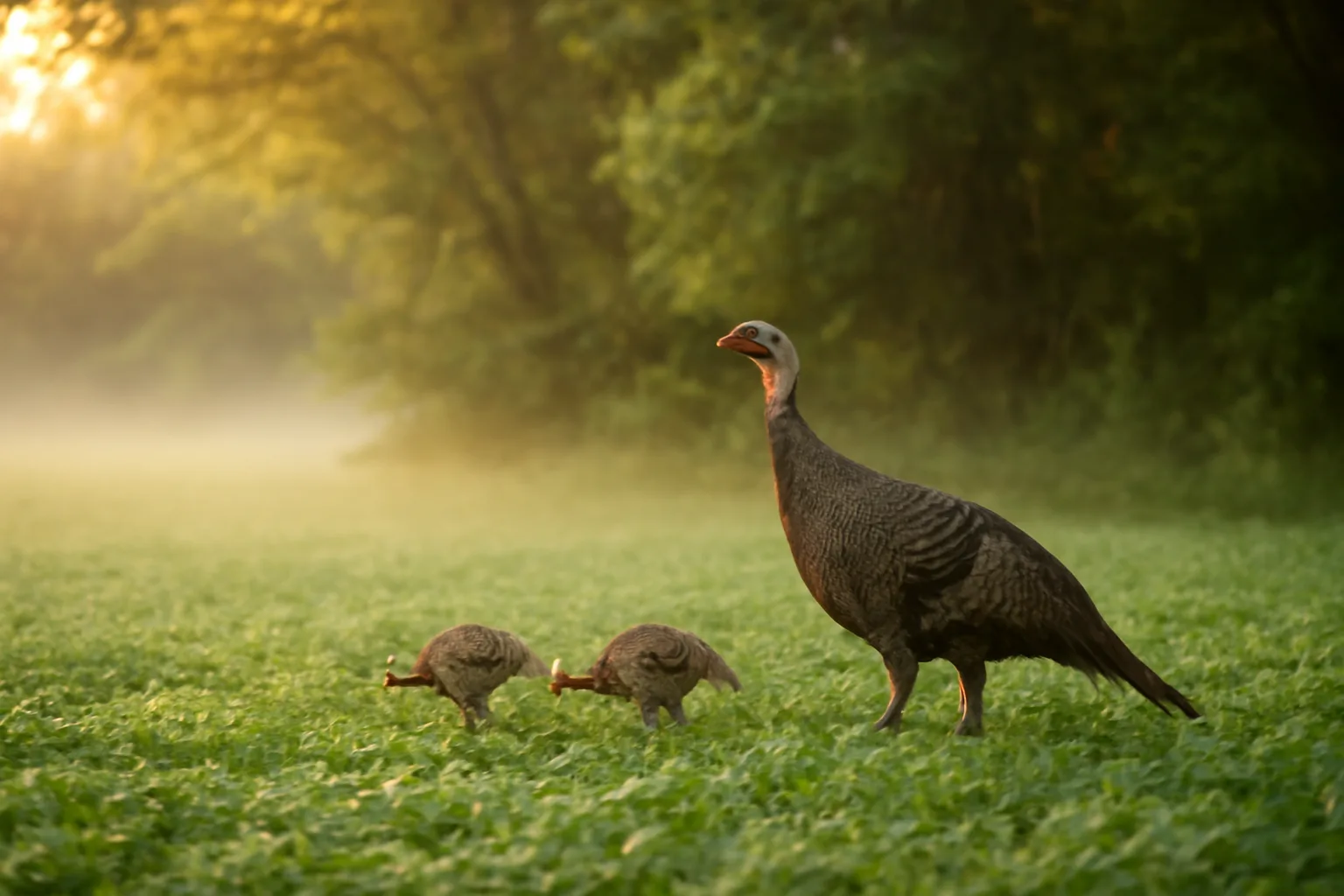
TL;DR
Plant turkey food plots in early spring (March to April in the South, April to May in the North), 2 to 4 weeks before your average last frost. Clover, chicory, and cereal grains work best because turkeys need bugs and greens up early, not fall grain. Fall brassica plots planted for deer also draw turkeys through winter.
When should you plant food plots for turkey?
Plant turkey plots in early spring, timed to your region's last frost date, not on the same fall calendar most people use for deer. That's the single biggest mistake people make: they treat turkey plots like deer plots and plant them in August or September, when what turkeys actually need is new green growth and bug activity starting in March and April. Turkeys don't eat the same way deer do. Hens need protein-rich food right before and during nesting season, which typically runs from March through May depending on latitude [1]. Poults need bugs, not grain, for the first several weeks of life. A clover or chicory plot that greens up in early spring gives hens a place to feed close to nesting cover, and it draws the insects poults live on for their first six to eight weeks. In the Deep South (Alabama, Georgia, Florida, southern Texas), that means plots should be established by mid-March. In the transition zone (Tennessee, Kentucky, Virginia, Missouri), aim for late March through mid-April. In the North (Wisconsin, Michigan, Minnesota, New York), you're usually looking at late April into May once soil temps climb and frost risk drops. The National Wild Turkey Federation notes that spring green-up timing and nesting season line up closely across most of the turkey's range, which is why plot readiness matters so much in that window [2]. If you're already planning a food plot whitetail rotation, the turkey plot is really just an earlier, smaller version of the same work: soil test, lime and fertilize per that test, then drill or broadcast into a clean seedbed.
When to plant food plots for deer (and how that overlaps with turkey)
Deer food plots split into two windows: spring/summer plots (May through July) for warm-season forage like soybeans and clover, and fall plots (August through October) for brassicas, cereal grains, and clover blends timed to hunting season [3]. Turkey needs mostly overlap with the spring deer window, not the fall one. A spring clover plot planted for deer in April or May does double duty. It's browsed by deer through summer and it's exactly the kind of low, protein-rich growth turkeys want during nesting and brood-rearing. If you only have time or acreage for one plot rotation, a perennial clover field planted in early spring covers both species better than almost anything else you could plant. Fall plots planted for deer (brassicas, cereal grains, winter peas) mostly miss the primary turkey window, but they're not wasted on turkey. Flocks will work fall grain plots hard once the leaves drop and other food gets scarce, especially cereal grains like oats and wheat that stay green into early winter. So the honest answer is: plant for deer on the deer calendar, but if you want a plot that's turkey-first, plant it in spring.
What is a food plot, exactly?
A food plot is a planted area, usually somewhere between a quarter acre and several acres, established specifically to provide forage for wildlife rather than for row-crop harvest or grazing livestock. On hunting ground, food plots serve two purposes at once: they feed deer and turkey through lean periods, and they concentrate animal activity somewhere you can hunt or observe. Most extension guidance treats food plots as a wildlife management tool, not a farming operation, which changes how you think about inputs. You're not maximizing yield per acre for sale. You're matching a planting to a soil test, a season, and a species' actual nutritional need. Cooperative extension services generally recommend starting with a soil test before any seed goes in the ground, because lime and fertilizer decisions built on guesswork waste money and often fail outright on acidic soil [4]. A good plot plan accounts for sunlight (4+ hours minimum for most forages), drainage, soil pH, and what's already growing nearby. If you want a plan built around your specific dirt and goals rather than generic advice, that's the whole point of a $99 custom plot plan like the one PlotSeason builds through the /plot-plan-builder, using your soil test results and property details instead of guessing.
When to plant oats for deer and turkey
Plant oats in late summer to early fall for deer (typically August to September, 60 to 90 days before your first hard frost) or in early spring for a turkey-focused plot. Oats are one of the most flexible cool-season grains you can plant, and they work on both ends of the calendar depending on what you're after. Fall-planted oats germinate fast, tolerate light frost, and stay palatable and green well into November in most of the whitetail's range, which is why they're a staple in fall food plot seed blends [3]. Spring-planted oats (March to April in the South, April to May farther north) green up quickly and draw turkeys for the same reason clover does: tender new growth and the bug life that comes with it. One caution: oats alone don't persist. They're an annual, they die back with hard freezes, and they don't reseed reliably. If you want oats to carry a plot through multiple seasons, pair them with a perennial clover as a nurse crop, which is common practice in extension-recommended fall blends.
When to plant turnips for deer (and do turkeys eat them?)
Plant turnips in late July through August, 90 to 100 days before your average first frost, since brassicas need a long growing season and a hard freeze to become palatable. Turnips are a fall and winter deer food, not a spring or summer plot, and turkeys generally aren't drawn to the bulb or the raw leaf the way deer are. Brassicas like turnips, radishes, and rape build sugar content after a frost converts starches, which is why deer often ignore a turnip plot in September and hammer it in December [3]. That timing lines up with hunting season in most states, which is exactly why turnip and brassica blends are so popular in fall deer food plot seed mixes. Turkeys will scratch through a frost-killed turnip plot looking for exposed soil insects and grain if it's mixed with oats or wheat, but the turnip itself isn't turkey forage in any meaningful way. If turkey is your primary target species, skip a pure turnip plot and put that acreage into spring clover instead.
Do turkeys eat clover, and is it their favorite food plot option?
| White/red clover | High (leaves + insects) | High | Early spring |
|---|---|---|---|
| Chicory | High (insects, greens) | High | Early spring |
| Oats | Moderate (spring growth) | High | Spring or late summer |
| Turnips/brassicas | Low | High (post-frost) | Late July to August |
| Sorghum | Low to moderate (seed heads) | Moderate | Late spring |
| Soybeans | Low | High | Late spring |
Yes, turkeys eat clover heavily, and it's one of the best food plot choices you can plant for them. Clover (white clover, red clover, and ladino varieties are all commonly used) provides tender, protein-rich leaves that hens and poults feed on directly, and it draws the insects poults depend on during their first weeks of life. State wildlife agencies that publish wild turkey habitat guidance consistently list clover and other legumes among the top recommended plantings for brood-rearing habitat, both for the direct forage value and for the insect activity clover stands attract [5]. A thick, low clover stand also gives hens visibility to watch for predators while poults feed, which matters as much as the nutrition itself. The catch with clover is establishment. It's slow to get going and it competes poorly with weeds in the first year, so a clean seedbed and a soil pH near 6.0 to 6.5 matter a lot [4]. If your soil test comes back low on pH, get lime down months ahead of planting, since lime takes time to move through the soil profile and correct acidity. | Species | Turkey value | Deer value | Best planting window |
Do deer eat clover, and how does it compare to other plot options?
Deer eat clover eagerly, and in most regions it ranks among the top three most consistently browsed food plot species, alongside soybeans and brassicas. Clover's advantage over annuals is that a well-maintained stand can produce for three to five years, which spreads your seed and establishment cost over multiple seasons instead of replanting every year. University extension forage guidance rates clover highly for both crude protein content and digestibility, which is why it shows up in nearly every regional food plot recommendation list, for deer and turkey both [4]. The tradeoff is that clover needs decent soil fertility and won't tolerate deep shade or standing water, so site selection matters more than with a tougher annual like sorghum. If you're building a rotation across a property, clover works well as the perennial anchor plot, with annual brassicas or grains rotated in nearby fields for fall hunting season. That's a pattern extension foresters and wildlife biologists recommend often: perennial legume plus annual grain or brassica gives you spring and fall coverage without replanting everything every year [3].
Do deer eat sorghum, and does it help turkey plots too?
Yes, deer eat sorghum, mostly the seed heads once they mature in late summer and fall, and turkeys will work a sorghum field for the same grain once it drops or is knocked down by weather. Sorghum isn't a top-tier deer food plot species on its own, but it has real value as a screening crop and a late-season grain source. Grain sorghum is planted in late spring after soil temperatures warm past roughly 60 degrees Fahrenheit, similar timing to corn, and it matures over the summer into a standing grain crop that holds seed heads into fall and winter [3]. Deer will browse young sorghum shoots some, but the real draw comes later when the heads fill out and eventually drop grain, which is also when turkeys start working the same ground. Sorghum's other job on a hunting property is visual cover. A standing sorghum strip blocks sightlines into a plot or travel corridor, which a lot of plot planners use deliberately alongside a food-focused planting, not as a replacement for one.
What are deer's favorite foods, and does that matter for turkey plots?
Deer preference shifts by season, but soybeans, clover, and acorns consistently rank as top choices across most of the whitetail's range, with brassicas and cereal grains taking over in late fall and winter. None of that list directly overlaps with what turkeys need most (insects and tender greens during nesting season), which is exactly why a turkey-first plot has to be planned separately from a deer-first plot. Agricultural soybeans and forage soybean blends are heavily preferred by deer during the growing season because of high protein content, and acorns from oak species remain one of the most important natural fall foods across whitetail range according to long-running forestry and wildlife research [6]. None of these are meaningful turkey foods in the way clover or chicory are. The practical takeaway: if your property already has a deer-focused plot rotation using deer food plot seed blends heavy on soybeans and brassicas, that rotation is doing almost nothing extra for turkey. Add a dedicated spring clover or chicory plot near nesting cover if turkey is part of your management goal, rather than assuming your deer plots are covering both species.
Do deer like honey, and is honey ever used in food plots?
No, honey has no real role in food plots, and it isn't something deer seek out or that plot managers use as an attractant or additive. There's no cooperative extension guidance or wildlife agency material recommending honey for deer or turkey plots, because it isn't a forage crop or a supplement with any established wildlife management use. What people sometimes mean by this question is whether sweet scents or mineral/attractant products marketed with honey or molasses in them draw deer. Some do use molasses as a binder or flavor carrier in mineral licks, but that's a different product category from a planted food plot, and state baiting and feeding regulations often restrict or ban that kind of supplemental feeding entirely depending on where you hunt [7]. Check your state wildlife agency's current baiting and feeding rules before using any attractant product, since they vary widely and change year to year.
How does turkey plot timing differ by region?
| Deep South | AL, GA, FL, southern TX | Mid-February to mid-March | Mid-March to April | |
|---|---|---|---|---|
| Transition zone | TN, KY, VA, MO, AR | Mid-March to mid-April | April to May | |
| Upper Midwest/Northeast | WI, MI, MN, NY, PA | Late April to late May | May to June | These windows come from typical last-frost dates and general nesting chronology reported by state wildlife agencies and NWTF regional guidance, and they'll shift by a couple of weeks in any given year depending on spring weather [1] [2]. If you're not sure which window applies, your state wildlife agency's turkey management page usually publishes local nesting season dates, and that's a better anchor than a generic national calendar. |
Turkey plot timing tracks your region's average last frost date and local nesting season, which means the same species planted in the Deep South in March gets planted in the upper Midwest in May, roughly six to eight weeks later. There's no single national planting date, and using a fall-plot calendar for a spring turkey plot is the most common timing mistake. | Region | Example states | Turkey plot window | Nesting season |
What should go into a turkey-focused food plot plan?
A turkey-focused plot plan starts with a soil test, picks a perennial clover or chicory base, times planting to your regional last frost date, and places the plot within a few hundred yards of nesting cover like brushy field edges or young timber. That combination covers hen nutrition, poult insect forage, and predator visibility all at once. Soil pH is the first thing to fix. Clover and chicory both want a pH in the 6.0 to 6.5 range, and cooperative extension guidance is consistent that lime applications take months to fully adjust soil chemistry, so testing in fall for a spring planting gives lime time to work [4]. Skipping the soil test is the single most common reason clover plots fail to establish in year one. Size and shape matter too. A long, narrow plot along a field edge gives hens more edge habitat and better sightlines than a square block of the same acreage. If you're weighing a dedicated turkey plot against just extending an existing deer food plots rotation, remember the species have different core needs, spring greens and insects for turkey versus fall carbs and protein for deer, and a plan built around only one species will underperform for the other.
Is a $99 custom plot plan worth it for turkey ground?
A custom plot plan is worth it if you want species and seed choices matched to your actual soil test and property layout instead of a generic regional recommendation. PlotSeason's $99 one-time Custom Food Plot Plan takes your soil test results and property details and builds a planting plan around them, which matters more for a mixed-species goal like deer and turkey than it does for a single simple deer plot. That said, your soil test lab is still the authority on exact lime and fertilizer rates for your dirt. Any plot plan, ours or anyone else's, is general management guidance built from your test numbers, not a substitute for a site visit or a guarantee of turkey or deer activity. Use it to decide what to plant and roughly when, then follow your lab's specific amendment recommendations to the pound. If you're ready to move from research to an actual planting plan, start at the plot plan builder and have your most recent soil test on hand.
Frequently asked questions
Do deer eat sorghum?
Yes. Deer eat sorghum mainly for the seed heads once they mature in late summer and fall, though browsing on young shoots happens too. It's not a top preferred forage compared to soybeans or clover, but it holds grain into winter and doubles as visual screening cover on a plot edge.
Do deer eat clover?
Yes, clover is one of the most consistently preferred deer forages across most regions, ranking alongside soybeans and brassicas. It offers high protein and digestibility and, when maintained well, a single stand can keep producing for three to five years before needing to be replanted.
When should I plant deer food plots?
Spring plots (soybeans, clover) go in May through July; fall plots (brassicas, cereal grains) go in August through October, timed 60 to 100 days before your first hard frost depending on species. Exact dates shift by region, so check your local cooperative extension planting calendar.
Do deer like clover?
Yes, strongly. Clover ranks among deer's top preferred food plot forages nationally, valued for its protein content and long growing season. It's also one of the best turkey foods, making it one of the few species that genuinely serves both animals from the same planting.
When should I plant oats for deer?
Plant oats in late summer to early fall, roughly 60 to 90 days before your first hard frost, for a fall deer plot. For a spring turkey-focused planting, oats go in during the same early-spring window as clover, timed to your region's last frost date.
When should I plant food plots for turkey specifically?
Early spring, roughly 2 to 4 weeks before your area's last frost date. That's mid-February to mid-March in the Deep South, mid-March to mid-April in the transition zone, and late April into May in the upper Midwest and Northeast, matching nesting season timing.
When should I plant turnips for deer?
Plant turnips in late July through August, about 90 to 100 days before your first expected frost. Brassicas like turnips need a long growing season and a frost event to sweeten up, which is why they're a fall and winter deer food, not a spring planting.
What is a food plot?
A food plot is a planted area, typically a quarter acre to several acres, established to provide wildlife forage rather than a crop for harvest or sale. On hunting land it feeds deer and turkey through lean seasons and concentrates activity somewhere you can observe or hunt.
What are deer's favorite foods?
Soybeans, clover, and acorns are consistently among deer's top preferred foods across most of the whitetail's range, with brassicas and cereal grains becoming more important in late fall and winter once other food sources decline.
Do deer like honey?
No. Honey isn't a forage crop or an established wildlife attractant, and no cooperative extension or wildlife agency guidance recommends it for deer or turkey plots. Some mineral or attractant products use molasses as a carrier, but that's a different category, and feeding rules vary by state.
Can one food plot serve both deer and turkey?
A perennial clover or clover-chicory plot planted in early spring comes closest, since deer browse it through the growing season and turkeys use it for nesting-season greens and insects. Fall brassica or grain plots planted for deer are secondary turkey food at best, mainly after frost.
How close should a turkey plot be to nesting cover?
Within a few hundred yards of brushy field edges, young timber, or other low cover where hens actually nest. Plots placed far from cover get less use during brood-rearing, since hens keep poults close to escape cover while they feed in early weeks.
Sources
- National Wild Turkey Federation, Wild Turkey Nesting and Brood Rearing: Turkey nesting season timing and hen/poult food needs in spring
- National Wild Turkey Federation, Habitat Management Guide: Spring green-up timing lines up with nesting season across turkey range
- Mississippi State University Extension, Establishing Wildlife Food Plots: Spring versus fall food plot planting windows and species timing
- University of Tennessee Extension, Soil Testing for Wildlife Food Plots: Soil test and pH recommendations before planting clover or other forages
- Pennsylvania Game Commission, Wild Turkey Management: Clover and legume plantings recommended for turkey brood-rearing habitat
- USDA Forest Service, Oak Regeneration and Wildlife Value: Acorns are a major seasonal food source for whitetail deer
- Pennsylvania Game Commission, Feeding Wildlife Regulations: State rules on baiting and supplemental feeding vary and should be checked before use