Last updated 2026-07-26
TL;DR
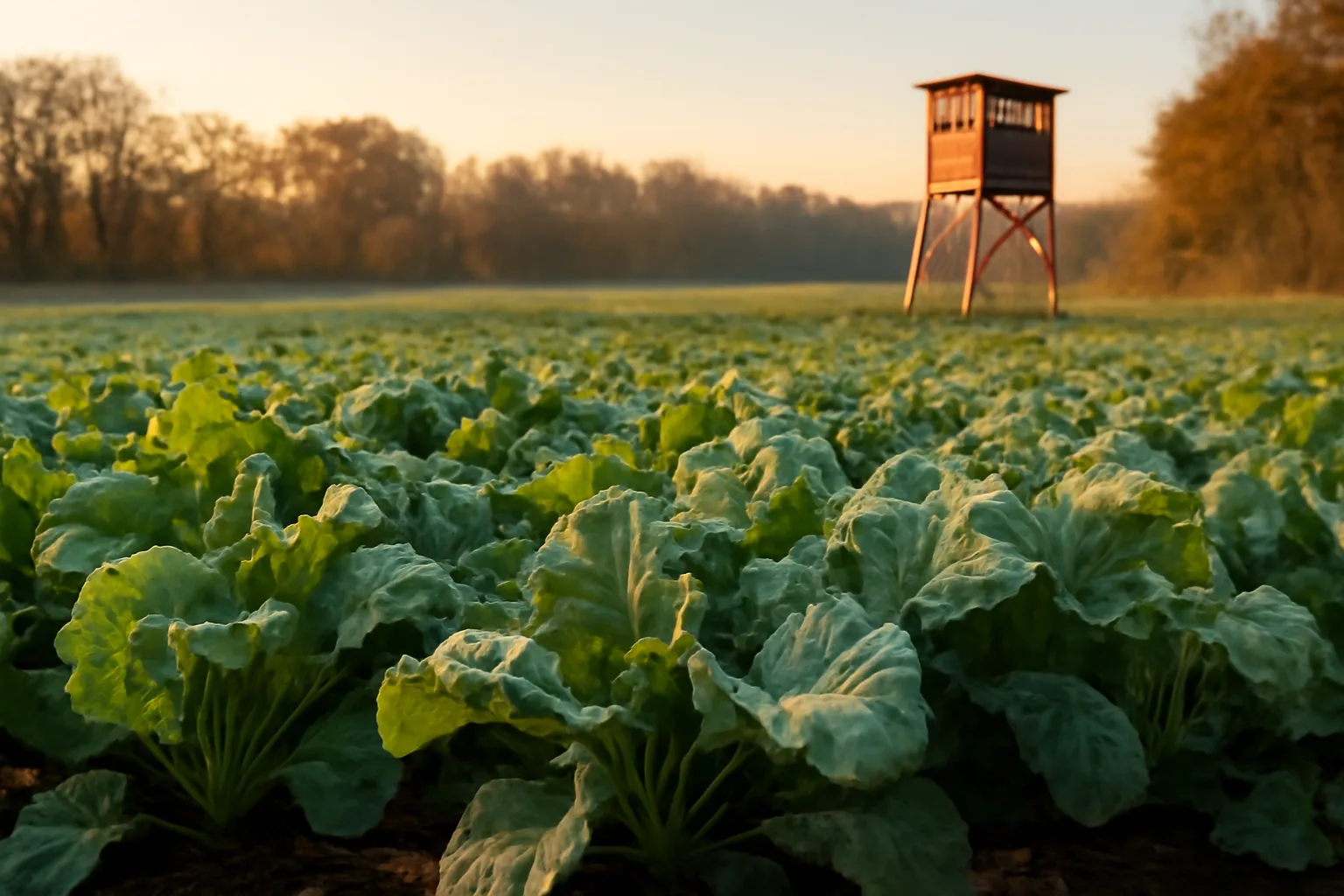
Plant brassica food plots 60 to 90 days before your area's average first fall frost, so plants mature into cold weather when sugars spike and deer switch to them hard. That's roughly mid-May to early June in the far North, June through early July in the mid-South, and July into early August across the Deep South and Southeast.
When should you plant brassicas for deer food plots?
The short answer: count backward 60 to 90 days from your local average first fall frost date, then plant. Brassicas like turnips, radishes, and rape need that window to bulk up leaves and roots before cold weather hits, and cold weather is exactly what makes deer start eating them hard. Plant too early and the plot bolts, gets woody, or gets grazed down before the good part even starts. Plant too late and you get a thin stand of stunted plants that never bulbs up. Most land-grant extension guidance for forage brassicas (used in livestock grazing systems, which is where most of the agronomy data comes from) recommends seeding 60 to 90 days ahead of a killing frost, depending on the species and variety. Turnips and radishes are on the faster end, often mature enough to graze in 60 to 80 days. Rape and kale can take closer to 90 days for full leaf development. Here's the trick that catches a lot of first-time plotters: deer often ignore brassicas for the first month or two after they come up. The plants are bitter and starchy early on. Then a hard frost converts starches to sugars, the leaves and bulbs turn sweet, and deer that walked past the plot in October are camped on it in December. If you plant late hoping for a quick fall bite, you'll likely miss that sugar conversion window entirely. For a full breakdown of species pairing and how brassicas fit alongside cereal grains and legumes in a rotation, see food plot whitetail.
What is a food plot, exactly?
A food plot is a planted plot of forage, usually annual grains, legumes, or brassicas, established specifically to feed deer or other wildlife and to give hunters a place to watch and hunt over. It's not a garden. It's not pasture in the farming sense either, though the agronomy overlaps heavily with both. State wildlife agencies generally treat food plots as a legal form of habitat management, separate from baiting, as long as the crop is planted and left standing rather than piled or spread loose. Rules on baiting versus food plots vary by state, so check your state wildlife agency's current regulations before hunting near any planted or supplemental feed source. Some states have specific distance or visibility requirements near plots during firearms season. Functionally, plots fall into a few buckets: annual cool-season food plots (brassicas, cereal grains, clover mixes seeded in fall), warm-season plots (soybeans, cowpeas, sunflowers planted spring through early summer), and perennial plots (clover, chicory, alfalfa that persist multiple years with mowing and fertility upkeep). Brassicas are almost always a cool-season, fall-focused planting. For a broader look at how plot types stack up, see deer food plots.
When to plant food plots for deer by zone (general calendar)
| Northern tier (MN, WI, MI, ND, northern NY) | Mid-to-late September | Mid-May to mid-June | |
|---|---|---|---|
| Upper Midwest / Northeast | Late September to early October | Late May to late June | |
| Mid-South / Mid-Atlantic (KY, VA, MO, southern OH) | Mid-to-late October | Mid-July to mid-August | |
| Deep South / Southeast (GA, AL, MS, FL panhandle) | Early-to-mid November | Late July to early September | These ranges come from long-term frost/freeze date averages compiled by NOAA's National Centers for Environmental Information for representative stations in each region [1]. Your actual county date can shift by two or three weeks depending on elevation and local microclimate, so check your specific county's average first frost before locking in a date. Warm-season plots (soybeans, cowpeas, sunflowers, sorghum) run on the opposite calendar, planted after your last spring frost, generally May through June across most of the whitetail range. Don't confuse the two windows. A lot of first-year plotters try to plant brassicas in May because that's when they're itching to get in the tractor, and end up with a bolted, bitter plot by August that deer walk past all fall. |
Zone matters more than calendar date. A grower in northern Minnesota and one in south Georgia are never planting the same crop on the same day, but they're both working off the same 60-to-90-day backward count from frost. | Region | Avg. first fall frost | Brassica planting window |
When to plant turnips for deer specifically
Turnips are one of the faster-maturing brassicas, generally ready to graze in 60 to 80 days depending on variety. That puts them at the early end of the brassica planting window for your zone; you don't need the full 90 days that kale or rape sometimes wants. Purple Top White Globe and Barkant are two common food-plot turnip varieties, both bred for root bulb size and leaf tonnage, since deer will eat the tops early and switch to rooting up bulbs later in winter once frost has sweetened them. Seeding rate for pure turnip stands runs 4 to 6 pounds per acre broadcast, drilled a bit lower, into a firm, weed-free seedbed at a quarter-inch to half-inch depth. Turnip seed is tiny; planting too deep is the single most common mistake. Many hunters blend turnips into a brassica mix with radishes and cereal grain rather than planting pure stands, since a mix spreads out palatability and root types and hedges against one component failing. If you're building a mix from scratch, a soil test first tells you whether your ground even needs the lime or phosphorus brassicas want; brassicas are heavy nitrogen and boron users and will show it fast if fertility's off.
When to plant oats for deer food plots
When to plant oats for deer
Oats go in on the same general calendar as brassicas, 60 to 90 days before frost, and are often drilled or broadcast right alongside a brassica blend since the two mature on a similar timeline and complement each other in the plot. Oats germinate fast, usually within 5 to 10 days in warm soil, and give deer an immediate green food source while the brassica bulbs and leaves are still building mass underground and up top. Oats also winterkill in most of the whitetail range once temperatures drop into the teens and lower, which is actually a feature, not a bug, for a lot of plotters. The oats provide October and November tonnage, then die back and let the brassica component take over as the December cold-weather draw. In the Deep South, oats can persist through a mild winter and keep producing into January. Seeding rate for oats in a food plot mix runs 2 to 3 bushels per acre (roughly 64 to 96 pounds) if planted alone, cut down to around 1 to 1.5 bushels per acre when blended with brassicas or clover so the oats don't shade out the slower-establishing companion species.
Do deer eat clover, and do deer like clover?
Yes, clover is one of the most consistently eaten forages in a whitetail's diet, and most food-plot research and extension literature treats it as close to a baseline forage against which other plantings get measured. White clover and red clover both show up repeatedly in state wildlife agency plot recommendations and university forage guides [2]. Clover's real advantage over brassicas is season length. A well-maintained perennial clover stand can provide forage from spring green-up through fall, whereas brassicas are a fall-and-winter specialist crop. That's why a lot of plot plans run clover as the backbone perennial plot and brassicas as a rotating fall annual in a separate field or a portion of a larger field. The tradeoff: clover needs mowing, needs decent soil pH (most clover species want pH in the 6.0 to 7.0 range) and takes a full growing season to really establish, while a brassica plot can be planted, grow, and get hunted over inside a single fall. If you're deciding between the two, or trying to figure out how they fit together in a rotation, see deer food plot seed for a breakdown by species.
Do deer eat sorghum, and how does it fit with brassicas?
Yes, deer eat sorghum, particularly the grain heads in fall and winter, though it's used more as a standing cover and winter grain crop than a primary forage plot in most whitetail programs. Grain sorghum and forage sorghum both get planted in food plot mixes, generally in the same spring warm-season window as corn and soybeans, not alongside brassicas. Sorghum's main food-plot role is providing standing grain and thermal cover into late winter after most annual plots have been grazed out. Some hunters plant a sorghum or corn strip next to a fall brassica plot specifically so there's a cover-and-food combo: deer feel comfortable feeding in the open brassica plot because there's a sorghum wall to duck into. It's a warm-season crop on a warm-season calendar, so don't try to fit it into your brassica planting window; that's a separate spring decision.
What are deer's favorite foods, and do brassicas make the list?
There's no single scientifically ranked "favorite food" list for whitetails, because preference shifts hard by season, region, and what's available. That said, several patterns show up consistently across deer diet studies and state agency forage guides: acorns and other hard mast rank extremely high in fall wherever oaks are present, soft mast and agricultural crops like soybeans and corn get heavy use when available, and clover and brassicas both show strong use in food-plot-specific research, brassicas especially after frost [2]. Brassicas are a genuine cold-weather favorite once sugars convert, not a fallback crop. Multiple state agency and university food-plot guides specifically recommend brassica blends for late-season hunting because deer preference for them measurably increases after frost, not despite it. If your goal is a December or January hunt over a plot, brassicas timed to peak right then are one of the stronger choices available. Worth saying plainly: no food plot, brassica or otherwise, guarantees deer activity or a harvest. Weather, local mast availability, hunting pressure, and deer density all move the needle more than any single planting decision. A brassica plot done right stacks the odds in your favor. It doesn't lock in an outcome.
Do deer like honey, and does it belong in a food plot?
No, honey has no real place in food plot planning and isn't a natural or legal supplemental deer attractant in most states. Deer aren't drawn to honey the way people sometimes assume from mineral-lick or attractant marketing; there's no research base showing honey as a meaningful deer food source, and pouring liquid attractants or feed products onto the ground crosses into baiting in states that regulate it. If you're trying to boost palatability or draw deer to a new plot faster, the better-supported approach is fixing soil fertility (a proper soil test and lime/fertilizer program does more for palatability than any additive) and picking a proven species mix. Deer eat what's nutritious and available, not what's sweet to a human nose. Check your state wildlife agency's baiting definition before adding anything to a plot beyond the seed and fertilizer itself, since some states define baiting broadly enough to include mineral and scent products used near a hunting site.
How do you build a planting calendar for your specific property?
Start with your county's average first fall frost date, not a generic regional guess. NOAA's climate normals tool lets you pull that number for a specific station near your land [1]. Count back 60 to 90 days depending on the brassica varieties in your mix, and that's your planting window. Next, pull a soil test. Brassicas are heavy feeders, particularly on nitrogen, phosphorus, and boron, and a $15 to $20 soil test from your state land-grant extension lab will tell you exactly what your specific dirt needs rather than guessing off a bag label. Your soil test lab's recommendation is the authority on lime and fertilizer rates for your ground; a general planting guide like this one can only give you typical ranges. If you'd rather not build the calendar and species mix yourself field by field, that's the exact gap a Custom Food Plot Plan is built to fill: a $99 one-time plan that takes your zone, soil test results, plot size, and equipment on hand, and turns it into a specific seed list, seeding rate, and planting date range for your ground, rather than a regional average. It's general guidance built from your inputs, not a site visit or a substitute for your soil lab's specific lime and fertilizer numbers. For picking the actual seed once your dates are set, food plot seed and domain food plot seed both break down variety selection by region.
What equipment do you need to plant brassicas on time?
Brassica seed is small and shallow-planted, which means equipment matters less than technique. A firm, fine seedbed beats a fancy drill. Many successful brassica plots get planted with nothing more than a disc, a hand broadcaster or ATV spreader, and a roller or light drag to press seed into contact with soil. If you're running a no-till drill, set seed depth shallow, a quarter inch is plenty for turnip and radish seed; going deeper than half an inch is a common cause of poor germination. Broadcasting works fine for brassicas specifically because the seed is small enough to make decent soil contact without deep incorporation, unlike larger-seeded crops like soybeans or corn that need real planting depth. Timing your equipment access matters as much as timing the seed. If your plot access depends on a wet spring drying out or a rented drill's availability, build slack into your 60-to-90-day window rather than planning to hit the exact last possible planting date. A week's delay because the tractor wasn't available can push a plot from "peaks in December" to "never really matures."
What happens if you plant brassicas too early or too late?
Plant too early, ahead of that 60-to-90-day window, and brassicas often bolt: they send up a seed stalk and flower rather than putting energy into leaf and root growth, especially if there's a stretch of hot, dry weather right after germination. Bolted brassicas get tough, fibrous, and far less attractive to deer, and some varieties can develop bitter compounds that reduce grazing even further. Plant too late and you get the opposite problem: cold weather shuts down growth before the plant ever reaches a useful size. A turnip planted 30 days before frost instead of 60 might produce a scraggly top with no real bulb at all. In northern zones, an early hard freeze can end growth abruptly, so plotters in short-season areas sometimes plant at the early edge of the window on purpose, accepting some early-season bolting risk in exchange for insurance against an early frost cutting the season short. The practical fix for uncertainty either way: split your plot. Plant half at the early edge of your window and half two to three weeks later. You'll rarely guess wrong on both halves in the same year, and you buy yourself a longer window of peak attractiveness across the fall instead of one narrow peak that might land before or after your hunting dates.
Frequently asked questions
Do deer eat sorghum?
Yes. Deer eat sorghum grain heads readily, especially in late fall and winter once other food sources thin out. Sorghum is planted in the spring warm-season window, not alongside fall brassicas, and works better as a standing grain and cover crop than as a primary food plot forage.
Do deer eat clover?
Yes, clover is one of the most reliably eaten food plot forages across the whitetail range, showing up consistently in state agency plot guides and university forage recommendations. White and red clover both perform well and provide forage from spring through fall, unlike brassicas which are mainly a fall and winter crop.
When should I plant deer food plots overall?
It depends on the crop type. Cool-season crops like brassicas, cereal grains, and clover go in 60 to 90 days before your first fall frost. Warm-season crops like soybeans, cowpeas, and sorghum go in spring, after your last frost date, typically May through June across most of the whitetail range.
Do deer like clover more than brassicas?
Preference shifts by season. Deer graze clover steadily spring through fall, while brassica preference spikes sharply after the first hard frost converts starches to sugars in the leaves and bulbs. Neither is universally preferred; they fill different windows, which is why many plotters run both.
When should I plant oats for deer?
Plant oats on the same 60-to-90-day-before-frost calendar as brassicas, often in the same blend. Oats germinate in 5 to 10 days and give deer early green forage while brassicas are still bulking up, then typically winterkill in hard cold, letting the brassica component take over late season.
When exactly should I plant food plots for deer?
Count back from your area's average first fall frost date for cool-season crops (60 to 90 days) or forward from your last spring frost for warm-season crops. There's no single national date; a Minnesota plotter and a Georgia plotter are often six to ten weeks apart on the calendar for the same crop.
When should I plant turnips for deer?
Turnips need roughly 60 to 80 days before your first fall frost to reach a useful size, on the faster end of the brassica family. In most of the whitetail range that lands somewhere between mid-June and early August, depending heavily on your specific zone and county frost date.
What is a food plot?
A food plot is a deliberately planted area of forage crops, grown to feed deer or other wildlife and give hunters a place to observe or hunt. It's distinct from baiting in most states as long as the crop is planted and left standing, though specific rules vary by state wildlife agency.
What are deer's favorite foods?
There's no fixed ranked list since preference shifts by season and region, but acorns and hard mast rank very high in fall where available, soybeans and corn get heavy use, and brassicas and clover both show strong use in food-plot-specific research, with brassica preference spiking hard after frost.
Do deer like honey?
No, there's no meaningful research showing deer are drawn to honey, and it has no real role in food plot planning. Liquid attractants and feed poured on the ground can also cross into baiting rules in states that regulate it, so it's worth avoiding for both practical and legal reasons.
How late is too late to plant a brassica food plot?
If you're inside 45 days of your average first fall frost, most brassica varieties won't have time to develop useful leaf or root mass before growth shuts down. At that point a fast cereal grain like winter wheat or rye is a better bet than brassicas for that season.
Can you plant brassicas and clover in the same plot?
Yes, though they're usually managed as separate plantings rather than one mix, since clover is a multi-year perennial and brassicas are annuals replanted yearly. Some plotters do interseed brassicas into a thinning clover stand in late summer to extend fall tonnage without tearing up the clover base.
Sources
- NOAA National Centers for Environmental Information, U.S. Climate Normals: Average first fall frost dates vary by region and are available by station/county
- University of Kentucky Cooperative Extension, AGR-18, "A Comprehensive Guide to Wheat Management in Kentucky": Seeding rates and establishment timing guidance for small grains used as forage
- Mississippi State University Extension Publication 2111, "Food Plots for White-tailed Deer": Clover and brassica species are commonly recommended and heavily used forages in whitetail food plot programs
- USDA Natural Resources Conservation Service, "Cover Crop Termination Guidelines" (Plant Materials Technical Note): Brassica species used as cover and forage crops, including days to maturity and seeding depth guidance
- North Dakota State University Extension: Recommended planting dates and conditions for turnips and other brassica species
- University of Arkansas Cooperative Extension: Recommended oat planting dates and rates for wildlife food plots
- Missouri Department of Conservation: Regional planting calendar guidance for deer food plots by zone