Last updated 2026-07-26
TL;DR
There's no single date. Fall food plots (brassicas, cereal grains, clover) go in roughly late July through mid-September, timed to soil temps below 85°F and 60-90 days before your first hard frost. Spring plots (clover, soybeans, warm annuals) go in April through May after your last frost. Your zone and species matter more than any calendar date.
When should you plant a deer food plot?
The honest answer is: it depends on what you're planting and where you live, but most of the country splits into two windows. Fall plots (brassicas, cereal grains, clover, chicory) go in the ground from late July through mid-September, timed so the plants mature right as deer need extra nutrition heading into winter. Spring and summer plots (soybeans, clover, cowpeas, warm-season annuals) go in from April through early June, after your last frost date. The real trigger isn't the calendar, it's soil temperature and days-to-frost. Brassicas like turnips and radishes want 60 to 90 days before your first hard frost to bulb up and sweeten. Cereal grains like oats and winter wheat germinate best when soil temps are between 50 and 85°F [1]. Clover, whether frost-seeded or drilled, wants soil temps in the mid-50s and consistent moisture to get established. Most state wildlife agencies and university extensions publish planting windows by region rather than a single date, because a food plot in Alabama and a food plot in Minnesota are on completely different clocks. Penn State Extension, for example, recommends late July through August for brassica and cereal grain plots in the Northeast, giving them time to establish before frost slows growth. If you're building a full-season plan, our food plot whitetail guide breaks down species pairing by season.
What is a food plot, exactly?
A food plot is a planted area, usually a fraction of an acre to several acres, established specifically to grow forage that deer and other wildlife will eat. It's not a garden and it's not a lawn. It's agriculture done at a small scale for one customer: whitetails. Food plots serve two different jobs depending on how you design them. Some are attraction plots, meant to draw deer into bow range during hunting season, usually small (a quarter acre to half acre) and tucked near thick cover. Others are nutrition plots, meant to add pounds and antler growth across the herd over months, and those tend to be bigger, a half acre to several acres, planted with high-tonnage forage like soybeans or clover. Most land managers run both types. A property might have two or three small hunting plots near stand sites and one or two larger nutrition plots farther back, less disturbed by human pressure. If you're deciding what goes where, deer food plots covers the layout side of that decision in more detail.
When should you plant food plots for deer by region?
| Deep South (zones 8-9) | Sept 15 - Nov 1 | March - April | |
|---|---|---|---|
| Mid-South / Transition (zones 7) | Sept 1 - Oct 1 | March 15 - May 1 | |
| Midwest / Mid-Atlantic (zones 5-6) | Aug 1 - Sept 15 | April 15 - June 1 | |
| Upper Midwest / Northeast (zones 3-4) | July 15 - Aug 30 | May 1 - June 15 | The pattern is simple: the farther north you are, the earlier you plant fall plots (because you need more growing days before frost shuts things down) and the later you plant spring plots (because your last frost comes later). The USDA Plant Hardiness Zone Map is the standard reference most extension offices use to set these windows. One planning trick that works well: count backward from your average first hard frost date. For brassicas, subtract 90 days. For winter wheat or cereal rye, subtract 60 days. For clover, you actually want to plant it either in early spring or 6-8 weeks before frost in fall, since it needs time to establish a root system before winter dormancy. |
Here's a rough breakdown by USDA plant hardiness zone equivalent region. These are starting windows, not hard rules; always check your local frost dates through your state extension office or NOAA's climate data before locking in a date. | Region | Fall plot window | Spring plot window |
When should you plant oats for deer?
Oats go in the ground in late summer for fall attraction, typically late July through early September depending on zone, and in early spring (March through April) if you want a spring/summer grazing plot. Oats germinate fast, often within 5-10 days at soil temps of 60-85°F [1], which makes them a favorite for hunters who want green growth on the ground quickly. Oats are a cool-season annual, meaning they grow best in moderate temperatures and die off completely with hard freezes below roughly 20°F. That's actually a selling point for fall plots: oats put out tender, high-protein forage in September and October when deer are hammering anything green, then fade out as winter sets in. In the Deep South, some hunters plant oats in fall and again in late winter for a second flush. One caveat worth knowing: oats alone don't hold up long term. Most experienced plot managers blend oats with brassicas or a cereal grain like winter wheat or rye, so there's still standing forage after the oats get grazed down or killed by frost.
When should you plant turnips for deer?
Turnips need to go in 80 to 90 days before your first expected hard frost, which for most of the whitetail range lands somewhere between late July and mid-August. Plant too late and the bulbs never size up; plant too early in hot weather and you risk poor germination or early bolting. Turnips are a brassica, and brassicas actually improve with a frost or two. The cold triggers a starch-to-sugar conversion in the leaves and bulbs, which is why deer often ignore a turnip plot in October and then hit it hard in December [2]. That's a timing trap for hunters who plant turnips expecting immediate action; the plot may look untouched for months before it becomes the most attractive food source on the property once it sweetens up. Soil prep matters as much as timing here. Turnips want a fine, firm seedbed and a soil pH close to 6.0-6.5. If your soil test comes back low on pH, get lime down early, since it takes months to fully adjust soil chemistry. For seed selection and blend options, deer food plot seed has a rundown of brassica varieties and how they compare.
Do deer eat clover, and when should you plant it?
Yes, deer eat clover heavily, and it's one of the most consistently preferred forages in food plot research. Clover is a perennial or biennial legume that regrows after grazing, which is exactly why it shows up on almost every serious food plot list. Clover goes in the ground at two points: early spring (as soon as soil is workable, often frost-seeded onto still-frozen ground in February or March in northern climates) or late summer (mid-August through mid-September) so it establishes before winter dormancy. Frost-seeding, where clover seed is broadcast onto freeze-thaw ground and the freeze/thaw cycle works it into the soil, is a genuinely low-cost, low-equipment way to get clover established without drilling. Do deer like clover more than other forages? University research backs it up. A widely cited whitetail forage preference study from the University of Georgia and other land-grant researchers consistently ranks clover among the top preferred food plot species, alongside soybeans [3]. It's also one of the most nutrient-dense options: quality clover stands run 20-30% crude protein during peak growth, which rivals or beats most other plot forage. The tradeoff is clover needs decent soil fertility and periodic mowing or spraying to keep grass and weeds from choking it out.
Do deer eat sorghum?
Deer eat sorghum, but it's not a top preference forage the way clover or soybeans are. Sorghum (including grain sorghum and forage sorghum types) is more valuable as a screening and bedding cover crop, or as a late-season grain source once the seed heads mature and drop, than as a primary attraction plot. Deer will browse young sorghum shoots, and they'll clean up dropped grain in fall and winter, but sorghum doesn't get hammered the way a fresh soybean field does in August. Where sorghum earns its place on a property is height and density: it can grow 5 to 8 feet tall, making it useful for blocking sightlines into a plot or creating standing cover that holds deer through hunting season. If you're choosing between sorghum and other summer annuals for a nutrition plot, soybeans, cowpeas, or a lablab blend will generally out-produce sorghum in terms of what deer actually consume pound for pound. Sorghum is a supporting player, not the headliner.
What are deer's favorite foods?
Deer preference shifts by season and region, but the forages that show up again and again at the top of preference studies are soybeans, clover, and acorns (particularly white oak acorns, which are lower in tannins and more palatable than red oak acorns). In agricultural areas, standing corn and soybean fields often outcompete any food plot a hunter could plant, simply on volume. Within food plot species specifically, soybeans and clover tend to rank highest for warm-season preference, while brassicas (turnips, radishes, kale) and cereal grains (oats, wheat, rye) rank highest for cool-season and late-fall preference once frost sweetens them up. Natural browse, forbs, and soft mast (like apples and persimmons) round out a deer's diet across the year, and no single planted plot replaces the diversity of a good natural habitat. It's worth remembering that deer preference isn't static. A plot that gets ignored in October might become the most visited spot on the property in January once other food sources dry up. This is exactly why smart plot plans stack multiple species with staggered peak attractiveness rather than betting everything on one crop. That's the core idea behind a food plot seed blend versus a single-species planting.
Do deer like honey?
Deer aren't drawn to honey itself in any meaningful food plot sense, but they will occasionally investigate honey-based deer attractant products marketed as scent or taste lures. There's no university research establishing honey as a preferred whitetail forage or additive, and it's not a component of any standard food plot seed mix or agronomic recommendation from land-grant extension services. Some commercial mineral and attractant products include sweeteners like molasses (a much more common and studied additive than honey), which can increase visitation to mineral sites in states where supplemental feeding and mineral use is legal. If you're considering any attractant product, check your state wildlife agency's regulations first, since baiting and feeding rules vary widely and some states classify mineral licks and scented attractants under baiting statutes.
How does baiting and feeding law affect food plot timing and setup?
Food plots themselves are legal in every state, since they're agricultural plantings, not bait. But the line between a food plot and illegal baiting gets blurry with things like mineral sites, spin-feeders, or piled grain, and the rules differ significantly state to state. Some states, like Michigan, restrict baiting and feeding statewide or by county due to chronic wasting disease and bovine TB concerns, with specific distance and volume rules [4]. Other states allow baiting for hunting outright. A living food plot planted and grown in soil is treated differently under nearly every state's law than a pile of corn or a gravity feeder, but always confirm with your state wildlife agency before combining a plot with any supplemental feed, mineral, or attractant product, since a compliant food plot can become a violation the moment you add loose grain or minerals nearby in a restricted area.
How do you decide between a spring plot and a fall plot?
Spring plots build herd health and antler growth; fall plots concentrate deer activity for hunting season. Most managers with more than an acre or two to work with plant both, on a rotation. Spring plots (April-June depending on zone) typically use soybeans, cowpeas, lablab, or clover, aimed at high-protein forage during antler growth and lactation. These plots take more acreage to survive summer browsing pressure, since deer will hit young soybeans hard enough to wipe out a small planting before it ever gets tall. Fall plots (late July-September depending on zone) use brassicas, cereal grains, and clover, aimed at concentrating deer in bow and gun range and getting them through the nutritional stress of late fall and winter. These plots can be smaller since the goal is often attraction rather than acreage of tonnage. A lot of hunters start with just a fall plot in year one, see how it performs, and add a spring nutrition plot in year two once they've got a better read on soil fertility and deer pressure on the property.
What actually determines your planting date better than a calendar?
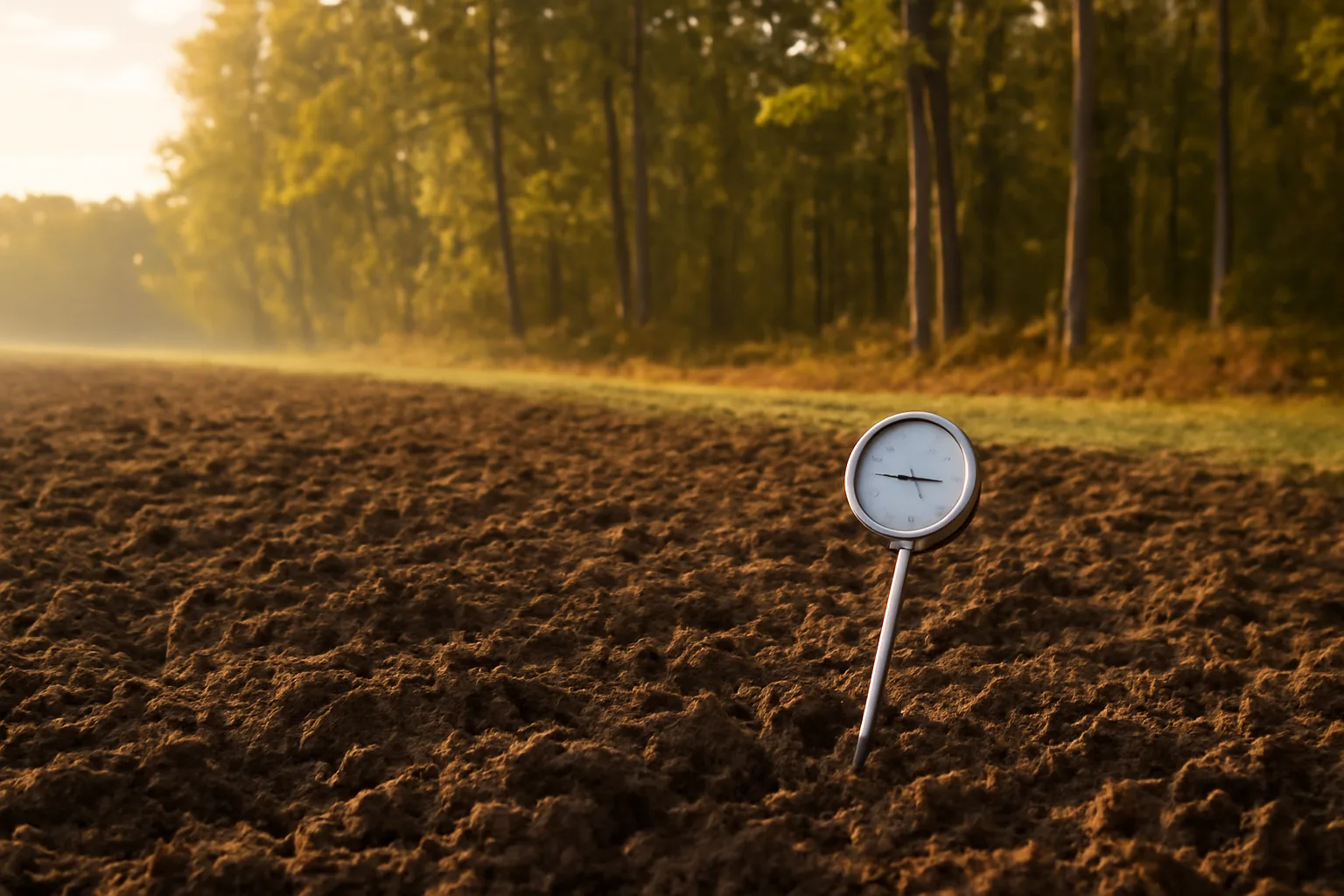
Three things matter more than any date on a calendar: your first and last frost dates, current soil temperature, and soil moisture. A planting calendar is a starting estimate; your actual conditions in a given year decide the real window. Frost dates vary year to year by a couple weeks even within the same zone, so check current-year outlooks through NOAA's Climate Prediction Center or your state extension's frost date tool rather than relying purely on historical averages. Soil temperature matters because seeds simply won't germinate reliably below their minimum threshold, no matter what the calendar says; a soil thermometer is a five-dollar tool that prevents a lot of wasted seed. Soil moisture is the wildcard most planting calendars can't account for. Planting cereal grains or brassicas into bone-dry August soil, even if the calendar says it's the right week, usually means poor germination and a thin stand. Many experienced plot managers watch the extended forecast and plant just ahead of a rain event rather than locking to a fixed date. This is also where a soil test earns its cost: knowing your baseline pH and fertility before you plant means you're not guessing at lime and fertilizer rates on top of guessing at timing. A soil test lab remains the real authority on your specific lime and fertilizer numbers; a planting calendar only handles timing. If you want species and rate guidance built around your zone and your test results, PlotSeason's $99 Custom Food Plot Plan turns that data into a one-time, written plan rather than a generic recommendation.
What equipment or prep changes your planting window?
No-till drilling lets you plant later into drier conditions than broadcasting into unworked ground, because the seed goes into contact with soil moisture below the dry surface crust. If you're broadcasting seed with a hand spreader or ATV spreader, you generally need to plant a bit earlier or right ahead of rain, since surface-broadcast seed dries out fast without irrigation. Disking and tilling before planting works well for brassicas and cereal grains that want a firm, fine seedbed, but tillage also releases soil moisture, which can work against you in a dry August. Some managers till two to three weeks ahead of planting to let the ground settle and catch a rain, rather than tilling and planting the same day. Equipment choice doesn't change the biological window (a turnip still needs its 80-90 frost-free days no matter how you plant it), but it does change your margin for error within that window. A drill can push a planting date a week or two later than a broadcast-and-drag method would allow in the same conditions.
Frequently asked questions
Do deer eat sorghum?
Yes, but sorghum ranks below clover and soybeans in preference studies. Deer browse young shoots and clean up dropped grain in fall and winter, but sorghum is more useful as tall screening cover or late-season grain than as a primary attraction crop.
Do deer eat clover?
Yes, clover is one of the most consistently preferred whitetail forages in university research, often ranking alongside soybeans at the top of preference studies. Quality clover stands run 20-30% crude protein during peak growth, making it valuable for both attraction and nutrition.
When to plant deer food plots?
Fall plots go in late July through mid-September depending on your zone; spring plots go in April through early June after your last frost. Timing depends more on frost dates and soil temperature than a fixed calendar date, so check your local extension office's frost data.
Do deer like clover?
Deer strongly prefer clover, and it consistently ranks among the top food plot forages in land-grant university preference research. It's also one of the most nutrient-dense options available, running 20-30% crude protein at peak growth, which supports both body condition and antler development.
When to plant oats for deer?
Plant oats late July through early September for fall attraction plots, or March through April for a spring/summer grazing plot, depending on your region. Oats germinate in 5-10 days at soil temps of 60-85°F and are usually blended with brassicas or cereal grains for longer-lasting forage.
When to plant food plots for deer?
There are two main windows: late July through mid-September for fall plots (brassicas, cereal grains, clover) and April through early June for spring plots (soybeans, clover, warm annuals). The exact date depends on your zone; northern growers plant fall plots earlier and spring plots later than southern growers.
When to plant turnips for deer?
Plant turnips 80-90 days before your first expected hard frost, typically late July through mid-August across most of the whitetail range. Turnips actually improve after a frost or two, since cold triggers a starch-to-sugar conversion, so don't expect heavy deer use until temperatures drop.
What is a food plot?
A food plot is a planted area established specifically to grow forage for deer and other wildlife, ranging from a quarter-acre hunting plot near a stand to several acres of nutrition-focused soybeans or clover. It's small-scale agriculture done for one customer: whitetails, either for attraction during hunting season or herd nutrition year-round.
What are deer's favorite foods?
Soybeans, clover, and white oak acorns consistently rank as top preferred whitetail foods in university studies. Among planted food plot species, soybeans and clover lead warm-season preference, while brassicas and cereal grains lead cool-season preference once frost sweetens them, typically in late fall and winter.
Do deer like honey?
There's no research supporting honey as a preferred whitetail food or effective food plot additive. Some commercial attractants use molasses, a more studied sweetener, but honey itself isn't part of any standard extension-recommended food plot mix. Always check state baiting rules before using any scented attractant product.
Can you plant a food plot too early?
Yes. Planting brassicas or cereal grains too early in hot, dry late-summer conditions can cause poor germination, early bolting, or seedling death before fall growth even starts. Waiting for soil temperatures to drop into a plant's ideal germination range usually beats rushing to hit an early calendar date.
How do I know my exact frost dates for planting?
Check your state cooperative extension office's frost date tables or NOAA's Climate Prediction Center for local historical averages, then confirm with the current year's extended forecast. Frost dates can shift by a couple weeks year to year even within the same USDA hardiness zone.
Is it legal to combine a food plot with mineral sites or bait?
It depends entirely on your state. Standing food plots are legal everywhere since they're agricultural plantings, but adding loose grain, mineral licks, or attractants near a plot can trigger baiting restrictions in states like Michigan that limit feeding due to disease concerns. Check your state wildlife agency's current regulations before combining the two.
Sources
- USDA NRCS Plant Fact Sheet, oats: oats germinate best in soil temperatures roughly between 50 and 85°F
- University of Tennessee Extension, brassicas for deer: brassica forage sweetens after frost due to starch-to-sugar conversion, increasing deer preference in late fall
- Michigan Department of Natural Resources, baiting and feeding regulations: Michigan restricts baiting and feeding of deer in specific zones with distance and volume rules due to disease concerns
- University of Georgia Extension: Recommended planting windows for clover and other cool-season forages for deer in the Southeast.
- Iowa Legislature: State baiting and feeding regulations that affect legal food plot practices and timing.