Last updated 2026-07-25
TL;DR
Fall food plot planting dates depend on your zone and species. Brassicas and turnips need 80 to 100 days before killing frost, so plant late July to mid-August up north, late August to September in the mid-South. Cereal grains and clover tolerate later planting, roughly mid-August through October, since they just need soil temps above 55°F and enough moisture to germinate.
When should you plant food plots for deer in the fall?
The honest answer is: count backward from your first killing frost, then pick a date based on what you're planting. Brassicas like turnips and radishes need the most lead time, generally 80 to 100 days before a hard frost, because they need to bulb up or build sugar reserves before cold weather hits. Cereal grains (oats, wheat, rye) and clover need far less lead time and actually do better planted a little later, when cooler soil temps cut down on weed competition and heat stress. Most of the whitetail range breaks into three rough planting windows: late July into early August for northern states (think Minnesota, Wisconsin, Michigan, Maine), mid-August through early September for the transition zone (Iowa, Ohio, Pennsylvania, Virginia), and September into October for the Deep South and lower Midwest (Texas, Alabama, Georgia, Arkansas). These aren't hard lines. Elevation, local frost records, and a wet or dry fall all push the window around by a couple weeks in either direction. Your state land-grant extension office publishes frost date tables for your county, and that's the single best free resource for dialing in a real date instead of guessing off a national map. The USDA also keeps county-level average frost data through its Regional Climate Centers.
What is a food plot, exactly?
A food plot is a planted patch of forage, usually somewhere between a quarter acre and several acres, established specifically to feed and attract deer or other wildlife. It's not a garden and it's not a lawn. Most plots run a rotation of annual grains, clovers, brassicas, or legumes chosen to hit a specific season and a specific nutritional need, like fall energy for the rut or spring protein for antler growth and lactation. Food plots got popular in the 1990s as private land management shifted from just hunting existing food sources (ag fields, mast, browse) to actively creating them. State wildlife agencies generally treat food plots as a habitat management practice, separate from baiting or supplemental feeding, though the legal line between the two varies a lot by state and matters for hunting over them. More on that below. If you want a plan built around your specific soil test results, latitude, and acreage instead of guessing off a generic calendar, that's exactly what a food plot whitetail plan is for. PlotSeason's $99 Custom Food Plot Plan takes your soil test numbers and property details and turns them into species picks and dates. It's general guidance built on your data, not a replacement for what your soil lab's report actually recommends for lime and fertilizer rates.
When do you plant turnips for deer?
Plant turnips for deer 80 to 90 days before your first expected hard frost. In northern zones that's late July to early August. In the transition zone it's mid-August. In the Deep South you can push it to early September and still get bulb development before deer start hammering the tops. Turnips need that long runway because the plant spends the first half of its life building leaf mass and the second half converting sugars into the root, and a real freeze (below 28°F) is actually what triggers the starch-to-sugar conversion that makes the bulbs palatable. Plant too late and you get a plot of small, bitter roots deer walk past. Purdue Extension's forage brassica guidance notes that brassicas planted after early September in the Midwest often don't reach useful maturity before a killing frost ends the growing season [1]. Turnips want a firm seedbed, light coverage (a quarter inch or less; they're small seeds), and a pH close to 6.0 to 6.5. Broadcasting into a prepared, weed-free seedbed with a cultipacker pass afterward beats no-till drilling for most small operations, since these seeds are tiny and germination drops fast if they're buried too deep.
When do you plant oats for deer food plots?
Plant oats 6 to 8 weeks before your first fall frost, which usually lands in late August through mid-September across most of the whitetail range, and as late as early October in the Deep South. Oats germinate fast (5 to 10 days in warm soil) and put on grazable growth within 3 to 4 weeks, so they don't need the long lead time brassicas do. Oats are also one of the most frost-tolerant cereal grains for fall grazing, staying green and palatable down into the low 20s before they finally die back, though a true winter-kill will end an oat plot in most northern states by December. That's actually a feature for hunters who want peak attraction during archery season and don't need the plot to survive into late winter. If you want a plot that holds up all winter, pair oats with winter wheat or cereal rye, which will outlast the oats and green back up in spring. Seeding rate for oats runs 2 to 3 bushels per acre (roughly 64 to 96 pounds) broadcast, per Extension forage program recommendations for cool-season annual grains in the Midwest [2]. Drill rates can run slightly lower since you get better seed-to-soil contact.
When is the best overall time to plant fall food plots by zone?
| Northern (MN, WI, MI, ME, upper NY) | July 15 to Aug 5 | Aug 1 to Aug 25 | Aug 1 to Sept 1 | |
|---|---|---|---|---|
| Transition (IA, IL, OH, PA, VA, MO) | Aug 1 to Aug 25 | Aug 15 to Sept 15 | Aug 15 to Sept 15 | |
| Southern (TX, AL, GA, AR, MS, LA) | Sept 1 to Sept 25 | Sept 15 to Oct 15 | Sept 15 to Oct 20 | These windows assume normal moisture. A dry August in the transition zone is one of the most common reasons plots fail; seed sits in dry dirt for two or three weeks, then a heavy rain brings up a stand of weeds first. If your forecast shows no rain for 10 days, it's usually smarter to wait than to plant into dust and hope. |
Here's a working table. Treat these as starting points, then adjust against your county's actual average first frost date, which you can pull from your state climate office or extension service. | Zone (states, roughly) | Brassicas / turnips | Cereal grains (oats, wheat, rye) | Clover (fall seeding) |
Do deer eat clover, and do they actually like it?
Yes. Clover is one of the most consistently used food plot forages across the whitetail's range, and deer readily eat both white clover (ladino, Durana, Dutch White types) and red clover. Multiple state wildlife agency food plot guides list clover as a top perennial choice specifically because of its high crude protein content, often 25 to 30% in vegetative growth, and because it regrows after grazing rather than getting wiped out in one visit like a lot of annuals. Clover's real advantage is duration. A well-maintained clover stand can produce for 3 to 5 years before it needs to be renovated or reseeded, giving you a plot that doesn't require replanting every single season the way brassicas or cereal grains do. Georgia DNR's wildlife management guidance recommends clover as a foundational perennial for year-round forage plots in the Southeast because it holds up through both a spring green-up period and, with overseeding, into fall [3]. Clover can be frost-seeded (broadcast onto frozen or freeze-thaw ground in late winter) or fall-seeded, generally 45 to 60 days before your first frost, so roots establish before winter dormancy. Fall seeding actually tends to produce a cleaner stand than spring seeding, since weed pressure is naturally lower in September than in April.
Do deer eat sorghum?
Yes, deer eat sorghum, both the grain heads and the leaves, though it's more commonly planted as a summer plot or a screening/bedding cover crop than a primary fall attractant. Grain sorghum produces heavy seed heads that deer, turkey, and other wildlife feed on into fall and winter once the plant dries down, and it's notably more drought-tolerant than corn, which makes it a common substitute in dry summer regions. Sorghum is planted in late spring through early summer (after soil hits 60°F), not as a fall planting, so if your goal is a fall attractant planted in August or September, sorghum isn't your tool. It works better as a summer plot that then carries seed heads into the early fall hunting season, or as standing cover mixed into a fall plot border. Some hunters also use grain sorghum as a substitute where standing corn isn't practical because of equipment or acreage limits. It's cheaper per acre and matures faster than corn in most varieties.
What are deer's favorite foods, and does that change in fall?
There's no single official ranked list, and any hunter who tells you deer have one universal favorite food is oversimplifying. What research and Extension data consistently show is that deer preference shifts by season, driven by nutritional need and what's actually available. In spring and summer, deer key in on high-protein forage: clover, soybeans, alfalfa, and natural browse, because does are lactating and bucks are growing antlers. In fall, preference shifts hard toward energy-dense foods as deer prep for winter and the rut burns fat reserves. Acorns are usually the top natural preference where available; deer will often walk past a planted plot to hit a good white oak drop. Among planted options, standing corn, soybeans (once pods have dried), and brassicas after a frost tend to pull the hardest fall use, because they deliver carbohydrates and sugar rather than just protein. A Mississippi State University Extension deer nutrition publication notes that whitetail diet selection tracks seasonal nutritional demand closely, shifting from protein-focused browse in spring and summer toward energy-dense mast and grain in fall [4]. So the honest answer to "favorite food" is: it depends on the month, the region, and what mast crop did that year.
Do deer like honey, and does that matter for food plots?
Deer don't eat honey in any meaningful way in the wild and it has no place in food plot planning. This question usually comes from confusion with commercial deer attractant products that use molasses, sugar, or scent-based liquid attractants, some of which are marketed with names that reference sweetness. Deer are drawn to sugar and carbohydrates generally, which is part of why post-frost brassicas and ripening corn pull so well in fall, but there's no practical use for honey itself in a plot or as a supplemental feed. If you're trying to boost fall attraction, the better move is picking forage that naturally produces sugars as it matures: brassicas after a frost, standing corn, soybeans left to dry down. That approach also holds up under most state baiting rules, since it's a planted crop rather than a placed attractant, which matters a lot depending on where you hunt (see below).
How do state baiting and feeding rules affect fall food plot hunting?
Food plots are legal to hunt over in nearly every state, but rules on baiting (placing loose grain, minerals, or attractants) are separate and vary widely, and mixing the two up can cost you a citation. A properly planted, rooted food plot is almost universally treated differently from a pile of corn dumped on the ground, but the definitions differ state by state, and some states restrict both. Michigan, for example, prohibits baiting for deer hunting statewide with narrow exceptions, under rules enforced by the Michigan DNR [5]. Pennsylvania's Game Commission similarly bans baiting and supplemental feeding of deer, tying the rule partly to chronic wasting disease (CWD) concerns about concentrating animals . Other states, like much of the Midwest and South, allow baiting with restrictions on quantity, distance from a stand, or timing, while treating food plots as unrestricted regardless of baiting law, since a growing crop isn't considered bait. Before you plant with hunting strategy in mind, pull up your state wildlife agency's current hunting digest. Rules change year to year, especially in states responding to new CWD detections, and a food plot planted in good faith doesn't protect you if you also toss corn on top of it in a state where that's illegal.
What soil prep and equipment actually matter for fall planting dates?
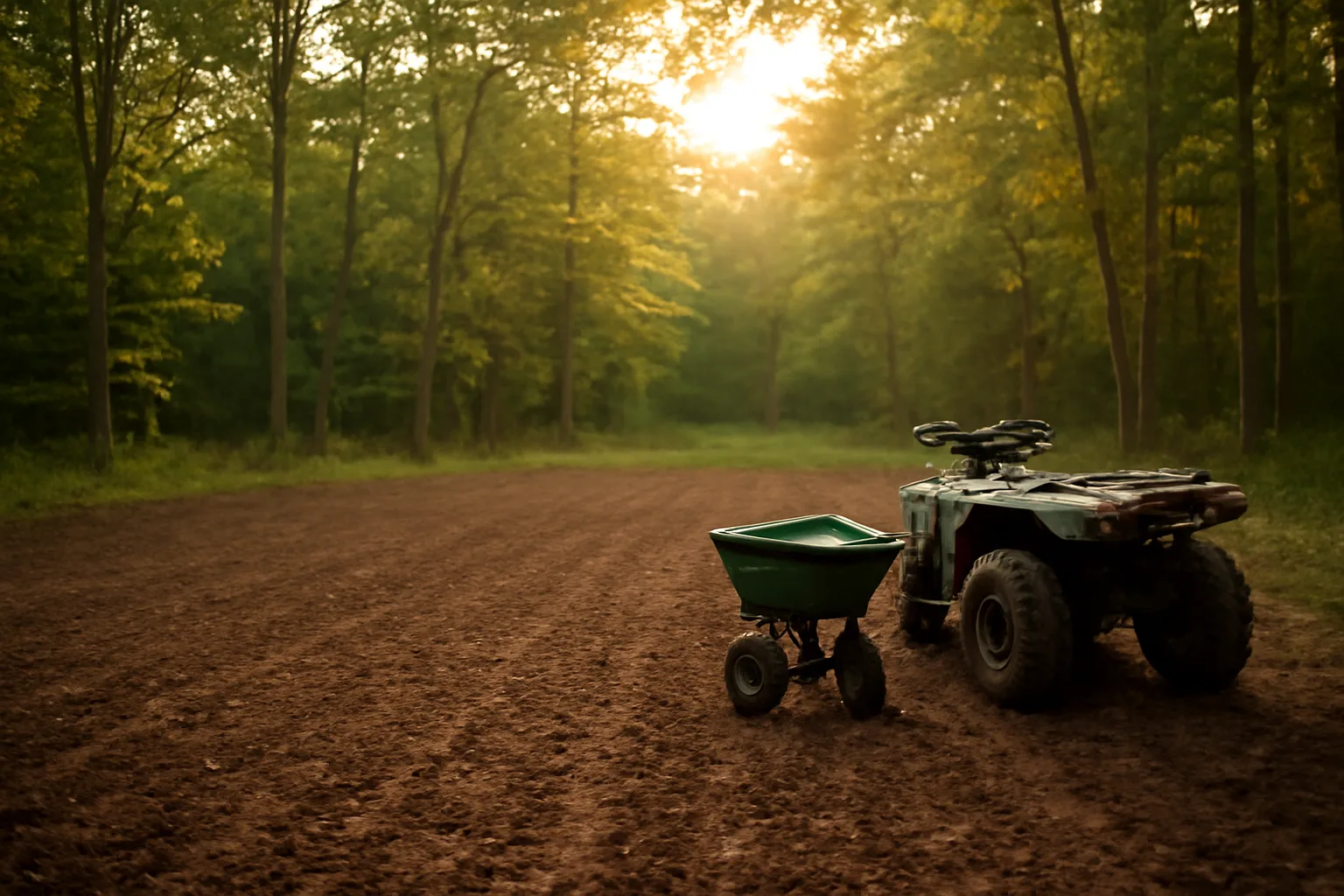
Your planting date is only half the equation. Soil temperature and moisture at planting matter just as much, and rushing a good calendar date into dry, unprepared dirt wastes the seed and the window. Cereal grains germinate reliably once soil hits about 55°F, and most extension planting guides use that as the baseline trigger rather than a calendar date alone [2]. A basic fall prep sequence: pull a soil test at least 6 to 8 weeks before planting so lime has time to start adjusting pH if needed (lime moves slowly, often taking months to fully react), spray or till out existing weed growth 2 to 3 weeks ahead, then plant into a firm, clean seedbed. Cultipacking after broadcasting small seed (clover, brassicas) improves germination noticeably by improving seed-to-soil contact. For equipment, a lot of small-acreage hunters get by with an ATV, a pull-behind spreader, a disc or cultipacker, and a hand-push seeder for edges and small kill plots. You don't need a tractor to plant a good half-acre plot, but you do need a firm seedbed, which is where a lot of broadcast-only, no-tillage plots fall short in dry years. If you're weighing options for deer food plot seed blends versus straight species, single-species plantings give you more control over planting date since you're not compromising between a fast-germinating grain and a slow brassica in the same bag. Blends are more forgiving on timing but usually mean at least one component isn't planted at its ideal date.
Should you plant a mix or a single species for fall plots?
It depends on how tightly you can control your planting date. A single species (say straight oats, or straight turnips) lets you hit its ideal window exactly. A brassica-and-grain mix, common in a lot of bagged food plot seed products, compromises: you're usually planting on the earlier end for the brassica component's sake, since brassicas need the longer runway and grains can catch up fast regardless of exact date. Mixes make sense when you want season-long attraction from one planting: grains green up fast for early season, brassicas take over as the frost-sweetened attractant later. Straight single-species plots make more sense on small acreage where you're trying to time peak attraction to a specific week of gun season, or where your soil test flagged a pH or fertility issue better matched to one crop's needs. Either way, match your species choice to your actual deer food plots goals for the season rather than defaulting to whatever's cheapest at the farm store. A $20 bag of the wrong species for your frost date is a wasted planting, full stop.
Frequently asked questions
Do deer eat sorghum?
Yes. Deer eat both sorghum leaves and grain heads, especially once the crop dries down in late summer and fall. It's mainly planted as a drought-tolerant summer crop rather than a fall planting, since it needs warm soil (60°F plus) to germinate in late spring or early summer.
Do deer eat clover?
Yes, clover is one of the most heavily used food plot forages nationwide. White and red clover both offer high crude protein, often 25 to 30% in vegetative growth, and regrow after grazing, unlike most annual plantings that get wiped out after repeated browsing.
When to plant deer food plots?
Count backward from your first fall frost date: brassicas need 80 to 100 days, so plant late July to early September depending on zone. Cereal grains and clover only need 6 to 8 weeks, so plant mid-August through October. Northern states plant earliest, the Deep South plants latest.
Do deer like clover?
Yes, clover is a top-preference forage for whitetails across most of the country, largely because of its protein content and its ability to regrow after grazing rather than being a one-time-use plot. It's especially valued in spring and summer, but a fall-overseeded stand still pulls strong fall use.
When to plant oats for deer?
Plant oats 6 to 8 weeks before your expected first fall frost, generally late August through mid-September in most of the whitetail range, and into early October in the Deep South. Oats germinate in 5 to 10 days and are grazable within 3 to 4 weeks.
When to plant food plots for deer?
Fall plots go in anywhere from late July (northern brassicas) to mid-October (southern cereal grains), timed to each species' lead-time needs before frost. Spring/summer plots for clover, soybeans, and warm-season annuals go in after your last frost date, typically April through June depending on zone.
When to plant turnips for deer?
Plant turnips 80 to 90 days before your first hard frost, roughly late July to early August in northern states, mid-August in the transition zone, and early September in the Deep South. A real freeze (below 28°F) converts starches to sugars, making the bulbs palatable, so timing matters.
What is a food plot?
A food plot is a planted area, usually a quarter acre to several acres, of forage crops (clover, brassicas, grains, legumes) established specifically to feed and attract deer or other wildlife. It's a habitat management tool distinct from baiting, though state rules on the distinction vary.
What are deer's favorite foods?
There's no single ranked list. Deer preference shifts seasonally: high-protein browse and clover in spring/summer, energy-dense acorns, corn, soybeans, and frost-sweetened brassicas in fall. Acorns typically outcompete planted food when a good mast crop is on the ground.
Do deer like honey?
No, honey isn't a real part of a whitetail's diet and has no practical use in food plot planning. Confusion usually stems from commercial attractant products using sugar or molasses. For fall attraction, frost-sweetened brassicas or ripening corn work far better and are grounded in actual deer feeding behavior.
How late is too late to plant a fall food plot?
If you're past your species' minimum lead time before a killing frost, it's too late for that crop to reach useful maturity. For brassicas that's roughly 70 days out; for oats and cereal rye it's closer to 5 to 6 weeks. Check your county's average first frost date before deciding.
Can you plant clover and brassicas together in fall?
Yes, but the brassica component should drive your planting date since it needs the longest runway. Clover establishes fine planted alongside brassicas in an August window and will persist as a perennial after the brassicas finish their cycle that winter.
Does soil temperature matter more than the calendar date for planting?
Both matter, but soil temperature is the actual biological trigger. Cereal grains germinate reliably once soil hits about 55°F. A calendar date is just a proxy for that condition in your area, and a cold snap or heat wave can shift the real planting window by a couple weeks either direction.
Sources
- Purdue University Extension, forage brassica production: Brassicas planted after early September in the Midwest often fail to reach useful maturity before a killing frost
- University of Wisconsin Extension, forage oats and small grains seeding guide: Oats seeding rate of roughly 2 to 3 bushels per acre and germination timing benchmarks
- Georgia Department of Natural Resources, Wildlife Resources Division food plot guidance: Clover recommended as a foundational perennial forage for year-round wildlife food plots in the Southeast
- Michigan Department of Natural Resources, baiting and feeding regulations: Michigan prohibits baiting for deer hunting statewide with narrow exceptions
- Pennsylvania Game Commission, baiting and feeding of wildlife regulations: Pennsylvania bans baiting and supplemental feeding of deer, tied partly to chronic wasting disease concerns