Last updated 2026-07-25
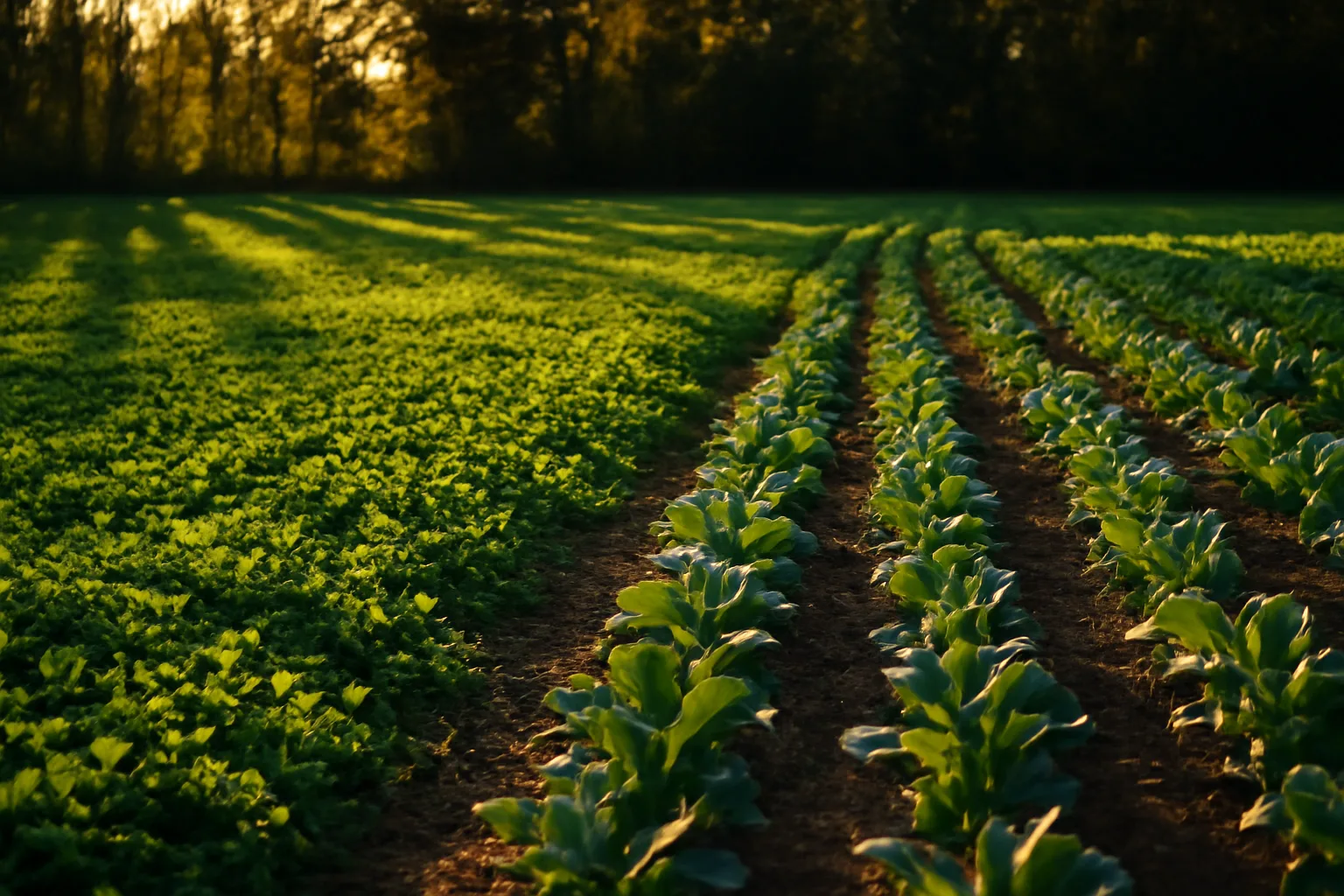
TL;DR
Plant clover or chicory for spring through fall protein, brassicas (turnips, radish) for a fall/winter draw after frost sweetens them, and oats or cereal grains for quick fall attraction. Match species to your soil test, your growing season, and whether you need a perennial or annual plot. Most planting happens late summer for fall plots and spring for clover establishment.
What is a food plot, exactly?
A food plot is a planted patch of ground, usually somewhere between a quarter acre and a few acres, seeded with forage that deer will eat. It's not the same thing as baiting. A food plot is a standing crop that grows in place, while baiting typically means piling loose feed like corn or minerals on the ground, and states regulate the two very differently. Most plots on private or leased ground get planted for one of two jobs: building deer on the property through summer and fall, or giving hunters a place to set up where deer are predictably feeding during shooting light. Some plots do both. A clover field might be your summer nutrition plot and also the spot you hunt in early October before the acorns drop. Size and shape matter more than people think going in. The USDA NRCS and most state wildlife agencies that publish food plot guidance recommend keeping plots small and irregular, often under an acre, so deer feel comfortable using them in daylight [1]. A 40-acre soybean field grown for row-crop agriculture behaves completely differently, in terms of deer comfort and huntability, than a half-acre kill plot tucked into timber. Before you pick a seed, check your state's rules. Baiting and supplemental feeding laws vary a lot, and some states draw a line between what counts as a legitimate agricultural planting versus a bait pile, especially with things like unharvested corn or mineral supplements left out. Your state wildlife agency's regulation page is the only source you should trust on this, not a seed bag or a forum post.
What are deer's favorite foods?
Deer are opportunistic browsers, and their preferences shift by season, region, and what's available. That said, extension research and deer diet studies consistently show a few categories deer come back to again and again: legumes (clover, soybeans, alfalfa), acorns and other hard mast, forbs and browse in spring and summer, and agricultural crops like corn and soybeans where those are common. Soybeans and clover show up at the top of most whitetail food preference studies because of protein content, in the 20 to 30 percent crude protein range for young clover and soybean leaves, which matters a lot during antler growth and lactation [2]. Acorns matter more in fall because of the fat and carbohydrate content deer need heading into winter, and deer will often abandon a food plot entirely during a heavy acorn drop. There's no single "best" food, because a doe nursing fawns in June has different nutritional needs than a buck in December trying to hold fat reserves through the rut's energy drain. That's the real argument for planting more than one species or plot type on a property: a clover field for spring/summer protein, and a brassica or grain plot for fall/winter energy, covers more of the calendar than a single monoculture plot ever will.
Do deer eat clover, and do deer like clover?
Yes. Clover is one of the most consistently used food plot species across the whitetail's range, and it's usually the first thing extension agronomists recommend for a perennial plot. White clover (Trifolium repens) and red clover (Trifolium pratense) both get heavy use, with white clover varieties like Ladino being the most common food plot choice because of its lower growth habit and grazing tolerance. Clover's appeal comes down to protein and availability. Good clover stands run 20 to 25 percent crude protein through the growing season, and because it's a perennial, it keeps producing new growth all spring, summer, and into fall as long as it's mowed or grazed to keep it from going stemmy [3]. That long window of availability is why clover plots get hit hard from green-up in spring straight through the early part of hunting season. Clover isn't a fall-only or spring-only plant. It's a three-season plant in most of the whitetail's range, which is exactly why it's the backbone species in so many food plot programs. The tradeoff is it needs decent soil pH (most extension guidance targets 6.0 to 6.5) and it can get out-competed by weeds if you don't mow or spray it once or twice a season [3]. For a rundown on clover blends and other seed choices, see deer food plot seed.
Do deer eat sorghum?
Yes, deer will eat grain sorghum (milo), both the leaves during the growing season and the grain heads once they mature, but it's not usually a first-choice food plot species on its own. Sorghum is more commonly planted as a cover crop, a screening plant, or a component in a wildlife blend alongside things like sunflower and millet, because it grows tall and thick and holds up in poor soil. Deer will browse sorghum leaves through summer, and the seed heads draw deer along with turkey, quail, and dove once they dry down in fall. Where sorghum earns its keep is drought tolerance and standing power through winter; it holds its structure and grain better than corn in a lot of northern climates, and it doesn't need the fertility corn needs to produce well. If you're picking one grain crop for a fall attraction plot and you only get one shot, most food plot agronomists would point you toward standard forage soybeans, corn, or oats before sorghum, simply because deer preference studies rank those higher. Sorghum is a solid secondary or blend component, not usually the headline act.
Do deer like honey (honey locust, honeysuckle, or literal honey)?
This question usually means one of two things, and it's worth separating them. If you mean actual honey, deer don't seek it out as a food source the way bears do; it's not part of any documented whitetail diet study and it's not something anyone plants in a food plot. If the question is really about honey locust trees or honeysuckle, that's a different story. Honey locust pods (Gleditsia triacanthos) are a genuine deer food, high in sugar content, and deer will clean up dropped pods hard in late fall and winter in parts of the whitetail's range where honey locust grows, mostly the eastern and central US [4]. Honeysuckle, particularly Japanese honeysuckle, gets browsed too, though it's considered invasive in a lot of states and isn't something extension offices recommend planting. Neither honey locust nor honeysuckle is a food plot seed you'd broadcast this spring. They're standing timber or shrub-layer plants more than plot species, so if you've got mature honey locust trees on the property, treat them as a bonus late-season food source rather than something to plant new.
When to plant food plots for deer: what's the general timing?
| Northern (Zone 3-4) | Mid-May to early June | Late July to mid-August | April to May, or Aug | |
|---|---|---|---|---|
| Transition (Zone 5-6) | Late April to mid-May | Mid-August to early Sept | March-April, or Aug-Sept | |
| Southern (Zone 7-8) | March to April | September to early October | Sept-Oct or Feb-March | These windows are general guidance, not a guarantee for your specific field. Frost dates, elevation, and a wet or dry spring can shift things by two or three weeks either direction, so a soil thermometer and your local extension office's frost date tables are worth more than any national chart, including this one. |
Timing splits into two seasons, and almost every planting decision comes back to which one you're planting for. Spring plantings (April through June in most of the whitetail's range) are for warm-season annuals like soybeans, corn, and sunflowers, and for establishing new perennial clover. Late summer plantings (roughly mid-July through early September, shifting earlier the farther north you go) are for cool-season annuals: brassicas, oats, wheat, rye, and other fall/winter plots. Soil temperature and your area's first frost date drive the real planting window more than the calendar date does. Cooperative extension services publish planting date guidance by region because a late-August planting in Wisconsin and a late-August planting in Georgia are completely different situations agronomically. Here's a rough national framework, though you should confirm against your local land-grant extension office or state wildlife agency's food plot guide before you plant: | Region | Spring annuals (soybeans, corn) | Fall annuals (brassicas, oats, cereal grains) | Clover establishment |
When to plant turnips for deer
Turnips get planted in late summer, generally 60 to 90 days before your first hard frost, because the whole point of a turnip plot is timing the bulb's starch conversion to sugar around that frost. Most of the country falls somewhere between mid-July and early September for turnip planting, with northern states planting first. Turnips (and brassicas generally, including radish and rape) go through a sugar-conversion process after a hard frost, where the plant converts starches to sugars as a cold tolerance mechanism, and that's what makes the bulbs and foliage suddenly a lot more attractive to deer. Before that frost hits, deer often ignore turnip plots almost entirely, then hammer them once temperatures drop, which surprises a lot of first-time planters who think their plot failed. Turnips need roughly 60 to 90 days of growing season before that first frost to bulb up properly, so back-planning from your area's average first frost date (available from NOAA or your state extension) is the right way to pick a planting date, not a fixed calendar day. Plant too late and you get leafy greens with no bulb; plant too early in warm soil and germination can be spotty.
When to plant oats for deer
Oats get planted in late summer for a fall food plot, typically August into early September depending on your zone, though oats can also go in as a spring cover crop or nurse crop in cooler climates. Oats are a fast-germinating cereal grain, often up out of the ground in 5 to 7 days under decent moisture, which makes them a good choice for hunters planting close to season. Oats are winter-hardy enough to survive into early winter in the South and mid-South, but a hard freeze will usually kill them off in northern states, unlike winter wheat or cereal rye which can overwinter and green back up in spring. If you're in a colder zone and want a fall plot that lasts into late season, wheat or rye is a more durable choice than straight oats. Oats have a real advantage as an early-season draw: deer hit young, tender oat shoots hard in September and October, before brassicas have sweetened up and before acorns start falling. A lot of food plot mixes blend oats with brassicas for exactly this reason, oats for the early pull, turnips or radish for the late-season sugar hit.
How do I match plot species to my soil, and does a soil test actually matter?
Yes, and it matters more than seed selection for most first-year plot failures. Clover, brassicas, and cereal grains all have a preferred pH range, generally 6.0 to 7.0, and food plot agronomists at land-grant universities are blunt about this: soil below pH 5.5 will tank germination and nutrient uptake no matter how good the seed is [3]. A soil test tells you your current pH, phosphorus, and potassium levels, and it tells you how much lime and fertilizer you actually need, instead of guessing off a bag's generic recommendation. Most state extension services offer soil testing for somewhere between $6 and $20 per sample, and results usually come back in one to two weeks. Your soil test lab is the authority on how much lime and fertilizer your specific field needs. A national article like this one can tell you what range to expect, but it can't read your dirt. If you want a planting plan built around your actual test results, region, and plot goals rather than generic advice, that's the kind of thing a plot-plan-builder is built for. It's a one-time $99 planning service, not a subscription, and it's meant to translate your soil numbers and property into an actual seed and timing plan instead of leaving you to guess.
What's the difference between an annual and a perennial plot, and which should I plant?
An annual plot (oats, brassicas, soybeans, corn) grows for one season and needs replanting every year. A perennial plot (clover, chicory, alfalfa) comes back on its own for 3 to 5 years with proper mowing and maintenance, though it needs re-establishment eventually as stands thin out. If you're planting your first plot ever, clover is usually the lower-risk, higher-payoff choice: it's forgiving on planting date, cheaper per acre over its lifespan since you're not buying seed every year, and it gives you spring through fall coverage. Brassicas and cereal grains take more precise timing (see the frost-date discussion above) but they give you a fall/winter energy source that clover, being a protein-heavy legume, doesn't really replace. Most experienced plot managers run both: a perennial clover field for season-long nutrition and early bow season hunting, and one or two annual fall plots for the late-season energy push and a dedicated hunting spot. If you can only manage one plot this year, clover on decent soil is the safer bet; if you're adding a second plot, that's where brassicas or oats earn their keep.
What seed mix or species should a beginner actually start with?
For a first-time planter with an average soil test (pH 6.0 to 6.5, moderate fertility) and no irrigation, a straightforward starting lineup looks like this: white clover for a perennial plot, and a brassica/cereal grain blend (turnips, radish, and oats or winter wheat) for a fall annual plot. That combination covers the calendar reasonably well without requiring specialized equipment. Clover needs a firm seedbed and can be broadcast with a hand spreader or ATV spreader and cultipacked; brassicas and oats need a disked or tilled seedbed but don't require precision drilling the way corn or soybeans do. If you want to go simpler still, a single half-acre clover plot in full sun on decent ground, limed and fertilized per a soil test, is a completely legitimate first-year plot. You don't need five species and three plots to have a good hunting spot; you need one plot that's actually growing well because the soil chemistry is right, more than you need variety. For more on matching seed choices to specific goals and property types, food plot whitetail and deer food plots cover plot design and layout in more depth, and food plot seed and domain food plot seed get into specific blends.
What about corn, soybeans, and other row crops for food plots?
Corn and soybeans are excellent deer foods, ranking at or near the top of most whitetail preference studies, but they're the highest-input, highest-risk option for a small food plot. Both need good soil fertility, decent acreage (small plots get hammered by deer before the crop matures, sometimes wiped out entirely), and in corn's case, a real herbicide and fertility program to get a standing crop by fall. Soybeans are more forgiving than corn on a small acreage, and forage soybean varieties bred for food plots (versus grain soybeans bred for yield) tend to hold up better to grazing pressure through the season. Corn on anything under 3 to 5 acres often gets browsed to nothing by August before it ever produces an ear, which is the single most common complaint from first-time corn planters. If you have the acreage and equipment, a corn or soybean plot gives you a fall standing-crop food source that's hard to beat for late-season energy. If you're working a half-acre or acre plot, you're usually better off with clover, brassicas, or oats, which tolerate grazing pressure a lot better than row crops do on small ground.
Frequently asked questions
Do deer eat sorghum?
Yes. Deer browse grain sorghum leaves through the growing season and eat the seed heads once they dry in fall. It's more commonly planted as a cover crop or blend component with sunflower and millet than as a standalone plot, since deer preference studies rank soybeans, corn, and clover higher.
Do deer eat clover?
Yes, clover is one of the most heavily used food plot species across the whitetail's range. White and red clover both get hit hard, and clover stands run 20 to 25 percent crude protein through the growing season, according to extension forage research, making it a strong spring-through-fall food source.
Do deer like clover?
Yes, deer show strong, consistent preference for clover in food plot studies and in the field. Its appeal comes from high protein content and long availability, since a well-maintained clover stand keeps producing new growth from spring green-up through fall, unlike a single-season annual crop.
When to plant deer food plots?
Spring plantings (April to June depending on zone) work for warm-season annuals like soybeans and corn, and for new clover establishment. Late summer plantings (mid-July to early September) work for brassicas, oats, and cereal grains. Your local land-grant extension office's frost date data is the best guide for exact timing.
When to plant oats for deer?
Plant oats in late summer, typically August into early September depending on your region, for a fall food plot. Oats germinate fast, often within 5 to 7 days, and give deer an early-season draw before brassicas sweeten up or acorns start dropping.
When to plant turnips for deer?
Plant turnips 60 to 90 days before your area's average first hard frost, generally mid-July to early September depending on region. That timing matters because turnips convert starches to sugars after a frost, which is what makes the bulbs and greens suddenly much more attractive to deer.
What is a food plot?
A food plot is a planted area of forage, usually a quarter acre to a few acres, seeded specifically to feed and attract deer. It's different from baiting, which involves piling loose feed, and most states regulate the two differently, so check your state wildlife agency's rules before planting or feeding.
What are deer's favorite foods?
Deer preference shifts by season, but legumes like clover and soybeans, hard mast like acorns, and tender browse consistently rank highest in whitetail diet studies. No single food wins year-round, which is why most plot managers plant a legume for spring/summer and a brassica or grain for fall/winter.
Do deer like honey?
Deer don't seek out literal honey as a food source; it's not documented in whitetail diet studies. If the question means honey locust pods, though, those are a real and heavily used late-season deer food in the eastern and central US, high in sugar and readily eaten once they drop.
What's the best food plot plant for a beginner?
White clover on a half-acre to one-acre plot, limed and fertilized per a soil test, is the most forgiving starting point. It's a perennial, so it comes back for several years, tolerates a range of planting dates better than annuals, and feeds deer from spring through fall.
How big should a deer food plot be?
Most wildlife agency and NRCS guidance suggests keeping individual plots under an acre, often a quarter to half acre, so deer feel comfortable entering in daylight. Larger properties often do better with several small plots scattered around than one large field.
Can I plant a food plot without a soil test?
You can, but you're guessing on lime and fertilizer, and soil below pH 5.5 will limit germination and growth regardless of seed quality. A soil test through your state extension office usually costs $6 to $20 and tells you exactly what your field needs before you spend money on seed.
Sources
- USDA NRCS, Wildlife Habitat Management Institute food plot guidance: Recommendation to keep food plots small and irregularly shaped for deer comfort and use
- Mississippi State University Extension, Deer Nutrition: Crude protein content of clover and soybean forage relevant to antler growth and lactation
- University of Tennessee Extension, Clover for Wildlife Food Plots: Clover crude protein range and soil pH requirements (6.0 to 6.5) for good stands
- USDA NRCS Plant Guide, Honeylocust (Gleditsia triacanthos): Honey locust pods are a wildlife food source, high in sugar, eaten by deer in fall and winter
- University of Georgia Extension: Recommendations on planting dates and species for deer food plots, including clover and cool-season forages
- Iowa State University Extension: Soil testing recommendations relevant to establishing food plots for wildlife