Last updated 2026-07-25
TL;DR
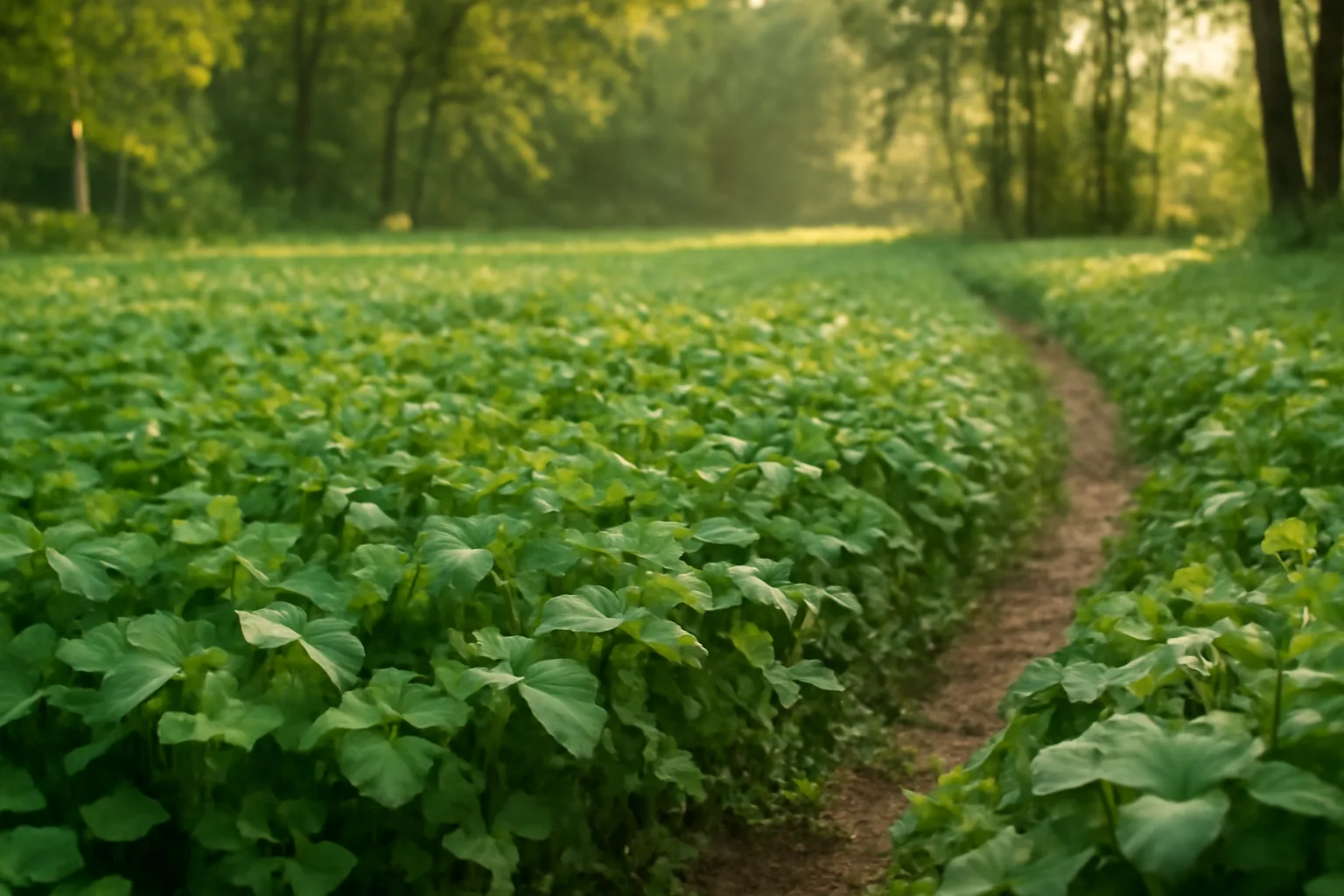
The best thing to feed deer in summer is a growing food plot, not a feed pile. Clover, soybeans, cowpeas, and alfalfa give protein through the stress months of July and August. Check your state's baiting and feeding rules first (many ban supplemental feeding or corn piles), then plant a summer-tolerant legume mix instead.
what should you actually feed deer in summer
Deer in summer need protein and easy digestibility more than raw calories. Does are nursing fawns. Bucks are growing antlers. Both need diets in the 16 to 20 percent crude protein range to hit their genetic potential, a range widely cited in whitetail nutrition research going back decades of deer research at Mississippi State University and other land-grant programs [1]. Corn is roughly 8 to 9 percent protein, which is why a corn pile does almost nothing for antler growth or lactation, no matter how much deer seem to like it. The honest answer is: plant a legume. Clover, soybeans, cowpeas, and alfalfa all run 20 to 30+ percent crude protein in their vegetative stage, and deer will hammer them all summer if the plot is established and has some size to it. A half acre is the bare minimum. An acre or more is better, so browsing pressure doesn't wipe the plot out before August. If you're set up with a soil test and some equipment already, a food plot whitetail planting is a far better summer investment than any bagged corn or mineral lick. Minerals have their place for trace nutrients, but they aren't food, and in a lot of states, feed piles cross into baiting rules you don't want to trip.
do deer eat sorghum
Yes, deer eat sorghum, both the grain heads and the young leafy growth, but it's not a summer favorite compared to legumes. Grain sorghum (milo) is planted more as a fall or winter standing grain crop, or as a screening and cover crop mixed with other species, not as a primary summer browse plot. Deer will nibble sorghum seedlings early in the season when they're tender, sometimes hard enough to require replanting on small plots. Once it matures and the stalk toughens up, deer shift to eating the grain heads in fall and winter. That's when sorghum earns its keep as a standing food source alongside corn and soybeans. For pure summer nutrition, cowpeas or soybeans planted in the same window will do far more for a herd than sorghum will. Sorghum is drought-tolerant and cheap. That's why it shows up in a lot of Southern food plot blends as a mixed-species planting rather than a monoculture.
do deer eat clover, and do deer like clover
Yes, and yes. Clover is one of the most reliable summer foods you can plant. White clover varieties like Ladino and red clover are staples of deer food plot programs because they're perennial, they regrow after grazing, and they hold roughly 25 to 30 percent crude protein through most of the growing season, a range consistent with clover forage quality data published by university forage agronomy programs [2]. Clover's biggest strength in summer is persistence. A well-maintained clover stand, mowed a couple times a season to knock back weeds and encourage new tender growth, can produce for 3 to 5 years before it needs renovation. That makes it a lower labor, lower cost option per year than annuals you replant every season. The tradeoff is establishment. Clover needs decent soil pH, generally in the 6.0 to 6.5 range, and it's slow the first year. If your soil test comes back at pH 5.5 or lower, lime it before you plant. Clover in acidic soil just sits there and sulks. This is exactly the kind of site-specific call your soil test lab should make, not a blog post. Treat any planting calendar as a starting point, not gospel for your dirt. A deer food plot seed blend with multiple clover varieties plus chicory is a common, forgiving choice for summer plots because chicory adds drought tolerance clover alone doesn't have.
when to plant food plots for deer, and when to plant clover, oats, and turnips specifically
| Clover (perennial) | Late April to May, or Aug 1-20 | April or Aug 15-Sept 15 | March-April or Sept-Oct | |
|---|---|---|---|---|
| Soybeans/cowpeas | Mid-May to early June | Mid-May to mid-June | Late April to May | |
| Oats (fall plot) | Aug 1 - Sept 1 | Aug 15 - Sept 15 | Sept 1 - Oct 15 | |
| Turnips/brassicas | Late July to mid-Aug | Aug 1 - Sept 1 | Aug 15 - Sept 15 | Clover is unusual in that it can be frost-seeded or planted in very early spring, or planted in late summer for fall establishment. Both windows work, and a lot of experienced planters prefer the late-summer window because there's less weed competition. Oats are almost exclusively a late summer or early fall planting for a reason: they're meant to be lush and attractive from September through the first hard freezes, not a summer food. Planting oats in May or June for summer forage is a poor use of the seed; they bolt and get tough in the heat. Turnips and other brassicas follow the same logic as oats. Mississippi State University Extension recommends planting brassicas 60 to 90 days before your first expected fall frost so the plants have time to bulb and sweeten after a cold snap [3]. Planting turnips in June for summer grazing skips the whole point of the crop; the leaves are edible but deer generally ignore turnip bulbs until frost converts starches to sugars. So if the real question is when to plant food plots for deer generally, the honest answer is it depends on what you're planting and what season you want it peaking in. Summer annuals (soybeans, cowpeas, sorghum) go in late spring. Fall annuals (oats, brassicas, wheat, rye) go in late summer. Perennial clover can go either time. |
Timing depends entirely on species and your zone, and this is where a lot of first-time planters waste a season. Here's a rough breakdown by region and crop, based on standard planting windows used by state extension services and wildlife agencies. | Crop | Northern zone (Zone 5-6) | Transition zone (Zone 6-7) | Southern zone (Zone 7-8) |
what is a food plot, exactly
A food plot is a planted area, usually somewhere between a quarter acre and several acres, established specifically to grow forage that attracts and feeds deer or other wildlife. It's different from a feed pile or mineral station because it's an actual crop, planted, fertilized, and managed like a small farm field, not a supplement dumped on the ground. Food plots serve two purposes depending on species and placement: nutrition plots (clover, soybeans, alfalfa) built to feed deer through stress periods like lactation and antler growth, and hunting or attraction plots (brassicas, cereal grains) placed and timed to draw deer into range during hunting season. Many properties run both, a large nutrition plot in an interior field and smaller kill plots near stand sites. State wildlife agencies generally treat food plots differently from baiting under hunting law, since the crop is grown in place rather than transported and dumped, but the line varies a lot by state, and some states regulate hunting over any planted food source the same as bait depending on how recently it was disturbed. Always check your state wildlife agency's current baiting and feeding regulation page before you plant near a stand or feed anything supplementally. Pennsylvania, for example, prohibits feeding of wild deer and elk statewide outside of specific exceptions under its game code [4], and Wisconsin restricts baiting and feeding at the county level in areas affected by chronic wasting disease [5]. Rules like this change fairly often, so don't rely on last year's regulation summary.
do deer like clover more than other summer plantings
Clover ranks at or near the top of most palatability studies and hunter surveys, but it's not automatically a deer's single favorite food. That shifts by region, season, and what's locally available. In agricultural areas, deer often prefer soybeans over clover in summer because the leaf mass and protein are similarly high, and beans can outcompete weeds better once established. What clover does better than almost anything else is season-long availability. Soybeans get browsed hard as seedlings, sometimes destroyed before they get established if deer density is high, then grow past heavy browsing pressure once the plant hardens off in July. Clover, by contrast, tolerates repeated grazing all summer because it regrows from the crown. If you're planning a whole property, a mix makes more sense than picking one favorite. A deer food plots strategy that combines a perennial clover field for season-long grazing with a soybean or cowpea plot for peak-summer tonnage covers more of the calendar than either alone.
what are deer's favorite foods overall
There's no single universal answer because deer are opportunistic browsers and preference shifts by region, season, and what's actually growing nearby, but a few categories come up again and again in state deer research and food plot studies. Acorns are consistently ranked as a top natural preferred food where oaks are present. White oak acorns in particular are lower in tannins and more palatable than red oak acorns, and deer will shift almost entirely to acorns during a good mast year, a pattern documented in white-tailed deer mast studies published through Mississippi State University Extension's deer program [6]. In agricultural country, soybeans and clover top most food plot preference rankings. Fruit like persimmons, apples, and honeysuckle berries draw heavy attention in late summer and fall where available. For planted food plots specifically, the general pecking order most extension agronomists and wildlife biologists describe goes something like this: soybeans and cowpeas during the growing season, clover season-long, brassicas and cereal grains after frost sweetens them, and standing corn or soybeans as a high-energy winter food. None of this is a guarantee. Deer preference on your specific property depends heavily on what else is available and how much hunting or human pressure they're under.
do deer like honey
There's no real evidence deer seek out honey as a food source, and it's not a practical or legal thing to feed them. Deer are herbivorous browsers built to digest plant fiber through a four-chamber rumen system. Concentrated sugar sources like honey aren't part of their natural diet and don't offer the protein or fiber they actually need in summer. More importantly, using honey, syrup, or scent-based attractants to draw deer counts as baiting in most states, and baiting rules are usually written around the substance's purpose (attracting deer to a location for hunting) rather than nutritional value. If you're tempted to use something like honey as an attractant near a stand, check your state wildlife agency's bait definition first. Several states define bait broadly enough to include any consumable substance placed to attract wildlife, more than just corn or minerals.
how much summer plot do you actually need
A common rule of thumb from wildlife biologists is roughly 1 to 5 percent of your total property acreage in food plots, split between summer and fall plantings, though this varies a lot with deer density and existing habitat quality. On a 100 acre property, that's somewhere between 1 and 5 acres total, not necessarily all in one field. Small plots under a quarter acre in high deer density areas often get browsed to the dirt by July, which defeats the purpose of a nutrition plot. If you only have room for one small plot, cowpeas or a clover/chicory blend tend to hold up to pressure better than soybeans, which need more acreage to survive early browsing. Soil fertility matters as much as acreage. A legume plot on soil that's never been limed or fertilized according to a real soil test will underperform no matter how well you time the planting. This is the one part of the process worth paying for professional input on, since a lab result specific to your field beats any general planting guide, including this one.
summer feeding rules: what's actually legal
Baiting and supplemental feeding laws vary enormously by state, and a lot of hunters assume food plots and feed piles are treated the same way legally when they usually aren't. Some states ban feeding deer outright, some allow feeding but ban hunting over bait, and some allow both with restrictions tied to disease management zones. Pennsylvania's Game and Wildlife Code prohibits feeding wild deer and elk in most circumstances, largely due to chronic wasting disease (CWD) spread concerns. The Pennsylvania Game Commission states that feeding deer and elk can concentrate animals and increase disease transmission risk, and its feeding ban page lays out the specific exceptions that still apply [4]. Wisconsin's administrative code similarly restricts baiting and feeding in counties affected by chronic wasting disease, with the specific county list and rules updated as management areas change [5]. Before you feed anything supplemental in summer, corn, mineral blocks, protein pellets, whatever, look up your state wildlife agency's current baiting and feeding regulation page. Rules change almost every year as CWD zones shift, and violations can carry real fines and license consequences. A food plot sidesteps most of this risk entirely since it's a grown crop, not a transported feed source, but always confirm your state's specific definition of baiting before hunting over or near any planted attractant.
building a summer plot plan that actually works
Start with a soil test. This is not optional advice, it's the single highest-leverage thing you can do before spending money on seed. Extension services and private labs both offer soil tests in roughly the $10 to $20 range that tell you exact lime and fertilizer needs. Guessing on pH is the number one reason food plots fail in the South and Midwest, since most of that ground runs naturally acidic. Once you have a soil test back, pick species based on what your soil and season actually support, not what looked good on a bag at the farm store. Cowpeas and soybeans tolerate lower fertility and heat better than clover in year one. Clover is the better long-term investment if your pH is already decent or you're willing to lime. If you want a starting point without guessing at species mixes and timing for your specific zone, PlotSeason's $99 one-time Custom Food Plot Plan builds a planting calendar and species recommendation off your property's zone and goals. It's general guidance built around real agronomy principles, not a substitute for your soil test lab's specific lime and fertilizer recommendations. You can start one at /plot-plan-builder. For seed selection once you know your species mix, a food plot seed or deer food plot seed comparison is worth reading before you buy, since blends vary a lot in quality and filler content.
Frequently asked questions
Do deer eat sorghum during summer?
Yes, deer browse young sorghum leaves and later eat the mature grain heads, but sorghum is a secondary summer food compared to legumes like soybeans or cowpeas. It's more commonly used as a drought-tolerant mixed-species planting or a fall standing grain crop than a primary summer nutrition plot.
Do deer eat clover, and do they prefer it?
Yes, clover is one of the most reliably eaten and highest-protein summer plantings, often in the 25 to 30 percent crude protein range based on forage quality data from university agronomy programs. Whether deer 'prefer' it over soybeans depends on local availability; both rank near the top of most food plot palatability comparisons.
When should you plant food plots for deer?
It depends on the crop. Summer annuals like soybeans and cowpeas go in late spring (mid-May to early June in most zones). Fall annuals like oats and brassicas go in late summer (August to mid-September). Perennial clover can be planted in early spring or late summer, whichever fits your weed pressure and schedule better.
When should you plant oats for deer?
Oats are a fall food plot crop, typically planted from early August through mid-September depending on your zone, so they're lush and attractive through hunting season and into early winter. Planting oats in spring or early summer for warm-season forage isn't a good use of the seed since heat causes them to bolt and toughen quickly.
When should you plant turnips for deer?
Plant turnips and other brassicas 60 to 90 days before your area's first expected fall frost, per Mississippi State University Extension guidance, which puts most plantings between late July and mid-September depending on region. Deer generally ignore turnip bulbs until after a frost converts starches to sugars, so earlier planting doesn't make them attractive sooner.
What is a food plot?
A food plot is a planted area, typically a quarter acre to several acres, established specifically to grow forage crops like clover, soybeans, or brassicas that attract and feed deer. It's different from a feed pile because it's an actual growing crop managed with fertilizer and planting schedules, not a supplement dumped on bare ground.
What are deer's favorite foods overall?
There's no single universal favorite; preference shifts by region and season. Acorns, especially white oak acorns, rank as a top natural food where available. Among planted crops, soybeans and clover consistently top food plot preference studies, with brassicas and cereal grains becoming more attractive after fall frosts sweeten them.
Do deer like honey?
There's no real evidence deer seek out honey, and it isn't part of their natural browsing diet, which is built around plant fiber rather than concentrated sugar. Using honey or other scent attractants to draw deer often qualifies as baiting under state law, so check your state wildlife agency's bait definition before using it near a stand.
What should I feed deer in summer if I only have a small plot?
On small acreage, cowpeas or a clover/chicory blend tend to survive browsing pressure better than soybeans, which need more acreage to establish before deer eat them down. A quarter acre or less in a high deer density area often gets grazed to bare dirt by midsummer regardless of species.
Is it legal to feed deer corn in the summer?
It depends entirely on your state. Some states, like Pennsylvania, prohibit feeding wild deer in most situations due to chronic wasting disease concerns, while others allow feeding but restrict hunting over bait, or apply county-specific bans in CWD zones. Always check your state wildlife agency's current baiting and feeding page before feeding anything supplemental.
How big should a summer food plot be?
Wildlife biologists commonly suggest 1 to 5 percent of total property acreage in food plots, split between summer and fall plantings, though deer density and habitat quality change that math a lot. On dense-deer properties, plots under a quarter acre often get browsed out before they mature.
Do I need to soil test before planting a summer plot?
Yes, a soil test is the highest-value step before planting, typically costing $10 to $20 through a university extension lab or private lab. It tells you exact lime and fertilizer needs; planting a legume in acidic, unlimed soil is one of the most common reasons summer food plots underperform.
Sources
- Mississippi State University Extension, Publication 2033: Nutrition and Nutritional Diseases of White-tailed Deer: Deer generally require diets in the range of 16 to 20 percent crude protein to support antler growth and lactation.
- University of Wisconsin-Madison Division of Extension, Team Forage: understanding forage quality reports: White and red clover forage commonly tests in the mid-20s to low-30s percent crude protein range in the vegetative stage.
- Mississippi State University Extension, Publication 2429: Brassicas for Deer Food Plots: Brassicas like turnips should be planted 60 to 90 days before the first expected fall frost.
- Pennsylvania Game Commission, Feeding Ban for Deer and Elk: Pennsylvania restricts feeding of wild deer and elk due to disease transmission concerns.
- Wisconsin Department of Natural Resources, NR 10.10 baiting and feeding administrative rule: Wisconsin applies county-level baiting and feeding restrictions tied to chronic wasting disease affected counties under its administrative code.
- Mississippi State University Extension, Publication 2308: White-tailed Deer and Mast Production: White oak acorns are more palatable to deer than red oak acorns due to lower tannin content.