Last updated 2026-07-26
TL;DR
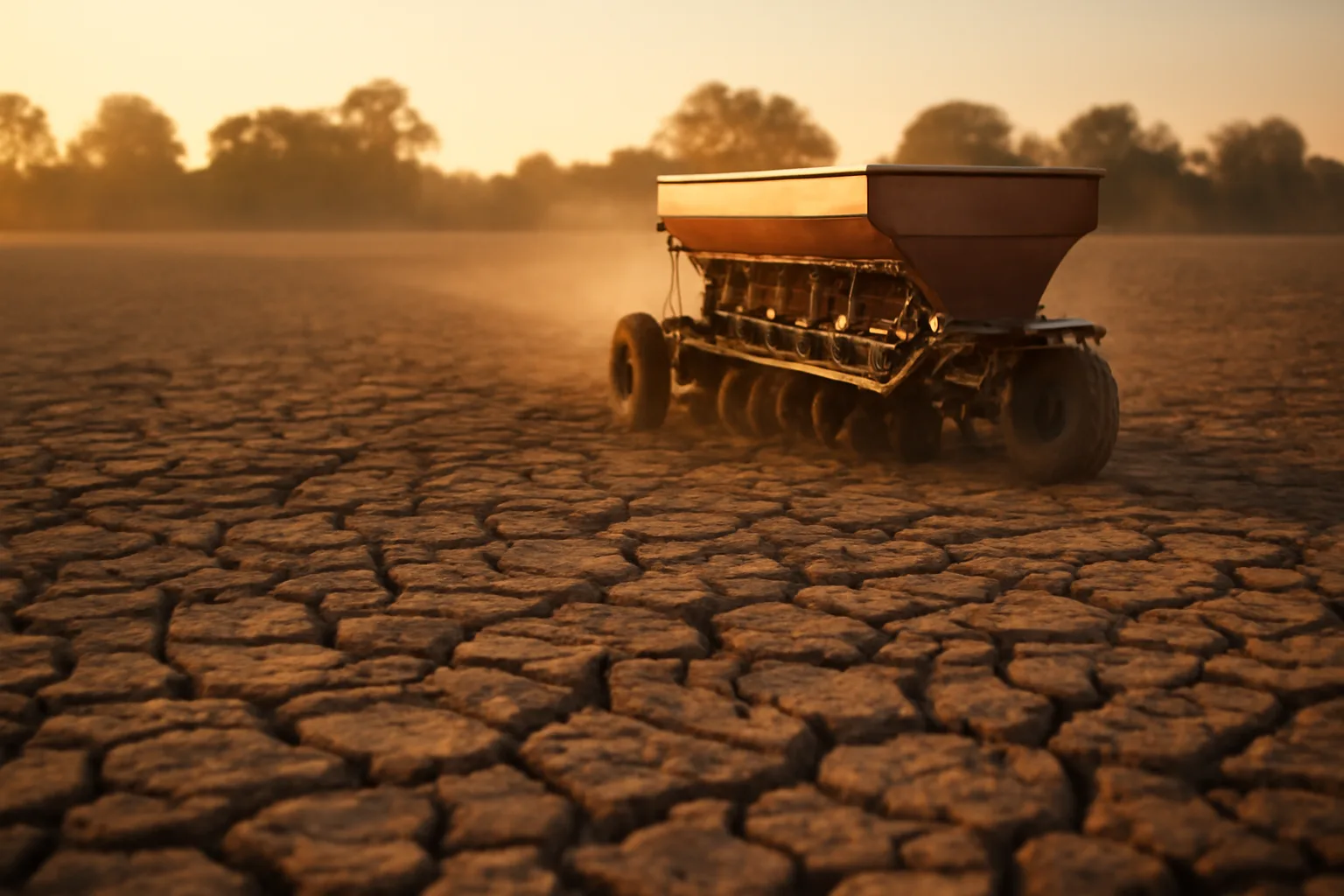
You can plant food plots with no rain in the forecast if you drill seed deeper into moisture, pick drought-tolerant species like sorghum, cowpeas, or brassicas, and time planting to your region's normal rain windows rather than the calendar date. Broadcasting into dust and hoping is the main way people waste money.
can you plant a food plot with no rain in the forecast
Yes, but you're managing risk, not eliminating it. Seed needs consistent soil moisture to imbibe water and germinate, and once it starts that process it can die if the soil dries back out before roots establish. The trick in a dry stretch is getting seed down to where residual soil moisture still exists, usually an inch or two below a crusted, dry surface, rather than broadcasting onto bone-dry topsoil and waiting. The USDA Natural Resources Conservation Service's soil health guidance points out that seed-to-soil contact and adequate moisture at the seed zone are the two non-negotiable factors for germination, regardless of species [1]. A drill that places seed at a controlled depth into moist soil will beat a broadcast-and-cultipack approach almost every time when rain is uncertain. Here's the thing about lime. If your soil test came back and you already limed, that lime takes months to fully react anyway, so a short-term dry spell doesn't waste that investment. What it can waste is seed cost and your planting window. Plenty of hunters treat a rainless forecast as a reason to wait. Sometimes waiting is right. Sometimes waiting means missing the only realistic window before your regional first-frost date closes the door on a fall blend.
when to plant food plots for deer
Timing depends more on your frost dates and rainfall pattern than on a fixed calendar date. Land-grant extension programs generally set food plot planting windows around two soil temperature and moisture thresholds: spring plots go in after soil warms past roughly 55-60°F, and fall plots go in 60 to 90 days before your average first frost so brassicas and cereal grains have time to establish before cold shuts growth down [2]. In the Midwest and Upper South, that usually puts fall plantings in mid-August through mid-September. In the Deep South, growers can push into October. The honest answer is that soil moisture, not the date on the bag, should make the final call. A lot of experienced plotters watch the ten-day forecast and plant a few days ahead of a predicted rain, so seed sits in the ground ready to pop the moment moisture arrives, instead of planting into a dry spell and hoping.
what is a food plot, exactly
A food plot is a planted area, usually somewhere between a quarter acre and several acres, established specifically to provide forage or attraction for deer and other wildlife on hunting land. It's not a farm field in the commodity-crop sense, though the same equipment (drills, disks, sprayers) is often used at smaller scale. Most plots fall into two rough categories: annual plots (brassicas, cereal grains, clovers reseeded yearly) planted for a single season's forage, and perennial plots (clover, alfalfa, chicory blends) meant to produce forage across multiple years with periodic mowing and fertilization. Supplemental feeding and baiting rules are a separate legal category in many states, and they don't automatically apply to food plots. Check your state wildlife agency's regulations before combining plots with any feeder or mineral station. If you want a plan built around your specific soil test, region, and acreage rather than a generic seed bag recommendation, that's the whole idea behind a food plot whitetail plan versus just buying a bag off the shelf.
what are deer's favorite foods
Deer are opportunistic browsers, and their preferences shift by season, region, and what's locally abundant. In general, whitetail deer favor high-protein, high-energy forages when available: soybeans and cowpeas in summer, acorns and other mast in fall, and winter wheat, clover, or brassicas going into cold months. University deer research programs have repeatedly found that deer preferentially select forbs and legumes with crude protein above roughly 16 percent when they're accessible, though acorns (lower in protein but very high in fat and carbohydrate) become a dominant fall food source wherever oaks are present [3]. There's no single universal 'favorite.' Clover, soybeans, and standing corn or acorns consistently rank at the top across most whitetail range studies. If you're picking one plot species to maximize attraction across a whole season, most extension and wildlife biologists point to clover for its combination of season-long availability, regrowth after grazing, and consistent protein content [4]. That's not marketing, it's just what shows up again and again in forage preference studies.
do deer eat clover, and do they actually like it
Yes, deer eat clover heavily and most wildlife biologists rank it among the most consistently preferred food plot forages available. Clover is a legume, meaning it fixes nitrogen and typically holds crude protein in the 18 to 25 percent range depending on variety, cutting stage, and soil fertility [4]. White clover (Ladino types) and red clover are the two most common food plot varieties. White clover tolerates grazing pressure better and spreads by stolons, so it can handle heavier browsing than red clover, which grows more upright and can get grazed out faster under high deer density. Both are perennials that, with proper liming and mowing, can produce for three to five years before needing to be reestablished. Clover does need consistent moisture to establish from seed, since the seed is small and shallow-planted (generally 1/4 inch deep or less). That makes clover one of the tougher species to establish during a true drought, because there's very little soil buffer around the seed. If you're planting clover with no rain in the forecast, a firm seedbed, a cultipacker pass after seeding, and planting into the coolest, highest-moisture microsite on your property (north-facing slope, lower ground) all improve your odds meaningfully more than with a deeper-planted grain.
do deer eat sorghum
Yes, deer readily browse grain sorghum, both the young green forage and the mature seed heads. Sorghum (often called milo) is valued in food plot mixes mainly for its drought tolerance and its late-season standing grain, which deer and turkey will work through fall and winter. Agronomy research consistently ranks grain sorghum among the more drought-tolerant row crops available to plotters, largely because of its deep, fibrous root system and lower water requirement per unit of biomass compared to corn [5]. That's exactly why sorghum shows up so often in blends marketed for dry regions or sandy soils. It germinates and survives with less rainfall than corn needs, though it still needs moisture at planting to get started. One caution worth knowing: sorghum contains compounds that can produce prussic acid (cyanide) under certain stress conditions, particularly after a frost or during severe drought stress on young regrowth. This is a livestock grazing concern documented by extension beef and forage programs more than a whitetail food plot concern, but it's worth knowing if you're running cattle or other livestock on the same ground .
when to plant turnips for deer
Turnips go in as a fall brassica planting, typically 80 to 90 days before your average first frost, since they need that runway to bulb out and reach peak palatability after a few hard frosts sweeten the starches into sugars. In most of the Midwest and Upper South that puts turnip planting in late July through August. In the Deep South, growers can plant into September [2]. Turnips are shallow-seeded (about 1/4 to 1/2 inch) like most brassicas, which means the same drought-establishment problem as clover: not much soil buffer around the seed. Extension guidance generally recommends planting turnips right ahead of a forecast rain event when possible, and using a cultipacker or light drag to firm the seedbed and hold moisture at the seed zone. Deer often ignore turnip tops and bulbs early in the season and hit them hard after the first hard frosts, once cold converts starches to sugars, so a turnip plot that looks untouched in October can turn into the most-hunted spot on the property by December.
when to plant oats for deer
Oats are a fall cereal grain planting, generally going in 60 to 75 days before first frost, which puts most regions in the August to mid-September window, similar to wheat and other small grains [2]. Oats germinate fast, often within 5 to 10 days given adequate moisture, and provide quick, high-attraction green forage that deer hit almost as soon as it emerges. Compared to wheat and rye, oats are less cold-hardy and typically winterkill in northern climates once temperatures drop into the teens or lower, so they work best as an early-to-mid fall attraction plot rather than a plot meant to carry deer through a hard winter. In milder southern climates, oats can persist and even be grazed most of the winter. Oats are planted deeper than clover or brassicas, generally 1 to 1.5 inches, which gives them a real advantage in a dry planting window. That depth reaches soil moisture that's often still present even when the surface has crusted over. This is one of the better species to lean on if you're forced to plant into a dry stretch, because the seed size and planting depth work in your favor.
do deer like honey (and does it belong in a food plot)
Deer aren't drawn to honey the way they are to salt, sugar-rich forage, or corn, and there's no credible wildlife research supporting honey as a food plot attractant or additive. Honey shows up in some commercial deer attractant sprays and mineral licks as a scent or flavor component, marketed more on the theory that deer are drawn to sweet smells than on any documented feeding preference study. If you're trying to boost sugar content in a plot to increase attraction, the better-documented route is planting brassicas or turnips that naturally convert starches to sugars after a frost, which is a real, extension-documented physiological process, rather than adding honey or sugar-based sprays to soil or forage. Save the money. Put it into seed, lime, or fertilizer instead. Check your state wildlife agency's regulations before using any additive product near a plot or feeder, since several states classify scent and feed additives under baiting rules that vary widely by state and can affect legal hunting distance and timing.
how do you actually plant a food plot when there's no rain coming
Start by checking depth over date. If the ten-day forecast shows nothing, dig a small hole where you're planning to plant. If you hit cool, moist soil an inch or two down, you can still get a stand with the right species and planting depth, even though the surface looks like dust. Drill or press seed to depth rather than broadcasting. A no-till drill or a grain drill puts seed directly into that moisture layer and closes the furrow behind it, which broadcasting can't do. If you only have a broadcaster, follow it with a cultipacker or a drag harrow to press seed into firm contact with soil and reduce evaporation from the seed zone. Lean on species that tolerate the gamble better. Grain sorghum, cowpeas, and soybeans have deeper root systems and larger seed reserves that carry a seedling further before it needs a rain event. Small-seeded broadcast species like clover and brassicas are the riskiest picks in a genuine drought because there's so little energy reserve in the seed itself to get a taproot down before topsoil moisture runs out. Consider waiting on a genuinely bare plot but planting standing cover crops as a bridge. If you've got existing perennial clover or a cereal grain holdover, mowing it back rather than tilling under and starting from bare dirt keeps some soil moisture and organic cover in place, buying you time until a real rain shows up. A deer food plot seed blend built for your region's typical rainfall pattern, rather than a generic national mix, matters more in a dry year than in a wet one, because the margin for error shrinks. This is part of why we built a $99 one-time Custom Food Plot Plan at plotseason.com/plot-plan-builder: it factors your region's typical planting windows and rainfall pattern into species selection rather than leaving you to guess off a bag label.
which food plot species handle dry planting conditions best
| Grain sorghum | 1 to 1.5 in | High | Deep roots, large seed reserve | |
|---|---|---|---|---|
| Cowpeas / soybeans | 1 to 1.5 in | High | Legume, adds nitrogen, deer favorite | |
| Oats | 1 to 1.5 in | Moderate-high | Fast germination, winterkills in far north | |
| Winter wheat | 1 to 1.5 in | Moderate-high | More cold-hardy than oats | |
| Turnips / brassicas | 0.25 to 0.5 in | Low | Shallow seed, needs surface moisture | |
| Clover | 0.25 in or less | Low | Small seed, minimal reserve, needs firm seedbed | The pattern is straightforward: bigger seed planted deeper survives a dry spell better than tiny seed planted shallow. If your region is running dry heading into your normal planting window, shifting your blend toward sorghum, cowpeas, or cereal grains and away from clover or brassicas for that particular planting is a reasonable, defensible call. |
Some species tolerate a dry establishment window far better than others, mostly because of seed size, planting depth, and root system. Here's a rough comparison based on typical extension planting guidance and agronomic seed depth recommendations [2][5]: | Species | Typical planting depth | Drought tolerance at establishment | Notes |
what if the drought breaks late, should you still plant
If rain finally shows up but it's well past your region's normal planting window, you're weighing a shorter growing season against no plot at all. For fall brassicas and turnips, extension guidance generally says you need at least 80 to 90 days before frost for bulbs to size up properly. Miss that window significantly and you'll get green tops but small or absent bulbs [2]. Cereal grains like oats, wheat, and rye are more forgiving of a late start since they're grown mainly for leafy forage rather than a bulb or grain head, and can still provide worthwhile late fall and winter grazing even planted three to four weeks past ideal. A late, undersized plot still beats bare dirt in most cases, both for soil coverage and for at least some deer attraction, but it's fair to set expectations lower and maybe skip the more marginal species like turnips in favor of oats or wheat, which handle a compressed timeline better.
how does soil moisture, more than rainfall totals, actually determine planting success
Total rainfall numbers can be misleading. What matters for germination is moisture actually present in the top 2 to 3 inches of soil where seed sits, and that depends heavily on soil type, recent temperatures, and whether the surface has crusted. Sandy soils drain fast and lose surface moisture within days of a rain event, while clay and loam soils hold moisture longer but can crust hard enough to block emergence if a plot dries out right after planting. NRCS soil health guidance notes that soil organic matter and structure directly affect water-holding capacity, which is part of why building organic matter over time (cover crops, reduced tillage) pays off in exactly these marginal, dry planting years [1]. If your soil test came back low on organic matter or with compaction issues, that's a longer-term fix, not something you solve before this season's planting. But it's a real reason to think about a multi-year plot rotation and soil-building strategy rather than treating each planting as a one-off gamble against the weather. A deer food plots rotation that includes a cover crop or clover year can measurably improve how that ground holds moisture the following season.
Frequently asked questions
Do deer eat sorghum in food plots?
Yes. Deer browse both young sorghum forage and mature grain heads, and it's a common choice in drought-prone regions because of its deep root system and lower water need compared to corn. It also provides standing winter forage after other plots are grazed out.
Do deer eat clover, and do they like it?
Yes, clover is one of the most consistently preferred whitetail forages in wildlife research, largely because of its high crude protein (often 18-25 percent) and season-long availability. White clover tolerates grazing pressure better than red clover and is the more common food plot choice.
When should you plant food plots for deer?
Spring plots generally go in once soil warms past about 55-60°F; fall plots go in 60 to 90 days before your area's average first frost. Exact dates vary by region, so check your state land-grant extension's planting calendar rather than a generic national date.
When should you plant turnips for deer?
Turnips need 80 to 90 days before first frost to bulb properly, which usually means late July through August in the Midwest and into September in the Deep South. Deer often ignore turnips until after several hard frosts sweeten the bulbs.
When should you plant oats for deer?
Oats go in 60 to 75 days before first frost, typically August to mid-September depending on region. They germinate fast (5-10 days with moisture) but usually winterkill in northern climates once temperatures drop into the teens.
What is a food plot?
A food plot is a planted area on hunting or wildlife land, usually a quarter acre to several acres, established specifically to provide forage or attraction for deer and other wildlife. Plots are either annual (brassicas, grains) or perennial (clover, alfalfa blends).
What are deer's favorite foods?
Deer favor high-protein forbs and legumes (over 16 percent crude protein) when available, plus acorns and other mast in fall for their fat content. Clover, soybeans, and acorns consistently rank highest across whitetail forage preference studies, though preference shifts by season and region.
Do deer like honey?
There's no credible research showing deer are drawn to honey specifically. It shows up in some commercial attractant products as a sweet scent additive, but the better-documented sugar attraction comes from frost-sweetened brassicas and turnips, not honey sprays or additives.
Can you plant a food plot if there's no rain in the forecast?
Yes, if you drill or press seed into residual soil moisture an inch or two below the dry surface rather than broadcasting onto dust. Species with larger seed and deeper planting depth, like sorghum, cowpeas, and cereal grains, handle a dry establishment window far better than clover or brassicas.
Which food plot seeds handle drought the best?
Grain sorghum, cowpeas, and soybeans generally handle dry establishment best because of larger seed reserves and deeper root systems. Cereal grains like oats and wheat are moderately drought-tolerant. Clover and brassicas are the riskiest because of their small, shallow-planted seed.
Should you till or no-till when planting in dry conditions?
No-till or minimum-till generally preserves more existing soil moisture than conventional tillage, since tilling exposes and dries out soil that would otherwise hold moisture at seed depth. A no-till drill into standing residue is usually the better choice in a dry stretch.
How deep should you plant food plot seed when it's dry?
Plant at the deeper end of the recommended range for your species; for example, oats or sorghum at 1.5 inches rather than 1 inch, since that depth is more likely to reach residual soil moisture below a dry, crusted surface. Follow with a cultipacker to firm contact.
Sources
- USDA NRCS, Soil Health guidance: Seed-to-soil contact and soil moisture are the essential germination factors, and soil organic matter affects water-holding capacity
- Purdue University Extension, Food Plots for Wildlife: Spring and fall food plot planting windows relative to soil temperature and first frost dates, and regional windows for brassicas, turnips, and cereal grains
- Michigan DNR, Wildlife Conservation Order Amendment No. 5 of 2018 (Baiting and Feeding): Baiting and supplemental feeding rules vary by state and are regulated separately from food plot planting
- Mississippi State University Deer Lab, "Deer Nutrition" (Jackson and Ditchkoff): Deer preferentially select forbs and legumes with higher crude protein when available, and mast becomes dominant in fall
- University of Georgia Extension, Clover and Food Plot Establishment (Bulletin 1347): White and red clover crude protein ranges and grazing tolerance differences
- Kansas State University Research and Extension, Grain Sorghum Production Handbook (C-687): Grain sorghum's deep root system and lower water requirement relative to corn
- Oklahoma State University Extension, Prussic Acid Poisoning in Livestock (PSS-2904): Sorghum species can develop prussic acid risk under frost or severe drought stress