Last updated 2026-07-26
TL;DR
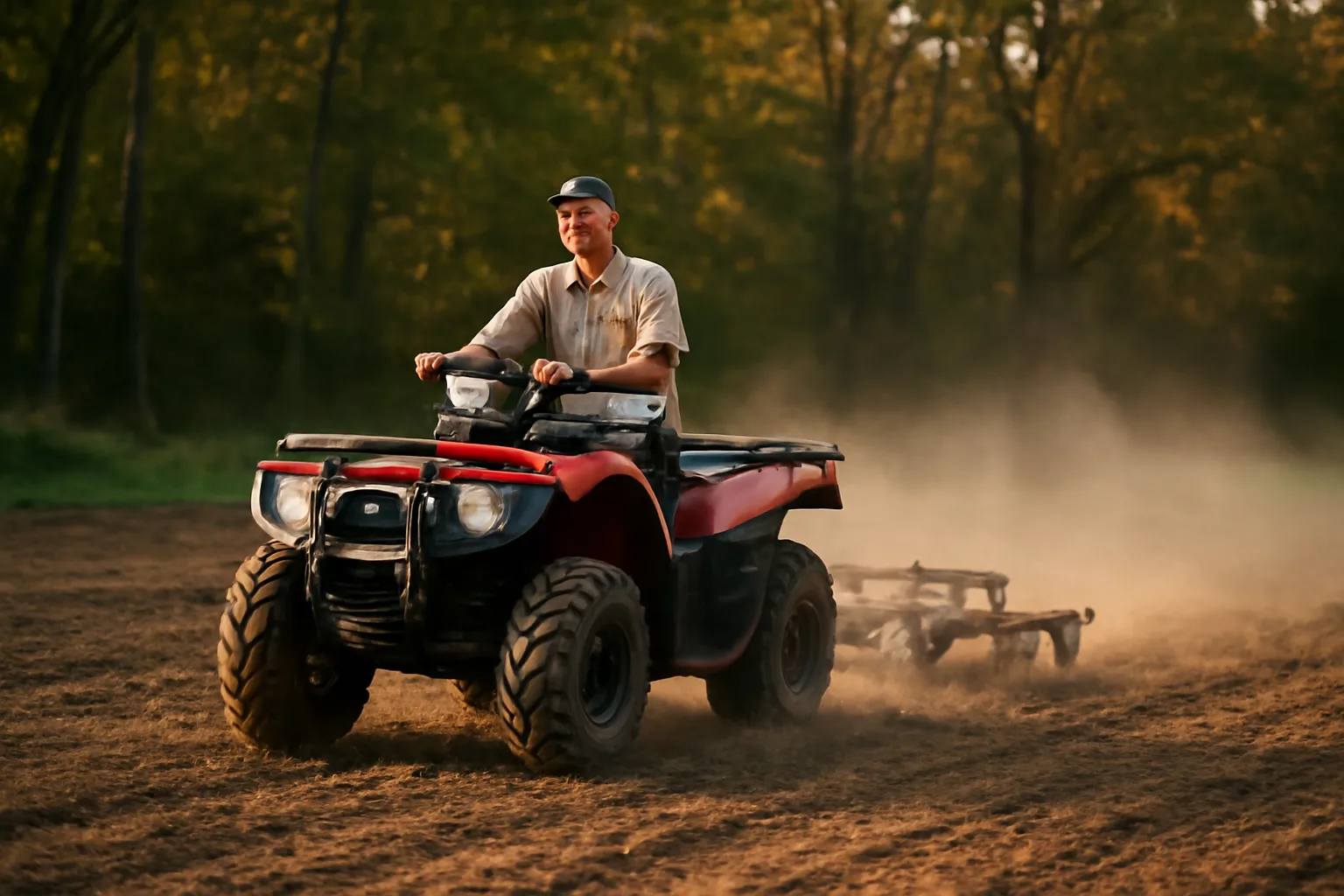
An ATV (or side by side) with a pull-behind sprayer, disc or cultipacker, and a broadcast spreader can plant a legitimate food plot from start to finish. You're trading tractor horsepower for patience: more passes, smaller implements, and tighter attention to seedbed prep. Most 1-3 acre plots are well within ATV range.
can you really plant a food plot with just an ATV?
Yes. An ATV or UTV in the 400cc to 700cc range, with a receiver hitch or drawbar, can pull the same category of implements a small tractor would, just at smaller widths and lighter weights. Think 4 to 5 foot discs instead of 7 foot ones, tow-behind sprayers with 15 to 25 gallon tanks instead of 100 gallon 3-point units, and cultipackers scaled to match. The tradeoff is time and finesse, not capability. A half-acre to 3-acre plot, which describes most hunting-lease and small-property plots, is genuinely easier to manage with an ATV than with a tractor that's overkill for the space. You'll make more passes and you'll need to plan trailer trips for lime and seed, but the actual agronomy (kill weeds, test soil, work the ground, plant at the right depth, cultipack) doesn't change based on horsepower. Where ATVs struggle is heavy sod-busting on virgin ground, moving lime in bulk (a ton of pelletized lime is 40 fifty-pound bags, and that adds up fast on a trailer rated for 1,000 to 1,500 pounds), and working wet, heavy clay. If your plot has never been broken before, you may need to rent a tractor with a heavier disc for the first pass and switch to ATV maintenance after that.
what is a food plot, exactly?
A food plot is a planted area, usually somewhere between a quarter acre and several acres, seeded with forage crops to attract and hold deer or provide nutrition through specific seasons. It's more than a place you dump corn. State wildlife agencies generally treat food plots (planted, rooted crops) differently from bait piles (loose grain, minerals, or feed placed on the ground), and the legal distinction matters in states with baiting restrictions. Food plots serve a few overlapping purposes: hunting attraction during season, nutrition for antler and body growth in spring and summer, and winter survival forage in northern climates where natural browse gets scarce. A well-planned property usually runs a mix. That's a clover or chicory plot that persists for years, a brassica or grain plot planted fresh each fall, and sometimes a spring plot of soybeans or cowpeas for summer nutrition. Check your state's specific baiting and feeding regulations before you assume a food plot is automatically legal in every context; some states restrict hunting over any supplemental feed within a certain distance of a stand, even if it's a planted crop. Your state wildlife agency's hunting digest is the authoritative source here, not a forum post.
when should you plant food plots for deer?
Timing depends entirely on your USDA hardiness zone and whether you're planting a spring/summer plot or a fall plot. There is no single national planting date. General rule of thumb across most of the whitetail's range: fall plots (brassicas, cereal grains, clover) go in from late August through early October, timed so you get 6 to 10 weeks of growth before the first hard frost or hunting season, whichever comes first. Spring/summer plots (soybeans, cowpeas, sunflowers) go in after your last frost date, typically April through June depending on latitude. Extension publications generally tie planting windows to frost dates and soil temperature rather than a calendar date, because a warm year in zone 6 can push planting two weeks earlier than a cold one. Pull your local frost dates from the NOAA Climate.gov frost date tool before you buy seed, and always confirm against your own soil test results and county extension recommendations rather than a bag's generic date range [1].
when to plant oats for deer
Oats are a fall-planted cereal grain, and most extension guidance puts the window between mid-August and mid-October depending on zone, aiming for 45 to 60 days of growth before killing frost. Oats germinate fast (5 to 10 days in warm soil) and are one of the most forgiving cereal grains for a first-time ATV planter because they tolerate a rougher seedbed than clover does. In the Upper Midwest and northern tier states, get oats in by early September. In the transition zone (Kentucky, Tennessee, Virginia), late September to mid-October works. In the Deep South, you can push into late October and still get a solid stand because frost comes later. Oats are also a good choice if your ATV setup is minimal, meaning a spreader and a drag harrow, because they don't demand the fine, firm seedbed that clover or brassicas need for good soil-to-seed contact. A quarter to half inch of coverage is enough; deeper than an inch and germination drops off.
when to plant turnips for deer
Turnips, like other brassicas, are planted in late summer to early fall, generally 60 to 90 days before your first expected hard frost. That translates to late July through early September in northern zones and August through mid-September in the transition zone. Turnips need that lead time because the crop does two things: it builds leafy top growth deer hit hard in early fall, and it bulbs up underground, and that bulb becomes more palatable and starch-rich after a couple of frosts convert starches to sugars. Plant too late and you get small bulbs and thin tops going into winter. Plant too early in hot, dry August soil and germination can be spotty without irrigation or a timely rain. Seeding depth matters more than people think: turnip seed is tiny and should go no deeper than a quarter inch, which is exactly why a cultipacker or roller behind your ATV earns its keep. Broadcasting turnip seed onto bare, firm soil and rolling it in works better than trying to drag it under with a disc, which buries it too deep.
do deer eat sorghum, and is it worth planting?
Deer will eat sorghum, particularly the grain heads and, to a lesser extent, the foliage, but it's not a top-tier food plot choice on its own. Sorghum (grain sorghum, or milo) is more commonly planted as a screening or bedding cover crop, or mixed into a blend for structure and late-season standing grain, than as a primary attractant. Where sorghum earns its place is in mixed plantings with soybeans or cowpeas, where the stalks provide structure for climbing legumes, or as a standalone screen to block sightlines into a plot or bedding area. According to the USDA NRCS plant guide for grain sorghum, the crop is drought-tolerant and adapted to many soil types, which is part of why it works as a low-input filler planting on ATV-scale ground [2]. It's easy to grow with basic ATV equipment (broadcast and cultipack, similar to corn), but if you're choosing one species to maximize deer use, clover, soybeans, or brassicas will outperform it in most field comparisons.
do deer eat clover, and do they actually like it?
Yes, and it's one of the most consistently preferred forages in food plot research. Clover (white clover, red clover, and various blends) offers 20 to 30+ percent crude protein in vegetative growth and stays palatable across spring, summer, and fall, which is rare for a single planting. University extension forage testing consistently ranks clover among the highest crude protein food plot forages available, and its perennial nature (2 to 5 years of production from one planting, depending on species and maintenance) makes it one of the best returns on ATV labor. You disc and plant once, then spend subsequent years mowing, spraying for weed suppression, and maybe overseeding rather than tearing the ground up again. That perennial character is exactly why clover is the plot most worth using better equipment on at planting: a firm, fine seedbed and a cultipacker pass before and after seeding make the difference between a thick stand and a patchy one, because clover seed is small and unforgiving of poor soil contact. If you're mapping out a property's rotation, a food plot whitetail plan that pairs a perennial clover plot with an annual fall plot covers both season-long nutrition and hunting-season attraction.
what are deer's favorite foods, and how does that change by season?
There's no single "favorite," because deer preference shifts hard with season, availability, and regional habitat. In spring and summer, deer key on high-protein forbs, clover, soybeans, and natural browse to support antler growth and lactation. In early fall, they shift toward acorns and other mast when it's dropping, often ignoring food plots entirely during a heavy acorn year. Late season, especially in northern climates, deer key hard on high-carbohydrate foods: standing corn, soybeans left in the field, and brassica bulbs and tubers that have gone through a frost or two. Regional research and extension forage trials generally rank soybeans, clover, and brassicas near the top of preferred plantings, with corn valuable mainly as a late-season energy source rather than early-season attraction. The practical takeaway: no single species covers a whole season. That's why most working plot programs plant more than one type. If you're building out a deer food plots rotation, pairing a spring/summer soybean or clover plot with a fall brassica or cereal grain plot covers the preference shift instead of fighting it with one crop.
do deer like honey (or anything sweet), and does it matter for plots?
There's no research support for deer having a meaningful attraction to honey specifically, and it's not a practical or legal additive in most food plot or hunting contexts. Deer are drawn to sugar content in a general sense (which is part of why frost-sweetened brassicas and standing corn get hit hard late season), but that's a function of carbohydrate and sugar levels in growing plants, not a product you add. Many states also classify any placed attractant, sweet liquid, scent, or otherwise, as bait if it's not part of a rooted, growing crop, which puts it in the same regulatory bucket as corn piles. If you're curious about attractant products, check your state wildlife agency's baiting definition first; it will save you a citation. The real answer for anyone asking about "sweet" attraction is: plant brassicas and let a frost do the sweetening naturally, legally, and for free.
what ATV equipment do you actually need to plant a food plot?
| Kill existing vegetation | Tow-behind or 3-point ATV sprayer, 15-25 gal | $200-$600 | |
|---|---|---|---|
| Break ground / work soil | ATV disc harrow, 4-5 ft | $400-$900 | |
| Firm seedbed / seed-in | Cultipacker or drag harrow, ATV-scale | $300-$800 | |
| Spread seed and fertilizer | Broadcast spreader (tow or spin-cast) | $100-$400 | |
| Haul lime, seed, fuel | Utility trailer, 4x6 or 5x8 | $600-$1,500 | A disc, a drag or cultipacker, and a broadcast spreader will plant 90 percent of standard food plot mixes. Add a sprayer once you're managing weeds in a perennial clover plot, since spot-spraying grass competition is what keeps clover thick into year two and three. If your ground is compacted or has never been worked, budget for renting a heavier tractor-disc pass once; after that, ATV-scale maintenance discing is usually enough. Retailers selling food plot seed and deer food plot seed often list recommended seeding rates and depths on the bag, which should guide your spreader settings more than a general rule of thumb. |
A workable ATV food plot kit has five pieces, and you don't need all of them brand new or matched. Most ATV planters build this out over two or three seasons rather than buying it all at once. | Task | ATV-scale implement | Rough cost range (new) |
what's the actual step-by-step process for planting a plot with an ATV?
The order of operations matters more than the specific tools, and skipping steps is the number one reason ATV plots fail or come in thin. 1. Soil test first, months ahead if possible. A basic soil test through your county extension office runs $10 to $20 in most states and tells you your pH and nutrient needs before you spend a dollar on seed. Your lab's recommendations are the authority on lime and fertilizer rates for your specific ground, not a generic online guide. 2. Kill existing vegetation with glyphosate 2 to 3 weeks before you plan to work the ground, giving it time to translocate through weeds and grass roots. 3. Apply lime according to your soil test, ideally 2 to 6 months before planting since lime takes time to move pH. If your test calls for a full ton per acre and your ATV trailer only holds 1,000 pounds at a time, plan multiple trips; don't skip the lime because hauling it is a hassle, since a plot planted into acidic soil under 6.0 pH will underperform no matter how good your seed is. 4. Disc or till to break up dead vegetation and create a workable seedbed, 2 to 3 passes if the ground is compacted. 5. Broadcast fertilizer per your soil test recommendation, then broadcast seed at the labeled rate. 6. Cultipack or drag to firm the seedbed and press small seed (clover, brassica) into good soil contact; larger seed (oats, soybeans) can be lightly disced in or cultipacked depending on the species. 7. Watch the weather. Seed going down within 24 to 48 hours of a forecast rain germinates faster and more evenly than seed sitting in dry soil waiting for moisture. A $99 Custom Food Plot Plan is built around this same sequence, matched to your zone, soil test, and the equipment you already have, so you're not guessing at seeding rates or planting windows on a bag label written for a different region.
how big a plot can one ATV realistically handle?
Most single-ATV setups handle 1 to 3 acres comfortably in a weekend, factoring in spraying, discing, and planting as separate passes done over consecutive days or weekends. Push past 5 acres with ATV-scale implements and you're looking at multiple full days per pass, which is where a lot of hunters start renting or borrowing a compact tractor for at least the initial breaking pass. The limiting factor usually isn't the ATV's power, it's implement width and trailer capacity for hauling lime and seed. A 4-foot disc working a 2-acre plot means roughly twice the passes of a 7-foot tractor disc on the same ground. That's fine if you have the weekends to give it; it's a real constraint if you're planting five or six small plots across a lease in a single fall window.
Frequently asked questions
Do deer eat sorghum?
Yes, deer eat sorghum grain and some foliage, but it's a secondary food plot choice, most useful as screening cover or mixed with soybeans for structure. For pure attraction, clover, soybeans, and brassicas outperform sorghum in most extension forage comparisons.
Do deer eat clover?
Yes, clover is one of the most preferred and highest-protein food plot forages, often testing at 20 to 30 percent crude protein in vegetative growth. It's palatable spring through fall and, as a perennial, can produce for 2 to 5 years from one planting with proper mowing and weed control.
When to plant deer food plots?
Fall plots (clover, brassicas, cereal grains) generally go in late August through early October, timed 6 to 10 weeks before your first hard frost. Spring/summer plots (soybeans, cowpeas) go in after your last frost date, typically April through June. Exact timing depends on your USDA hardiness zone and local frost dates.
Do deer like clover?
Yes, clover ranks near the top of preferred food plot forages in extension research due to its high crude protein content and long season of availability. It's often the first species deer hit in a mixed plot planting, especially in spring and summer.
When to plant oats for deer?
Oats are planted in fall, generally mid-August through mid-October depending on zone, giving 45 to 60 days of growth before a killing frost. They germinate quickly (5 to 10 days) and tolerate a rougher seedbed than clover or brassicas, making them forgiving for ATV planters.
When to plant food plots for deer?
It depends on the crop and your zone: fall annuals like brassicas and cereal grains go in late summer to early fall, while spring/summer plots like soybeans go in after last frost. Always check your local extension office's frost dates rather than relying on a generic seed bag date.
When to plant turnips for deer?
Turnips go in 60 to 90 days before your first expected hard frost, generally late July through early September in northern zones and into mid-September in the transition zone. That lead time lets the bulb develop and sweeten with fall frosts before hunting season.
What is a food plot?
A food plot is a planted area of forage crops, typically a quarter acre to several acres, seeded to attract deer and provide nutrition through specific seasons. It's legally and practically distinct from a bait pile in most states, since it's a rooted, growing crop rather than placed feed.
What are deer's favorite foods?
There's no single favorite; preference shifts by season. Deer key on high-protein clover and soybeans in spring and summer, natural mast like acorns in early fall when available, and high-carb foods like standing corn and frosted brassicas in late season.
Do deer like honey?
There's no research showing deer are meaningfully attracted to honey specifically. Their attraction to sugar is tied to naturally occurring carbohydrates in plants, like frost-sweetened brassica bulbs, not to added sweet substances, many of which are also legally classified as bait in various states.
Can a small ATV really plant a food plot without a tractor?
Yes, for plots in the 1 to 3 acre range, an ATV or UTV with a disc, cultipacker, and broadcast spreader can handle the full process: spraying, tillage, seeding, and firming. Larger plots or heavy, uncleared ground may still need one tractor pass to start.
What's the minimum equipment to plant a food plot with an ATV?
At minimum you need a way to work the soil (a drag harrow or small disc), a broadcast spreader for seed and fertilizer, and ideally a cultipacker for small-seeded crops like clover and brassicas. A sprayer becomes important once you're managing perennial plots or heavy weed pressure.
How much does it cost to plant a food plot with ATV equipment?
Basic ATV implements (spreader, small disc, drag harrow) run roughly $700 to $1,700 combined new, plus seed, lime, and fertilizer costs per acre based on your soil test. Renting equipment for a single season instead of buying is often cheaper for a one or two-plot property.
Sources
- NOAA Climate.gov, First Fall and Last Spring Frost Dates Map: Regional frost date data used to time spring and fall plot planting windows, since planting guidance is tied to frost dates rather than a fixed calendar date
- Penn State Extension, Food Plots for Wildlife (Penn State Agronomy Guide): Seedbed preparation, soil testing, and liming steps for successful food plot establishment
- USDA NRCS Plant Fact Sheet, White Clover (Trifolium repens): Clover crude protein content and perennial production characteristics
- USDA NRCS Plant Guide, Grain Sorghum (Sorghum bicolor): Sorghum growth characteristics, drought tolerance, and use as a wildlife food and cover planting
- USDA NRCS Plant Fact Sheet, Purple Top Turnip (Brassica rapa): Turnip and brassica growth habit and recommended planting lead time before frost
- University of Georgia Extension, Wildlife Food Plots (Bulletin 1347): Recommended lime application timing relative to planting for pH adjustment