Last updated 2026-07-25
TL;DR
Most food plots run between a quarter acre and two acres. Small, hidden kill plots for bow season can be as tight as 1/10 to 1/2 acre. Larger destination or ag-style plots for whole-herd nutrition often run 1 to 5 acres. Size depends on your goal (hunting vs. feeding), deer density, equipment, and how much cover surrounds the opening.
What is a food plot, exactly?
A food plot is a planted area on hunting land, usually somewhere between a few hundred square feet and several acres, seeded with forage that deer and other wildlife will eat. It's not a garden and it's not a lawn. The goal is either to hold deer on your property, give them better nutrition than the surrounding woods and ag fields offer, or create a spot you can hunt over. Most state wildlife agencies and land-grant extension programs treat food plots as a wildlife habitat management tool, separate from row-crop agriculture, even though the planting methods overlap a lot. The USDA's NRCS maintains conservation practice standards covering wildlife habitat work, including Practice Standard 645 (Upland Wildlife Habitat Management), and cost-share programs in several states will help fund food plots or similar plantings as part of broader habitat management [1]. There are two broad categories, and they get sized very differently: kill plots (small, tucked into cover, meant to be hunted at close range) and destination or nutrition plots (larger, meant to feed a herd through summer or winter stress periods). Everything in this article assumes you already know which type you're building. If you don't, that decision comes before the acreage math. For a rundown of plot styles and how they differ, see food plot whitetail.
How big should a deer food plot actually be?
For a bow-season kill plot, 1/4 acre to 1/2 acre is the sweet spot for most properties. Small enough that deer feel safe stepping into it in daylight, large enough to hold a few plants worth eating past October. Some hunters go smaller, down to a tenth of an acre, tucked into a logging clear-cut or a bend in a creek bottom. That works fine if the surrounding cover is thick and the plot is basically a bedroom door deer walk through anyway. For destination or nutritional plots meant to carry a herd through late summer drought or a hard winter, you want more like 1 to 5 acres, sometimes bigger on large tracts. The logic is simple: a half-acre plot gets hammered to dirt by August if you're running any real deer density. A 3 to 5 acre plot of a tough perennial like clover or chicory can take that pressure and keep producing. Most state agency and university guidance converges on a rough rule: dedicate somewhere between 1% and 5% of your total acreage to food plots, with the plots themselves broken into multiple smaller fields rather than one giant opening. University extension wildlife specialists commonly recommend multiple small to mid-size plots scattered across a property rather than one large one, both for browse pressure reasons and because it spreads deer activity across more of your land, giving you more usable stand sites [2].
How much food plot acreage do I need for my deer density?
This is the question size charts skip, and it's the one that actually matters. A half-acre clover plot in a county with 15 deer per square mile behaves completely differently than the same plot where density hits 40+ deer per square mile. There's no perfect formula, and any extension agent who tells you otherwise is oversimplifying. But a commonly cited starting point from wildlife management literature is roughly 1 acre of quality food plot per 20 to 30 deer, assuming decent natural browse is also available on the property. In high-density areas of the Midwest and Southeast, some managers push closer to 1 acre per 10 to 15 deer because natural browse is already stressed. Your state wildlife agency's deer density estimates by management unit are the place to start. Many states, including Pennsylvania, Michigan, and Georgia, publish annual deer population estimates or harvest density data by wildlife management unit on their .gov sites. Cross-reference that with what your own trail cameras and browse pressure are telling you. If your clover gets mowed to nubs by June every year, you need more acreage, more plots, or fewer deer, not more plot design. If you'd rather not guess at all this yourself, a Custom Food Plot Plan from PlotSeason runs $99 one-time and factors in your acreage, region, and goals to hand back species and layout guidance. It's general guidance, not site-specific agronomy. Your soil test lab is still the final word on lime and fertilizer rates for your dirt.
When should you plant food plots for deer?
Timing splits into two windows almost everywhere in the whitetail's range: a spring/summer planting for warm-season forage, and a late-summer planting for fall/winter annuals. The exact dates shift by USDA plant hardiness zone, so a Georgia planting date and a Minnesota planting date can be six to eight weeks apart. As a rough national framework: spring plantings (clover, chicory, soybeans, corn) go in after your last frost date, typically April through May in the Midwest and Northeast, March in the Deep South. Fall plantings (brassicas, cereal grains, annual clovers) go in 60 to 90 days before your first hard frost, which usually lands somewhere between late July and early September depending on latitude. Your state's cooperative extension office publishes a frost-date map and planting calendar specific to your county, and that's a better source than any generic national chart. NOAA's National Centers for Environmental Information maintains historical freeze/frost date normals by weather station that many extension programs draw from when building local planting calendars [3]. For a zone-by-zone breakdown built specifically around deer plot timing rather than row-crop timing, see PlotSeason's deer food plots guide.
When should you plant oats for deer?
Plant oats for deer 6 to 10 weeks before your area's first fall frost, which puts most of the country somewhere between mid-August and mid-September. Oats are a cool-season annual grain that deer hit hard as soon as it emerges, often before brassicas or clover in the same field get touched. Oats germinate fast, usually within 7 to 10 days in warm, moist soil, and they can be grazed down to almost nothing by hungry deer in high-density areas within a few weeks of emergence. Because of that, a lot of experienced plotters mix oats with something slower to establish, like a brassica or a cereal rye, so there's still something growing after deer strip the oats. Oats also winterkill in most of the northern half of the country once temperatures drop into the teens for extended periods, so they're primarily an early-fall to early-winter forage, not a food source that carries into February the way brassicas or stockpiled clover can.
When should you plant turnips for deer?
Turnips go in 80 to 90 days before your first expected frost, generally late July through mid-August across most of the whitetail's range, a little earlier up north and later in the Deep South. That window matters more with turnips than almost any other food plot species, because turnips need real time to bulb before cold weather locks in the sugar conversion that makes them palatable. Here's the thing nobody tells new plotters: deer often ignore turnip tops and bulbs completely until after the first hard frost or two. The cold converts starches to sugars, and that's when a turnip plot goes from untouched to eaten to dirt in a matter of days. If you plant turnips too late, that frost-sweetened window either gets cut short or misses your hunting season entirely. University extension brassica guidance generally notes that turnips and other brassicas need adequate soil moisture at planting and roughly 80 or more days of growing season to reach a usable bulb size before hard freeze [4].
Do deer eat sorghum?
Yes, deer eat sorghum, both the leaves and the grain heads, though it's not usually a first-choice forage the way clover or soybeans are. Grain sorghum (milo) is more commonly planted as a screening or standing-corn-alternative crop that also feeds deer and turkey through winter once the seed heads mature and dry down. Sorghum's real value in a food plot mix is often structural. It grows tall (4 to 7 feet), gives deer cover to move through in daylight, and holds its grain into winter after other annuals are gone. Some plotters use it as a nurse crop or screen around the edge of a clover or brassica plot, giving deer confidence to enter the field earlier in the evening. Deer will browse young sorghum shoots readily, and whitetail-specific sorghum/sudangrass blends are sold by most food plot seed companies for exactly this dual purpose: forage plus cover. If your goal is pure nutrition tonnage, though, soybeans or a clover blend will out-produce sorghum on a per-acre feed value basis.
Do deer like clover, and is it their favorite food?
Yes, deer like clover a lot, and it's one of the most consistently productive food plot forages available. White clover (including Ladino types) and red clover both show up repeatedly in university deer research plots because they combine high protein content, typically 20 to 30% crude protein in vegetative growth, with strong regrowth after grazing [5]. Is clover deer's single favorite food? That's a harder claim to prove. Deer are opportunistic browsers and their preferences shift by season, region, and what else is available. In spring and summer, clover, soybeans, and native forbs top most preference studies. In fall, acorns often beat everything, including clover, when there's a good mast crop on the ground. Deer will walk past a lush clover plot to eat white oak acorns almost every year there's a strong drop. What clover does better than almost anything else is durability. A well-maintained perennial clover plot can produce forage for 3 to 5 years before needing to be reseeded, unlike annuals that need replanting every year. That's why it's the backbone forage in most multi-plot systems: deer food plot seed blends built around clover give you a base that's productive most of the growing season, with annuals rotated in around it for fall hunting.
What are deer's favorite foods overall?
| White oak acorns | 6-10% | Very high when available | Fall | |
|---|---|---|---|---|
| Soybeans (vegetative) | 25-30% | Very high | Summer | |
| White clover | 20-30% | High | Spring-fall | |
| Brassicas (turnip/radish) | 15-20% (leaves), higher sugar in bulb | High after frost | Fall-winter | |
| Grain sorghum | 8-11% | Moderate | Fall-winter | |
| Standing corn | 8-10% | Moderate (high in winter for energy) | Fall-winter | Protein figures are approximate ranges compiled from extension forage tables and vary by soil fertility, plant maturity, and growing conditions [6]. Don't treat any single number here as gospel for your field; your own soil test and forage sample would give the real answer for your dirt. |
Deer preference research consistently ranks a handful of foods at the top: acorns (especially white oak family acorns, which are lower in tannins and more palatable than red oak acorns), soybeans, clover, and native forbs and browse specific to the region. Corn is popular with hunters but it's actually a lower-protein, lower-preference food relative to legumes; deer eat it readily, especially in winter for energy, but it's not top-tier nutrition. Multiple state wildlife agencies and university deer research programs have published forage preference data over the years, and acorns consistently come out near the top whenever they're available, often pulling deer off planted plots entirely during a heavy mast year. Here's a rough comparison of common food plot and natural forage options: | Food source | Typical crude protein | Deer preference | Season available |
Do deer like honey, and does it belong in a food plot?
Deer aren't drawn to honey the way they're drawn to sugar-rich forage or mineral licks, and honey has no real place in food plot planning. This question usually comes up because of "honey hole" slang or confusion with commercial deer attractant products, some of which do use molasses or sugar-based scents to draw deer to a mineral site or bait pile, not a planted plot. If you're trying to figure out whether a sweet attractant will pull deer to a spot, check your state's baiting and supplemental feeding regulations first. This varies enormously by state and even by county in some cases. Michigan, for example, restricts baiting and feeding deer statewide in the Lower Peninsula under its Wildlife Conservation Order due to chronic wasting disease and bovine TB concerns, with specific exceptions tied to food plots versus bait piles [7]. Wisconsin similarly enforces county-by-county baiting bans tied to its chronic wasting disease and baiting/feeding rules under Wisconsin Administrative Code NR 19 [8]. A planted food plot is legal essentially everywhere; a bait pile or mineral lick with molasses or honey added to it might not be, depending on your state and county. Always check your state wildlife agency's current regulations before adding any attractant to a hunting site.
How does plot shape and layout affect the size you need?
A long, narrow, kidney-bean or hourglass-shaped plot lets you hunt more of it with less deer exposure to human scent and lets you place a stand where wind works from more directions. A square or round plot the same total acreage forces deer to cross more open ground to reach any one edge, which spooks more mature bucks in daylight. For a half-acre kill plot, aim for a shape roughly 200 feet long by 100 feet wide, or a kidney shape that lets you tuck a stand into a pinch point. That gives you edge habitat on both the entry and exit sides, which matters more for daylight movement than raw acreage does. For larger destination plots over an acre, don't feel obligated to keep one continuous opening. Two or three smaller plots totaling 3 acres, connected by travel corridors of standing timber, usually hold and move deer better than one 3-acre clear-cut. That's consistent with the university extension guidance mentioned earlier: multiple smaller plots outperform one big one for both browse pressure and huntability [2].
What equipment do you actually need, and does plot size change that?
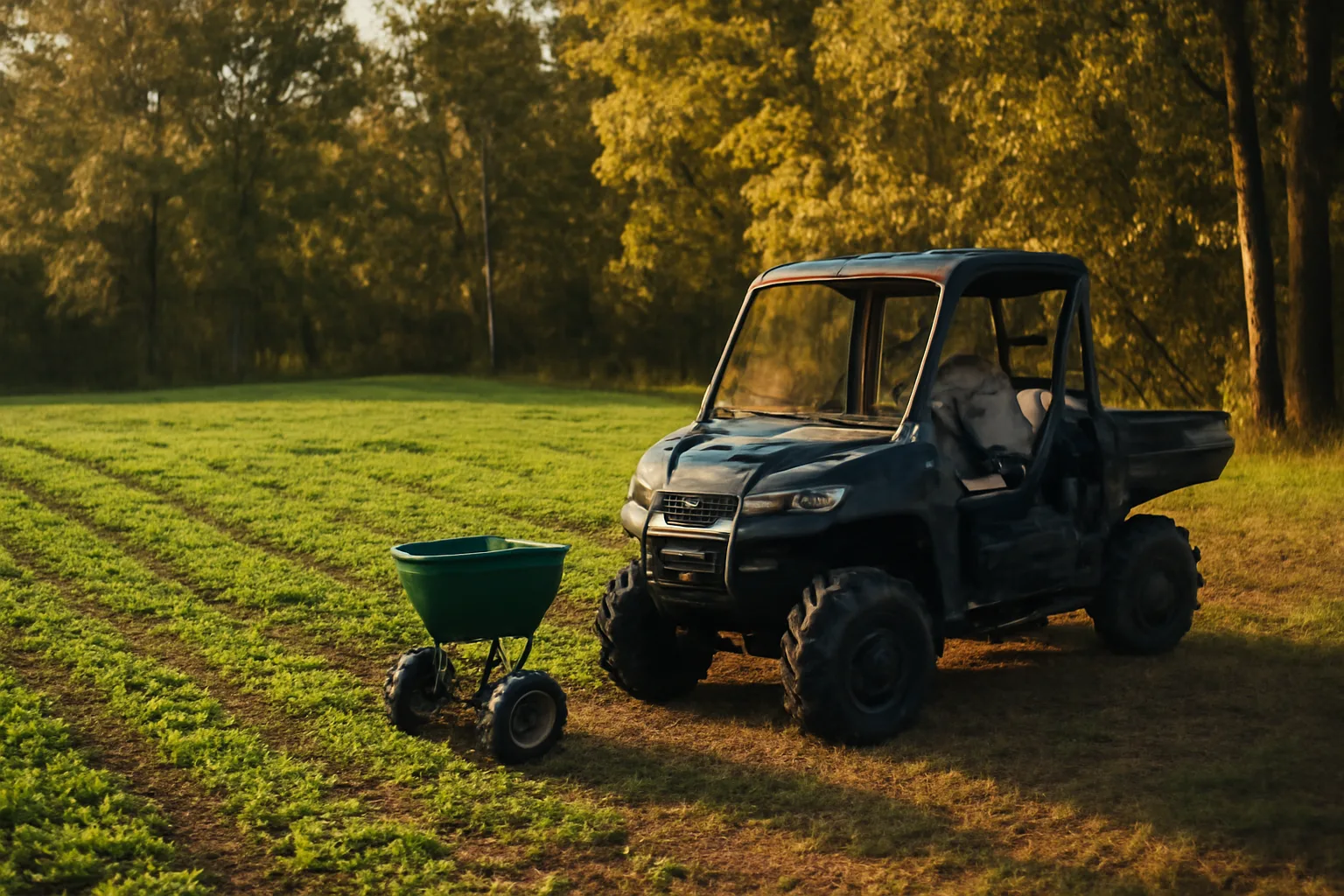
Under half an acre, you can plant with hand tools or a small ATV/UTV mounted spreader, a hand-crank broadcast spreader, and a drag harrow made from a chain-link fence section. A lot of successful kill plots get planted entirely with a UTV, a bag of seed, and an afternoon. Over an acre, you're better off with a tractor, even a small 25 to 45 horsepower compact tractor, running a disc or tiller, a cultipacker, and a broadcast spreader or no-till drill. The math on renting versus owning depends on how many plots you're running and how many years you'll keep doing this; most guys with 2 to 4 plots on 40 to 100 acres end up buying a used compact tractor within a couple seasons because rental costs and scheduling headaches add up fast during the narrow August planting window. Soil prep matters more than horsepower. A perfectly disced seedbed planted with a hand spreader will outperform a rough, clumpy field planted with a $40,000 no-till drill. Get your soil test done first (most state land-grant university soil labs run $10 to $20 per sample and turn results in 1 to 2 weeks), amend based on what it says, and only then worry about which piece of equipment gets the seed in the ground. For a full rundown of what to plant and how, food plot seed and deer for food cover species selection in more depth.
Frequently asked questions
How big should a deer food plot be?
Most kill plots run 1/4 to 1/2 acre. Destination or nutrition plots for whole-herd feeding run 1 to 5 acres, often split into several smaller fields rather than one large opening. Deer density, available natural browse, and hunting versus feeding goals all shift the right number for your property.
What is a food plot?
A food plot is a planted area, usually a fraction of an acre up to a few acres, seeded specifically with forage to feed deer and other wildlife or to create a spot to hunt over. It's managed as wildlife habitat, distinct from row-crop farming, though the equipment and methods overlap heavily.
When to plant food plots for deer?
Spring plantings (clover, soybeans, chicory) go in after your last frost, typically March in the South through May in the North. Fall plantings (brassicas, cereal grains, annual clovers) go in 60 to 90 days before your first fall frost, usually late July through early September depending on latitude.
When to plant oats for deer?
Plant oats 6 to 10 weeks before your area's first fall frost, generally mid-August to mid-September across most of the whitetail range. Oats germinate fast, often within 7 to 10 days, and get grazed hard early, so many hunters mix them with a slower brassica for later-season food.
When to plant turnips for deer?
Plant turnips 80 to 90 days before your first expected frost, generally late July through mid-August. Deer often ignore turnip bulbs and tops until after a hard frost sweetens the starches, so planting late enough to bulb up but early enough to hit that frost window matters a lot.
Do deer eat sorghum?
Yes. Deer browse young sorghum shoots and eat the mature grain heads, though it's usually not a first-choice forage compared to clover or soybeans. It's often planted for cover and winter standing grain rather than as the primary nutrition source in a plot.
Do deer eat clover, and do deer like clover?
Yes, deer eat and clearly prefer clover. White and red clover run 20 to 30% crude protein in vegetative growth and regrow well after grazing, making clover one of the most reliable perennial forages in whitetail food plot systems across most of the country.
What are deer's favorite foods?
Acorns, especially white oak family acorns, typically top preference studies when available, often pulling deer off planted plots entirely during a good mast year. Soybeans and clover follow closely behind for spring and summer forage, with brassicas and cereal grains preferred in fall and winter.
Do deer like honey?
Not particularly, and honey isn't a food plot ingredient. Confusion here usually comes from sugar-based commercial attractants used at mineral or bait sites, which is a separate practice from planting forage. Check your state's baiting and feeding regulations before using any attractant, since rules vary widely.
How much food plot acreage do I need per deer?
A rough starting point from wildlife management literature is 1 acre of quality food plot per 20 to 30 deer where natural browse is decent, tightening to 1 acre per 10 to 15 deer in high-density areas. Your state agency's deer density data by management unit is the best starting reference.
Is a bigger food plot always better?
No. A single oversized plot often gets less daylight deer activity than several smaller plots spread across a property, because deer feel exposed in large open fields. Multiple 1/4 to 1-acre plots connected by cover usually outperform one giant field for both browse durability and huntability.
What's the minimum size for a food plot to work?
Plots as small as a tenth of an acre can work if they're tucked into thick cover and function as a close-range kill plot rather than a nutrition source. Below that, deer traffic and forage volume both drop off fast, and the plot stops being worth the seed cost.
Sources
- USDA Natural Resources Conservation Service, Conservation Practice Standard 645, Upland Wildlife Habitat Management: Food plots and wildlife habitat plantings are recognized under USDA NRCS conservation practice standards, some eligible for cost-share support.
- Alabama Cooperative Extension System, Food Plots for Deer and Other Wildlife (ANR-2044): Multiple smaller food plots scattered across a property generally outperform one large plot for browse pressure and deer distribution.
- NOAA National Centers for Environmental Information, Freeze/Frost Occurrence Data: Historical freeze and frost date normals by weather station are used by extension programs to set fall planting windows.
- Clemson Cooperative Extension, Brassicas for Deer Food Plots: Brassicas including turnips need an adequate growing season and soil moisture to reach usable bulb size before hard freeze.
- University of Georgia Extension, Food Plots for Wildlife (Bulletin 1348): White and red clover typically provide roughly 20 to 30 percent crude protein in vegetative growth stages.
- USDA Natural Resources Conservation Service, PLANTS Database Plant Profile for Red Clover (Trifolium pratense): Comparative crude protein and forage characteristics for clover and other food plot forage species.
- Michigan Department of Natural Resources, 2024 Wildlife Conservation Order, Baiting and Feeding of Deer: Michigan restricts deer baiting and feeding in parts of the state due to chronic wasting disease and bovine TB management, with rules that differ from food plot regulations.
- Wisconsin Administrative Code, NR 19 Wild Animals: Wisconsin enforces baiting and feeding rules tied to chronic wasting disease management that vary by county.