Last updated 2026-07-25
TL;DR
A food plot soil test kit measures pH, phosphorus, potassium, and organic matter so you know what to fix before seed goes in the ground. Home kits run $10-$20 and give rough estimates. Lab tests through a land-grant extension office cost $8-$20 per sample and give real lime and fertilizer numbers. Test 2-3 months before planting so amendments have time to work.
what is a food plot soil test kit
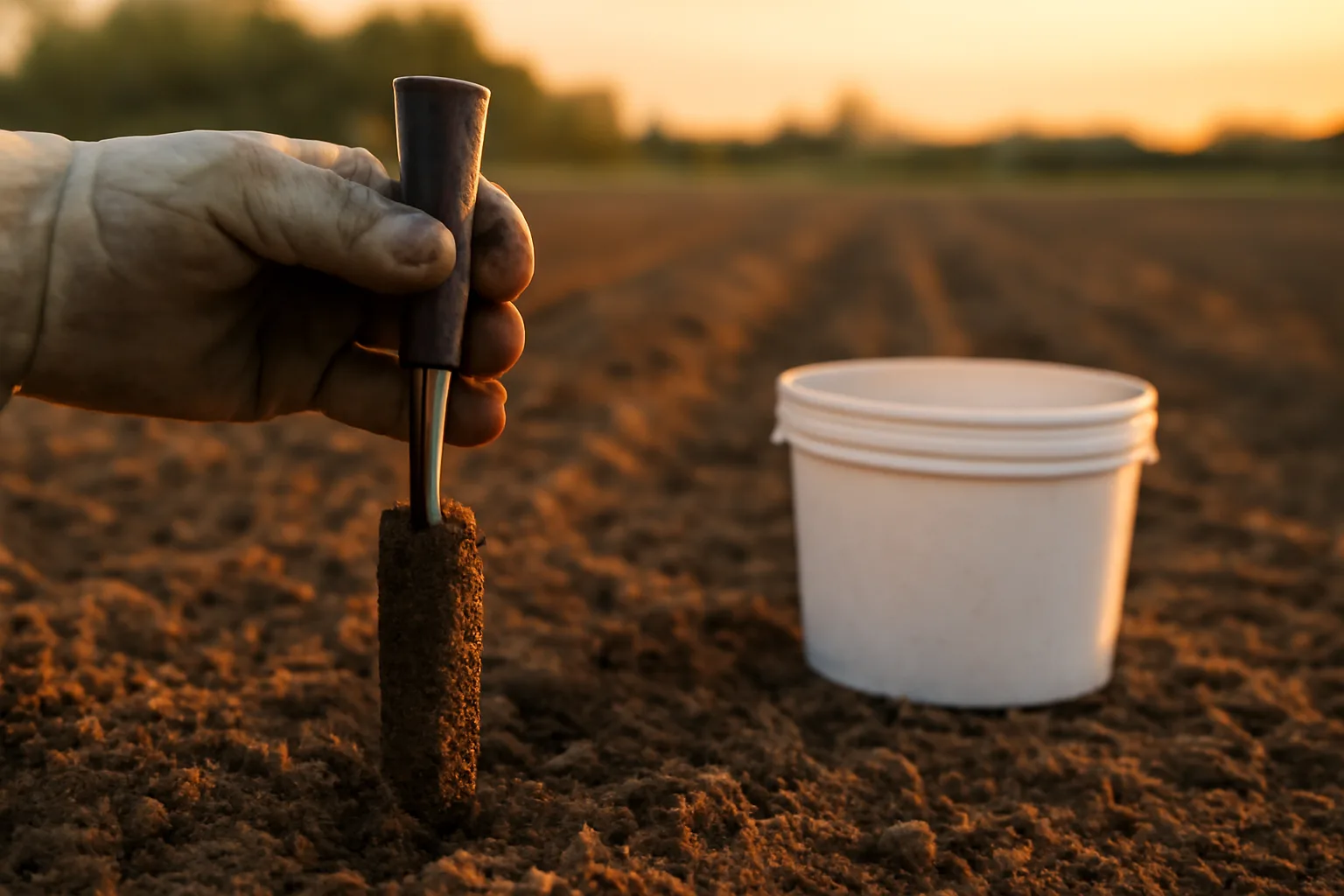
A food plot soil test kit is a tool for measuring the chemistry of your dirt before you plant anything. At minimum it tells you pH (how acidic or alkaline the soil is) and gives some read on phosphorus, potassium, and sometimes nitrogen and organic matter. Some kits are simple colorimetric strips or capsules you mix with soil and water in the field. Others are just a box, a bag, and a mailing label that sends your sample to a university lab. The cheap drugstore-style kits (the ones with little vials and colored liquid) run about $10 to $20 and give you a ballpark reading, usually in ranges like "low, medium, high" rather than exact numbers. They're fine for a quick gut check but they're not precise enough to calculate exact lime or fertilizer rates. The better move, and what most state extension services recommend, is a real lab test. You still buy a kit (a box and sample bags), but instead of reading colors yourself, you mail dirt to a lab and get a printed report with actual parts-per-million numbers and specific recommendations for your crop. Land-grant universities like Penn State, Mississippi State, and Purdue run these labs and typically charge $8 to $20 per sample [1] [2]. A soil test kit does not tell you whether deer will show up. It tells you whether your soil can grow the crop you're planting. Those are different questions, and mixing them up is the single most common mistake in food plot planning.
why do you need a soil test before planting a food plot
Without a soil test you're guessing at lime and fertilizer rates, and guessing usually means underapplying lime, which is the single biggest yield killer in food plots. Clover, brassicas, and most legumes want a pH between 6.0 and 7.0. Below that, phosphorus and other nutrients get locked up chemically and the plant can't use them no matter how much fertilizer you dump on the ground [3]. Purdue Extension's food plot guidance is blunt about this: liming an acidic soil to the right pH does more for yield than any other single input, and it's cheaper than buying extra fertilizer to compensate for a low pH you never fixed [4]. If your soil sits at pH 5.2 (common in a lot of wooded, previously unfarmed ground), you might need 2 to 3 tons of ag lime per acre to get it to 6.5. That's not something you eyeball. A soil test gives you the tonnage. Skipping the test doesn't save money. It just moves the cost from a $10-$20 lab fee to wasted seed, wasted fertilizer, and a thin, weedy plot that deer walk past.
how do you use a food plot soil test kit correctly
Pull 8 to 12 subsamples from across the plot area, mix them in a clean plastic bucket, and send in one composite sample per distinct field or soil type. That's the standard method taught by most extension soil labs [1] [2]. Here's the process step by step: 1. Use a soil probe, auger, or a clean spade to pull cores from random spots across the plot, avoiding gate areas, old fence lines, and low wet spots that don't represent the whole field. 2. Sample to a depth of 4 to 6 inches for row crops and food plots (this differs from lawn testing, which is usually shallower). 3. Mix all the cores together in a plastic bucket. Never use a galvanized metal bucket, it can contaminate the zinc reading. 4. Pull about a pint of the mixed soil, let it air dry if wet, and put it in the sample bag from your kit. 5. Fill out the crop code correctly. Labs give different lime and fertilizer recommendations for clover versus brassicas versus corn, so this field matters. 6. Mail it in or drop it at your county extension office. Turnaround is usually 1 to 2 weeks depending on the lab's season (spring is their busy time). If you're testing multiple plots with different soil types (a bottom field versus a ridge-top clearing), test them separately. Combining a sandy plot and a clay plot into one sample gives you an average that's wrong for both.
when to plant food plots for deer
Timing depends entirely on what you're planting and where you live, but the general rule is: spring plots go in after your last frost, and fall plots go in 60 to 90 days before your first frost so the crop has time to establish before it gets cold or before hunting season starts. For most of the whitetail's range, that means spring plantings (soybeans, cowpeas, spring clover) go in April through June depending on latitude, and fall plantings (brassicas, cereal grains, fall clover) go in from mid-August through October. The USDA plant hardiness zone map is the standard reference for figuring out your frost dates and planting windows. A soil test result doesn't change your calendar, but it can change your outcome within that calendar. If your test comes back in June and says you need lime, get it applied that summer so it has months to react with the soil before you drill seed in August or September. Lime is slow. It can take 3 to 6 months to fully adjust soil pH, so late applications right before planting help some but not as much as an application done well ahead of time [3]. For a planting calendar built around your specific zone and species mix, food plot whitetail walks through regional timing in more detail.
when to plant clover for deer
Spring-planted clover generally goes in from March through May once soil temperatures hit the mid-50s Fahrenheit, though clover can also be frost-seeded in late winter (broadcast onto frozen or thawing ground in February or March) or planted in late summer, from mid-August to mid-September, if you have irrigation or reliable rain [4]. Clover needs a pH of 6.0 to 6.5 to fix nitrogen properly through its root nodules, which is why the soil test matters more for clover than for almost any other food plot species. Low pH doesn't just stunt clover, it can shut down the nitrogen-fixing bacteria entirely, leaving you with a pale, thin stand no matter how much you fertilize [3]. Do deer like clover? Yes, and it's one of the most consistently used food plot species across whitetail range. It's palatable, high in protein (often 20-25% crude protein in a well-maintained stand), and it regrows after grazing, so a good clover plot can get hit hard in spring and still bounce back by summer. It's also one of the lower-maintenance perennial options once it's established, typically lasting 3 to 5 years before you need to reseed.
when to plant oats for deer
Oats are almost always a fall planting, going in from late August through September in most of the whitetail's range, timed so the oats germinate and put on 4 to 8 inches of growth before frost slows them down. Some hunters in the Deep South plant a second oat crop in early spring, but the fall window is the one that matters for hunting season attraction. Oats are a cool-season annual grain. Deer hit them hard right after they emerge, when the leaves are tender, and again in late fall and winter once other food sources thin out and the plant's starches convert to sugars after a hard frost. That sugar conversion is one reason oats and other cereal grains get more attractive as the season goes on rather than less. Oats aren't picky about soil pH the way clover is, they'll tolerate a slightly lower pH (around 5.5 to 6.0) and still produce a usable stand, but yields and tonnage improve noticeably with the same 6.0 to 7.0 range most food plot crops want [4].
when to plant turnips for deer
Turnips go in from late July through early September, roughly 90 to 100 days before your area's first hard frost, since they need that runway to bulb out before the ground gets too cold to grow. Do deer eat turnip bulbs and greens? Yes, but there's a real pattern here worth knowing before you plant a whole field of them. Deer usually hit the leafy tops first, often within a few weeks of germination, and mostly ignore the bulbs until after several hard frosts convert the starches to sugars, which is typically late November or December in most of the whitetail's range. If you're hunting an early fall season and you planted pure turnips, you might find your deer aren't touching the bulbs yet. That's normal, not a failure. Turnips (and brassicas generally) are heavy nitrogen feeders. A soil test that shows low nitrogen or low organic matter is a strong signal you need supplemental nitrogen fertilizer, often 40 to 60 pounds of actual nitrogen per acre, beyond whatever your lime and phosphorus/potassium recommendation says [4]. Skipping nitrogen on a brassica plot is one of the most common reasons for a thin, yellow-looking stand. For picking a turnip-clover-oat blend and getting seeding rates right, deer food plot seed covers mix ratios in more depth.
do deer eat sorghum and what other crops make the list
Yes, deer eat grain sorghum, both the seed heads and, to a lesser extent, the foliage, though it's more commonly used as a screening or standing-corn-alternative crop than a primary attractant, since deer generally prefer softer, higher-sugar forages when they have a choice. Sorghum's real value in a lot of plots is cover and a late-winter food source once other options are gone, plus it's more drought-tolerant than corn in marginal soil. What are deer's favorite food, in general terms? Research and field observation both point toward a similar list: agricultural crops like soybeans and corn when available, followed by native browse (forbs, woody stems, acorns) that makes up the bulk of a wild deer's actual diet across the year. Cooperative extension nutrition studies consistently find that acorns and other hard mast are preferred fall foods when available, because of their high fat content, and that legumes like clover and soybeans are preferred where mast is scarce or out of season [5]. Do deer like honey? There's no real research support for deer being specifically drawn to honey, and it's not a standard food plot or attractant ingredient. Some commercial deer attractant products include sugar or molasses-based scents, which deer can respond to because of the sugar content, but that's a different claim than "deer like honey" as a food source. If you're looking at a mineral or attractant product with honey or sugar listed, treat it as a scent lure, not a food plot crop, and check your state's baiting and feeding regulations before using any attractant scent near a stand, since rules vary widely by state and some treat scented products the same as bait [6].
reading your soil test report: what the numbers mean
| pH below 5.5 | Strongly acidic, nutrient lockup likely | 2-3 tons ag lime/acre, applied months ahead | |
|---|---|---|---|
| pH 6.0-7.0 | Good range for most food plot species | No lime needed | |
| Phosphorus "low" | Root development and establishment will lag | Apply per lab's P2O5 recommendation, often 40-80 lbs/acre | |
| Potassium "low" | Weaker stress tolerance, disease susceptibility | Apply per lab's K2O recommendation | |
| Organic matter under 2% | Sandy or heavily eroded soil, drains fast | More organic inputs over time, split fertilizer applications | The lab that ran your test is the actual authority here. Every state's lab calibrates its recommendations to regional soils and crops, so a report from Mississippi State's lab and one from Penn State's lab might phrase things a little differently even for the same pH and P/K numbers [1] [2]. Follow your lab's specific lime and fertilizer rates rather than a generic online chart, including this one. This article is general guidance, not a substitute for your own test results. |
A standard lab soil test report has a handful of numbers that actually matter for food plot decisions: pH, phosphorus (P), potassium (K), and sometimes organic matter percentage and cation exchange capacity (CEC). Here's a rough guide to interpreting a typical report for food plot crops: | Reading | What it means | Typical fix |
home test kits vs lab tests: which is worth the money
| Cost | $10-$20, reusable for several tests | $8-$20 per sample, one-time | |
|---|---|---|---|
| Accuracy | Rough ranges (low/medium/high) | Precise ppm values | |
| Turnaround | Minutes | 1-2 weeks | |
| Fertilizer recommendation | Generic, not crop-specific | Specific to your crop and acreage | |
| Best use | Quick pH check, mid-season monitoring | Pre-planting decisions on lime and fertilizer rate | Mississippi State University Extension notes that home test kits "can be useful for monitoring trends but are not a substitute for laboratory analysis when making lime and fertilizer decisions" [1]. That's about as clear an endorsement of the lab-test-first approach as you'll get from an extension office. If you manage several plots across a property, budget for one lab test per distinct soil type or field, not per acre. A 3-acre plot on uniform soil needs one composite sample. A property with a bottom field, a ridge clearing, and an old logging road opening probably needs three separate tests. |
Home kits are worth buying for a fast reality check between full lab tests, not as a replacement for one. A lab test once every 2 to 3 years, supplemented by a cheap home pH check before each planting season, is a reasonable approach for most food plot budgets. | | Home kit | Land-grant lab test |
putting it together: from soil test to planted plot
Once your results come back, the order of operations is: apply lime first (if needed), let it react for as long as your schedule allows, then apply fertilizer close to planting, then plant on your species' correct calendar window. A realistic spring-to-fall timeline looks like this: test in April or May, get lime down in May or June, plant your fall brassica and clover mix in late August, apply starter fertilizer at or just before planting. That gives lime 2 to 4 months to move pH before seed goes in, which lines up with most extension guidance on lime reaction time [3] [4]. If you're managing multiple properties or plot types and want help translating soil test numbers into an actual seed mix and calendar for your zone, that's the kind of site-specific work a $99 one-time Custom Food Plot Plan is built for. It's general planning guidance based on what you send in, not a replacement for your lab's specific lime and fertilizer numbers, but it saves the guesswork of matching species to your particular pH, drainage, and frost dates. For picking the actual seed once your soil chemistry is sorted, food plot seed and deer food plots cover species selection and blend options in more detail.
Frequently asked questions
Do deer eat sorghum?
Yes, deer eat grain sorghum seed heads and some foliage, though it's usually planted more for cover and late-winter food than as a primary attractant. Deer generally prefer softer, higher-sugar forages like clover or brassicas when those are available on the same property.
Do deer like clover?
Yes, clover is one of the most consistently used food plot species across whitetail range. It's high in protein, regrows after grazing, and gets hit hard in spring and summer. It needs a soil pH of 6.0 to 6.5 to fix nitrogen properly, so a soil test matters a lot for clover success.
When should I plant food plots for deer?
Spring plots (soybeans, cowpeas, spring clover) go in after your last frost, typically April through June depending on latitude. Fall plots (brassicas, cereal grains, fall clover) go in mid-August through October, timed 60 to 90 days before your area's first hard frost using the USDA hardiness zone map as a reference.
When should I plant oats for deer?
Plant oats from late August through September in most whitetail range, giving them time to establish 4 to 8 inches of growth before frost. Deer favor young oat shoots right after emergence and again in late fall once frost converts starches to sugars, making the plant more palatable.
When should I plant turnips for deer?
Plant turnips from late July through early September, about 90 to 100 days before your area's first hard frost. Deer usually eat the leafy tops first and don't touch the bulbs heavily until after several hard frosts sweeten them, often late November or December.
What is a food plot?
A food plot is a planted area, usually a fraction of an acre to several acres, seeded with forage crops like clover, brassicas, or grains to supplement a deer herd's diet and concentrate deer activity for observation or hunting on a piece of managed ground.
What is a deer's favorite food?
Wild deer prefer hard mast like acorns when available, because of the high fat content, followed by agricultural crops (soybeans, corn) and legumes like clover and alfalfa. Diet shifts seasonally and regionally based on what's actually available on the landscape.
Do deer like honey?
There's no solid research showing deer specifically seek out honey. Some attractant products use honey, sugar, or molasses as a scent additive, and deer can respond to the sugar content, but honey isn't a standard food plot ingredient or a documented food preference.
How much does a food plot soil test kit cost?
Home colorimetric kits run about $10 to $20 and give rough pH and nutrient ranges. Land-grant university lab tests, which give precise numbers and crop-specific recommendations, typically cost $8 to $20 per sample, not counting the mailing kit itself.
How deep should I sample soil for a food plot test?
Sample to a depth of 4 to 6 inches, which is standard for row crops and food plots. Pull 8 to 12 cores from across the plot area, mix them in a plastic (not metal) bucket, and submit one composite sample per distinct soil type or field.
How long does it take lime to change soil pH?
Lime typically takes 3 to 6 months to fully react and adjust soil pH, depending on lime particle size, soil moisture, and how well it's incorporated. That's why extension agronomists recommend testing and liming well ahead of your planting date rather than right before it.
Can I use the same soil test for clover and turnips?
You can use the same physical sample, but request separate crop-specific recommendations when you submit it, since labs calibrate lime and fertilizer rates differently for legumes like clover versus heavy nitrogen feeders like turnips and other brassicas.
Sources
- Mississippi State University Extension, Soil Testing for the Home Gardener/Producer: Home soil test kits are useful for trend monitoring but not a substitute for lab analysis in fertilizer decisions; lab test cost guidance
- Penn State Extension, Agricultural Analytical Services Lab soil testing fees: Lab soil test costs and standard sampling method
- Purdue University Extension, Managing Soil pH for Crop Production: Optimal pH range 6.0-7.0 for most legumes/food plot species and lime reaction timing
- Purdue University Extension, Establishing and Managing Wildlife Food Plots: Liming is the single most impactful input for food plot yield; nitrogen needs of brassicas; oat pH tolerance
- University of Georgia Warnell School / Deer Nutrition Extension Research: Acorns and hard mast are preferred fall whitetail foods due to fat content; legumes preferred when mast is scarce
- Various state wildlife agency baiting and feeding regulations (verify per state): Baiting and feeding regulations vary by state and can apply to scent attractants