Last updated 2026-07-24
TL;DR
A food plot seeder is any tool that puts seed into or onto soil at the right depth and spacing, from a $40 handheld spreader to a $3,000+ ATV drill. Small brassica and clover seed needs surface contact or a quarter inch of soil; oats and cereal grains need 1 to 2 inches. Match the seeder to your acreage, seed type, and how much soil prep you're willing to do.
what is a food plot seeder, exactly
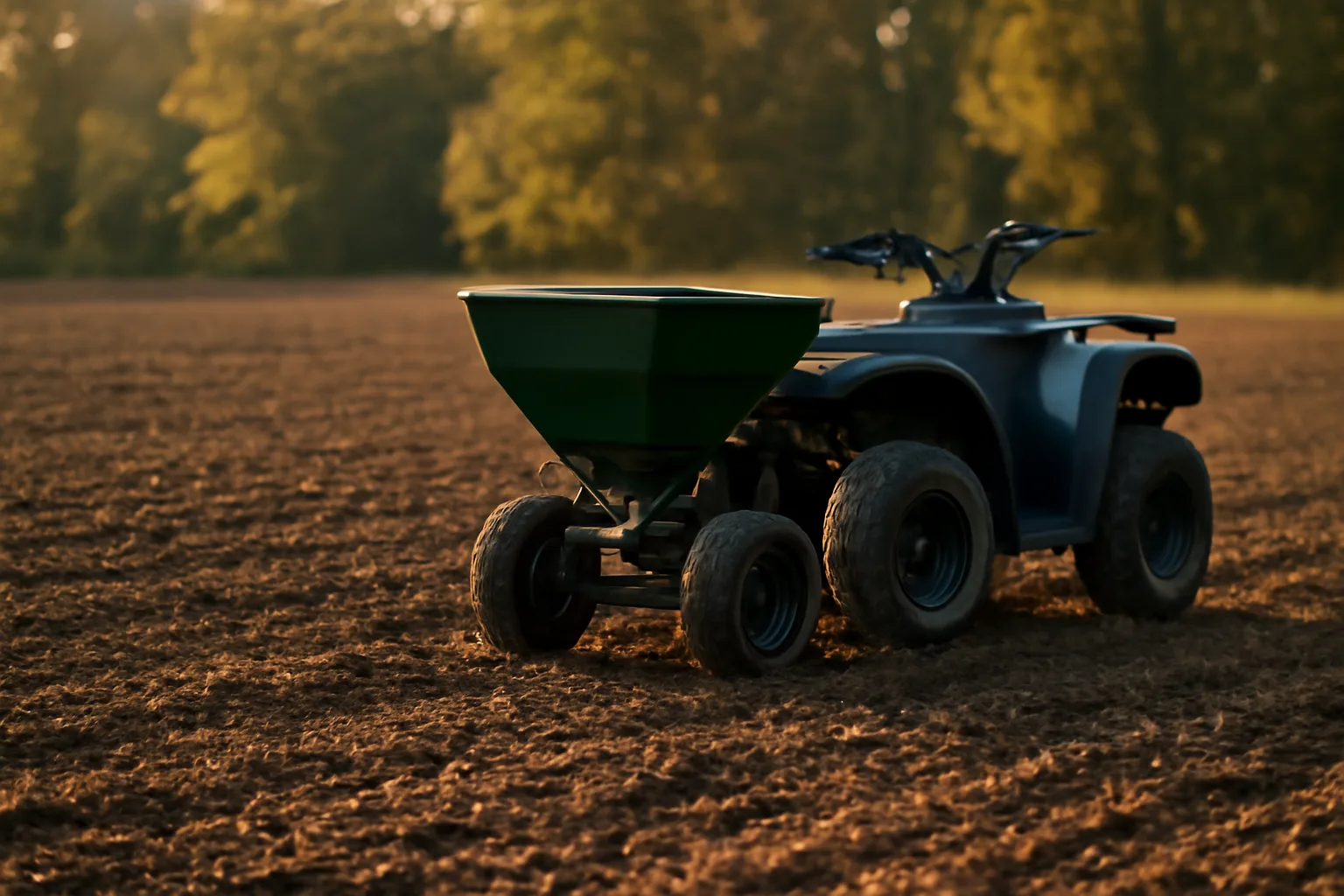
A food plot seeder is any device you use to distribute seed across prepared or unprepared ground, ranging from a hand crank spreader you sling over your shoulder to a tractor-pulled no-till drill with disc openers and a packer wheel. The job is the same no matter the price tag: get seed to the right depth, at the right rate, with decent soil contact. Most hunters own or rent one of four types. Handheld or backpack broadcast spreaders throw small seed over the top of worked ground. ATV or UTV tow-behind broadcast spreaders do the same thing faster over bigger acreage. Drop spreaders (like the kind used on lawns) give tighter control but cover less ground per pass. No-till drills cut a slot, drop seed at a set depth, and close the row, which matters a lot for larger seeds like corn, soybeans, and cereal grains. The term "food plot seeder" gets used loosely online to mean all of these. What actually matters is matching the tool to the seed. A $50 handheld spreader does a fine job with clover or brassica seed broadcast onto a firm, worked seedbed. That same spreader is a poor match for soybeans, which want to be planted 1 to 1.5 inches deep in rows. Planting depth and stand uniformity are two of the biggest levers on soybean yield, according to research summarized by Iowa State University's Corn and Soybean Initiative on planting date and depth effects.
what type of food plot seeder should i actually buy
| Handheld/backpack spreader | $40-$120 | Under 0.5 acre | Clover, brassica, small grains | |
|---|---|---|---|---|
| ATV/UTV tow spreader | $150-$600 | 0.5-5 acres | Clover, brassica, oats, wheat | |
| Drop spreader | $80-$250 | Under 1 acre | Fine seed, precise borders | |
| No-till drill | $2,500-$8,000+ | 5+ acres | Corn, soybeans, cereal grains, mixes | If you're not sure which mix fits your ground before you shop for a seeder, it's worth working backward from species. A food plot seed guide or a species-specific look at deer food plot seed will tell you the seeding depth and rate you need, and that tells you what tool can deliver it. |
For plots under half an acre, a handheld or backpack spreader (Solo, Earthway, or similar) at $40 to $120 handles almost everything: clover, brassicas, oats, wheat. You'll drag a hand rake or ATV drag behind you to work seed in. For plots between a half acre and 5 acres, an ATV or UTV tow-behind broadcast spreader ($150 to $600) is the workhorse most food plotters land on. Look for one with a rate-adjustment gate and a hopper that handles both fine seed (clover) and coarser seed (oats, wheat) without bridging or clumping. For anything over 5 acres, or if you're running corn, soybeans, or milo in rotation, a no-till drill starts to make financial sense, whether you own one or rent one through a local co-op or conservation district. Drills cost $2,500 to $8,000+ used, which is why a lot of hunters split the cost with neighbors or rent by the day. NRCS cost-share programs, including the Environmental Quality Incentives Program authorized under 16 U.S.C. 3839aa, sometimes cover equipment or seed costs tied to approved wildlife habitat practices, so it's worth a call to your local NRCS field office before you buy [1]. Here's a rough comparison: | Seeder type | Cost range | Best acreage | Best seed types |
when to plant food plots for deer
Planting windows depend entirely on your zone and whether you're planting a spring/summer plot or a fall plot, and the two aren't interchangeable. Spring plots (clover, chicory, soybeans, cowpeas) go in after your last frost date, generally April through June depending on latitude. Fall plots (brassicas, cereal grains, cool-season clover) go in 60 to 90 days before your first hard frost so plants establish before growth slows. The most reliable way to nail your date is your state's average first and last frost data, which most land-grant extension offices publish by county. NOAA's National Centers for Environmental Information maintains station-level freeze and frost date records that are more accurate than the generic "zone map" charts that circulate on hunting forums [2]. As a rough national guide: Deep South and Gulf Coast, fall plots go in September through early October. Mid-South and transition zone, late August through mid-September. Upper Midwest and Northern tier, late July through August for brassicas, and into September for cereal grains alone since they establish faster and tolerate cold better. Soil temperature matters as much as the calendar date. Brassicas germinate across a broad band of soil temperatures, and cereal grains will germinate down to about 40°F soil temp. A soil thermometer costs about $10 and removes a lot of the guesswork the calendar alone can't answer.
when to plant oats for deer
Oats for fall deer plots go in 6 to 8 weeks before your first expected frost, which lets them reach a few inches of leafy growth before cold slows them down. In most of the whitetail's range that lands somewhere between mid-August and mid-September. Oats germinate fast, often in 5 to 7 days under good moisture, and they're one of the more forgiving cereal grains for a broadcast-and-drag approach with a basic spreader. You don't need a drill. Seed at roughly 100 to 120 lbs/acre if drilled, or up to 140 lbs/acre if broadcast, since broadcast seeding needs a higher rate to compensate for uneven soil contact. Oats will winterkill in the Upper Midwest and northern tier once temps drop into the low teens for extended periods, which is actually fine for hunters there, since the plant's job is fall attraction, not year-round persistence. In the South, oats often survive winter and can be grazed into late winter or even hayed in spring.
when to plant turnips for deer
Turnips go in 90 to 100 days before your first fall frost, earlier than most other brassicas because they need more time to bulb out. Planting too late gives you leafy growth but skinny, undeveloped roots that deer largely ignore until forced to by snow cover. In practical terms that means late July into early August for the Upper Midwest and Northeast, and mid-August into early September for the transition zone and mid-South. Seed depth is shallow, a quarter inch or less, since turnip seed is tiny (about 150,000 seeds per pound) and won't emerge from deep coverage. This is exactly the kind of seed where a cheap broadcast spreader followed by a light cultipacker or ATV drag outperforms a drill, since drills often bury brassica seed too deep. Deer typically hit the tops first in early fall, then switch to the bulbs after a few hard frosts convert starches to sugars. This shift is well documented in university deer forage work. It's one of the more predictable patterns in food plot management.
do deer eat sorghum
Yes, deer eat sorghum, both the grain heads and the young leafy growth, though it's more commonly planted as a screening or standing-corn-alternative crop than a primary attractant. Grain sorghum (milo) produces a seed head deer and turkey both use heavily once it matures and dries down in fall. Sorghum is drought-tolerant compared to corn, which makes it a reasonable substitute in parts of the Plains and lower Midwest where corn struggles in dry years. Kansas State University's Grain Sorghum Production Handbook covers hybrid selection and planting rates for the region in detail [3]. It's usually drilled at 2 to 6 lbs/acre for grain sorghum, a rate that demands more seeding precision than a broadcast spreader can give you, so most sorghum plots go in with a planter or drill, not a broadcast unit. A lot of food plotters use sorghum less for the grain and more for the standing cover it provides. Bedding and screening cover through winter matters, and sorghum stalks hold up to wind and snow load better than most brassica or legume stands.
do deer eat clover, and do deer like clover
Yes, deer eat clover heavily, and it's consistently one of the most preferred food plot forages available, both white clover (Ladino, Durana) and red clover varieties. Clover offers 20-plus percent crude protein in good growing conditions, comparable to alfalfa, and it regrows quickly after grazing, which is why it holds up under heavy deer pressure better than a lot of annual plantings. Clover's biggest advantage over annuals is persistence. A well-maintained clover stand can produce for 3 to 5 years before you need to reseed. Soil pH above 6.0 is generally needed for good nodulation and nitrogen fixation in clover, a point echoed across land-grant forage extension guidance . That's a big reason your soil test matters more for clover than almost any other food plot species: get the lime application wrong and the stand never really takes off, no matter how good your seed is. For seeding, clover is tiny (around 700,000 seeds/lb for white clover), so it wants surface broadcast or a quarter inch of coverage at most. A cultipacker or light drag after broadcasting gives you the seed-to-soil contact clover needs without burying it too deep.
what are deer's favorite foods
There's no single universal answer, since preference shifts by season, region, and what's available naturally, but clover, soybeans, and acorns consistently rank at or near the top across most whitetail research. Deer are highly selective browsers, and studies tracking rumen contents and preference trials generally find legumes (clover, soybeans, cowpeas) preferred over grasses and most brassicas when all are available at the same growth stage. The USDA Forest Service's Fire Effects Information System summary on white-tailed deer food habits documents this legume preference across multiple regional studies . Acorns deserve their own mention. White oak acorns in particular are lower in tannins and higher in palatability than red oak acorns, and in years with a strong mast crop, deer will often bypass planted food plots entirely in favor of acorns. Season matters too. Spring and summer, deer favor high-protein forages like clover and soybeans to support antler growth and lactation. Fall and winter, energy-dense foods (corn, acorns, brassica bulbs after a frost) become more important as deer build fat reserves.
do deer like honey
There's no real evidence deer seek out honey, and it's not a documented food plot or attractant strategy in any wildlife agency or extension material. This question likely comes from confusion with "honey hole" (hunter slang for a great stand location) or with sweetened mineral and attractant products marketed with names that reference sugar or molasses. Deer do have a documented preference for sugary, high-carbohydrate foods, which is part of why molasses-based mineral licks and sweet feed products get used as attractants in states where supplemental feeding and baiting are legal. But that's a different thing from honey itself, and there's no research showing deer specifically seek out honey or bee-related products in the wild. Check your state wildlife agency's current baiting and feeding regulations before you place any attractant product. Baiting deer is illegal in a significant number of states, and even where legal, rules on distance from stands, quantity, and timing vary widely and get enforced. Baiting restrictions in several states are tied to Chronic Wasting Disease management zones and can change from year to year as those zones shift, so a rule that applied last season may not apply this one.
how does seeder choice change your planting calendar
The tool you use can actually shift your ideal planting window by a week or two in either direction, which surprises a lot of first-time plotters. Drilled seed goes in at a consistent depth and germinates more uniformly, so you can plant closer to the early edge of your window with more confidence. Broadcast seed depends on rainfall to work it into the soil and get germination going, so broadcast plots often do better planted a bit earlier, giving more buffer for a rain event to hit before your frost deadline arrives. This is also where soil prep interacts with your seeder choice. A no-till drill can go into standing residue or a sprayed-out field with minimal prep, which saves time in a tight planting window. A broadcast spreader generally wants a worked, firm seedbed, disked or tilled and then cultipacked, which adds days to your timeline that you need to plan for. If you're building out a full-season plan and trying to sequence spring plots, fall plots, and equipment needs together, that's exactly the kind of site-specific sequencing a Custom Food Plot Plan is built for. It's a $99 one-time plan that takes your location, soil test results, and acreage and gives you a species and timing plan, though your soil test lab remains the actual authority on lime and fertilizer rates specific to your dirt.
do you need a tractor and drill, or is a broadcast spreader enough
For the vast majority of hunting-land food plots (clover, brassicas, oats, wheat, most annual mixes), a broadcast spreader paired with basic ground prep does the job just as well as a drill, and costs a fraction as much. The seed types most whitetail plotters use are small, shallow-planted, and broadcast-friendly. Where a drill earns its cost is larger seed planted at depth and in rows: corn, soybeans, and grain sorghum specifically. These crops need consistent depth (1 to 2 inches) and row spacing to get good stands and to allow any later cultivation or spraying. Broadcasting corn or soybeans generally gives a spotty, uneven stand and wastes a meaningful amount of seed, since seed left on the surface is easy pickings for birds and rodents before it ever germinates. A practical middle path a lot of small-acreage hunters use: rent or borrow a drill once a year for the row-crop plots (corn, beans), and handle everything else with an ATV broadcast spreader they own outright. That keeps total equipment spend under $1,000 for most setups while still covering the species you'd normally rotate through. If you're weighing species against what your ground and budget can support, a broader look at deer food plots or food plot whitetail planning covers how species choice and equipment choice work together.
Frequently asked questions
What is a food plot seeder used for?
A food plot seeder distributes seed across a plot at a controlled rate and depth, ranging from handheld broadcast spreaders for small seed like clover to no-till drills that place larger seed like corn and soybeans at precise depth and row spacing.
Do deer eat sorghum?
Yes. Deer eat both the grain heads and young leafy growth of sorghum. It's more drought-tolerant than corn, making it a common substitute in dry regions, and it also gets used for standing winter cover and screening, more than as a food source.
Do deer eat clover?
Yes, heavily. Clover is one of the most consistently preferred deer forages, offering 20-plus percent crude protein in good growing conditions and regrowing quickly after grazing.
When should I plant food plots for deer?
Spring plots (clover, soybeans, chicory) go in after your last frost date, typically April through June. Fall plots (brassicas, cereal grains) go in 60 to 90 days before your first hard frost, so anywhere from late July in the north to early October in the Deep South.
Do deer like clover more than other food plot species?
Clover consistently ranks at or near the top of deer preference studies alongside soybeans, largely because of its protein content and regrowth after grazing. Preference does shift seasonally though, and acorns can outcompete any planted forage during a heavy mast year.
When should I plant oats for deer?
Plant oats 6 to 8 weeks before your first expected fall frost, generally mid-August to mid-September across most of the whitetail's range. Oats germinate fast, often within 5 to 7 days, and tolerate broadcast seeding well.
How do I decide between spring and fall planting for a given plot?
It depends on the species and your goal. Spring plantings target summer growing season forage for antler development and lactation. Fall plantings target hunting-season attraction, and the exact date should follow soil temps and frost dates specific to your county, not a generic national calendar.
When should turnips be planted for deer?
Turnips need 90 to 100 days before your first fall frost, earlier than most other brassicas, because they need time to develop the root bulb, more than leafy top growth. Late July to early August works for northern zones, mid-August to early September for the transition zone.
What exactly is a food plot?
A food plot is a planted area, usually on hunting land, seeded with forage crops (clover, brassicas, cereal grains, soybeans) to provide supplemental deer nutrition and to concentrate deer activity in a predictable, huntable location.
What are deer's favorite foods?
Clover, soybeans, and acorns rank consistently high in preference research, with white oak acorns particularly favored due to lower tannin content. Preference shifts by season: protein-rich forages in spring and summer, energy-dense foods like acorns and corn in fall and winter.
Do deer like honey?
There's no research or wildlife agency guidance supporting deer seeking out honey specifically. Deer do show preference for sugary, high-carb foods, which explains molasses-based mineral products, but honey itself isn't a documented attractant or food plot strategy.
Do I need an ATV or a tractor to run a food plot seeder?
Most food plot broadcast spreaders mount to an ATV or UTV and work fine for plots up to about 5 acres. Larger acreage, or row crops like corn and soybeans that need a drill, generally require tractor power to pull the equipment.
How much does a food plot seeder cost?
Handheld spreaders run $40 to $120. ATV tow-behind broadcast spreaders run $150 to $600. No-till drills, which handle corn, soybeans, and precise-depth seeding, cost $2,500 to $8,000 or more used, which is why many hunters rent or share one.
Is broadcasting seed as good as drilling it?
For small, shallow-planted seed like clover and brassicas, broadcasting followed by a light drag or cultipacker works just as well as drilling. For larger seed planted at depth, like corn and soybeans, a drill gives a much more even, reliable stand.
Sources
- USDA Natural Resources Conservation Service, Environmental Quality Incentives Program statutory authority: NRCS conservation programs can subsidize equipment or practices for wildlife plantings
- NOAA National Centers for Environmental Information, Freeze/Frost Data: county-level first and last frost date data is more precise than generic zone maps
- USDA Natural Resources Conservation Service, Plant Guide for Brassica Species: brassica germination and establishment guidance
- Kansas State University Research and Extension, Grain Sorghum Production Handbook: grain sorghum is more drought tolerant than corn in Plains growing conditions
- USDA Forest Service, Fire Effects Information System, White-tailed Deer Food Habits: legumes are generally preferred over grasses and many browse species in deer diet studies