Last updated 2026-07-24
TL;DR
A food plot seeder is any tool that gets seed into contact with soil, from a hand-crank spreader to a pull-behind drill. Broadcast spreaders work for small plots and surface-sown seed like clover; drills and cultipacker-seeders work best for larger acreage and buried seed like corn or beans. Match the tool to your seed size, plot size, and soil type.
What is a food plot?
A food plot is a planted area on hunting land, usually somewhere between a quarter acre and several acres, seeded with forage that deer and other wildlife will eat. It is not a garden and it is not a lawn. The goal is to grow something deer want to eat during a specific window, whether that is early season clover, late season brassicas, or a standing corn plot for winter cover and calories. Most state wildlife agencies and land-grant universities treat food plots as a habitat management tool, not a guarantee of more deer or bigger antlers. The USDA Natural Resources Conservation Service and university extension programs frame plots as one part of a broader habitat plan that includes native browse, water, and cover [1]. A plot planted in the wrong season, on bad soil, with no lime or fertilizer, will underperform no matter how good the seed bag looks. The seeder is the tool that turns bagged seed into a stand. Get the seeder decision right and you save yourself a season of thin, patchy growth.
What kind of food plot seeder do I actually need?
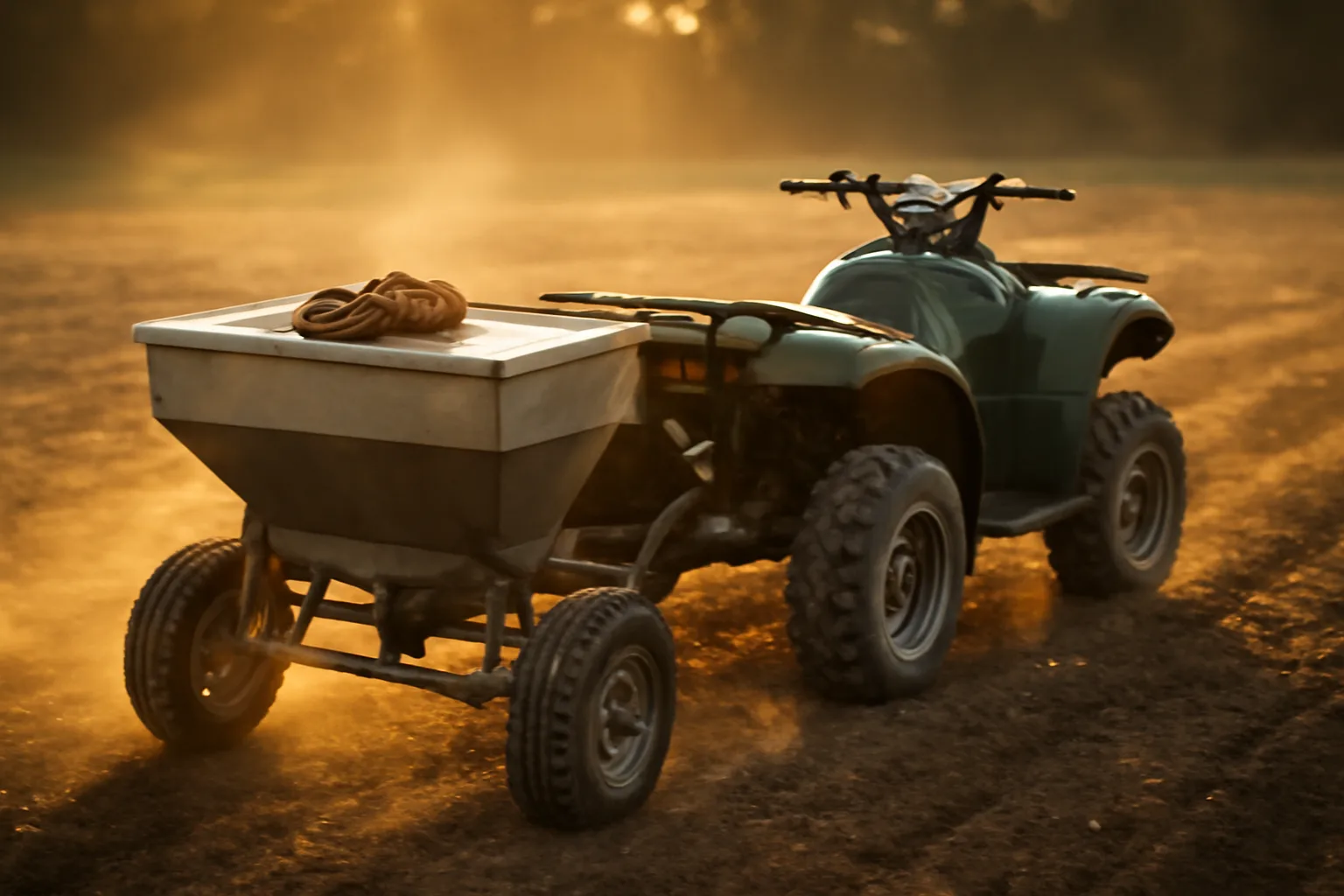
The right seeder depends on plot size, seed type, and what you're already pulling behind a tractor or ATV. There is no single best seeder. There is a best seeder for your acreage and your seed. For plots under a half acre, a hand-crank or backpack broadcast spreader (the same type used for lawn fertilizer) is often enough. These cost roughly $30 to $150 depending on hopper size and build quality. They work fine for small-seeded forages like clover, chicory, and brassica blends that get broadcast on the surface and lightly covered. For plots from a half acre up to 3 or 4 acres, a tow-behind broadcast spreader (ATV or UTV mounted) speeds things up a lot. These run $150 to $600 for basic models. Some have a ground-drive wheel that ties seeding rate to travel speed, which matters for even coverage. For larger acreage, or if you're planting row crops like corn, soybeans, or sorghum that need seed placed at a specific depth, you want a drill or a planter. A no-till drill can seed directly into standing residue or sod without full tillage, which saves diesel and time and reduces erosion. Used no-till drills for food plot use commonly run $2,000 to $8,000+, and many co-ops or conservation districts rent them out by the day, which is worth checking before you buy one for a few acres a year. Cultipacker seeders (a seed box mounted ahead of or behind a cultipacker roller) are popular for small grains, clover, and brassica because they meter seed and then press it into firm soil in one pass. This single-pass approach is one of the better ways to get consistent seed-to-soil contact without owning a full drill.
Broadcast spreader vs. drill vs. cultipacker seeder: which wins?
| Hand-crank/backpack spreader | Clover, brassica, chicory (surface sow) | $30-$150 | None (surface only) | Under 0.5 acre | |
|---|---|---|---|---|---|
| Tow-behind broadcast spreader | Clover, oats, brassica, cereal grains | $150-$600 | None (surface only) | 0.5-4 acres | |
| Cultipacker seeder | Small grains, clover, brassica blends | $1,000-$4,000 (new); less used | Light, consistent pressing | 1-10 acres | |
| No-till grain drill | Corn, soybeans, sorghum, cereal rye | $2,000-$15,000+ (wide range used vs. new) | Precise, adjustable depth | 3+ acres | Broadcast spreaders are cheap and forgiving but waste seed if you overlap passes, and they do nothing for seed-to-soil contact. You still need to drag a chain harrow, culti-packer, or ATV tires over broadcast seed to press it in, especially for small seed like clover and brassica. Drills cost more up front but use seed efficiently (often 20 to 30 percent less seed than broadcasting for the same stand, though this varies by species and site) and give you the depth control that big-seeded crops like corn and soybeans need. A drill is overkill for a tenth-acre clover plot behind the cabin. It is the right tool if you're planting several acres of beans or corn every year. If you only plant one or two small plots a season, renting or borrowing beats buying. |
Each tool has a job it does well and a job it does badly. Here's how they actually compare on the ground. | Seeder type | Best for | Typical cost | Seed depth control | Plot size sweet spot |
When to plant food plots for deer?
Timing depends on what you're planting and where you live, but the two big windows are spring (for warm-season crops) and late summer to early fall (for cool-season crops). There is no single national date. Your local extension office and frost dates matter more than any generic calendar. Spring plantings (April through June in most of the whitetail range) work for warm-season annuals like soybeans, corn, and sorghum, which need warm soil to germinate and a full growing season before frost. Late-summer to early-fall plantings (roughly late July through early September, depending on latitude) work for cool-season annuals and perennials: clover, brassicas, turnips, oats, wheat, and cereal rye. These crops tolerate light frost and often taste sweeter to deer after a hard frost converts starches to sugars, which is part of why brassica and turnip plots get hammered in November and December. A rough rule many extension programs use: count backward from your average first fall frost date and plant brassicas and turnips 80 to 100 days ahead of that date, and plant clover and cereal grains 45 to 60 days ahead of it [2]. Check your county's frost date through your state climatologist or land-grant extension office rather than guessing. For a full breakdown by region, see food plot whitetail and deer food plots.
When to plant oats for deer?
Oats are a cool-season annual, and most extension guidance recommends planting them 60 to 90 days before your first killing frost, which puts most of the whitetail range somewhere between late August and mid-September for fall plots [2]. Oats can also be planted in early spring (March to April in the Midwest and South) for a spring/summer forage window, but fall planting is far more common for hunting plots because oats are highly attractive to deer through October and November before hard frosts knock them back. Oats germinate fast, often within 5 to 10 days in warm, moist soil, which makes them a good nurse crop mixed with slower-establishing clover. A cultipacker seeder or a simple broadcast-and-drag setup both work fine for oats since the seed is large enough to handle rough coverage. One caution: oats alone don't survive hard winters in northern zones. They're an annual, not a perennial, so don't expect a stand to come back next spring without reseeding.
When to plant turnips for deer?
Turnips are planted in mid to late summer, generally 90 to 100 days before your area's first fall frost, since they need a full season to bulb out before deer start eating the roots [2]. In the Upper Midwest and Northeast that often means late July to early August. In the mid-South and southern Appalachians, growers can wait until late August or even early September. Turnip seed is tiny, similar in size to clover seed, so it needs shallow planting, about a quarter inch deep or less, and firm seed-to-soil contact. A cultipacker seeder or a broadcast spreader followed by a light cultipacker pass both work well. Drilling turnips too deep is a common mistake; seed buried more than half an inch often fails to emerge. Deer usually ignore turnip bulbs early in the season and go for the leafy tops first. They typically switch to digging up and eating the bulbs after a few hard frosts sweeten the starches, which is why turnip plots often look untouched in October and stripped bare by January.
Do deer eat clover, and do they actually like it?
Yes. Clover is one of the most consistently preferred forages in whitetail diet studies, and it's a mainstay recommendation from nearly every state wildlife agency and university extension food plot program [3]. White clover and red clover both show up repeatedly in deer diet composition studies as high-use forage during spring and summer. Clover's appeal comes down to protein and digestibility. Good clover stands run 25 to 30 percent crude protein during active growth, which rivals or beats most commercial pellet feeds, and it stays palatable through repeated grazing since it's a perennial that regrows after being browsed down [4]. The tradeoff is establishment. Clover seed is small, needs shallow planting (1/4 inch or less) and firm soil contact, and it's slow to establish compared to annual grains. Most plotters mix clover with a nurse crop like oats to hold soil and give quick cover while clover roots in. A cultipacker seeder handles this combination well in one pass. For species selection details and blend options, see deer food plot seed and food plot seed.
Do deer eat sorghum?
Yes, deer eat sorghum, particularly the grain heads once they mature, and sorghum also provides standing winter cover that many other food plot crops don't. It's more common as a wildlife food plot crop in the South and parts of the Midwest where it handles heat and drought better than corn. Sorghum is a warm-season crop, planted the same general window as corn, typically after soil temperatures reach 60 degrees F, which lines up with late April through June depending on latitude. It needs a planter or drill for consistent seed depth (roughly 1 to 1.5 inches), though broadcasting followed by a light disc pass can work in a pinch on smaller plots. Deer use sorghum less aggressively than they use soybeans or corn during the growing season, but the standing grain heads become a solid late-fall and winter food source, especially in areas where snow cover limits access to other forage. It's often planted in a mix with other warm-season grasses rather than as a monoculture.
Do deer like honey, and does it matter for food plots?
There's no real evidence deer are drawn to honey itself, and it has no role in a legitimate food plot program. This question usually comes up because of "honey hole" terminology (a favorite hunting spot) or because some mineral and attractant products use honey or molasses-based scents to add sweetness and smell. Deer do respond to sugar and sweetness in food generally, which is part of why brassicas and turnips taste better to them after a frost converts starch to sugar. But pouring honey or syrup on the ground isn't a food plot strategy, and in most states it would fall under baiting or supplemental feeding rules rather than food plot planting. Check your state wildlife agency's baiting and feeding regulations before using any attractant, scent, or mineral product near a hunting area. Rules vary widely by state and even by county in some cases (chronic wasting disease management zones often have stricter feeding bans), and violations can carry real penalties [5]. Your state fish and wildlife or natural resources department's regulations page is the authority here, not a product label.
What are deer's favorite foods, and how does that change by season?
Deer preference shifts constantly with what's available and what's nutritionally needed, but across most whitetail range, the consistent favorites include clover, soybeans, acorns (especially white oak acorns), and browse from young woody plants [6]. Food habit studies going back decades, including classic work compiled by state wildlife agencies, consistently rank legumes (clover, soybeans) and mast (acorns) near the top of preferred foods when available. In spring and summer, deer key in on high-protein forage to support antler growth and lactation, which is why clover and soybean plots get hit hard during the growing season. In fall, acorn availability often drives deer movement more than any planted plot, particularly in a heavy mast year when deer may largely ignore food plots in favor of natural oak drops. In late fall and winter, energy needs shift toward carbohydrates and fat reserves for the cold, which is when standing corn, brassicas, and turnips (post-frost) become the most attractive planted options. No single crop is the favorite year-round. A food plot program that only offers one species leaves gaps the rest of the season. For a broader look at species selection across a full year, see deer for food and domain food plot seed.
How do I calibrate a food plot seeder correctly?
Calibration matters more than the brand of seeder you buy. An uncalibrated spreader either wastes seed (and money) by overseeding or leaves a thin, weedy stand by underseeding. For broadcast spreaders, most manufacturers publish a setting chart by seed type, but those charts assume average seed size and flow, so a bag-and-catch test is worth the ten minutes it takes. Run the spreader over a tarp of known area at your planned setting, weigh what comes out, and compare it to the recommended seeding rate on the seed bag (usually given in pounds per acre). For drills and cultipacker seeders, most have a seed box with adjustable gate openings tied to a rate chart specific to that machine and seed type. Small-seeded forages like clover and brassica need a much smaller gate opening than large-seeded crops like corn or soybeans, and mixing seed sizes in the same box (a common mistake with clover/oat blends) can cause the heavier oat seed to flow faster and settle to the bottom, throwing off your rate. A rough seeding rate reference, though your seed tag is the final word: clover, 6 to 12 lbs/acre broadcast; brassica/turnip blends, 4 to 6 lbs/acre; oats, 2 to 3 bushels/acre (roughly 64 to 96 lbs/acre); soybeans, 50 to 100 lbs/acre depending on row spacing .
Do I need a soil test before I even worry about a seeder?
Yes, and it matters more than the seeder choice. A $10 to $20 soil test through your state land-grant extension office tells you pH and nutrient levels, and most food plot species (clover especially) struggle badly below a pH of 6.0 . No seeder fixes a soil chemistry problem. Your soil test report is the real authority on lime and fertilizer rates for your specific dirt. A general article like this one can tell you the ballpark, but your lab results account for your actual soil type, existing nutrient levels, and the crop you're planting. Follow the lab's recommendation over any generic number you read online. If you want a starting point pulling your soil test, your equipment list, and your zone together into an actual planting plan, that's the kind of thing a Custom Food Plot Plan is built for. It's a one-time $99 tool, not site-specific agronomy advice in place of your soil lab, but it turns a soil report and a seeder into an actual seasonal plan instead of guesswork.
What's the cheapest way to get a good stand without buying a drill?
For most hunters planting under 3 acres a year, the cheapest path to a decent stand is a broadcast spreader plus a cultipacker or drag harrow pass, not a drill. Broadcast the seed, then press it in with something heavy dragged behind an ATV, a chain-link section, a piece of carpet, or a rented cultipacker. This two-step approach costs a few hundred dollars in equipment (or nothing if you borrow) and works well for clover, brassica, oats, and wheat, all of which are shallow-planted species anyway. It's a poor fit for corn, soybeans, or sorghum, which need real depth control a drill or planter provides. Renting a drill for a day, through a farm co-op, conservation district, or equipment rental outfit, often costs less than $150 to $300 for a day and gets you drill-quality results for a large plot without the multi-thousand-dollar purchase. Check with your county extension office or state forestry/wildlife agency; some maintain loaner equipment specifically for habitat projects.
Frequently asked questions
Do deer eat sorghum?
Yes. Deer eat sorghum grain heads once they mature, and standing sorghum also gives good late-season cover. It's a warm-season crop planted alongside corn timing (after soil hits 60°F) and works well in the South and parts of the Midwest where drought tolerance matters.
Do deer eat clover?
Yes, clover is one of the most consistently preferred whitetail forages in diet studies, prized for its 25-30 percent crude protein content during active growth. Both white and red clover show up repeatedly as high-use species in state and university food plot research.
When to plant deer food plots?
It depends on the crop. Warm-season plants like corn and soybeans go in spring (April-June). Cool-season plants like clover, oats, and brassicas go in late summer through early fall (late July-September), timed 45-100 days before your local first frost depending on species.
Do deer like clover?
Yes, strongly. Clover ranks near the top of preferred forages in wildlife diet studies and is a staple recommendation from nearly every state extension food plot program because of its protein content and its ability to regrow after repeated browsing through the growing season.
When to plant oats for deer?
Plant oats 60 to 90 days before your area's first fall killing frost, which lands most of the whitetail range between late August and mid-September. Oats can also be spring-planted (March-April) but fall planting is far more common for hunting plots.
When to plant food plots for deer?
Spring (April-June) for warm-season crops like corn, beans, and sorghum. Late summer to early fall (late July-September) for cool-season crops like clover, oats, wheat, and brassicas. Count backward from your county's average first frost date rather than using a fixed calendar date.
When to plant turnips for deer?
Plant turnips 90 to 100 days before your first fall frost, typically late July to early August in the Upper Midwest and Northeast, or late August to early September in the mid-South. Turnip seed needs shallow planting, about a quarter inch deep, with firm soil contact.
What is a food plot?
A food plot is a planted patch of forage, usually a quarter acre to several acres, established on hunting land to give deer and other wildlife supplemental food during a specific season. It's a habitat management tool, not a guarantee of more deer or bigger antlers.
What are deer's favorite foods?
Across most of the whitetail range, consistent favorites include clover, soybeans, acorns (especially white oak), and young woody browse. Preference shifts by season: high-protein forage like clover in spring and summer, then acorns and carbohydrate-rich crops like corn, brassicas, and turnips in fall and winter.
Do deer like honey?
There's no solid evidence deer specifically seek out honey. Deer respond to sugar and sweetness generally, which is why frost-sweetened brassicas and turnips get hit hard, but honey has no legitimate role in food plot planting and using it as an attractant may violate state baiting rules.
What's the difference between a broadcast spreader and a drill for food plots?
A broadcast spreader scatters seed on the surface and needs a separate pass (cultipacker, drag harrow) to press seed into soil. A drill places seed at a controlled depth in one pass. Broadcasting works fine for small seed like clover and brassica; drills are better for corn, beans, and sorghum.
How much does a food plot seeder cost?
Hand-crank spreaders run $30-$150. Tow-behind broadcast spreaders run $150-$600. Cultipacker seeders run roughly $1,000-$4,000 new. No-till drills range from $2,000-$15,000+ depending on width and condition. For under 3 acres a year, renting a drill often beats buying one.
Can I use a lawn spreader for a food plot?
Yes, for small plots under half an acre, a standard hand-crank or backpack lawn spreader works fine for clover, brassica, and other small-seeded forages. Just run a calibration test first, since lawn spreader rate charts are built around fertilizer granules, not seed.
Sources
- USDA Natural Resources Conservation Service, Wildlife Habitat Management Practice Standards: Food plots are one part of a broader habitat management plan, not a standalone fix
- USDA NRCS, Environmental Quality Incentives Program (EQIP) overview: Conservation districts and NRCS-administered programs support habitat practices, including equipment-assisted conservation work
- University of Tennessee Extension, publication SP731, "Establishing Wildlife Food Plots": Brassica and turnip planting timed 80-100 days before first frost; clover and cereal grains 45-60 days before frost
- University of Georgia Extension, Circular 1027, "Forages for Wildlife": Good clover stands can reach 25-30 percent crude protein during active growth
- Kansas State University Agricultural Experiment Station and Cooperative Extension Service, MF3122, "Grain Sorghum Production Handbook": Sorghum is planted after soil temperatures reach roughly 60 degrees F, similar timing to corn
- University of Missouri Extension, publication G9418, "Food Plots for Deer and Other Wildlife": Typical seeding rates: clover 6-12 lbs/acre, brassica/turnip blends 4-6 lbs/acre, oats 2-3 bushels/acre, soybeans 50-100 lbs/acre