Last updated 2026-07-25
TL;DR
Most food plot species need at least 4 hours of direct sun, and yields drop hard below that. Under partial shade (2-4 hours), your best bets are cereal grains like winter rye and oats, along with brassicas such as turnips and certain clover varieties bred for shade tolerance. Deep, closed-canopy shade under 2 hours of sun won't grow a productive plot no matter what seed you buy.
What actually happens to food plot seed in shade
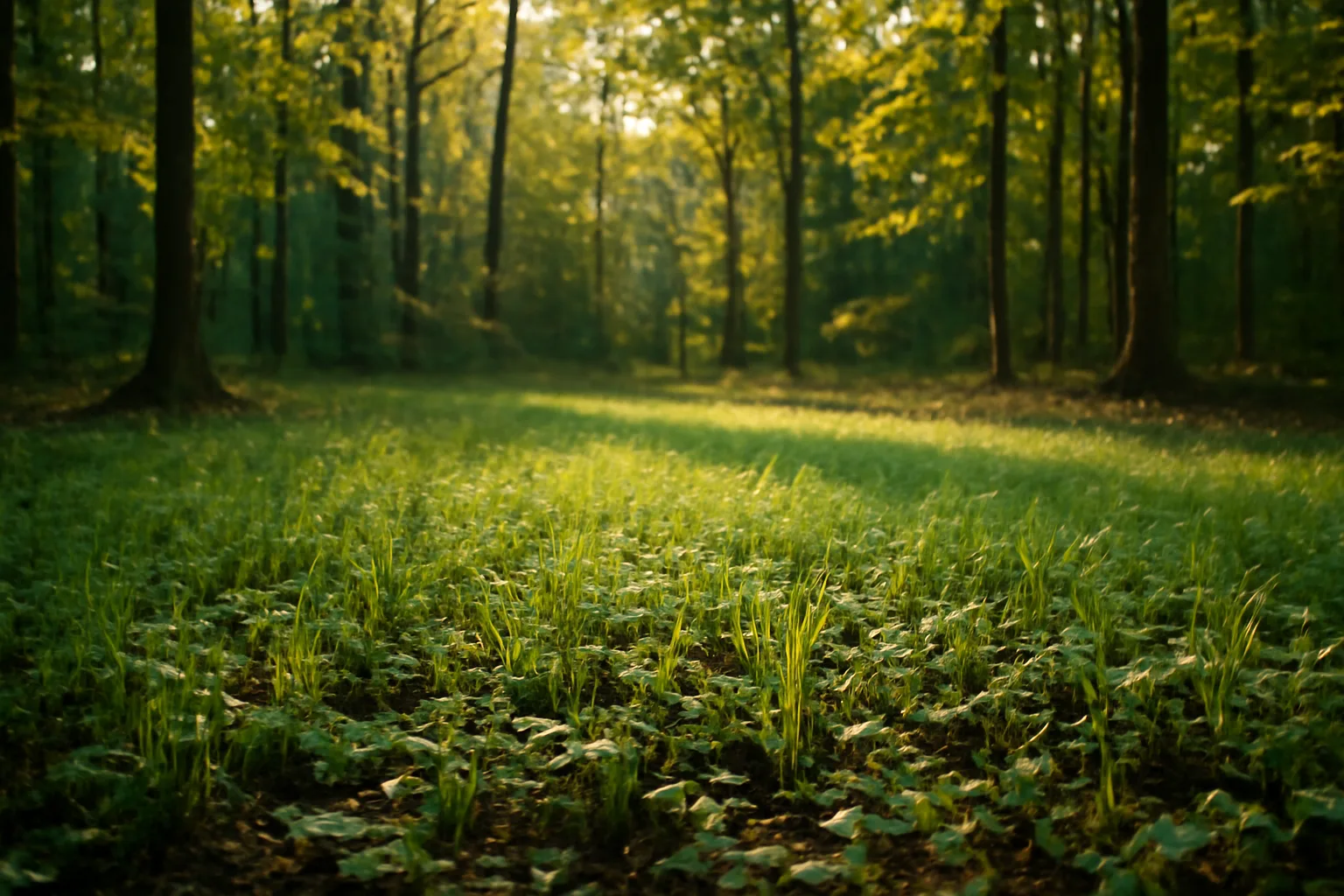
Shade doesn't just slow plants down, it changes which species survive at all. Photosynthesis needs a minimum light threshold, and most food plot annuals and perennials were bred and selected for full-sun agriculture, not timber understories. Purdue Extension research on shade tolerance in forage and turf species found that light levels below 50% of full sun cause measurable drops in tillering, root mass, and stand persistence in most cool-season grasses [1]. On a practical level, a plot that gets 2 hours of direct sun a day is not the same project as one getting 5 hours. You're not choosing a slightly worse version of your sunny plot mix. You're choosing a different, much shorter list of species, and even those will look thinner and produce less tonnage per acre than the same seed in full sun. Walk the plot at 10am, 1pm, and 4pm on a clear day and note whether it's lit or shaded. That 20-minute exercise saves you from wasting money on seed that was never going to work there. If you're working with a hardwoods opening or a logging deck ringed by mature timber, get honest about your actual sun hours before you buy anything.
How much sun does a food plot actually need
Most productive food plot species want a minimum of 4 to 6 hours of direct sunlight per day, with 6+ hours considered full sun and ideal for clover, alfalfa, chicory, and soybeans. Below 4 hours you're in the partial shade zone where species selection narrows fast. Below 2 hours of direct sun, you're in what foresters call deep shade, and almost nothing grown for food plots will persist there long term. The University of Georgia Extension's guidance on forage crop establishment notes that legumes and warm-season forages need strong, consistent sun exposure through the growing season to reach expected yield, and that plots tucked into timber openings often underperform because of canopy shade rather than soil fertility [2]. If your soil test comes back perfect but your plot is ringed by 70-foot oaks, the soil test isn't your limiting factor. Light is. One fix that costs nothing but time: hinge-cut or fell a few trees on the south side of the plot. Opening the canopy even 15 to 20 feet can add real sun hours to a plot that's currently borderline. This works better than any seed blend switch if you're in the 2-4 hour range and want to push toward the 4-6 hour range.
What food plot seed grows best in shade
| Winter (cereal) rye | 2-3 hours | Best all-around shaded plot performer |
|---|---|---|
| Oats | 3-4 hours | Great fall tonnage, winterkills north of transition zone |
| Forage turnips/radish | 3-4 hours | Tops browsed early, bulbs later after frost |
| Ladino/white clover | 4 hours minimum | Thin stand below 4 hours, fades by year two |
| Chicory | 5-6 hours | Not a shade plant, skip it in timber openings |
| Soybeans | 6+ hours | Full-sun crop, poor shade performer |
| Alfalfa | 6+ hours | Full-sun crop, avoid in partial shade |
For plots getting 2 to 4 hours of direct sun, your realistic options are winter rye, oats, and certain brassicas like forage turnips and daikon radish. These species tolerate lower light better than clover, soybeans, or chicory because they grow fast in cool, lower-light conditions (fall and early spring) and don't rely on season-long full-sun photosynthesis to bulk up. Cereal rye is probably the single best shaded-plot performer. It germinates in cool soil, tolerates acidic ground, and keeps growing later into fall than almost anything else, which matters more in shaded plots where every bit of light is already scarce. Oats are a close second: fast germination, good tonnage early, but they winterkill in most of the whitetail range north of the transition zone, so they're more of a fall attractant than a season-long plot. Brassicas (turnips, radish, rape) do reasonably well in partial shade because deer often hit the tops in early fall and the bulbs later after frost. You get two feeding windows out of one planting even if the plant itself is smaller than it would be in full sun. Clover is the tricky one. Ladino and white clover varieties are shade-tolerant compared to red clover or alfalfa, and some seed companies market 'shade blends,' but even the most shade-tolerant clover wants at least 4 hours of direct sun to persist past one season. Below that, expect a thin stand that fades out by year two. Here's a rough comparison of how common food plot species handle reduced light: | Species | Minimum sun for a decent stand | Notes in shade |
Do deer eat sorghum
Yes, deer eat sorghum, particularly the grain heads in fall and winter, but it's more of a secondary food source than a primary food plot species most hunters plant on purpose. Grain sorghum is more commonly used as a screening or standing-corn-alternative crop that also provides some late-season browse and cover. In shaded plots specifically, sorghum isn't a great fit. Like corn and soybeans, it's a full-sun warm-season crop that needs strong light through the growing season to produce grain heads. If you're working a shaded opening, sorghum is not the plant to reach for. Save it for open-field plots where you want a tall screening crop with some late-season food value.
Do deer like clover, and do deer eat clover
Yes, deer eat clover readily and it's one of the most consistently preferred food plot forages across the whitetail's range, but it performs poorly once shade cuts sun exposure below about 4 hours a day. Clover is a perennial legume, high in protein, and deer will hit it hard spring through fall when it's actively growing. The catch for shaded ground is persistence. A clover stand planted in a 3-hour-sun opening might look fine the first spring, then thin out by the second summer as the plants can't rebuild root reserves fast enough in low light. If you've got a partially shaded spot you really want in clover, look for named shade-tolerant white clover varieties, keep mowing height higher to preserve leaf area, and accept that stand life will likely be shorter than a full-sun clover field. For a broader look at clover's role in a full-sun plot lineup, see food plot whitetail.
When to plant food plots for deer, oats, and turnips
Timing depends heavily on region, but as a general framework: cool-season plots (clover, brassicas, cereal grains) go in from late summer through early fall, while warm-season plots (soybeans, cowpeas, corn) go in spring after your last frost date. For oats specifically, most extension guidance recommends planting in late summer to early fall, roughly 45 to 60 days before your area's first hard frost, so plants establish enough leaf growth before cool weather slows them down. The University of Georgia Extension's small grain forage bulletin places fall oat planting windows in the September to early October range for much of the Southeast, adjusting earlier for northern latitudes [3]. Turnips follow a similar late-summer window. Purdue Extension notes brassica plantings for deer forage generally go in from late July through August in the Midwest, giving 80-90 days of growth before a hard frost sweetens the bulbs and tops [1]. Planting too late means small, spindly plants that never bulb up properly, especially in a shaded plot where growth is already slower. As a rough national framework: - Zone 3-4 (upper Midwest, northern New England): cool-season plots late July through August
- Zone 5-6 (transition zone, mid-Atlantic, lower Midwest): late August through mid-September
- Zone 7-8 (Southeast, lower South): mid-September through October These are starting points, not guarantees. Always check your local extension office's frost date data before locking in a planting date.
What is a food plot, exactly
A food plot is a planted area, usually somewhere between a quarter acre and a few acres, established specifically to provide supplemental forage for deer and other wildlife on hunting or managed land. Food plots aren't a wildlife feeding program in the sense of dumping corn on the ground. They're planted crops, managed with soil tests, fertilizer, and mowing, much like a small-scale farm field, just built around species deer prefer rather than species meant for grain harvest. Most hunters plant food plots for two overlapping reasons: to supplement natural forage during stress periods (late summer drought, deep winter) and to concentrate deer activity in a specific, huntable location. A well-placed plot near bedding cover can pull deer into daylight movement patterns that are easier to hunt than relying on natural browse alone. Some states regulate food plots differently from baiting. Baiting typically refers to placing loose grain, mineral, or feed on the ground, while a food plot is a standing, rooted crop, which most states treat as legal agricultural activity rather than baiting. Rules vary a lot by state though. Always check your state wildlife agency's current regulations before planting near a stand, especially if you're in a CWD management zone, since some states add extra restrictions on supplemental feeding in those areas. For a general overview of species used in food plots for deer, see deer food plot seed and food plot seed.
What are deer's favorite foods
Deer preference shifts by season and region, but across most whitetail range, acorns, soybeans, clover, and standing corn rank consistently high in preference studies and browse surveys. Acorns in particular are a heavily preferred fall food where oaks are present, often outcompeting planted food plots when there's a good mast year. Among planted food plot species, soybeans and clover tend to top most preference rankings during their respective growing seasons, with brassicas (turnips, radish) becoming highly preferred after the first hard frost converts starches to sugars in the plant tissue. That's why a lot of hunters see turnip plots ignored in October and hammered in December. The plant hasn't changed, but the sugar content has. None of this changes based on shade. A shaded plot growing rye or turnips still gets eaten if it's the best food source around. Deer aren't picky about how much sun a plant got, just what it tastes like and how much energy it delivers.
Do deer like honey
Deer don't seek out honey in the wild and it's not a natural or recommended food plot or attractant additive. This question comes up occasionally because some commercial deer attractant sprays use sweet, sugary scent compounds, but straight honey isn't something deer forage for and isn't part of any legitimate food plot seed mix or planting strategy. If you're trying to boost fall attraction, a frost-sweetened brassica plot does the same sugar-content job through an actual browsed food source, which is a better use of your money and time than trying to make honey work in the field.
How do you plant a food plot in a shaded opening
Planting in shade takes more prep, not less, because you're working with a smaller margin for error. Start with a soil test specific to that opening. Shaded ground under hardwoods often runs more acidic than open-field soil due to leaf litter and slower organic matter breakdown, and your soil test lab's lime and fertilizer recommendations are the real authority here, not a generic online chart. Broadcast seeding works fine for small woods openings where you can't get a drill in. Use a hand spreader or a small ATV-mounted spreader, and increase your seeding rate by roughly 10-20% over the bag's full-sun recommendation to compensate for lower germination and thinner stands in shaded soil. Rake or drag lightly to get seed-to-soil contact. In a leaf-littered opening this step matters more than in open dirt. Mow back any existing weeds or saplings before planting and keep an eye on canopy encroachment. A plot that had 4 hours of sun three years ago might be down to 2 hours now if the surrounding trees have grown. Revisit your sun assessment every couple of seasons, especially in fast-growing timber like poplar or sweetgum stands. If you want a soil-test-based planting plan built around your specific plot's light, soil, and region, that's exactly the kind of site-specific work a $99 Custom Food Plot Plan is built to handle. It takes your test results and site conditions and turns them into a species list and planting calendar rather than a generic blend recommendation.
When should you just skip the shaded spot entirely
If your opening gets less than 2 hours of direct sun, even in the growing season peak, skip planting a food plot there and use it for something else, like a bedding thicket, a mock scrape, or a stand location that benefits from being near a natural funnel. No seed blend, fertilizer rate, or lime application fixes a fundamental light deficit. A better long-term move in a deep-shade opening is a hinge-cutting project to open the canopy, paired with planting a shade-tolerant food plot in the interim two or three years while young growth fills back in. Some land managers treat these deep-shade spots as sanctuary or bedding cover instead, which often has more impact on deer movement than a struggling half-acre plot ever would. For broader plot placement and species strategy across your whole property, deer food plots and deer for food cover how to balance food plot locations against bedding and travel corridors.
Frequently asked questions
Do deer eat sorghum?
Yes, deer eat grain sorghum heads, especially in late fall and winter, but it's a full-sun warm-season crop and a poor fit for shaded plots. Most hunters use it as a screening or standing late-season crop in open fields rather than a shade-tolerant option.
Do deer eat clover?
Yes, clover is one of the most consistently preferred food plot forages, high in protein and browsed heavily spring through fall. It struggles in shade below about 4 hours of direct sun a day though, with stands thinning out within a year or two.
When to plant deer food plots?
Cool-season plots (clover, brassicas, cereal grains) go in late summer to early fall, roughly 45-90 days before your first hard frost. Warm-season plots (soybeans, cowpeas) go in spring after the last frost date. Exact timing depends on your USDA hardiness zone and local frost dates.
Do deer like clover?
Yes, clover ranks among deer's top preferred forages in most regions, largely due to its high protein content. Preference doesn't change with light levels, but a shaded clover stand yields less and persists for fewer seasons than a full-sun stand.
When to plant oats for deer?
Plant oats roughly 45-60 days before your area's first hard frost, generally September into early October across much of the Southeast per University of Georgia Extension guidance, and earlier in northern latitudes. Oats winterkill in most areas north of the transition zone, so treat them as a fall-focused planting.
When to plant food plots for deer?
Timing splits into two windows: cool-season species go in late summer through early fall, and warm-season species go in spring after your last frost. Check your local cooperative extension office's frost date charts, since the right week can shift by a month or more between northern and southern states.
When to plant turnips for deer?
Plant turnips in late July through August across most of the Midwest, giving 80-90 days of growth before a hard frost sweetens the bulbs and tops, per Purdue Extension forage guidance. Planting later than this often produces small, underdeveloped bulbs.
What is a food plot?
A food plot is a planted area, typically a quarter acre to a few acres, established to provide supplemental forage for deer and concentrate their activity for hunting or land management purposes. It's a standing, rooted crop, managed with soil tests and fertilizer, not a loose feed pile.
What are deer's favorite foods?
Acorns, soybeans, clover, and standing corn rank consistently high in deer preference across most of the whitetail range. Preference shifts seasonally, brassicas like turnips become highly preferred after a hard frost converts starches to sugars in the plant tissue.
Do deer like honey?
No, deer don't naturally seek out honey and it isn't used in legitimate food plot seed or planting strategies. Some commercial attractant sprays use sweet scent compounds, but a frost-sweetened brassica plot is a more effective and practical way to capitalize on deer's preference for sugary fall forage.
What food plot seed grows best in full shade under a closed forest canopy?
Nothing grows well in true closed-canopy shade with less than 2 hours of direct sun. Winter rye is the most shade-tolerant food plot species available and can survive down to roughly 2-3 hours of sun, but even rye thins out and underperforms in deeper, denser shade.
How many hours of sun does a food plot need to grow clover?
Clover generally needs at least 4 hours of direct sunlight a day to establish a persistent stand, and 6+ hours produces a much thicker, longer-lasting plot. Below 4 hours, expect a thin first-year stand that fades out within a season or two.
Can you fertilize your way around a shade problem in a food plot?
No. Fertilizer and lime correct nutrient and pH deficiencies, not light deficiencies. A plot with excellent soil fertility but only 2 hours of daily sun will still underperform compared to a mediocre-soil plot with 6 hours of sun, because photosynthesis, not nutrient uptake, is the limiting factor.
Sources
- Purdue University Extension, forage and food plot species shade tolerance guidance: Light levels below 50% of full sun reduce tillering, root mass, and stand persistence in most cool-season forage species; brassica planting windows for deer forage in the Midwest
- University of Georgia Extension, "Wildlife Food Plots" (Circular 1131): Warm-season legumes and forage crops need strong, consistent sun exposure to reach expected yields in food plots, and shaded timber openings often underperform because of canopy shade rather than soil fertility
- University of Georgia Extension, "Small Grain Forage" (Bulletin 1216): Fall oat planting windows fall in the September to early October range for much of the Southeast
- Michigan Department of Natural Resources, Wildlife Conservation Order 2.44, Baiting and Feeding of Deer and Elk: Michigan's wildlife conservation order defines baiting and feeding restrictions for deer, including provisions tied to CWD management zones
- USDA Natural Resources Conservation Service, Plant Guide: Cereal Rye (Secale cereale): Cereal rye germinates in cool soil, tolerates acidic and lower-fertility ground, and grows later into fall than most other cool-season cover and forage grains