Last updated 2026-07-25
TL;DR
The Firminator is a pull-behind implement that tills, seeds, and cultipacks in one pass, built by Titan Machinery's food plot division for hunters working smaller acreages behind ATVs, UTVs, or compact tractors. It costs roughly $3,000 to $9,000 depending on size and doesn't replace a soil test. It's a time-saver, not a requirement.
What is a Firminator food plot planter?
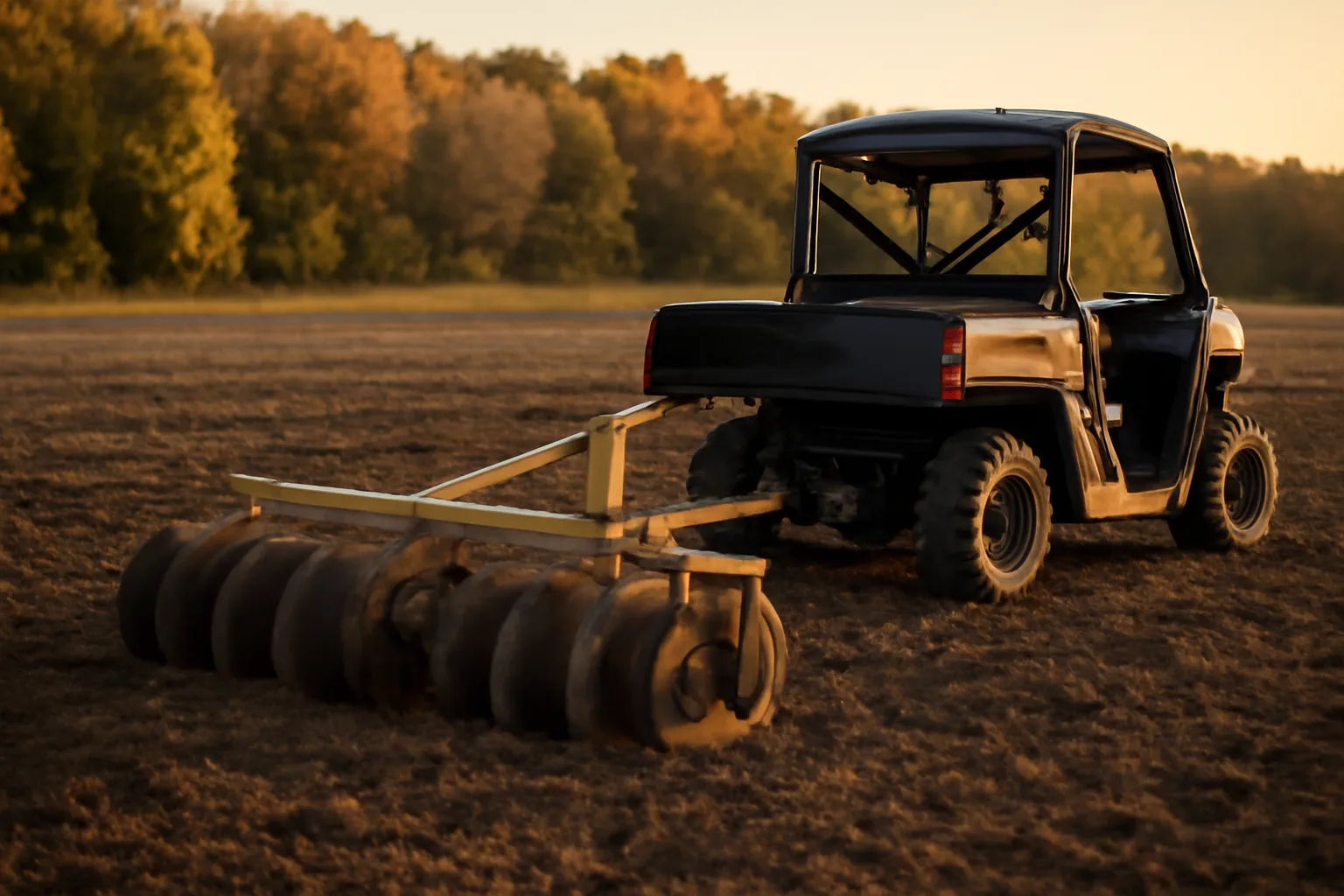
The Firminator is a pull-behind food plot implement made by Firminator (a brand under Fasse Manufacturing / Elements Ag, marketed heavily through outdoor TV and hunting retail channels). It combines a set of aggressive disk gangs, spike-tooth or spring-tooth harrows, a seed hopper with a broadcast spreader, and a cultipacker roller into one unit that gets pulled behind an ATV, UTV, or small tractor. The pitch is simple: one pass instead of four. Traditionally you'd disk the ground, work it down, broadcast or drill seed, then cultipacker it to firm the seedbed and get good seed-to-soil contact. The Firminator tries to do all of that in a single trip across the field, which matters a lot if you're working small food plots on a weekend and don't own a full tillage train. It's one of several branded all-in-one units on the market (Woods, Kasco, and others make similar implements), and it fits a specific niche: landowners and lease hunters planting plots in the 0.5 to 5 acre range who don't want to invest in a tractor-scale disk, drag, and seeder separately. For a basic primer on what a food plot actually is and why hunters plant them, see food plot whitetail.
How does the Firminator actually work in the field?
You pull it once across a plot that's already had weeds knocked down or sprayed. The front gang of disks cuts into the soil, the coulters or shanks behind that break up clods, the seed hopper meters seed down through drop tubes or a broadcast spinner, and the rear cultipacker roller presses the seed in and firms the surface. The result, when soil conditions cooperate, is a seedbed that's ready to grow without four separate implement changes. That saves time and fuel, and for someone hunting a lease three states away who only gets one or two weekends to plant, that's real value. The catch is that one-pass tillage works best on ground that's already reasonably worked or soft (old ag fields, previously tilled plots, sandy to loam soils). On hard clay, heavy sod, or rocky ground, you may still need a preliminary pass with a disk or need to run the Firminator twice. No single implement turns compacted clay into a seedbed in one trip; physics doesn't care about marketing copy.
How much does a Firminator cost, and is it worth it?
Pricing varies by model width and features, but expect somewhere between roughly $3,000 for a small ATV-pull unit up to $9,000 or more for larger tractor-pull models with bigger hoppers and wider gangs. Dealer pricing and used market listings both show this general range, though exact MSRP changes by year and dealer. Whether it's worth it depends entirely on your acreage and how often you plant. If you're doing under 2 acres a year and already own a disk or a tiller and a cultipacker (or can borrow one), you can build the same seedbed with separate passes for a lot less money. If you're planting 5, 10, or more acres across multiple plots every season, the time savings of a one-pass implement adds up fast, especially if your plots are spread across a big property or lease. A lot of hunters find a middle ground: a smaller disk harrow plus a cultipacker, run in two passes, costs less than a Firminator and does nearly as good a job if you're not in a rush. There's no wrong answer here, just a tradeoff between capital cost and time.
Do I need a Firminator, or will a disk and cultipacker work fine?
You don't need a Firminator. Plenty of great food plots get planted every year with a rented or borrowed disk, a drag harrow made from chain-link fence and a pallet, and a hand-crank or ATV broadcast spreader. What you actually need, regardless of equipment, is a firm, weed-suppressed seedbed with good seed-to-soil contact and the right seeding depth for whatever you're planting. Clover and brassica seed is tiny and needs to be barely covered, a quarter inch or less; cereal grains like oats and wheat want closer to 1 to 1.5 inches. Cornell Cooperative Extension and most land-grant guides on food plot establishment emphasize seedbed prep and depth over any specific piece of equipment. Where a Firminator (or similar all-in-one unit) earns its keep is convenience and consistency, especially for people who plant several plots a year and want to standardize the process. If you're planting one small plot occasionally, borrow or rent equipment before you buy a dedicated implement. For guidance on matching seed type to your plot before you worry about equipment, check deer food plot seed.
When should you plant food plots for deer?
Timing depends on your zone and what you're planting, not the calendar date alone. Broadly, food plot planting splits into two windows: spring/early summer for warm-season annuals and perennials, and late summer/early fall for cool-season annuals and brassicas. Spring plantings (roughly April through June depending on latitude) work for soybeans, clover, chicory, and warm-season annual blends. These need soil temps consistently above 50-55°F and no risk of hard frost. Fall plantings (roughly late July through September in northern zones, August through October further south) work for brassicas, cereal grains, and clover overseeding. The general rule most extension services give: count backward from your area's average first hard frost and get brassicas and cereal grains in the ground 60 to 90 days ahead of it, since these plants need that runway to bulk up before cold weather. Local extension frost date tools (like those from NOAA and land-grant universities) are the best source for your specific frost date [1].
When to plant oats for deer
Oats are a cool-season annual and go in the ground in late summer to early fall for most whitetail country, typically August through mid-September in the North, and September into early October further south. Oats germinate fast (5-10 days in good conditions) and provide highly attractive early fall forage, but they're frost-sensitive and will die back with hard freezes, usually before winter really sets in. Some hunters also plant oats in early spring as a quick cover crop or nurse crop for clover, but for hunting purposes the fall planting is what puts oats in front of deer during archery and early gun seasons. University extension forage guides note oats' quick establishment and high palatability compared to some other cereal grains.
When to plant turnips for deer
Turnips need roughly 80 to 90 days to reach full maturity and get planted in mid-to-late summer, generally late July through August depending on your frost date. Plant them too early and they bolt or get overgrown before the cold snaps that make them sweet and palatable; plant them too late and they don't bulb up before frost stops growth. Here's the important quirk with turnips specifically: deer often ignore the leaves and bulbs early in the fall and only start hammering them hard after a few frosts convert starches to sugars, making them noticeably sweeter. That means a plot that looks untouched in October can get hammered in December. Don't judge a brassica plot's success too early. Brassica and turnip guidance from extension forage programs generally recommends a seeding rate around 4-5 lbs per acre for pure turnip stands and notes the frost-driven palatability shift as a documented pattern in deer forage research [2].
Do deer eat sorghum?
Yes, deer will eat sorghum, particularly grain sorghum heads and young sorghum forage, but it's not a top preference food and usually gets used more as a screening/cover crop or a supplemental grain component in a blend than a primary attractant plot. Sorghum is popular in some regions as a drought-tolerant summer crop and doubles as standing cover that also holds some food value into fall and winter once the heads mature. Compared to soybeans, corn, or brassicas, sorghum ranks lower on most whitetail preference studies and extension forage lists, largely because deer have plenty of higher-preference options most of the season. If you're planting sorghum, it's smart to think of it as a secondary structure and food source, not your main attractant plot.
Do deer like clover, and do deer eat clover?
Yes, clover is one of the most consistently preferred food plot forages for whitetails, and it's often cited by extension wildlife programs as a top-tier perennial choice because of its protein content and long growing season. Clover regrows after grazing, tolerates mowing, and provides forage from spring through fall in a properly maintained stand, which is why it shows up in nearly every food plot seed mix on the market. White clover (Ladino and similar varieties) and red clover both get planted widely; Ladino tends to be more shade-tolerant and lower-growing, while red clover grows taller and handles drier soils a bit better in some regions. Clover typically gets planted in early spring or late summer/early fall depending on your zone, and a well-maintained clover stand can last 3-5 years before needing to be replanted, according to multiple state extension forage guides. For a broader rundown on species selection beyond clover, see deer food plots.
What are deer's favorite foods?
There's no single universal answer because preference shifts by season, region, and what's available, but across most whitetail research, acorns, soybeans, clover, and corn consistently rank as high-preference foods. In late summer and fall, soft mast and agricultural crops like soybeans dominate; in winter, especially in northern climates, deer shift hard toward whatever standing grain, browse, or brassica tubers remain. Acorns in particular get cited repeatedly in wildlife research as a preferred fall food when available, because of their high fat content, which matters for deer building fat reserves before winter. A widely cited whitetail food preference study out of Mississippi State University and similar regional research consistently lists soybeans, clover, and acorns near the top of preference rankings, with items like cereal grains and brassicas rated as good but secondary options depending on season. Bottom line: there's no one magic seed. What deer prefer changes with the calendar, which is exactly why most successful food plot programs plant a mix of spring/summer and fall forages rather than a single species.
Do deer like honey (or honey-based attractants)?
Deer are drawn to sugar and sweet scents in general, which is the theory behind some commercial mineral and attractant products that include molasses or sweetener bases, but there isn't solid published research specifically testing honey as a standalone deer attractant. Deer are known to browse honeysuckle heavily (a completely different plant from honey), which sometimes causes confusion. If you're asking whether pouring honey or sugar syrup in a plot does anything meaningful for attraction, the honest answer is that scent-based and taste-based commercial attractants have mixed and largely anecdotal support, and there's no rigorous field study confirming honey specifically outperforms standing food sources. A well-managed food plot with the right forage for the season will do far more for consistent deer activity than any bait or attractant product, and using bait or minerals may be restricted or illegal in your state during hunting season, so check your state wildlife agency's regulations before using any attractant [3].
How does a Firminator compare to other one-pass or disk-style planters?
| Method | Approx. cost | Best for | Tradeoff | |
|---|---|---|---|---|
| Firminator (or similar one-pass unit) | $3,000-$9,000+ | Multiple plots, limited time on property | High upfront cost | |
| Disk harrow + drag + cultipacker (separate passes) | $800-$3,000 total (used) | Occasional planters, budget-conscious | More time, more trips across the field | |
| No-till drill | $2,500-$10,000+ | Minimal tillage, erosion-prone ground | Needs decent soil contact already; less forgiving on rough ground | |
| Hand tools + ATV disk/spreader | Under $500 | Small plots under an acre, tight budgets | Slow, more physical labor | The Firminator sits in the middle-to-upper range of cost but wins on convenience for anyone managing multiple plots or working with limited weekend time. A no-till drill is the better call if you're trying to reduce soil disturbance and erosion, especially on sloped ground, since no-till planting leaves more residue on the surface and cuts erosion risk, a point USDA NRCS soil health guidance repeatedly emphasizes for row-crop and cover-crop establishment generally [4]. |
What's the right way to plan a food plot before buying equipment?
Start with a soil test, not a seed catalog or an equipment purchase. Your local extension office or a private ag lab will tell you your soil pH and nutrient levels, and most food plot failures trace back to skipping this step, planting into soil that's too acidic for clover or brassicas to take up nutrients properly. Land-grant extension soil test guides consistently recommend testing every 2-3 years and applying lime based on lab recommendations rather than guessing [5]. Once you know your soil chemistry, pick species suited to your region and planting window (see the timing sections above), then figure out what equipment you actually need to get seed in the ground at the right depth. A Firminator is a nice-to-have for people planting multiple plots regularly; it is not a prerequisite for a good food plot. If you want a starting point that turns your soil test and property details into an actual plan, a resource like the $99 one-time Custom Food Plot Plan at /plot-plan-builder walks through species and rate recommendations based on your zone and soil results. Your soil-test lab is still the authority on exact lime and fertilizer amounts; a plan like this gives general species and calendar guidance layered on top of that.
What mistakes do people make with one-pass planters like the Firminator?
The most common mistake is running the implement over ground that's too hard or too weedy without any prep work first. A one-pass tool still needs reasonably workable soil; running it over sod-bound or rock-hard clay usually means a shallow, inconsistent seedbed no matter how good the implement is. The second common mistake is seeding rate errors, either from a hopper that's not calibrated for the seed size (fine clover seed meters very differently than large soybean seed) or from driving too fast and blowing through the plot in a way that leaves gaps. Slow down, calibrate, and check your rate against extension-recommended seeding rates for whatever species you're planting rather than trusting factory hopper settings blindly. Third, people skip the soil test and assume the tillage step alone fixes fertility problems. Tillage breaks up soil physically; it does nothing for pH or nutrient deficiency. That's still a soil test and lime/fertilizer problem, not an equipment problem.
Frequently asked questions
Do deer eat sorghum?
Yes, deer eat sorghum, especially the grain heads and young forage, but it's typically a secondary food source and screening/cover crop rather than a top attractant. Most whitetail preference research ranks it below soybeans, clover, and acorns for consistent draw.
Do deer eat clover?
Yes, clover is one of the most consistently preferred whitetail forages, valued for its high protein content and long growing season from spring through fall. It's a staple in nearly every commercial food plot mix and is widely recommended by state extension wildlife programs.
When to plant deer food plots?
Warm-season plots (soybeans, warm annual blends) go in April through June once soil is consistently above 50-55°F. Cool-season plots (brassicas, cereal grains, clover) go in late summer to early fall, timed 60-90 days before your area's average first hard frost.
Do deer like clover?
Yes, clover ranks near the top of preferred whitetail forages in most extension and wildlife research, largely because of its protein content, palatability, and season-long availability. Both white (Ladino) and red clover varieties are widely planted and well-tolerated by deer across most regions.
When to plant oats for deer?
Plant oats in late summer to early fall, typically August through mid-September in northern zones and September into early October further south. Oats germinate quickly, in 5 to 10 days under good conditions, and provide strong early-fall forage before hard frost kills the plant back.
When to plant food plots for deer?
Split your plantings into two windows: spring through early summer for warm-season annuals and perennials like soybeans and clover, and late summer through early fall for brassicas and cereal grains. Exact dates depend on your local frost date, which your state extension office or NOAA frost maps can confirm.
When to plant turnips for deer?
Plant turnips in mid-to-late summer, generally late July through August, so they have the 80 to 90 days they need to bulb up before hard frost. Deer often ignore turnip bulbs and leaves early on and hit them hard only after several frosts sweeten the starches.
What is a food plot?
A food plot is a planted area, usually on hunting land, seeded with forage crops like clover, brassicas, cereal grains, or soybeans to provide supplemental nutrition and attract deer or other wildlife. Plots range from small quarter-acre kill plots to multi-acre agricultural-style fields.
What are deer's favorite foods?
Preference shifts by season, but acorns, soybeans, and clover consistently rank as top whitetail foods in wildlife research, largely because of protein and fat content. Brassicas and cereal grains rank as strong secondary options, especially in late fall and winter when other food is scarce.
Do deer like honey?
There's no solid published research testing honey specifically as a deer attractant, though deer are generally drawn to sweet scents, which is why some commercial mineral products use molasses bases. A well-timed food plot does far more for consistent deer activity than any honey or sugar-based bait.
How much does a Firminator food plot planter cost?
Expect roughly $3,000 for a smaller ATV-pull model up to $9,000 or more for larger tractor-pull units with wider gangs and bigger hoppers. Exact pricing varies by dealer, model year, and features, so check current dealer listings for your specific size.
Do I need a Firminator to plant a good food plot?
No. A disk harrow, a drag, and a cultipacker run in separate passes will build an equally good seedbed for less money; it just takes more time and more trips across the field. A Firminator's main advantage is convenience for people planting multiple plots on a tight schedule.
Can I use a Firminator on hard clay or heavy sod?
It's tougher going. One-pass implements like the Firminator work best on ground that's already reasonably soft or previously worked. On compacted clay or thick sod, you'll likely need a preliminary disking pass or two passes with the Firminator itself to get a workable seedbed.
Sources
- NOAA National Weather Service, frost/freeze climate data: Local frost date data used to time fall food plot plantings
- University of Tennessee Extension, brassica food plot guidance: Turnip planting window, maturity timeline, and frost-driven palatability shift
- State wildlife agency baiting and feeding regulations (varies by state): Baiting and attractant use during hunting season is regulated and varies by state
- USDA Natural Resources Conservation Service, soil health and no-till guidance: No-till and reduced tillage practices reduce erosion risk compared to conventional tillage
- University of Missouri Extension, soil testing guidance: Soil testing every 2-3 years and applying lime based on lab recommendations rather than estimation