Last updated 2026-07-25
TL;DR
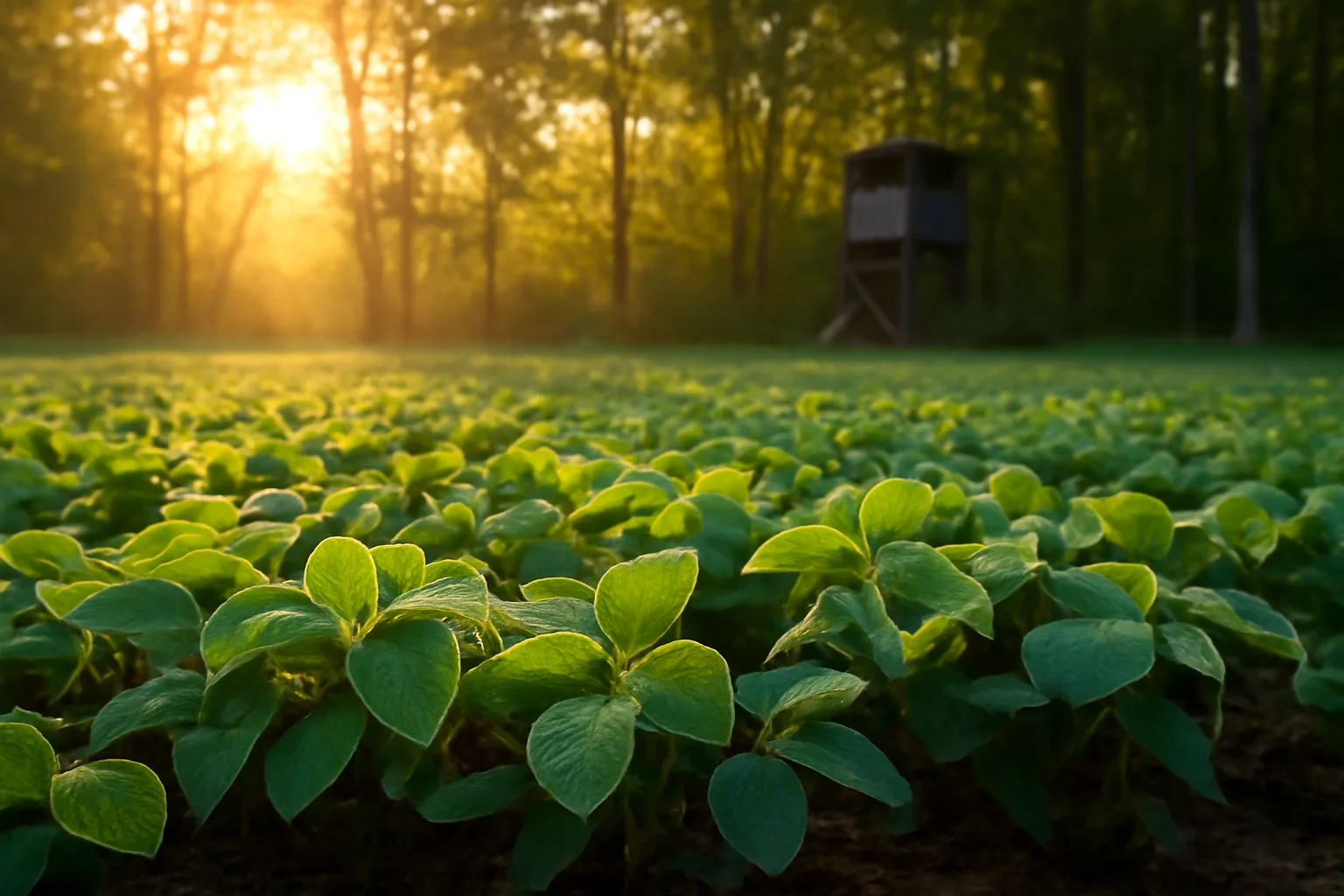
Soybeans are one of the best summer food plot options because deer eat the leaves all season and the pods and beans hold through fall and winter. Plant after last frost when soil hits 60-65°F, drill 1-1.5 inches deep at 50-60 lbs/acre for forage blends, and expect deer to hammer seedlings hard until plants outgrow browsing pressure.
what is a food plot, and why do soybeans fit so well?
A food plot is a planted patch of ground on hunting land, usually somewhere between a quarter acre and several acres, grown specifically to feed deer or other wildlife and to give hunters a place to watch or intercept animals. Some plots are annuals replanted every year, some are perennials like clover that come back for three or four seasons, and most serious plot programs run a mix of both. Soybeans fall into the annual, warm-season category. They're a legume, which means they fix nitrogen out of the air through bacteria living on their roots, so they need less nitrogen fertilizer than a grass crop like corn. Whole-plant soybean forage runs roughly 20-30% crude protein during the vegetative growth stage, based on forage quality data compiled by university agronomy programs. That's why deer key in on young bean fields so hard. The catch is that soybeans are also a magnet for deer browsing pressure. A one-acre plot in a high-density deer area can get grazed to the dirt before it ever gets a chance to establish. That's the single biggest failure mode for first-time soybean planters, and it's fixable with acreage, timing, and sometimes a temporary electric fence around seedlings for the first three to four weeks.
when to plant food plots for deer (soybeans specifically)
Soybeans go in after your last expected frost date, once soil temperature is consistently at or above 60°F, ideally pushing toward 65-70°F for faster germination. Planting too early into cold, wet soil just rots the seed or stalls germination and gives weeds a head start. Across the whitetail's range, that generally means: - Deep South (zone 8-9, Gulf states, south Texas): late March through April
- Mid-South / transition zone (zone 7, Tennessee, Arkansas, Virginia): late April through mid-May
- Midwest / mid-latitude (zone 6, Missouri, Kentucky, southern Iowa, Kansas): mid-May through early June
- Northern tier (zone 4-5, Minnesota, Wisconsin, Michigan, Maine, upstate New York): late May through mid-June These windows track closely with the corn and soybean planting dates cattle and row-crop farmers already use in each state, since it's the same crop and the same soil temperature threshold. USDA's National Agricultural Statistics Service publishes state-level planting progress reports every spring that food plotters can cross-reference for their county [1]. One planting-date wrinkle specific to plots: because deer browse soybeans so hard as seedlings, some plot managers intentionally plant a week or two later than row-crop farmers do, so the beans emerge into slightly warmer soil and grow faster through the vulnerable cotyledon stage. It's a small edge, but on high-pressure ground it matters.
how do you actually plant a soybean plot, step by step?
Start with a soil test. Soybeans grow best in soil with a pH between 6.0 and 6.8, and if your test comes back below 6.0, lime needs time (often 4-6 months) to fully react and raise pH, so ideally you're liming the fall before a spring soybean planting [2]. Your soil test lab's recommendation is the real authority here on exact lime and fertilizer rates for your dirt. Treat any general number in this article as a starting point, not a substitute for your results. A basic planting sequence: 1. Test soil, apply lime months ahead if needed. 2. Kill existing vegetation with glyphosate 7-10 days before planting, or till it under. 3. Broadcast or drill seed. Drilling at 1 to 1.5 inches deep gives the most consistent stand; broadcasting works but needs cultipacking or light disking afterward to get seed-to-soil contact. 4. Seeding rate: 50-60 lbs/acre for forage-blend soybeans drilled, up to 100-120 lbs/acre if broadcasting shallow-covered seed (broadcast rates run higher because germination is less reliable). 5. Fertilize based on soil test, but soybeans typically need phosphorus and potassium more than nitrogen, since the plant fixes much of its own nitrogen once nodulation kicks in. 6. Inoculate seed with the correct Bradyrhizobium japonicum strain if the ground hasn't grown soybeans in the last 3-5 years. This is cheap insurance and most feed stores carry pre-inoculated seed already. Row spacing doesn't matter much for a deer plot the way it does for grain yield. Drilled narrow rows (7-15 inches) canopy faster and choke out weeds better than 30-inch rows, which is a real advantage in a plot you're not going to spray all season.
what are deer's favorite food plot plants, and where do soybeans rank?
There's no single scientifically ranked list of deer's favorite food, because preference shifts by season, region, and what else is available on the landscape. But agricultural crops consistently show up at the top of forage preference studies and deer diet analyses. Soybeans, corn, and clover are the three most commonly cited high-preference plantings in whitetail research and extension literature. What soybeans do better than almost anything else is deliver protein through the entire growing season and then flip to a high-energy, high-fat food source once the pods mature and dry down. That dual role, summer browse plus a standing grain crop through fall and winter, is rare. Corn does the fall/winter energy part well but offers little browse value in summer since deer can't eat a cornstalk. Clover offers great spring/summer browse but no fall grain component. If you're picking one plant to maximize both antler-growing season nutrition and late-season food, soybeans and a clover/chicory perennial mix cover different halves of the calendar, which is why most plot plans layer several species rather than betting on one.
do deer like clover, and how does it compare to soybeans?
Yes. Deer show strong, consistent preference for clover, and it's one of the most planted perennial food plot species in North America for that reason. White clover varieties like Durana and Ladino, plus red clover, regrow after grazing and can produce usable forage for three to five years off one planting, according to variety trial and management guidance from university forage programs [3]. The tradeoff against soybeans is tonnage and timing. An acre of clover produces less total forage biomass than an acre of soybeans, and clover growth slows hard in July and August heat in the South and transition zone, sometimes going semi-dormant. Soybeans hit their peak biomass right in that same window and keep producing through August before pods start filling. Most experienced plot managers run both: clover as the perennial backbone that needs almost no annual work beyond mowing and a spring fertilizer touch-up, and soybeans as the annual heavy-hitter for peak summer tonnage and a fall/winter grain carryover. If you can only plant one plot and you want low maintenance, clover wins. If you want maximum pounds of forage per acre and don't mind replanting yearly, soybeans win.
do deer eat sorghum, and should it replace or pair with soybeans?
Yes, deer eat grain sorghum (milo), both the developing seedheads and the plant itself as browse, though it's generally considered less preferred than corn or soybeans as a stand-alone forage. Sorghum's real value in a plot is drought tolerance and standing winter cover. It holds up in hot, dry conditions better than corn, and its dense stalks provide screening and thermal cover through winter. Sorghum works well mixed into a soybean plot as a nurse crop or structural component: the sorghum stalks give soybean vines something to climb later in the season and add stem structure that keeps the plot from turning into a flat, grazed mat. Some blended "beans and sorghum" plot mixes are sold specifically for this reason. On its own, sorghum is a fine drought-insurance crop for marginal soil, but it's not typically anyone's top pick if soil and rainfall support soybeans instead.
when to plant oats for deer
Oats go in as a cool-season annual, planted in late summer to early fall for most of the whitetail's range, roughly August through September in the North and September into October in the mid-South and South. Oats germinate fast, sometimes emerging within about a week in warm soil, and produce highly palatable, tender forage that deer often prefer over other fall grains early in its growth. Oats can also go in as a spring planting in northern climates, but their main food plot role is as a fall attractant and as a nurse crop mixed with brassicas or clover, since the quick-germinating oats hold soil and suppress weeds while slower species establish. Oats winterkill in most of the northern and transition zones once temperatures drop into the teens and lower, so they're not a season-long food source there, more of an early-fall to early-winter window. A lot of plot mixes pair oats with soybeans in a two-stage program: soybeans for summer, then a fall planting of oats, winter rye, or a brassica blend drilled into the same ground (or an adjacent plot) once beans are harvested or browsed down.
when to plant turnips for deer
Turnips go in the ground roughly 90 to 100 days before your area's first hard frost, since that's about how long they need to bulb up and reach peak sugar content. For most of the whitetail range that lands somewhere between late July and early September, with northern states planting earlier in that window and southern states later . Turnips are a brassica, and deer usage of turnip plots often follows a predictable pattern: light early browsing on the leaves, then a sharp jump in consumption of both leaves and bulbs after the first hard frosts convert starches to sugars, making the plant taste sweeter. That's why turnip plots often look ignored in October and get hammered in December. Turnips don't pair directly into a soybean rotation timing-wise since soybeans are still standing when turnip planting windows open in most zones. The common approach is a separate brassica plot planted in mid to late summer, running alongside a spring-planted soybean field, so you've got summer protein from beans and a late-season energy/sugar source from turnips going into the toughest part of winter.
roundup ready vs conventional soybeans: which should you plant?
| Seed cost | Higher | Lower | |
|---|---|---|---|
| Weed control | Spray glyphosate over the top | Pre-plant burndown, tillage, or mowing | |
| Best for | Weedy ground, no-till plots | Clean ground, tilled seedbeds | |
| Equipment need | Sprayer required | Sprayer optional | For a first-time plot on ground that's been mowed hayfield or pasture, conventional beans with a good burndown spray before planting usually work fine and save money. For reclaimed ag ground or anything with a rough weed history, Roundup Ready earns its extra cost. |
Roundup Ready (glyphosate-tolerant) soybeans let you spray glyphosate over the top of an emerged plot to knock back grass and broadleaf weeds without killing the beans. That's a real advantage on ground with heavy weed pressure or a history of tough weeds like pigweed. The seed costs more, and you need a sprayer and glyphosate on hand, but the ability to clean up a weedy plot mid-season without hand-pulling or mowing is worth it for a lot of plot managers. Conventional (non-GMO) soybean forage blends cost less per bag and work fine on clean ground or ground you're willing to prep well ahead of planting with a burndown herbicide and maybe a pre-emergent. Several food plot seed companies sell forage-specific soybean blends (as opposed to grain-yield row-crop varieties) bred to stay leafier and more palatable longer into the season, since a plot doesn't need the same seed-yield traits a commercial grain farmer wants. | Factor | Roundup Ready | Conventional forage blend |
do deer like honey, and does it matter for food plots?
No. Honey has no real role in deer food plots, and there's no credible evidence deer specifically seek it out as a natural food source. Whitetails are herbivores whose diet consists of browse, forbs, mast, and agricultural forage, not honey or other animal-derived sugars. This question sometimes comes up because commercial deer attractant sprays and mineral products occasionally include sugar or molasses-based scents, but that's a scent/mineral lick product category, not a food plot planting question. If you're trying to pull deer to a plot faster in the first season, the tools that actually work are proven: attractive forage species (soybeans, clover, brassicas), mineral sites placed legally and away from the plot itself, and time. There's no shortcut additive that replaces a well-planted, well-timed plot. Worth flagging here too: check your state wildlife agency's baiting and feeding regulations before adding any mineral, scent, or supplemental feed near your plot. Baiting rules vary widely by state, some ban it outright for deer hunting, some restrict distance from a stand, and some allow it with conditions. Your state fish and wildlife agency's hunting regulations page is the actual authority on this, not a seed company or blog.
what threats and mistakes ruin soybean plots most often?
Overbrowsing is the number one soybean plot killer, especially on plots under 2-3 acres in areas with high deer density. Deer can graze emerging soybean seedlings down to nubs before the plant ever gets past the first true leaves, and once the growing point is repeatedly bitten off, the plant dies rather than regrowing. Bigger plot acreage, temporary electric fencing during the first 3-4 weeks after emergence, or planting a "sacrifice" perimeter of cheaper seed are the practical fixes, since there's no herbicide or spray that stops browsing. Other common failure points: planting too shallow (soybeans need real seed-to-soil contact and 1-1.5 inches of coverage, not a surface broadcast with no cultipacking), skipping the soil test and guessing at lime and fertilizer, and planting into a poor weed-control situation where grass outcompetes beans in the first three weeks. Japanese beetles and bean leaf beetles can also strip leaves hard in mid-summer in some regions. Purdue University Extension's field crop entomology program notes that defoliation approaching 20-30% during pod-fill is the general threshold where scouting and, if needed, a labeled insecticide application become worth the cost . Drought is the other big variable. Soybeans have decent drought tolerance once established compared to some plot species, but a dry stretch during flowering and early pod-set can cut yield hard. There's no fixing weather, but planting on your best available soil-moisture ground, rather than the sandiest ridge on the property, helps.
how do soybeans fit into a full-season plot plan?
A soybean plot rarely stands alone in a well-built plot program. The usual pattern: perennial clover or clover/chicory plots for low-maintenance spring and summer browse, a soybean plot (or beans/corn combo) as the big summer tonnage and fall standing-grain piece, and a late-summer brassica or cereal grain planting (oats, winter rye, turnips) layered in for the late-season energy push once temperatures drop. Acreage allocation matters more than species choice for a lot of properties. A common rule of thumb from plot seed companies and some state agency habitat guides is roughly 1-3% of a property's total acreage in food plots, with the rest managed as bedding, cover, and natural forage, though this varies a lot by region and deer density and isn't a hard federal or state standard. Getting the species mix, acreage split, and planting order right for a specific piece of ground is exactly the kind of planning that benefits from a second set of eyes on your soil test and property map. That's the gap the Custom Food Plot Plan is built to fill, a $99 one-time plan built around your soil test results, region, and goals, though it's general planning guidance, not a substitute for what your soil lab or a local agronomist tells you about your specific dirt. For readers still deciding what to plant where, it's worth comparing soybeans against other core plot species side by side before committing acreage; see food plot whitetail and deer food plots for broader species breakdowns, and deer food plot seed for blend options.
Frequently asked questions
When should I plant soybeans in a deer food plot?
Plant after your last frost date once soil temperature holds at 60°F or warmer, ideally 65-70°F. That's late March/April in the Deep South, late April/May in the mid-South, mid-May/June in the Midwest, and late May/mid-June in the northern tier. Cross-check USDA NASS state planting progress reports for a more local benchmark.
How deep should I plant soybean seed in a food plot?
Drill or plant soybeans 1 to 1.5 inches deep. Shallower planting risks the seed drying out before germination; deeper planting can delay or prevent emergence, especially in heavier clay soils. If broadcasting instead of drilling, follow with a cultipacker or light disking to get seed-to-soil contact.
Do deer eat sorghum in food plots?
Yes, deer browse grain sorghum plants and eat the developing seedheads, though most plot managers rank it below corn and soybeans as a preferred forage. Sorghum's biggest value is drought tolerance and winter cover from its dense stalks, and it's often mixed with soybeans as a structural nurse crop rather than planted alone.
Do deer like clover, and is it better than soybeans?
Deer show strong, consistent preference for clover, and varieties like Durana or Ladino white clover can produce forage for three to five years per planting. Clover is lower-maintenance than soybeans but produces less total tonnage and slows in summer heat, while soybeans peak in summer biomass. Most plot programs run both rather than choosing one.
When should I plant oats for a deer food plot?
Oats go in as a fall cool-season annual, generally August through September in the North and September into October in the mid-South and South. They germinate quickly and offer highly palatable early-fall forage, but they winterkill in most northern and transition zones once hard freezes set in.
When is the best time to plant turnips for deer?
Plant turnips roughly 90-100 days before your area's expected first hard frost, since that's the time needed to bulb and sweeten. That generally lands between late July and early September depending on latitude. Deer usage often spikes after the first hard frosts convert plant starches to sugars.
What exactly is a food plot?
A food plot is a planted area on hunting land, typically a quarter acre to several acres, grown specifically to provide forage for deer or other wildlife and often to give hunters a place to observe or hunt over. Plots can be annual crops replanted yearly or perennials that persist for several seasons.
What are deer's favorite foods overall?
There's no single ranked scientific list since preference shifts by region and season, but agricultural crops like soybeans and corn plus clover consistently rank as top-preference plantings in whitetail forage studies and extension literature. Natural mast like acorns is also a major seasonal preference where available.
Do deer like honey or sugar-based attractants?
No, there's no credible evidence deer specifically seek out honey; whitetails are herbivores that eat browse, forbs, mast, and agricultural forage. Some commercial attractants use sugar or molasses scent components, but that's a separate product category from food plot planting and isn't a meaningful food source on its own.
Should I use Roundup Ready or conventional soybeans for a plot?
Roundup Ready beans let you spray glyphosate over the top to clean up weeds mid-season, which helps on weedy or no-till ground, but cost more and need a sprayer. Conventional forage blends cost less and work fine on clean, well-prepped ground. Choose based on your weed pressure and whether you already have spray equipment.
How much of my property should be in food plots?
A commonly cited rule of thumb from plot seed companies and some habitat guides is roughly 1-3% of total property acreage in food plots, with the remainder in bedding cover and natural forage. This isn't a formal state or federal standard and varies by region, deer density, and property goals.
Why do deer destroy my soybean plot before it establishes?
Small plots (under 2-3 acres) in high deer-density areas often get browsed to the ground before beans reach a mature growth stage, since deer target tender seedlings hard. Fixes include planting more acreage, using temporary electric fencing for the first 3-4 weeks after emergence, or planting a cheaper sacrifice perimeter around the main plot.
Sources
- USDA National Agricultural Statistics Service, Crop Progress Reports: State-level soybean planting progress dates used for regional timing comparison
- University of Missouri Extension, Soil pH and Liming: Soybeans grow best at pH 6.0-6.8 and lime needs months to react before planting
- University of Georgia Extension, White Clover: White clover varieties like Ladino can persist and produce forage for three to five years
- Oklahoma State University Extension, Grain Sorghum Production: Grain sorghum is more drought tolerant than corn and provides winter cover from dense stalks
- University of Georgia Extension, Brassicas for Deer: Turnips need roughly 90-100 days before first frost to bulb and reach peak palatability
- Purdue University Extension, Field Crops IPM: Soybean Insects: Defoliation thresholds around 20-30% during pod-fill warrant insecticide response for leaf-feeding beetles