Last updated 2026-07-24
TL;DR
A good deer food plot seed mix pairs a perennial (clover) with an annual (brassicas, oats, or cereal grains) so you get spring-through-fall coverage. Deer readily eat clover, oats, and turnips; sorghum is eaten but usually as a screen/grain crop, not a preferred forage. Timing depends on your frost dates, not a calendar date.
What is a food plot, exactly?
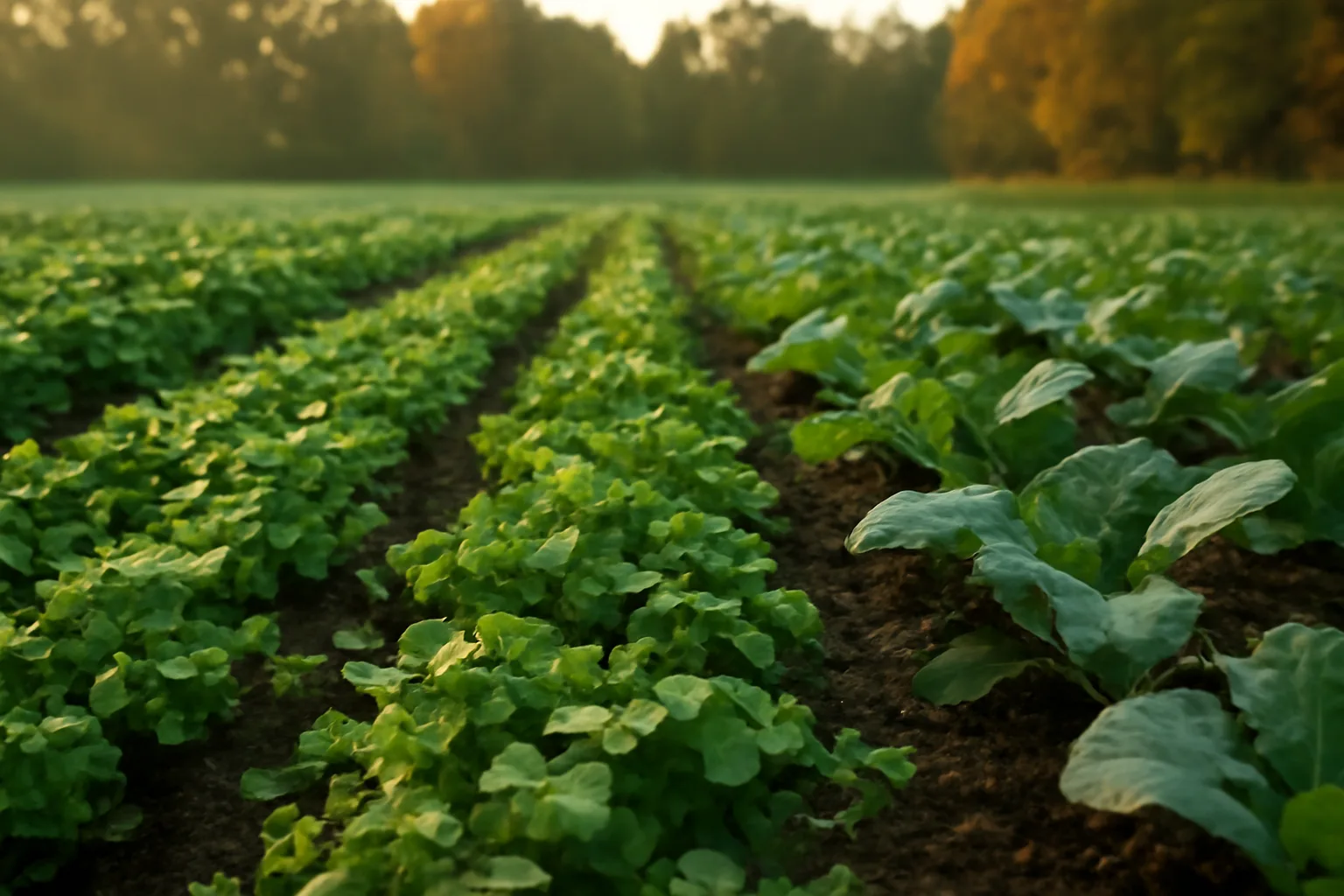
A food plot is a planted patch of ground, usually somewhere between a quarter acre and a few acres, seeded with forage that deer and other wildlife will eat. It's more than "a field you mow." You're managing it like a small farm crop: soil test, lime, fertilizer, seed selection, and a mowing or spraying schedule. Most plots fall into two rough categories. Annual plots get replanted every year (brassicas, cereal grains, sorghum, peas) and often produce the most tonnage per acre in a single season. Perennial plots (clover, chicory, alfalfa) get planted once and then maintained for two to five years with mowing and fertilizer touch-ups. The USDA's National Agroforestry Center and state wildlife agencies generally treat food plots as a habitat management tool, not a substitute for natural browse. The Quality Deer Management Association (now the National Deer Association) has long recommended plots make up no more than 1 to 5 percent of a property's total acreage, with the rest left in natural cover and forage. If you want a walkthrough of plot placement and design before you buy seed, that's covered in food plot whitetail.
What do deer actually prefer to eat?
Deer are opportunistic browsers, and their preferences shift by season, region, and what's available. That said, decades of forage preference studies (many run through university extension programs and the Mississippi State Deer Lab) consistently rank a handful of plants at the top: soybeans, cowpeas, clover, and certain brassicas during their peak palatability windows. In spring and summer, deer lean hard on high-protein forages like clover and soybeans to support antler growth and lactation. In fall and winter, energy-dense options like brassicas (after a frost sweetens them), acorns, and cereal grains become more attractive. There's no single "favorite" food across all seasons; it's really a rotating menu driven by nutritional need and what's actually growing. One thing to flag: baiting and supplemental feeding rules vary a lot by state, and some states draw a legal line between a planted food plot and a pile of corn or mineral. Always check your state wildlife agency's current regulations before assuming a practice is legal where you hunt [1].
Do deer eat clover, and is it worth planting?
Yes. Clover is one of the most consistently preferred food plot forages, and it's usually the backbone of a perennial plot program. White clover (Ladino types especially) and red clover both show up near the top of deer preference trials, and university extension guides frequently recommend clover as a first planting for new plot owners because it's forgiving and productive [2]. Clover's real strength is season length. Once established, it produces palatable forage from spring green-up through the first hard frosts, sometimes longer in mild climates. Purdue University Extension notes that well-managed clover stands can persist three to five years before you need to till and reseed [2]. The tradeoff is establishment patience. Clover seed is small and needs good seed-to-soil contact, a firm seedbed, and correct soil pH (most clovers want 6.0 to 7.0). If your soil test comes back at pH 5.5, clover will struggle no matter how good the seed is. That's the kind of thing your soil test lab's recommendation should override any generic seed bag advice. For a broader look at species pairing, see deer food plot seed.
Do deer eat sorghum, and what's it actually good for?
Deer will eat sorghum grain and will browse young sorghum foliage, but it's not typically planted as a primary deer forage the way clover or brassicas are. Grain sorghum (milo) and forage sorghums are more commonly used as a screening crop, a drought-tolerant summer filler, or a component in a wildlife blend meant to also draw turkey, quail, and dove. Sorghum's real value in a food plot mix is agronomic, not necessarily palatability. It handles heat and drought better than corn, needs less nitrogen, and its heavy stalks make good visual cover along plot edges. NRCS plant guides list grain sorghum among the wildlife food and cover species suited to drier regions with limited irrigation [3]. If your goal is pure deer nutrition, sorghum is a supporting player, not the headliner. If you want cover plus incidental deer use plus other game species, it earns a spot in the mix.
Do deer like clover more than other plot options?
Preference studies and decades of practical plot experience put clover near the top, but "like" depends on what else is available and the time of year. During spring and early summer, clover's protein content (often 20 to 25 percent crude protein in good stands) makes it very attractive, especially to lactating does and bucks growing antlers [4]. Come late summer, if clover gets stressed by drought or heat, deer will shift toward soybeans, native browse, or whatever's still green and tender. Come fall, brassicas and cereal grains often pull deer away from clover, especially once a frost converts starches to sugars in turnip and radish tops. So clover is a strong, reliable, season-long option. It's rarely the single best choice every week of the year. That's why most serious plot plans mix a perennial clover plot with one or two annual plots nearby, so deer have options as the season changes.
When should you plant food plots for deer?
Timing depends far more on your local frost dates and soil temperature than on a fixed calendar date. Broadly, you're working with two windows: a spring planting window for warm-season annuals and clover, and a late-summer window for fall brassicas, cereal grains, and clover overseeding. Spring plantings (clover, soybeans, cowpeas) generally go in after your last frost date, when soil temps are reliably above 50 to 55 degrees F. Fall plantings (brassicas, oats, wheat, rye) usually go in 6 to 10 weeks before your area's first expected fall frost, so the plants have time to establish before growth slows [4]. Because frost dates shift by hundreds of miles north to south, a mid-August planting date in Wisconsin might be a mid-September date in Tennessee. Your state land-grant extension office publishes frost date tables and planting calendars specific to your county; that's a better source than a generic seed bag date range.
When to plant oats for deer
Oats are typically planted in late summer to early fall, roughly 60 to 90 days before your first hard frost, so plants can reach a few inches of leafy growth before cold weather. In much of the whitetail's range that lands somewhere between mid-August and mid-September, though southern states can push into October. Oats germinate fast (often within a week in warm, moist soil) and put out tender, sugar-rich forage that deer hit hard in early fall, sometimes before brassicas even mature. Extension trial data from the University of Tennessee and other land-grant programs consistently shows oats among the more attractive fall cereal grain options in deer preference cafeteria-style trials [4]. One caveat: oats winterkill in a lot of northern climates once temps drop into the low teens or single digits for extended periods. If you're in zone 4 or colder, wheat or rye often outlasts oats through winter and into a spring green-up bonus.
When to plant turnips for deer
Turnips are a fall brassica, and the standard advice is to plant them 90 to 100 days before your first expected killing frost, which usually puts seeding in mid-July through August across most of the whitetail's range. That timing lets the plant build a bulb and full leaf canopy before frost sweetens it up. Here's the part a lot of first-time plot owners miss: turnips (like other brassicas) aren't very attractive to deer until after one or more hard frosts convert starches in the leaves and bulb into sugars. Purdue Extension and other land-grant sources note deer often ignore brassica plots in early fall, then hammer them hard once cold weather sets in [2]. If you plant too late and frost hits before the plant matures, you get small bulbs and less forage tonnage, which is a common reason a turnip plot looks disappointing. Turnip seed is tiny (similar to clover), so it needs a firm, shallow seedbed, roughly a quarter inch deep or less. Broadcasting onto a rough, cultipacked seedbed generally works better than trying to drill it deep.
How do you build a food plot seed mix from scratch?
Start with your soil test, not the seed catalog. Most state extension soil labs (and many private labs) will return pH, phosphorus, potassium, and lime recommendations within a couple of weeks for $10 to $20 per sample. Your lab's lime and fertilizer recommendation is the authority here; a seed mix can't fix a pH problem. Once you know your pH and fertility situation, pick a perennial base (clover, alfalfa, or chicory) for season-long protein, then layer in one or two annuals timed to your fall or spring windows (brassicas, oats, winter wheat, cowpeas, soybeans). A simple, well-tested combo a lot of extension guides point to is clover plus a brassica blend, planted in adjoining plots so deer always have a green option nearby. Mix ratios matter less than most seed bag marketing suggests. A 60/40 or 70/30 split between a leafy brassica (turnip, radish) and a bulb-forward brassica gives you both early browse and late-season bulb tonnage. For soybeans or cowpeas mixed with a cereal grain, the grain mostly acts as a nurse crop and weed suppressor, not a big deer draw on its own. If you'd rather skip the trial-and-error and get a mix, planting window, and fertilizer plan matched to your specific soil test and region, that's exactly what our $99 one-time Custom Food Plot Plan is built for. It's general planning guidance based on your inputs, not a site visit or a guarantee of deer activity, but it saves you from guessing at ratios and dates.
Do deer like honey (honey locust, honeysuckle, or literal honey)?
If the question is about honey the food (bee honey), no, that's not a deer forage question with any real answer; deer don't seek out honey and it has nothing to do with food plots. More likely, this question is really about honey locust trees or honeysuckle vine, both of which deer do browse. Honey locust pods (the long, twisted brown pods that drop in fall) are a well-documented native deer food, high in sugar, and often eaten avidly once they drop, similar to how deer hit acorns. Japanese honeysuckle, a nonnative invasive vine in much of the eastern U.S., is also heavily browsed by deer, so much so that its presence is sometimes used as an indicator of deer browse pressure in forestry research [5]. Neither is something you'd typically plant in a food plot seed mix. Honey locust is a tree you'd manage or retain if it's already on your property, and honeysuckle is usually a species you're controlling, not planting.
Clover vs. brassicas vs. cereal grains: which should you plant?
| Forage type | Best planting window | Season of peak attraction | Typical stand life | Notes | |
|---|---|---|---|---|---|
| White/Ladino clover | Spring or late summer | Spring through fall | 3-5 years [2] | Needs pH 6.0-7.0, firm seedbed | |
| Brassicas (turnip, radish) | 90-100 days before first frost | Late fall/winter, after frost | Annual | Deer often ignore until after a hard frost | |
| Oats | 60-90 days before first frost | Early to mid fall | Annual, winterkills in cold zones | Fast germination, tender forage | |
| Winter wheat/rye | Late summer to early fall | Fall and again in spring | Annual (or overwinters) | More cold-hardy than oats | |
| Grain sorghum | Late spring, after soil warms | Summer/fall grain drop | Annual | Cover crop and grain source more than top forage | |
| Soybeans/cowpeas | Late spring, after last frost | Summer | Annual | High protein, vulnerable to overbrowsing when young | No single row in that table is "the best." A property with only clover has nothing new to offer once fall brassicas would normally pull deer in; a property with only brassicas has a dead plot from January to July. Most experienced plot managers run two or three of these in rotation across separate plots. For more on matching species to your specific goals, see deer food plots and food plot seed. |
How much seed and fertilizer does a small plot actually need?
Seeding rates vary a lot by species, so read the bag, but rough ballpark figures from land-grant extension guides: clover is typically seeded at 6 to 10 lbs per acre broadcast, brassicas at 4 to 6 lbs per acre, oats at 2 to 3 bushels (roughly 64 to 96 lbs) per acre, and soybeans at 50 to 60 lbs per acre for wildlife plantings (lower than grain-crop rates) [3]. Fertilizer needs come straight from your soil test, and there's real variability property to property. As a general reference point, the University of Tennessee Extension's food plot guide notes many new plots benefit from 300 to 400 lbs per acre of a balanced fertilizer like 19-19-19 at planting, with lime applied months ahead of time if pH is low, since lime takes months to fully react in the soil [4]. Don't skip the lime step because it feels slow. A pH of 5.2 can cut nutrient availability so much that fertilizer money is partly wasted. If lime is called for, get it down as early in the year as you can, ideally the season before you plant.
What equipment do you need to plant a food plot mix?
For small plots (a half acre to two acres), you can get by with a UTV or small tractor, a disc or tiller, a cultipacker (or a drag), and a broadcast spreader. Drilling is more precise for larger-seeded crops like soybeans and cereal grains, but broadcasting works fine for clover, brassicas, and other small seed if you follow with a cultipacker to firm the seedbed. A lot of failed clover and brassica plots trace back to seed planted too deep or left sitting on loose, fluffy soil with no seed-to-soil contact. Land-grant guides consistently point to seedbed firmness, not fancy equipment, as the bigger driver of germination success for small-seeded species [2]. If you're planting cereal grains or soybeans at scale, a no-till drill saves seed and improves stands, but it's a bigger investment that often only pencils out if you're planting several acres a year or can rent/borrow one.
What mistakes ruin a food plot seed mix most often?
Planting too early or too late for your frost dates is the single most common mistake, especially with brassicas and oats. Planting brassicas 120 days before frost instead of 90 to 100 just means bigger, tougher, less palatable plants by the time deer start eating them. Skipping the soil test is the second big one. Guessing at lime and fertilizer wastes money either way, either underfeeding a hungry field or overspending on nutrients the soil didn't need. A $15 to $20 soil test is cheap insurance against both. Overbrowsing on small annual plots, especially soybeans, is a real problem too. Deer can hammer young soybean plants before they get established, especially on properties with high deer density and only one small plot. Fencing off a nursery area for the first several weeks, or planting a larger acreage than you think you need, are the two common fixes extension agronomists suggest [4].
Frequently asked questions
Do deer eat sorghum?
Yes, deer will eat sorghum grain and browse young foliage, but it's usually planted for cover, drought tolerance, or as a multi-species wildlife crop rather than as a top deer forage. Clover, soybeans, and brassicas rank higher in most deer preference studies.
Do deer eat clover?
Yes, clover is one of the most consistently preferred deer food plot forages, ranking near the top in university preference trials. It provides 20 to 25 percent crude protein in good stands and stays palatable from spring through fall, making it a common base for perennial plots.
When should you plant food plots for deer?
Timing follows your local frost dates, not a fixed calendar date. Spring annuals and clover go in after your last frost when soil hits 50 to 55 degrees F; fall brassicas and cereal grains go in 6 to 10 weeks (often 90 to 100 days for brassicas) before your first fall frost.
Do deer like clover?
Yes, clover ranks consistently high in deer forage preference research, especially White/Ladino types. It's attractive spring through fall, though deer may shift to soybeans or brassicas seasonally depending on what's available and freshest.
When should you plant oats for deer?
Plant oats roughly 60 to 90 days before your area's first expected hard frost, generally mid-August to mid-September in much of the whitetail range, later in the South. Oats germinate quickly but winterkill in very cold climates, so wheat or rye may outlast them further north.
When are food plots planted overall?
Most plots split into two windows: spring (after last frost, for clover and warm-season annuals like soybeans) and late summer to early fall (6 to 10 weeks before first frost, for brassicas and cereal grains). Check your county extension office's frost date tables for exact local dates.
When should you plant turnips for deer?
Plant turnips 90 to 100 days before your area's first expected killing frost, usually mid-July through August across most of the whitetail's range. Deer often don't eat them heavily until after a frost converts starches in the leaves and bulb to sugar.
What is a food plot?
A food plot is a planted area, often a quarter acre to a few acres, seeded with forage like clover, brassicas, or cereal grains to supplement natural browse for deer and other wildlife. Extension and deer management groups recommend plots make up roughly 1 to 5 percent of total property acreage.
What are deer's favorite foods?
There's no single year-round favorite; deer preferences shift by season. Spring and summer favor high-protein forages like clover and soybeans, while fall and winter favor energy-dense options like frosted brassicas, acorns, and cereal grains, based on decades of forage preference research.
Do deer like honey?
Not literal bee honey; that's unrelated to deer forage. If the question means honey locust pods, yes, deer readily eat the sugar-rich pods that drop in fall. Deer also browse honeysuckle vine, though neither is a typical food plot seed mix ingredient.
Can you plant clover and brassicas together in one mix?
It's uncommon and usually not ideal, since clover is a perennial you maintain for years and brassicas are annuals you till under. Most plot managers plant them in separate, adjoining plots instead, so deer have both a season-long clover option and a fall brassica option nearby.
How big should a deer food plot be?
There's no universal number; it depends on your property size, deer density, and goals. Many land managers follow the general guideline of keeping food plots to roughly 1 to 5 percent of total acreage, with the remainder left as natural habitat and cover.
Is it legal to plant a food plot in every state?
Food plots themselves are legal nationwide as a habitat practice, but rules around hunting over them, baiting, and supplemental feeding vary significantly by state. Always check your state wildlife agency's current regulations before assuming a specific practice is allowed where you hunt.
Sources
- State wildlife agency baiting/feeding regulations vary; example, Michigan DNR feeding and baiting rule: Baiting and supplemental feeding rules for deer vary by state and should be checked before planting or hunting practices
- Purdue University Extension, food plot forage recommendations: Clover is recommended as a foundational forage for new food plot plantings
- USDA NRCS Plant Guide, Sorghum: Grain sorghum is listed among wildlife food and cover species suited to drier regions
- University of Tennessee Extension, food plot forage protein content: Clover forage can provide 20 to 25 percent crude protein in well-managed stands
- USDA Forest Service, Japanese honeysuckle as deer browse indicator: Japanese honeysuckle is heavily browsed by deer and used as a browse pressure indicator in forestry research