Last updated 2026-07-25
TL;DR
The best deer food plot plants depend on your zone and soil, but clover, oats, and brassicas (turnips) cover most situations. Clover goes in spring or late summer, oats and turnips go in late summer for fall attraction, and grain sorghum works as a summer annual mainly in warmer regions. Deer eat all of these; preference shifts by season and local food supply.
what is a food plot, exactly
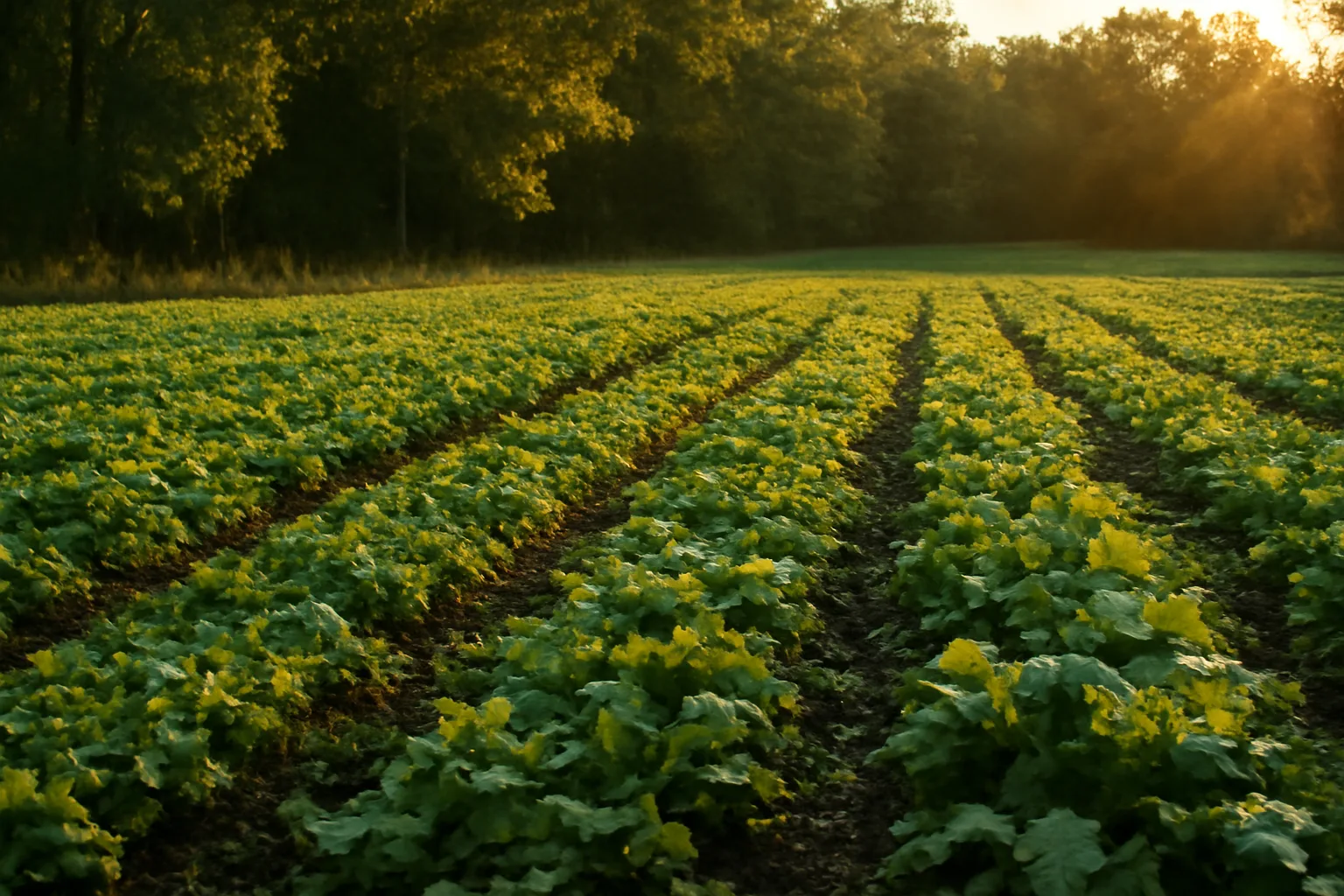
A food plot is a planted patch of ground, usually somewhere between a quarter acre and several acres, seeded with forage that deer and other wildlife will eat. That's it. No mystery. People plant them on hunting land to add nutrition to a deer's diet, to concentrate deer activity near a stand, or both. The USDA Natural Resources Conservation Service treats food plots as a wildlife habitat practice, often cost-shared under conservation programs when they support broader habitat goals rather than pure hunting attraction [1]. That distinction matters if you're chasing cost-share money, but for most hunters on owned or leased ground, a food plot is just a farm field scaled down to fit a woodlot or a ridge-top opening. Plots generally fall into two buckets: annuals (planted every year, higher yield, more work) and perennials (clover, chicory blends, planted once and maintained for 3 to 5 years). Most properties run both, using annuals for fall hunting attraction and perennials for season-long nutrition. If you want a broader rundown on how these plot types differ in practice, see food plot whitetail.
when to plant food plots for deer
Timing splits into two windows almost everywhere in the whitetail's range: a spring/early summer window for warm-season annuals and perennials, and a late summer window (roughly late July through early September) for the fall brassica and cereal grain plots most hunters actually hunt over. Cool-season annuals like oats, wheat, and turnips want 60 to 90 days before your first hard frost, which lets them establish before growth slows. In the Upper Midwest and Northeast that usually means planting between late July and mid-August. In the Mid-South and Deep South, growers can wait until September or even early October [2]. Warm-season plots (soybeans, sorghum, cowpeas, corn) go in after your last frost date, typically April through June depending on latitude. Clover can be frost-seeded in late winter, drilled in early spring, or planted in late summer alongside your brassicas, since it establishes in cooler soil better than most people expect. Your local university extension office publishes frost date tables specific to your county, and that's a better source than a national chart. Penn State Extension, for example, lays out a planting window for Pennsylvania brassica plots of late July to mid-August specifically so plants reach grazing maturity before deer season opens.
do deer like clover, and is it worth planting
Yes, deer eat clover readily, and it's one of the most planted food plot species in North America for a reason: it produces from spring through fall, handles grazing pressure well, and fixes its own nitrogen once established. White clover (including ladino types) and red clover both show up constantly in extension forage trial data as high-protein deer forage, often tested at 20 to 25% crude protein in vegetative growth stages [3]. That's genuinely useful nutrition for lactating does and antler-growing bucks, more than a marketing number. The catch: clover needs decent soil pH (extension guides generally recommend 6.0 to 6.5) and it will not tolerate standing water or deep shade. It's also slow to establish, usually 60 to 90 days before it can handle real grazing pressure, so don't expect a hunting draw the first fall unless you overseed a young stand with something faster like oats. A well maintained clover plot can produce for 3 to 5 years before it needs to be reseeded, which makes the per-year cost lower than annual grain plots even though the seed itself often costs more upfront.
do deer like oats, and when should you plant them
Deer readily eat oats, especially in early growth stages and again after a frost sweetens the plant's sugars. Oats are one of the most reliable fall attraction plantings because they germinate fast, tolerate a wide pH range, and provide green forage right through several frosts in most regions. Plant oats 45 to 60 days before your average first frost date so they reach a few inches of growth before deer season opens. For most of the whitetail's range that lands between late July and late August; in the Deep South you can push into September [2]. Drill or broadcast at roughly 2 to 3 bushels per acre (about 96 to 144 lbs) depending on soil and drill depth, per standard extension seeding rate tables for forage oats. Oats alone don't survive hard winters much past zone 6 or so; they're an annual, and cold kills them off eventually. That's fine, because their real job is providing tonnage of green, palatable forage during archery and early gun season, not year-round cover. Pairing oats with a small grain like winter wheat or with clover extends the plot's usefulness past the first killing frost.
when to plant turnips for deer, and do deer actually eat them
Deer do eat turnips, though the interest level changes a lot through the season. Deer often ignore turnip leaves and bulbs in September and October, then hammer the plot hard in November and December once a few frosts convert the plant's starches to sugars. Plant turnips 80 to 90 days before your first hard frost. That's roughly late July through mid-August across most of the whitetail range, matching the window extension programs recommend for brassica plots generally. Turnips are typically seeded at 4 to 6 lbs per acre, often blended with other brassicas like radish or rape rather than planted alone, since a monoculture brassica plot can leave deer with nothing to eat in early fall while they wait for frost to hit. A common complaint from first-year planters: 'deer aren't touching my turnips.' Usually that's not a failure, it's a timing mismatch. Deer typically start working turnip tops in October and don't dig for the bulbs in earnest until after a couple of frosts, sometimes not until December in mild years. If you're hunting early season over a turnip-only plot, you may be hunting an empty restaurant. For a broader look at brassica-based fall plots and how they compare to grain options, check deer food plot seed.
do deer eat sorghum
Yes, deer eat grain sorghum, both the standing grain heads and the young foliage, but it's a more regional and more situational plot species than clover or brassicas. Grain sorghum (milo) is a warm-season annual most useful in the Southeast, Mid-South, and parts of the Midwest where the growing season is long and hot enough to mature a grain head. Sorghum works well as a standing grain plot for late season, since the heads hold seed well into winter and deer, turkeys, and doves all use it. It's also a solid choice on poor or drought-prone soils, since sorghum is notably more drought-tolerant than corn, according to USDA and land-grant agronomy guidance on grain sorghum production [4]. Where sorghum falls short: it's not a great early-season browse plot, since deer tend to prefer the softer forages around it until the grain matures, and in northern zones (roughly zone 5 and colder) the growing season often isn't long enough to reliably finish a grain head before frost. If your property sits in that range, soybeans or corn usually make more sense as your warm-season grain plot.
what are deer's favorite foods, and does that change by season
There's no single favorite. A whitetail's diet shifts constantly with what's available, and food plot species compete with natural browse, mast crops, and agriculture for a deer's attention every single day. That said, some patterns show up again and again in deer diet studies and extension forage guides. Soft mast (acorns, especially white oak acorns) is often preferred over almost anything planted when it's on the ground, since acorns are high in fat and carbohydrates going into winter [5]. Among planted forages, clover and soybeans consistently rank high in preference trials for their protein content during the growing season, while brassicas and cereal grains take over as the preferred food source once frost hits and natural browse quality drops [3]. So 'favorite food' really means 'best food available right now.' A food plot's job isn't to out-compete a hot acorn drop in October. It's to give deer a reliable, high-quality food source during the weeks when natural forage is thin, usually late summer stress periods and the post-frost stretch of late fall and winter.
do deer like honey (and does it belong in a food plot conversation)
Deer are not drawn to honey the way they're drawn to a soybean field or a mineral site. There's no meaningful body of wildlife research or extension guidance treating honey as a deer attractant, and it doesn't belong in the same category as planted forage or mineral supplementation. What people usually mean when they ask this is whether sweet-smelling attractants (molasses-based sprays, sugar beet products, syrup-soaked corn) pull deer in. Some hunters swear by them for short-term, small-scale attraction near a stand. But they're not a food plot strategy, they're a bait or lure strategy, and a lot of states regulate or flatly ban baiting for deer hunting. Check your state wildlife agency's regulations before using any attractant, honey included, especially if you hunt near a state or CWD-management zone. Baiting rules vary widely and change often; several states restrict feeding and baiting specifically to slow the spread of chronic wasting disease [6]. Your state agency's hunting digest is the actual authority here, not a forum thread.
how do you pick the right plants for your specific property
Start with a soil test, not a seed catalog. Your local cooperative extension office or a private ag lab will test pH, phosphorus, potassium, and organic matter for somewhere around $10 to $20 per sample in most states, and that report tells you more about what will actually grow than any seed bag label . Clover and brassicas both want pH in the 6.0 to 6.5 range; sorghum and cereal grains tolerate a wider range but still yield better closer to neutral. If your test comes back at 5.2, you're not planting clover successfully until you address that with lime, full stop, and your soil test report will usually tell you exactly how many tons per acre to apply. After pH, think about drainage, sunlight (most food plot species want 4 to 6 hours of direct sun minimum), and how much equipment you actually have. A no-till drill opens up perennial clover establishment on rocky or sloped ground where tillage isn't practical; a disc and cultipacker is fine for most annual grain and brassica plots. Property size and hunting pressure matter too. Small plots (under a half acre) tucked in timber get hit hard early and can be grazed out fast, favoring tougher species like cereal grains or brassicas over delicate clover. Larger, open plots can support a wider mix and rotate acreage between species year to year. If you'd rather not build this plan from scratch, PlotSeason's $99 one-time Custom Food Plot Plan takes your zip code, soil test results, and equipment on hand and builds a species and planting calendar around your specific property. It's general guidance built from your numbers, not site-specific agronomy advice, so your soil test lab is still the final word on lime and fertilizer rates.
what does a realistic planting calendar look like across zones
| Zone 3-4 (Upper Midwest, Northeast) | Late July to mid-August | Mid-May to mid-June | |
|---|---|---|---|
| Zone 5-6 (Mid-Atlantic, lower Midwest) | Early August to early September | Late April to late May | |
| Zone 7-8 (Mid-South, Southeast) | Late August to early October | Early April to mid-May | |
| Zone 9+ (Deep South, Gulf Coast) | September to October | March to April | Notice the pattern: cool-season plots go in later as you move south, because the goal is timing plant maturity to the first frost, not to a calendar date. Warm-season plots go in earlier as you move south for the same reason, chasing a longer frost-free growing season. For species-specific seeding rates, blend recommendations, and regional variety picks, deer food plots and food plot seed both go deeper into product-level choices once you've nailed down your window. |
Here's a simplified comparison of typical planting windows by USDA hardiness zone grouping. Treat these as starting points, since local extension frost date data for your specific county will always be more accurate than a national zone chart [2]. | Zone group | Cool-season annuals (oats, wheat, turnips, clover) | Warm-season annuals (soybeans, sorghum, corn) |
Frequently asked questions
Do deer eat sorghum?
Yes. Deer eat both the foliage and the grain heads of sorghum, and it's a solid warm-season plot choice in the Mid-South and Southeast, especially on drier soils where corn struggles. It's less useful as an early-season attraction plot and mostly shines as standing grain for late season.
Do deer like clover?
Deer readily eat clover and it's one of the highest-protein forages you can plant, often 20-25% crude protein in vegetative stages according to extension forage trials. It needs pH near 6.0-6.5 and 60-90 days to establish before it can handle heavy grazing pressure.
When should you plant food plots for deer?
Warm-season annuals go in after your last frost, typically April through June. Cool-season annuals (oats, wheat, turnips, clover) go in 60-90 days before your first fall frost, usually late July through September depending on latitude. Check your local extension office's frost date tables for your exact county.
When should you plant oats for deer?
Plant oats 45 to 60 days before your average first fall frost, which lands between late July and late August across most of the whitetail range, and into September in the Deep South. Seed at roughly 2 to 3 bushels (96-144 lbs) per acre.
When should you plant turnips for deer?
Plant turnips 80 to 90 days before your first hard frost, usually late July through mid-August in most regions. Deer often ignore turnip bulbs until after a couple of frosts sweeten the starches, so don't expect heavy use until October or November.
What is a food plot?
A food plot is a planted area, typically a quarter acre to several acres, seeded with forage crops to feed deer and other wildlife. Hunters use them to add nutrition to a property and to concentrate deer activity near stand locations during hunting season.
What is deer's favorite food?
There's no single favorite; whitetail diets shift with what's available. White oak acorns are often preferred over anything planted when they're on the ground due to their fat content, while clover and soybeans rank high during the growing season and brassicas take over after frost.
Do deer like honey?
No meaningful research supports honey as a deer attractant. People sometimes mean sweet, molasses-based attractant sprays, which some hunters use for short-term draw near a stand, but these aren't food plot strategies and many states restrict or ban baiting outright.
How big should a first food plot be?
A quarter acre to one acre is a reasonable starting size for most owned or leased properties, especially tucked into timber. Smaller plots get grazed out faster under heavy deer pressure, so if you only have one small plot, favor tougher species like oats or brassicas over delicate perennial clover.
Can you plant clover and brassicas together?
Yes, though they're usually planted separately or in adjacent plots rather than mixed in one seed drop, since clover is a perennial and brassicas are annuals reseeded yearly. Some hunters overseed a thin clover stand with oats in late summer to add fall tonnage without disturbing the clover base.
How much does a soil test cost before planting a food plot?
Most state cooperative extension labs charge around $10 to $20 per sample for a standard soil test covering pH, phosphorus, potassium, and organic matter. That's a small cost against a wasted planting, since your test results usually determine lime and fertilizer rates directly.
Is baiting deer with food plots legal?
A planted food plot is generally legal everywhere and isn't considered baiting under most state definitions, since baiting typically refers to placed feed like corn piles or mineral blocks, not standing crops. Still, rules vary by state and CWD-zone status, so check your state wildlife agency's current hunting digest before hunting near any supplemental feeding site.
Sources
- USDA Natural Resources Conservation Service, Wildlife Habitat Practices: Food plots are recognized as a wildlife habitat practice, sometimes eligible for conservation program support
- USDA National Agricultural Statistics Service, first frost date data: Frost dates vary by region and drive planting window timing for cool- and warm-season forages
- University of Tennessee Extension, Forages for Wildlife: Clover and other legume forages test at roughly 20-25% crude protein in vegetative growth stages
- USDA Economic Research Service, Sorghum data and background: Grain sorghum is more drought-tolerant than corn and suited to warmer, drier growing regions
- Wisconsin Department of Natural Resources, Baiting and Feeding Regulations: States regulate or restrict baiting and feeding of deer, in part to slow spread of chronic wasting disease
- Iowa State University Extension, Soil Testing for Yield Response: Standard soil test panels for pH, phosphorus, potassium and organic matter typically cost around $10-$20 per sample