Last updated 2026-07-25
TL;DR
Yes, you can plant a food plot in the woods, but success depends on sunlight. Most food plot species need at least 4-6 hours of direct light daily, so you'll likely need to thin the canopy or find a natural opening. Shade-tolerant options like clover, brassicas, and cereal grains do better than sorghum or beans under partial cover.
Can you actually plant a food plot in the woods?
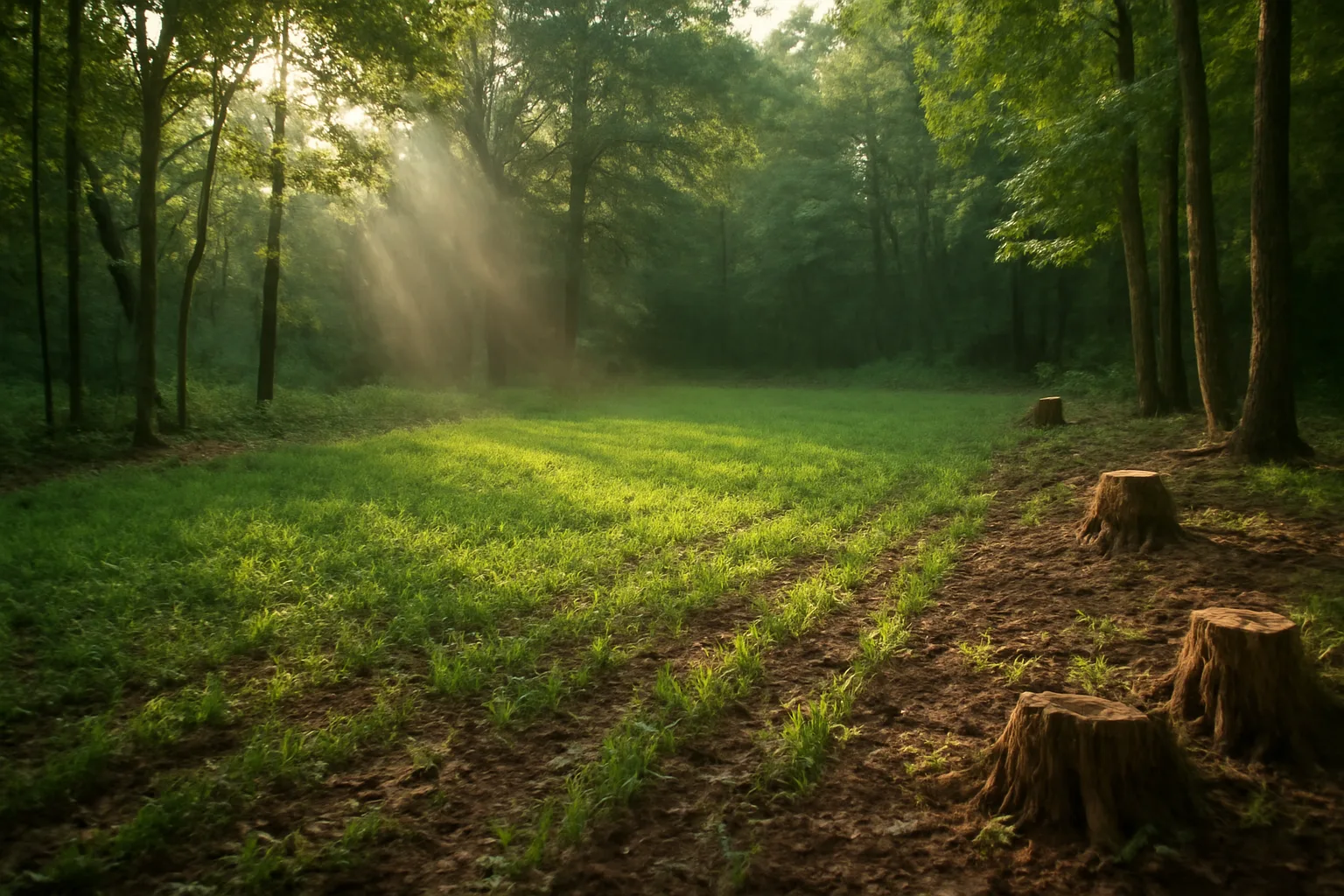
Yes, but the woods themselves are the limiting factor, not the idea. Every food plot species is a plant first, and plants need photosynthesis to grow. A closed-canopy hardwood stand in full leaf can block 90 percent or more of available sunlight from reaching the forest floor, according to research summarized by the USDA Forest Service on light availability under forest canopies [1]. That's not enough light for almost anything you'd want to grow for deer. What actually works is planting in forest openings: old logging decks, right-of-ways, blown-down timber gaps, abandoned homesites, or areas you've deliberately thinned or clear-cut. If you have mature timber with a closed canopy and no gaps, you're not planting a food plot in the woods. You're planting a food plot in a hole you cut out of the woods. That distinction matters because it changes what you need to do before you ever put seed in the ground. The other option, and one a lot of hunters overlook, is timber stand improvement (TSI) through hinge-cutting or selective thinning. Extension foresters at Mississippi State University and Penn State note that opening the canopy by 30 to 50 percent through selective cutting can shift understory composition toward more forage-producing plants and let in enough light for shade-tolerant food plot species [2]. You don't need a bulldozer. A chainsaw and a few weekends of work on a half-acre to acre-sized opening can get you there. If you're planning a woods plot, start with a food plot whitetail strategy built around your actual light conditions, not the seed bag's ideal conditions.
What is a food plot, exactly?
A food plot is a planted area of forage, usually somewhere between a quarter acre and several acres, established specifically to feed and attract deer or other wildlife. It is not the same as a garden or a farm field, even though the agronomy overlaps heavily. The goal is forage production timed to coincide with deer nutritional needs and hunting season, not maximum yield per acre. State wildlife agencies generally treat food plots as a form of habitat management distinct from baiting, though the line gets legally blurry in some states. Michigan's DNR, for example, defines a food plot as "a planted area of vegetation left in the field for wildlife to consume," while baiting involves placing separate feed materials [3]. That distinction is why food plots are legal in most states even where baiting is restricted or banned. Check your own state wildlife agency's regulations before planting anything, especially in a state with baiting restrictions, because a few states regulate plots differently based on size, visibility, or proximity to a stand. Food plots generally fall into two categories: annual plots you replant each year (brassicas, cereal grains, sorghum) and perennial plots that persist for multiple seasons (clover, chicory, alfalfa). Woods plots, because of light and soil limitations, usually lean toward whichever category tolerates the site better, and that's often perennial clover once it's established. For a broader breakdown of plot types by purpose and duration, see deer food plots.
How much sunlight does a food plot in the woods actually need?
Most food plot species need a minimum of 4 to 6 hours of direct sunlight per day to produce usable forage, and full sun (6+ hours) produces noticeably better yield and stand persistence. Extension guidance from Purdue University's forestry and wildlife program recommends food plot openings of at least half an acre in forested settings specifically because smaller clearings don't let in enough sun during most of the day, especially with mature timber on the edges [4]. Here's the practical math: a one-acre circular clearing surrounded by 60-foot-tall trees will have shade encroaching from the tree line for a good portion of the day, especially in morning and evening. The interior of that clearing gets much better light than the edges. That's why foresters recommend elongated openings running east-west, or clearings larger than people initially think they need, often an acre or more if surrounded by tall timber. If you're stuck with a small clearing (under a quarter acre) ringed by tall hardwoods, don't fight it. Either fell some of the bordering timber to widen your light window, or accept that you're limited to the most shade-tolerant species available, and even those will underperform compared to a fully sunlit plot.
What food plot species tolerate shade best?
| White/red clover | High | 4-6 hrs | Best all-around woods plot choice | |
|---|---|---|---|---|
| Chicory | High | 4-6 hrs | Deep taproot, drought-tolerant | |
| Oats | Moderate-high | 5-6 hrs | Fast germination, good early cover | |
| Winter rye | Moderate-high | 4-6 hrs | Extremely cold-tolerant | |
| Brassicas (turnips) | Moderate | 6 hrs | Needs more light than clover | |
| Soybeans | Low | 6-8 hrs | Not recommended for wooded sites | |
| Grain sorghum | Low | 6-8 hrs | Full-sun crop, poor woods choice | For seed selection matched to your specific light and soil situation, deer food plot seed breaks down blends by condition. |
Clover, chicory, and some cereal grains are the most shade-tolerant food plot options, though even these still need meaningful daily light. Clover in particular has a reputation as the go-to woods plot species, and for good reason: white clover and red clover can persist and produce forage in partial shade conditions that would kill soybeans or sorghum outright. Cereal grains like oats and winter rye also handle partial shade reasonably well and germinate fast, which makes them useful for narrow forest openings that get filtered light through much of the day. Brassicas (turnips, radishes) are more light-demanding than clover but still outperform warm-season row crops in marginal light. What doesn't work well in the woods: soybeans, corn, and grain sorghum. These are full-sun row crops bred for open agricultural fields, and they'll grow leggy, weak, and unproductive in anything less than 6+ hours of direct sun. If your only planting site is a shaded interior clearing, skip these entirely and don't waste the seed money. | Species | Shade tolerance | Sunlight minimum | Notes |
Do deer eat sorghum?
Yes, deer eat grain sorghum, and it's a solid late-season food source because standing sorghum holds its seed heads through winter better than corn does in many regions. Sorghum is also more drought-tolerant than corn, which makes it popular in the southern Plains and parts of the Southeast. But sorghum is a full-sun, warm-season row crop. It's not a realistic option for a shaded woods plot. If you have a genuine full-sun opening (an old field, a large clear-cut, a powerline right-of-way) sorghum can work well as a standing grain source into late winter. In a woods interior with partial canopy, it will struggle and likely won't produce a usable grain head at all. Deer also browse sorghum foliage earlier in the growing season before grain fills, so it provides some dual-purpose value, forage plus late-season grain, in the right site.
Do deer eat clover, and do they actually like it?
Yes, deer eat clover heavily, and it's consistently ranked among the most preferred food plot forages by wildlife biologists and extension researchers. Clover is high in crude protein, typically 20 to 30 percent depending on variety, growth stage, and soil fertility, which matters most during spring green-up and antler growth season. Do deer like clover more than other options? In most preference studies and practical field observations, yes, especially compared to grasses or low-protein browse. That said, deer preference shifts seasonally. Clover gets hit hard in spring and summer, then deer often shift toward acorns, browse, and standing grain in fall as clover's nutritional value and palatability drop somewhat with cooler temperatures, though it doesn't disappear as a food source. Clover is also one of the better choices specifically for woods plots because it tolerates partial shade, persists for 3 to 5 years once established (depending on variety and management), and doesn't require annual replanting like brassicas or cereal grains. That combination of shade tolerance and perenniality is why clover shows up in almost every wooded food plot recommendation from state extension programs.
When should you plant food plots for deer?
Timing depends on your region and whether you're planting a spring/summer plot or a fall plot, and it varies by a matter of weeks depending on your USDA plant hardiness zone. As a general framework: spring plots (clover, soybeans, forage peas) go in after your last frost date, typically April through May in northern states and March in the South. Fall plots (brassicas, cereal grains, winter peas) go in 60 to 90 days before your first fall frost so plants have time to establish before growth slows. Your local USDA Cooperative Extension office publishes frost date data specific to your county, and that's a far better source than a generic planting chart. The USDA's plant hardiness zone map is a useful starting reference for broad timing windows across regions. For woods plots specifically, timing matters even more because you're already fighting a light deficit. Planting into a canopy gap right as surrounding trees leaf out in late spring means your light window shrinks fast. Many woods-plot growers plant slightly earlier than an open-field grower would, to get germination and early growth done before full leaf-out closes the canopy overhead.
When should you plant oats for deer?
Oats are typically planted in late summer to early fall, roughly 6 to 8 weeks before your first expected frost, so they establish before cold weather slows growth. In most of the Midwest and Upper South, that puts oat planting somewhere in the August to early September window. In the Deep South, growers can push into October. Oats germinate fast (often within 5 to 10 days in warm soil) and provide quick green forage that deer hit hard in early fall. They're also relatively shade-tolerant compared to other cereal grains, which makes them a reasonable pick for wooded openings with moderate light. Oats winterkill in colder zones once temperatures drop into the low 20s Fahrenheit for extended periods, so in the northern half of the whitetail's range they function as a fall-only annual, not a plant that carries deer through winter. Winter rye or wheat are better choices where you need late-winter standing forage.
When should you plant turnips for deer?
Turnips are planted in mid to late summer, generally 90 to 100 days before your first fall frost, since they need that full runway to bulb up and reach peak palatability by the time deer start hitting them hard in late fall and winter. For most of the whitetail range, that means a planting window somewhere between late July and mid-August. Turnips are interesting because deer often ignore the foliage early and then switch to eating both leaves and bulbs hard after the first few hard frosts, when frost converts starches to sugars and makes the plant sweeter. That's why turnip plots often look untouched in October and get hammered in December. Turnips need more direct sunlight than clover, generally 6 hours minimum, so they're a tougher sell for a deep-woods opening. They do best in larger clearings, cut-over areas, or field-edge plots with real sun exposure most of the day.
What's the best food plot strategy specifically for wooded ground?
The best strategy for a wooded property is to identify or create real canopy openings first, then match species to the light and soil you actually have, rather than trying to force a full-sun species into deep shade. Start by walking your property with a compass or a sun-tracking app during the growing season to see which spots get real midday sun. If you don't have a natural clearing large enough (most guidance suggests at least a half acre for real production), consider timber stand improvement work: felling a percentage of the canopy trees in a planned area to open it up. This is slower and more labor-intensive than dropping seed in an existing field, but it's often the only path to a productive plot on heavily timbered ground. Many state forestry agencies and extension foresters can help design a TSI cut that benefits both timber value and food plot potential simultaneously. Once you have your opening, get a soil test done before you plant anything. Woods soil is frequently more acidic and lower in organic phosphorus than open agricultural ground because of decades of leaf litter decomposition and lack of tillage, and your soil test results (not a generic recommendation) should drive your lime and fertilizer decisions. A basic soil test through your county extension office or a private lab typically costs $10 to $20 and takes 1 to 2 weeks for results [5]. A site-specific plan matters more in the woods than in an open field, because you're already working with a smaller margin for error on light, drainage, and soil chemistry. If you want a plan built around your actual site conditions instead of guessing from a seed bag's generic instructions, PlotSeason's $99 one-time Custom Food Plot Plan factors in your canopy cover, soil test results, and region to recommend species and timing that fit your ground specifically.
What are deer's favorite foods overall?
Deer preference shifts by season and region, but across most of the whitetail's range, acorns, soybeans, clover, and standing corn rank consistently high in preference studies and browse surveys. Acorns in particular are a preferred fall food where oaks are present, and in mast years (heavy acorn production years) deer will often ignore food plots entirely in favor of natural mast. Agricultural crops like soybeans and corn rank extremely high where available, which is part of why food plots compete poorly against a neighboring farm field. Clover and other legumes rank high for spring and summer nutrition because of their protein content. Brassicas and turnips rank lower in preference until after a hard frost sweetens them, then preference jumps. There's no single universal "favorite food" because deer diet studies consistently show strong regional and seasonal variation, driven by what's locally available and each species' nutritional state at the time (lactating does and antler-growing bucks have different needs than a deer in December). If you're building a full-season plot strategy, food plot seed covers how to layer species for spring, summer, and fall coverage.
Do deer like honey, and does it matter for food plots?
There's no evidence deer specifically seek out or prefer honey, and it has no real relevance to food plot planning. Deer are herbivores with a diet built around browse, forbs, mast, and agricultural forage; there's no wildlife research or extension guidance recommending honey as an attractant or supplement. The question likely comes from confusion with commercial deer attractant products that use sweet, sugary, or fermented scents (some marketed with names referencing honey, molasses, or apple) to appeal to a deer's strong sense of smell. Those products are attractants, not food plot inputs, and in many states they fall under baiting regulations rather than food plot rules. Check your state wildlife agency's specific definition before using any scent or mineral attractant near a stand, since baiting restrictions vary significantly by state and can carry real penalties. If you want deer nutrition backed by actual research, stick with the species covered above (clover, brassicas, cereal grains, soybeans) rather than novelty attractant products.
Frequently asked questions
Can you plant a food plot in a small clearing surrounded by tall trees?
Yes, but production will be limited unless the clearing is at least a half acre and gets several hours of direct midday sun. Smaller clearings ringed by tall timber often get shaded most of the day even when the canopy directly overhead is open, so expect thinner stands and lower yield than an open-field plot.
What's the minimum sunlight a food plot needs?
Most food plot species need at least 4 to 6 hours of direct sunlight daily to produce usable forage, with full sun (6+ hours) giving better yield and persistence. Shade-tolerant options like clover and chicory can survive on the lower end of that range; row crops like soybeans and sorghum generally can't.
Do deer eat sorghum?
Yes, deer eat both sorghum foliage and grain heads, and standing sorghum is a useful late-season food source in full-sun plots. It's a warm-season row crop that needs 6 to 8 hours of direct sun, so it performs poorly in shaded or wooded plot sites.
Do deer like clover?
Yes, clover is one of the most preferred food plot forages, largely because of its high crude protein content (roughly 20 to 30 percent depending on variety and soil fertility). It's especially popular in spring and summer, and it's one of the better choices for partially shaded woods plots because of its shade tolerance.
When should I plant food plots for deer?
Spring plots (clover, soybeans) typically go in after your last frost date, often April to May in northern states and March in the South. Fall plots (brassicas, cereal grains) go in 60 to 90 days before your first fall frost. Check your county's USDA Cooperative Extension office for exact local frost dates.
When should I plant oats for deer?
Plant oats roughly 6 to 8 weeks before your first fall frost, typically August to early September in the Midwest and Upper South, later in the Deep South. Oats germinate fast and provide quick fall forage but winterkill in colder zones, so they don't carry deer through deep winter.
When should I plant turnips for deer?
Plant turnips 90 to 100 days before your first fall frost, usually late July to mid-August in most of the whitetail range. Deer often ignore turnip foliage until after the first hard frost sweetens the plant, then hit both leaves and bulbs hard through late fall and winter.
What exactly is a food plot?
A food plot is a planted area of forage, usually a quarter acre to several acres, established to feed and attract deer or other wildlife on hunting ground. It's legally distinct from baiting in most states, though state wildlife agencies vary in how they define and regulate the difference, so check your state's rules.
What are deer's favorite foods?
Acorns, soybeans, clover, and standing corn rank consistently high in preference studies, though preference shifts by season and region. In heavy mast years, deer often prefer natural acorns over planted food plots entirely, which is worth planning around if you have oak timber on your property.
Do deer like honey?
There's no research or extension evidence that deer seek out honey specifically. Deer are herbivores focused on browse, forbs, mast, and agricultural forage. Commercial attractant products referencing honey or sweet scents are marketing, not food plot science, and some fall under state baiting restrictions.
What food plot species grow best in shade?
Clover, chicory, oats, and winter rye tolerate partial shade better than other food plot species, generally surviving on 4 to 6 hours of daily sunlight. Soybeans, corn, and grain sorghum are full-sun row crops and consistently underperform or fail in wooded or heavily shaded plot sites.
Do I need to cut down trees to plant a food plot in the woods?
Often, yes. If your property lacks a natural clearing of at least a half acre with several hours of direct sun, thinning or removing a portion of the canopy (timber stand improvement) is usually the only way to get enough light for a productive plot. A chainsaw and a weekend or two of work can open a workable site.
Sources
- USDA Forest Service, light availability under forest canopy research: Closed-canopy forest can block the large majority of available sunlight from reaching the forest floor
- Mississippi State University Extension, timber stand improvement and wildlife habitat: Selective thinning that opens the canopy shifts understory plant composition toward more forage species
- Michigan Department of Natural Resources, baiting and feeding regulations: State definition distinguishing food plots from baiting/feeding practices
- Purdue University Extension, forest wildlife food plots: Forested food plot openings need at least a half acre to provide adequate sunlight
- USDA/university extension soil testing programs, general cost guidance: Basic soil test costs and turnaround time through extension/private labs