Last updated 2026-07-26
TL;DR
The best Louisiana food plot mix pairs a cool-season blend of oats, wheat, and clover (planted late September to November) with a warm-season option like iron clay peas or grain sorghum planted April through June. Louisiana's mild winters and acidic soils mean clover and brassicas often outperform corn-heavy mixes, but a soil test still drives every real decision.
what is a food plot, and why does louisiana need a different approach
A food plot is a planted patch of forage on hunting land, built to feed deer and hold them close during hunting season. It is not a garden and it is not lawn care. The goal is tonnage of digestible protein or carbs at the right calendar moment, in a spot deer can reach and a hunter can watch. Louisiana is not Iowa. Most of the state sits in USDA Hardiness Zones 8b and 9a, with a long frost-free season that can run 240 to 300 days depending on where you are, from the Florida parishes down to the coastal marsh edges. That means cool-season plots (clover, oats, wheat) can stay green and grazeable most of the winter without the hard freezes that shut plots down further north. It also means summer heat and humidity hit hard, so warm-season plants need to tolerate both drought stress and standing water in low ground, sometimes in the same growing season. Soil is the other big variable. Much of Louisiana runs acidic, especially in the piney woods of the northern and central parishes, and pH below 5.5 is common on unlimed ground [1]. Deer forage species like clover and alfalfa want a pH closer to 6.0 to 6.8. If you skip the soil test and just throw seed, you are gambling with your seed money, plain and simple.
when to plant food plots for deer in louisiana
| Cool season | Mid-Sept to early Nov | Oats, wheat, clover, brassicas |
|---|---|---|
| Warm season | Mid-April to June | Iron clay peas, soybeans, grain sorghum |
Louisiana runs two real planting windows: a cool-season window from mid-September through early November, and a warm-season window from mid-April through June. There is no single 'best' month statewide because the parishes span two USDA zones and different frost dates, so local extension guidance and your own frost records matter more than a national calendar. For cool-season plots, LSU AgCenter guidance generally points to planting small grains and clovers in the fall once soil temperatures cool and rain becomes more reliable, roughly late September into November depending on the parish [2]. Planting too early in September, while it's still 90 degrees, often burns up tender clover seedlings before they establish. Planting too late risks the seed sitting in cold, wet soil without germinating before deer season opens. For warm-season plots, the window opens once the last frost risk passes, typically March in south Louisiana and into April further north, and runs through June for most legumes and sorghum [3]. Warm-season plots are less about hunting-season concealment and more about summer nutrition for lactating does and antler-growing bucks. Plus, they can be brush-hogged or disked under in August ahead of a fall planting. | Season | Planting window | Typical species |
do deer eat clover, and is it worth planting in louisiana
Yes, deer eat clover readily, and it is one of the most reliable forages for Louisiana food plots because it tolerates the state's mild winters and keeps producing through spring green-up. White clover and red clover both show up on nearly every extension-recommended deer forage list in the Southeast [4]. Clover's advantage in Louisiana specifically is that it does not go fully dormant the way it does in northern states. In a mild winter, a good clover stand can stay grazeable from November through the following June, giving you eight months of forage from one planting if you mow it a couple times to knock back weed competition. The catch is pH. Clover struggles below 5.8, and a lot of Louisiana ground sits well under that without lime. A soil test before you plant clover is not optional if you want the stand to last past year one. Perennial clover blends do cost more up front than a bag of annual wheat, but they save you a planting trip every fall once established, which matters if your lease is a few hours from home.
do deer eat sorghum, and how does it fit a louisiana rotation
Yes, deer eat grain sorghum, both the standing grain heads late in the season and the green forage earlier in summer, though it is generally considered a secondary or filler forage compared to soybeans, peas, or clover. Sorghum's real strength in Louisiana is heat and drought tolerance during the brutal July and August stretch when a lot of other warm-season plants stall out. Grain sorghum also works well as a standing grain crop that holds up into fall, similar to how corn is used further north, but at a fraction of the fertilizer and input cost. It handles Louisiana's clay soils and occasional flooding better than corn does in many bottomland fields. If you are choosing between corn and sorghum on tighter budget acreage, sorghum is usually the more forgiving call in a state with unpredictable summer rainfall. Where sorghum falls short is as a stand-alone deer attractant during early bow season. Deer will eat the leaves and immature heads, but they are not drawn to it the way they are to soybeans or a fresh clover plot. Treat it as a supporting player, maybe 20 to 30 percent of a warm-season mix, not the headline act.
do deer like honey, and does it belong in a food plot mix
Deer are not drawn to honey the way people sometimes assume from mineral lick marketing. There is no meaningful wildlife research showing honey as a deer attractant, and it does not appear in any USDA or land-grant extension forage guidance for food plots. Deer are herbivores built around browse, forbs, mast, and agricultural crops, not sugary liquids. The honey question usually comes up because some commercial mineral and attractant products use honey or molasses as a scent or flavor additive in mineral licks, not as a food plot planting. Those products are a different category entirely from seed mixes and won't be covered by the same agronomy rules. If you want a real sweet attractant with actual research behind it, sugar beets and certain brassica varieties produce sugars deer respond to after a frost sweetens the plant tissue, a documented pattern in cold-tolerant brassicas. Honey itself is not a food plot input and won't move the needle on deer activity.
when to plant oats for deer in louisiana
Plant oats in Louisiana between mid-September and late October for the best combination of fall growth and winter survival. Oats germinate fast, often in 5 to 10 days with decent soil moisture, and they green up quicker than wheat, which makes them a popular choice for hunters who want plot cover in place before archery season opens in early October. Oats are less winter-hardy than wheat or rye, and a hard freeze in a bad year can knock them back harder, though Louisiana's mild winters mean this is less of a concern than it would be in Tennessee or Kentucky. Local parish extension offices track which oat varieties have performed best across the state's soil regions in recent seasons, and that's worth a phone call before you buy seed [5]. A lot of successful Louisiana plots run oats mixed with wheat and a clover, so if the oats get thin from grazing pressure or a cold snap, the wheat and clover carry the plot through winter.
when to plant turnips for deer in louisiana
Plant turnips in Louisiana from late August through mid-September, earlier than most other cool-season plantings, because turnips need 80 to 90 days to bulb out before the first hard frost sweetens them and makes the tubers attractive to deer. Planting turnips in October in Louisiana usually leaves you with leafy tops but undersized bulbs by the time deer season peaks in December. Deer often ignore turnip bulbs early in the fall and hammer the leafy tops instead, then switch to digging up and eating the bulbs after a frost converts starches to sugars, a pattern documented across brassica research and widely referenced in extension food plot guidance. In south Louisiana, frosts come later and less reliably than up north, so turnip bulbs may never sweeten the way they would in a colder climate, which is worth factoring in if bulb consumption is your goal. Turnips also do best in loosened, well-drained soil. Louisiana's heavier clay and gumbo soils in the Mississippi and Red River bottoms can crust hard after a rain, which hurts small-seeded brassica germination unless the ground is disked well ahead of planting.
what is the best food plot mix for louisiana, season by season
| Cool season blend | Oats, wheat, clover, brassica | Late Sept to early Nov | Fall attraction, winter tonnage |
|---|---|---|---|
| Warm season blend | Iron clay peas, sorghum | Mid-April to June | Summer protein, standing grain |
| Perennial clover | White or red clover | Sept, then maintained | Multi-year, low replant cost |
There is no single bag that covers a full Louisiana year, and any product claiming otherwise is oversimplifying. The most reliable approach splits into a cool-season blend and a warm-season blend, planted on the same acreage in rotation or on separate plots if you have the ground. For cool season, a mix of oats or wheat, a cold-hardy clover like arrowleaf or crimson, and a brassica like turnip or forage radish covers early archery season attraction, winter tonnage, and spring green-up all in one planting. This kind of blended small grain and clover mix is a standard recommendation across Southeastern extension programs because it spreads risk across species with different germination speeds and frost tolerance [4]. For warm season, iron clay peas or forage soybeans paired with a grain sorghum give you high-protein summer forage plus a standing grain component that holds into early fall. Iron clay peas in particular tolerate Louisiana's humidity and clay soils better than many soybean varieties, and they reseed reasonably well in a lot of parishes. | Plot type | Core species | Best planting window | Main benefit |
what soil and fertility work does a louisiana plot actually need
Get a soil test before you buy a single bag of seed. LSU AgCenter's soil testing program runs standard tests for a modest fee and returns pH along with phosphorus, potassium, and other nutrient levels specific to your field, with results interpreted against LSU's own fertility recommendations for forage crops [1]. Guessing on lime and fertilizer is the single most common way hunters waste money on food plots, because a $30 bag of clover seed planted into pH 5.0 soil without lime is largely wasted seed. Louisiana's acidic soils, especially in the piney woods regions of the north and central parishes, often need real lime tonnage, sometimes 1 to 2 tons per acre or more, to bring pH into the 6.0 to 6.5 range clover and brassicas want [1]. Lime takes months to fully react in the soil, so applying it in spring ahead of a fall planting works far better than trying to fix pH the same week you plant. Your soil test lab is the authority on your specific lime and fertilizer rates. A general article like this one can tell you the ballpark and the reasoning, but the actual numbers on your bag of lime should come from the test results for your field, not a blog post.
what equipment do you actually need to plant a louisiana food plot
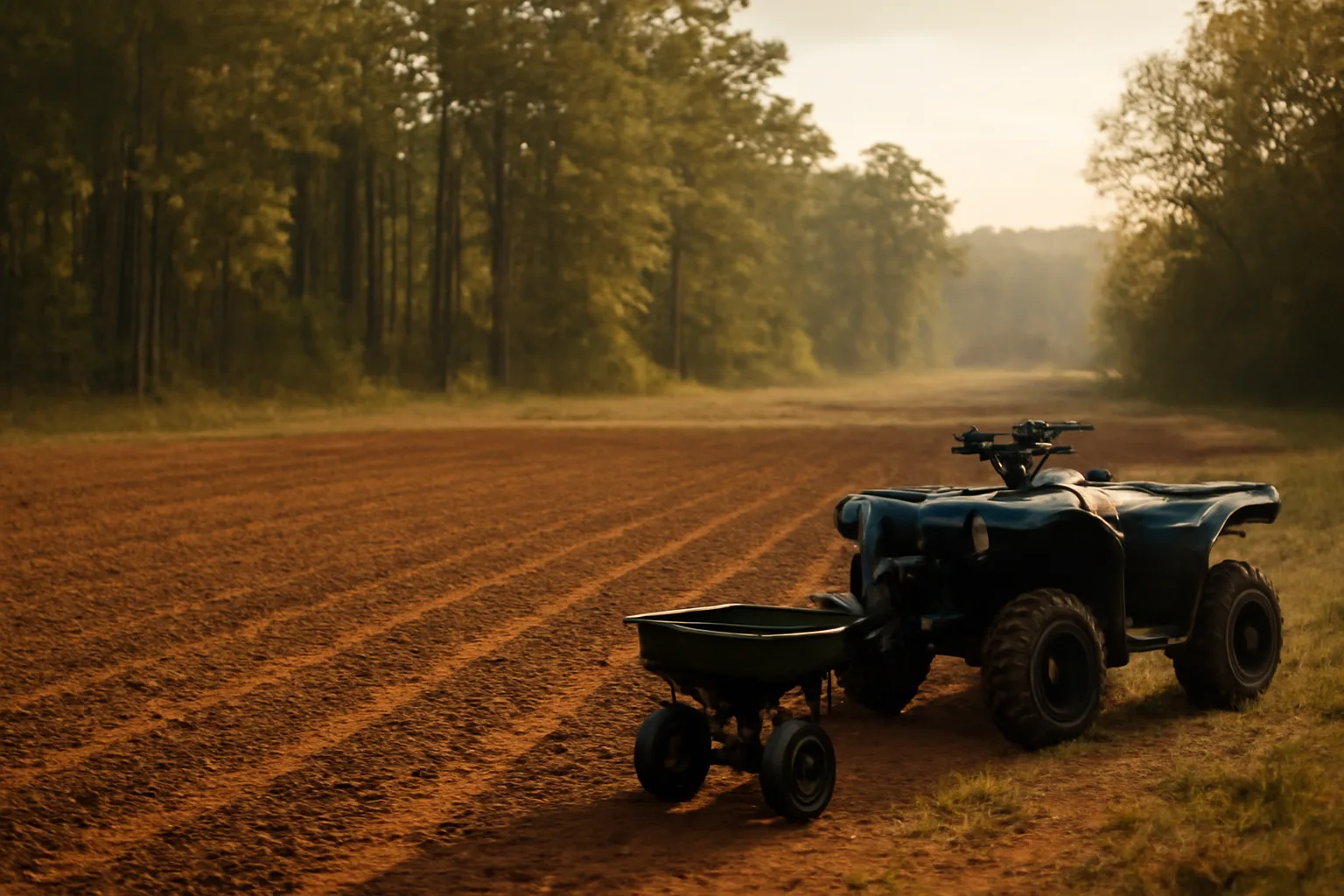
A functional plot needs four things done in order: kill or clear existing vegetation, work the soil, plant the seed at the right depth, and pack it in. You do not need a tractor with a 12-foot disk to do any of this on a one-acre plot. A UTV or ATV with a drag harrow or cultipacker, a hand or tow-behind broadcast spreader, and a sprayer for glyphosate ahead of planting covers most small food plots under 2 acres. For clover and brassica seed, which is tiny, seed-to-soil contact matters more than planting depth, so a cultipacker pass after broadcasting often beats trying to bury the seed with a disk. Oats and wheat, being larger seed, tolerate a bit more burial and do fine with a light disk pass followed by a cultipacker. Bigger acreage or heavier clay ground benefits from an actual tractor and disk, especially in the gumbo soils of the Mississippi Delta parishes where a hand tool just bounces off dry, cracked clay. If you are unsure what your specific ground and acreage calls for, that is exactly the kind of site-specific question a soil test and a written plan can answer better than a general equipment list.
what are deer's favorite foods, and how does that shape your mix
Deer preference research consistently shows a stacked ranking: soft mast (persimmons, apples), agricultural legumes (soybeans, peas, clover), then browse, forbs, and hard mast like acorns, with the exact ranking shifting by season and regional food availability . There is no single 'favorite' food across all seasons because deer preference tracks whatever gives them the most protein or energy relative to what's locally scarce at that moment. In Louisiana specifically, white oak and water oak acorns are heavily used in fall when available, and deer will often bypass a food plot entirely during a heavy mast year. This is well documented in Southeastern deer research and is one reason food plots should be viewed as a supplement to natural browse, not a replacement for it . A food plot competes with whatever the woods are already offering, so a mast year can make an otherwise good plot look like it's failing when really the deer just have better options nearby. Soybeans and peas rank near the top of most attraction studies during their growing season because of high crude protein content, often 20 to 30 percent in the leaf tissue, which matters most during antler growth and lactation in late spring and summer . Clover runs a close second and has the advantage of a much longer usable window across fall, winter, and spring.
how do you build a plan specific to your own ground
Everything in this article is a starting framework, not a substitute for knowing your own dirt. Two properties ten miles apart in the same parish can have completely different soil pH, drainage, and shade patterns, and those differences change which mix actually performs. If you want a plan built around your specific soil test results, acreage, and hunting goals rather than a generic statewide mix, PlotSeason's $99 one-time Custom Food Plot Plan takes your soil test numbers and property details and builds a species and timing plan around them. It is general guidance built from your data, not a replacement for your soil lab's specific lime and fertilizer recommendations, which remain the final word on your field's chemistry. Whatever route you take, start with the test, match species to your actual pH and drainage, and plant on the calendar your specific parish supports rather than a national average date.
Frequently asked questions
Do deer eat sorghum?
Yes, deer eat both the green forage and mature grain heads of sorghum, though it ranks below soybeans, peas, and clover in most preference studies. Sorghum's real value in Louisiana is heat and drought tolerance through summer, and its usefulness as a standing grain crop into fall at lower cost than corn.
Do deer eat clover?
Yes, clover is one of the most reliable deer forages in the Southeast and stays grazeable most of the winter in Louisiana's mild climate. White and red clover both show up on standard extension forage recommendations, but stands need pH above 5.8 to persist, so a soil test and lime application matter before planting.
When should you plant food plots for deer in Louisiana?
Plant cool-season plots (oats, wheat, clover, brassicas) from mid-September through early November, and warm-season plots (iron clay peas, soybeans, sorghum) from mid-April through June. Exact timing shifts by parish since Louisiana spans USDA Zones 8b and 9a with different frost dates.
Do deer like clover more than other food plot forages?
Deer show strong preference for clover, generally ranking it near the top alongside soybeans and peas in Southeastern forage studies. Clover's advantage over annuals is duration; a good perennial stand feeds deer from fall through the following summer instead of one season.
When should you plant oats for deer in Louisiana?
Plant oats between mid-September and late October. Oats germinate faster than wheat, often within 5 to 10 days, making them useful for getting plot cover established before archery season opens in early October, though they're less freeze-tolerant than wheat or rye.
When should you plant turnips for deer in Louisiana?
Plant turnips earlier than most cool-season crops, from late August through mid-September, because bulbs need 80 to 90 days to develop before frost sweetens them. Planting in October usually leaves undersized bulbs by peak hunting season.
What is a food plot?
A food plot is a planted area of forage crops on hunting land meant to feed deer and other wildlife while giving hunters a predictable place to watch and hunt. It differs from farming in scale and purpose; the goal is nutrition and attraction, not commercial yield.
What are deer's favorite foods?
There is no single favorite; deer preference shifts by season and local availability. Soft mast like persimmons and apples, then agricultural legumes like soybeans, peas, and clover, generally rank highest, with acorns and browse filling in based on what's naturally available that year.
Do deer like honey?
No, deer are not meaningfully drawn to honey, and it does not appear in USDA or land-grant extension food plot forage guidance. Some mineral lick products use honey or molasses as a scent additive, but that's a different product category from actual food plot seed mixes.
What is the best cool-season food plot mix for Louisiana?
A blend of oats or wheat, a cold-hardy clover (arrowleaf or crimson), and a brassica like forage radish or turnip covers early fall attraction, winter tonnage, and spring green-up in one planting, and it's a standard approach recommended across Southeastern extension programs.
Do food plots work if deer have plenty of natural mast available?
Food plots often see reduced use during heavy acorn years because deer preference tracks whatever's most abundant locally. A food plot is a supplement to natural browse and mast, not a replacement, and its apparent performance can vary year to year based on what the surrounding woods offer.
How much lime does Louisiana food plot soil typically need?
It varies by parish and field, but acidic ground in the piney woods regions often needs 1 to 2 tons of lime per acre or more to bring pH from the 5.0 to 5.5 range up to the 6.0 to 6.5 range clover and brassicas prefer. A soil test from a lab like LSU AgCenter gives the exact number for your field.
Sources
- LSU AgCenter Publication 3479, Louisiana Soil Fertility and Fertilizer Recommendations: Louisiana soils are commonly acidic and lime rates should be based on lab soil test results
- LSU AgCenter Publication 2237, Forage Establishment in Louisiana: Cool-season forage planting in Louisiana is generally recommended in fall once soil temperatures cool
- LSU AgCenter Publication 2871, Summer Annual Forages for Louisiana: Warm-season legume planting windows run from spring after last frost through early summer in Louisiana
- University of Florida IFAS Extension, Food Plots for Wildlife publication SS-AGR-320: Clover and small grain blends are standard recommended forages for deer food plots in the Southeast
- LSU AgCenter Publication 2270, Louisiana Small Grain Variety Trials: Oat variety performance is tracked regionally across Louisiana soil types through AgCenter trials
- Louisiana Department of Wildlife and Fisheries: Offers state-specific deer management information relevant to timing and planning food plots in Louisiana.
- University of Florida IFAS Extension: Discusses cool-season food plot species such as oats and clover suited to Gulf Coast conditions similar to Louisiana.