Last updated 2026-07-24
TL;DR
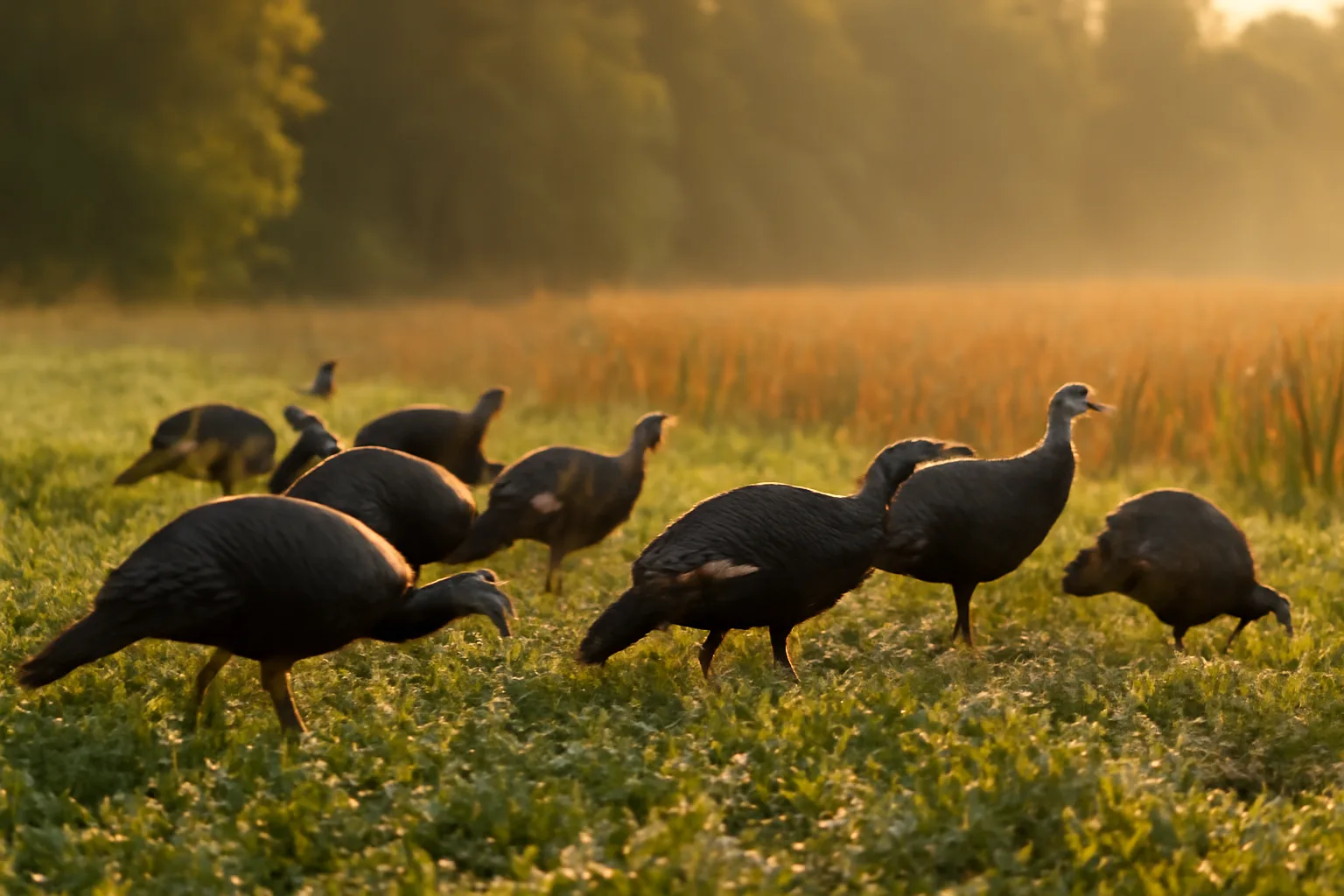
The best turkey food plot combines a grain component (chufa, corn, or grain sorghum) with clover or another legume. Chufa is the classic turkey-specific choice because turkeys dig for the tubers all fall and winter. Most existing deer clover plots already attract turkeys too, since poults need the bugs clover attracts more than the plant itself.
What is a food plot, and does it work differently for turkeys than deer?
A food plot is a planted area on hunting or wildlife land, usually somewhere between a quarter acre and a few acres, seeded with a crop that wildlife will eat or use for cover. Most food plots on deer leases are built with whitetail in mind: clover, brassicas, cereal grains, soybeans. Turkeys will use almost all of these plots too, just for different reasons. Deer eat the plant itself, mostly. Turkeys, especially poults in their first eight weeks of life, need insects far more than plant matter. Research on wild turkey brood habitat has repeatedly found that poults depend on high-protein insect diets during their first several weeks, and that legume-heavy ground cover like clover holds far more of those insects than grass or bare soil [1]. So a plot built for deer often does double duty for turkey, particularly in spring and early summer when hens are raising broods. Where turkey-specific plots differ is in the addition of a grain or tuber crop that adult turkeys will dig for or peck at through fall and winter, when insects are scarce. That's where chufa, corn, grain sorghum, and small grains come in. If you already have a food plot whitetail plan for the property, you're most of the way to a turkey plot already.
What's the single best food plot for turkey?
If you can only plant one thing specifically for turkeys, plant chufa. Chufa (Cyperus esculentus) isn't a grain at all, it's a sedge that produces small underground tubers, and wild turkeys will tear up a chufa patch scratching for them from late summer through winter. It's been a staple turkey food plot crop across the Southeast for decades, and it's one of the few crops planted almost exclusively for turkeys rather than deer. Chufa needs sandy to loamy, well-drained soil and a long growing season, generally 100 to 120 frost-free days, which is why it's most reliable in the Southeast and lower Midwest. University of Georgia Extension recommends planting chufa from April through June once soil temperatures warm, at a seeding rate around 40 to 50 pounds per acre for drilled plots [2]. If chufa isn't practical for your soil or region, a clover and grain combination plot is the next best thing. Clover brings the bugs turkeys and poults need in spring and summer; a small grain like winter wheat or oats brings green forage and seed heads turkeys will pick at into winter.
Do deer eat sorghum, and does it work for turkey plots too?
Yes, deer eat grain sorghum, though it's not usually their first choice compared to soybeans or corn. Grain sorghum (milo) is more often planted as a deer and turkey dual-purpose crop or as a wildlife food source in areas too dry for corn, since it's notably more drought tolerant. Sorghum needs less water than corn to produce a grain head, which makes it a common choice in the western Corn Belt and southern Plains where rainfall is less reliable. For turkeys specifically, sorghum is a solid fall and winter food source. The seed heads stand above snow longer than many other grains, and turkeys will work a sorghum field hard once the heads dry down and start dropping seed. It's commonly planted alongside corn or beans in larger wildlife food plots for that reason, giving you a fall grain source that holds up even if corn gets knocked down by wind or wildlife. One caution: sorghum and sudangrass forages can accumulate prussic acid (cyanogenic glycosides) at levels that are toxic to grazing livestock, particularly in young, drought-stressed, or frost-damaged growth, per Oklahoma State University Extension forage guidance [3]. This is a livestock grazing management concern more than a wildlife plot concern, since deer and turkey browse mature, dried standing grain rather than grazing lush young forage.
Do deer like clover, and is it good for turkey too?
Deer like clover a lot, it's one of the most consistently used food plot crops in the whitetail world, and turkeys benefit from it almost as much, just for a different reason. Clover is a legume, and legume plots host far more insects than grass or grain plots, which matters most for hens with poults from May through July [1]. White clover (including ladino types) and red clover are both common choices. They're perennial, meaning a well-established stand can produce for three to five years with proper mowing and fertility, which makes clover one of the better cost-per-year plots you can plant. University of Kentucky Cooperative Extension recommends maintaining white and red clover stands at a soil pH near 6.0 to 6.5 and notes that clover responds strongly to phosphorus and potassium applications guided by a soil test [4]. If you're already running clover for deer, you don't need a separate turkey plot in most cases. The bugs are already there. What you might add nearby is a small grain strip or a chufa patch to extend turkey use into the fall and winter months when the clover itself goes semi-dormant.
When to plant food plots for deer and turkey, by season
| Deep South / Gulf Coast | March to May | September to November | |
|---|---|---|---|
| Mid-South / Transition zone | April to June | August to October | |
| Midwest / Upper Midwest | May to June | Mid-August to mid-September | |
| Northeast | May to June | Mid-August to early September | For a full breakdown by zone, see our seasonal planting guides. |
Timing depends heavily on your zone and on whether you're planting a spring/summer plot or a fall plot. Broadly, food plot planting falls into two windows across most of the whitetail's range: a spring window (April through June) for warm-season annuals and perennials, and a late summer to early fall window (mid-August through October) for cool-season annuals like brassicas and cereal grains. Spring plantings (clover, chufa, soybeans, corn, sorghum) should generally go in after your last frost date and once soil temps are consistently in the 50s to 60s Fahrenheit. Fall plantings (brassicas, winter wheat, oats, cereal rye) usually go in 4 to 8 weeks before your average first frost, giving the crop enough growing season to establish before cold weather. Here's a rough planting window table by region. Always check your local extension office for your specific frost dates, since these vary by hundreds of miles within a single state. | Region | Spring plot window | Fall plot window |
When to plant oats for deer (and turkey)?
Oats are usually planted as a fall food plot crop, typically from mid-August through October depending on your zone, timed so the oats have 6 to 8 weeks of growth before a hard frost. Oats germinate fast and put out a lot of green forage quickly, which is why they're a favorite fall attractant crop. Oats aren't very cold hardy compared to winter wheat or cereal rye. A hard freeze in the mid-20s Fahrenheit or below will usually kill oats outright, while wheat and rye can survive well into winter and green back up in spring. That means oats are best used where you want a strong early fall draw and don't need the plot to carry through the dead of winter, or in southern zones where winters are mild enough that oats survive. Turkeys will use an oat plot for the green forage and any insects it holds, and they'll pick through fallen grain if the oats are allowed to head out. It's a secondary turkey food source at best, not a primary one, but it adds variety to a mixed plot plan.
When to plant turnips for deer, and do turkeys use them?
Turnips and other brassicas are planted in late summer to early fall, generally 60 to 90 days before your first expected hard frost, since brassicas need that runway to bulb out and reach peak palatability. In much of the whitetail range that means a planting window from late July through early September, consistent with University of Tennessee Extension guidance on brassica food plots for deer [5]. Turnips are a deer crop first. Deer often ignore the leafy tops early in the season and hammer the bulbs after a few hard frosts convert starches to sugars, which is the whole appeal of brassicas as a late-season draw. Turkeys have little interest in turnip bulbs or foliage. They might pick through a turnip plot for insects in the tilled soil early on, but you shouldn't count turnips as a turkey food source. If turkey use matters to you as much as deer use, plant turnips in a separate plot or blend them with a grain component rather than expecting the turnip crop itself to draw birds.
What are deer's favorite foods, and how does that compare to turkey preferences?
Deer preference studies and decades of food plot experience point to a fairly consistent short list: soybeans and other legumes rank at or near the top during the growing season, clover is a reliable year-round favorite, and brassicas and cereal grains take over as cold-season draws once frost sweetens them up. Acorns, where available, often outcompete any planted food source in fall because of their high fat content, something wildlife biologists have documented repeatedly in white oak and red oak preference studies. Turkey preferences run differently. Insects dominate the diet of poults and are a major food source for adult hens through summer. Adult turkeys of both sexes shift toward hard mast (acorns, beechnuts) and grain seed heads in fall and winter, which is why a chufa patch or a standing corn or sorghum field pulls flocks so reliably once temperatures drop. The overlap between deer and turkey preferences is real but partial. Clover, soybeans, and standing grain fields serve both species. Turnips, radishes, and other pure brassicas mostly serve deer alone.
Do deer like honey, or is that a myth in food plot talk?
This one comes up a lot in hunting forums, and it's mostly a mix of folklore and marketing. Deer don't naturally seek out honey in the wild the way they seek out acorns or clover, and there's no wildlife agency or extension publication recommending honey as a deer attractant. Some commercial deer attractant sprays and mineral licks include sugar, molasses, or honey-scented additives because deer, like most mammals, respond to sweetness and simple sugars. Where honey (or more precisely, sugar) may play a real role is in social attractant products, not food plots. These are legally distinct from food plots in most states, and many states classify sugar, molasses, corn piles, and mineral licks as bait, which triggers separate hunting regulations. A food plot, by contrast, is a standing crop and is legal to hunt over in the vast majority of states even where baiting is banned. If you're wondering whether to add a honey-based attractant to a plot, save the money. Put it into fertilizer or lime instead. A soil test-driven fertility program will move the needle on deer and turkey use far more than a bottle of sweetener ever will.
Check your state's baiting and feeding rules before you plant or supplement
This matters more than most hunters realize. States differ enormously on what counts as legal food plot hunting versus illegal baiting, and the line often comes down to whether the crop is a growing, standing plant versus a placed pile of grain, mineral, or feed. Some states, like Michigan, restrict baiting and feeding statewide or regionally due to chronic wasting disease concerns. Michigan's baiting law, under Michigan Compiled Laws 324.40111a, generally prohibits baiting and feeding of deer and elk statewide, with narrow exceptions and additional restrictions layered in around CWD management areas [6]. Other states draw a hard line between hunting over a planted, standing crop (legal almost everywhere) and hunting over placed bait like corn piles or mineral blocks (illegal in many states, legal in others with restrictions). Before you plant anything or set out a mineral site near your turkey or deer plot, check your state wildlife agency's current regulations. Rules change year to year, especially around CWD zones, so don't rely on last season's guide.
How do you build a mixed plot that works for both deer and turkey?
Think in layers rather than picking one crop. A strong dual-purpose plot usually has three components working together across the season. First, a clover base for spring and summer bug production and deer forage. Second, a grain strip, corn, grain sorghum, or a small grain like wheat, for fall and winter turkey and deer use. Third, if your soil and climate allow it, a chufa patch tucked into a corner for turkeys specifically, since it needs different soil drainage and a longer warm season than clover. A half-acre to one-acre plot split roughly 60% clover, 30% grain, and 10% chufa (where chufa is viable) covers most of the calendar. Soil testing drives everything here. Cooperative extension services across the country recommend a soil test every 2 to 3 years for food plots, with lime and fertilizer applied according to that test rather than a generic bag rate [4]. Your soil test lab, not a blog article, is the final authority on how much lime and fertilizer your specific plot needs. If you want help laying out a mixed plot plan around your soil test and acreage, PlotSeason's $99 one-time Custom Food Plot Plan builds a species and layout plan around your specific ground rather than a one-size-fits-all seed bag recommendation.
Which food plot seeds should you actually buy for a turkey-friendly plot?
For most properties, a practical shopping list looks like this: a clover blend (white or ladino clover, sometimes mixed with a small amount of chicory), a grain sorghum or corn variety suited to your growing zone, and chufa seed if your soil is sandy and well-drained with a long enough season to mature it. Buy clover and grain seed from a dealer who can tell you the specific variety and its maturity days, more than a generic "deer plot mix" bag with no species breakdown. Cheaper blends sometimes cut clover seed with annual ryegrass as filler, which looks green fast but doesn't persist and doesn't produce the bug load that real clover does. For a deeper look at specific seed options and how to match them to your soil, see our guides on deer food plot seed and food plot seed selection.
Frequently asked questions
Do deer eat sorghum?
Yes. Deer eat grain sorghum (milo), though it's usually a secondary choice behind corn and soybeans. It's most valuable in drier regions where corn struggles, since sorghum needs less water to produce a grain head. Turkeys also use standing sorghum through fall and winter once the seed heads dry and start dropping.
Do deer like clover?
Deer like clover strongly and consistently. It's one of the most planted food plot crops nationwide because it's high in protein, tolerates mowing and grazing pressure, and comes back for years as a perennial when soil pH and fertility are maintained around 6.0 to 6.5, per University of Kentucky Cooperative Extension guidance.
When should you plant food plots for deer?
Warm-season plots (clover, soybeans, corn, chufa) go in spring, generally April through June after your last frost. Cool-season plots (brassicas, wheat, oats) go in late summer to early fall, roughly 4 to 8 weeks before your first frost. Exact windows shift by 6 to 8 weeks between southern and northern zones.
When do you plant oats for deer?
Plant oats in late summer to early fall, typically mid-August through October depending on your zone, aiming for 6 to 8 weeks of growth before a hard frost. Oats aren't very winter-hardy and usually die out after a freeze in the mid-20s Fahrenheit, unlike winter wheat or cereal rye.
When do you plant turnips for deer?
Plant turnips 60 to 90 days before your expected first hard frost, generally late July through early September in most whitetail range, based on university extension brassica planting guidance. Frost converts starches to sugars in the bulb, which is why deer use spikes in late fall and winter.
What is a food plot?
A food plot is a planted patch, usually a quarter acre to a few acres, seeded specifically to attract or feed wildlife like deer and turkey. Common crops include clover, brassicas, soybeans, corn, and cereal grains. Plots differ from bait piles because they're a standing, growing crop, which keeps them legal to hunt over in most states even where baiting is restricted.
What are deer's favorite foods?
Soybeans and other legumes, clover, and acorns rank consistently high in deer preference. Brassicas like turnips and radishes become favorites after frost sweetens the bulbs. Acorns, especially white oak, often outcompete any planted crop in fall due to their high fat content, based on long-standing wildlife biology research on mast preference.
Do deer like honey?
Not naturally in the wild sense. There's no extension or wildlife agency guidance recommending honey as a deer food source. Some commercial attractant products use honey scent or sugar because deer respond to sweetness, but a real food plot with proper fertility does far more for deer and turkey use than any honey-based additive.
What's the best single food plot crop for turkeys?
Chufa is the most turkey-specific crop, since turkeys dig for its underground tubers from late summer through winter. It needs sandy, well-drained soil and 100 to 120 frost-free days. Where chufa isn't viable, a clover and grain combination plot is the next best turkey draw, covering both insect production and fall seed.
Do turkeys eat the same plants as deer?
Partially. Clover, soybeans, and standing grain fields like corn or sorghum attract both species. But turkeys rely much more on insects, especially poults in their first eight weeks, and adult turkeys favor hard mast and grain seed heads over browse. Pure brassica plots like turnips mostly serve deer, not turkey.
Is it legal to hunt turkey or deer over a food plot?
In most states, yes, since a standing planted crop is legally distinct from placed bait like corn piles or mineral blocks. Rules vary by state and can change due to chronic wasting disease concerns, as seen with Michigan's statewide baiting and feeding law under MCL 324.40111a. Always confirm current rules with your state wildlife agency before hunting a plot.
How big should a turkey food plot be?
There's no fixed rule, but a half-acre to one-acre mixed plot (clover, grain, and chufa where viable) covers most turkey needs across the season without requiring a large equipment investment. Turkeys will also use edges of larger deer plots, so a dedicated turkey-only plot often isn't necessary if you already run clover or grain plots for deer.
Can you plant a food plot for turkey and deer in the same spot?
Yes, and it's the most efficient approach for most landowners. A layered plot combining clover (spring and summer bugs and forage), a grain strip like corn or sorghum (fall and winter), and chufa where soil allows, covers both species without needing separate acreage for each.
Sources
- Journal of Wildlife Management, brood habitat and insect availability for wild turkey poults: Turkey poults rely heavily on insects in their first weeks, making legume-rich ground cover valuable brood habitat
- University of Georgia Cooperative Extension, chufa for wildlife food plots: Chufa planting window and seeding rate guidance for wildlife food plots
- Oklahoma State University Extension, prussic acid poisoning potential of forage sorghums: Sorghum and sudangrass forages carry prussic acid toxicity risk to grazing livestock at certain immature or stressed growth stages
- University of Kentucky Cooperative Extension, establishing and managing clover for wildlife: Clover food plot soil pH and fertility recommendations
- University of Tennessee Extension, brassicas for deer food plots: Brassica planting window timed 60 to 90 days before first hard frost
- Michigan Compiled Laws 324.40111a, baiting and feeding of deer and elk: Michigan restricts deer and elk baiting and feeding statewide with region-specific rules tied to CWD management