Last updated 2026-07-26
TL;DR
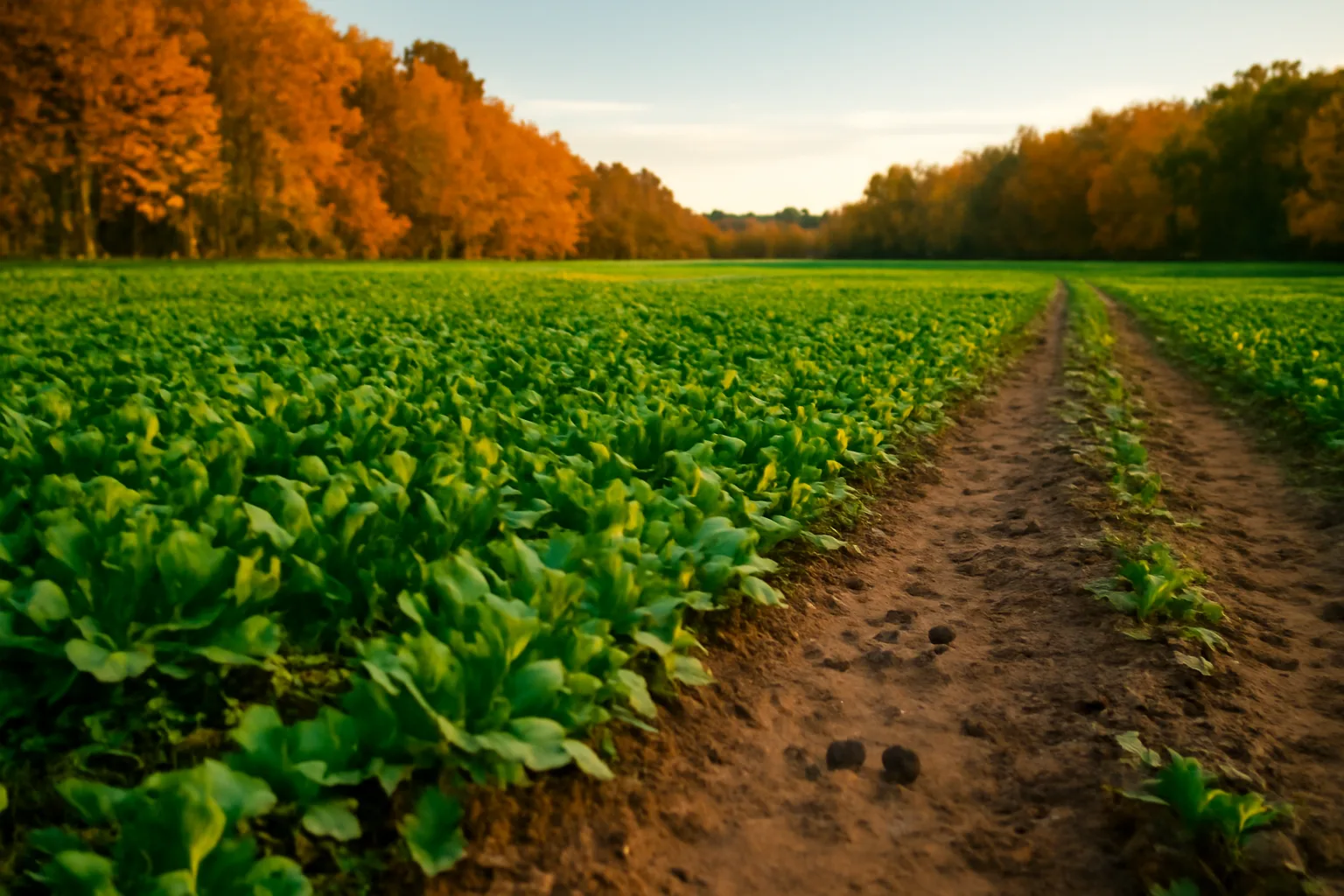
On high-density deer ground, the best food plot is a large-acreage cereal grain and brassica blend (oats, wheat, and forage turnips or radish) planted at higher-than-normal seeding rates, protected early with fencing or size, because clover and beans often get grazed to dirt before they establish. Bigger plots (2+ acres) and forage tonnage matter more than species novelty.
What is a food plot, and why does deer density change the plan?
A food plot is a planted area of forage, usually somewhere between a quarter acre and several acres, put in specifically to feed and hold deer on a property. Most state wildlife agencies and university extensions describe it as a wildlife management tool, not a farming operation, and that distinction matters here. A regular farm field gets planted once and harvested once. A food plot on high-density deer ground has to survive being eaten almost from the day it germinates. The USDA Natural Resources Conservation Service and land-grant extensions both frame food plots as part of a broader habitat plan, alongside native browse and cover, not a replacement for it [1]. That's worth remembering because on high-density ground, the food plot is often the only green thing left standing by August. Everything else has been browsed into the dirt. High deer density changes the math in three ways. First, germination window shrinks, because young seedlings get hit within days of emergence. Second, total acreage needed goes up, sometimes way up, because a half-acre plot that would hold a low-density herd fine gets erased in a week by a high-density one. Third, species selection shifts toward things that either grow fast enough to outrun grazing pressure or that deer genuinely prefer less, buying the plot time to establish. Deer density itself varies enormously by region. Many state agencies estimate densities from under 10 deer per square mile in parts of the West to over 40, sometimes over 60, in parts of the Midwest and Southeast where habitat is fragmented and hunting pressure is light [2]. If you don't know your local density, your state wildlife agency's deer management or harvest report page usually has regional estimates, and that number should drive plot size decisions more than anything else.
What actually works as the best food plot for high deer density?
For genuinely high-pressure ground, cereal grains and brassicas beat clover and soybeans in year one, mostly because of how fast they grow and how much tonnage they produce per acre. Winter wheat, oats, and cereal rye establish quickly, tolerate some early grazing pressure without dying outright, and keep producing through fall and into winter in most zones. Brassicas like forage turnips, radish, and rape are the other half of a strong high-density blend. They're slower to get going than cereal grains but produce enormous bulk later in the season, and cold weather sweetens them (the plant converts starches to sugars after a hard frost), which often means deer hit them harder in late fall and winter rather than August [3]. That later preference shift is actually useful on high-density ground: it gives the plant a few extra weeks to establish before it becomes the most attractive thing in the field. A blend, not a monoculture, spreads risk. If deer hammer the cereal grain early, the brassicas are still bulking up roots and leaves underground and can carry the plot through winter. Purdue University's extension forage guidance on brassicas for deer notes they can produce very high yields per acre and are notably cold tolerant, both useful traits when you need volume [3]. Soybeans and clover aren't bad plants, they're just fragile in year one under heavy pressure. Beans in particular can get grazed at the cotyledon stage and never recover, according to multiple university extension food plot guides, which is why soybean plots on high-density ground usually need serious acreage (5+ acres) or exclusion fencing around at least part of the field to let some plants get past the vulnerable stage [3]. For readers weighing specific seed choices, food plot seed and deer food plot seed break down blends by region and soil type in more depth.
Do deer eat sorghum?
Yes, deer eat sorghum, particularly the grain and the leaves, and it's used both as a food plot component and, in some regions, as a screening/cover crop because of its height. It's more common in the South and lower Midwest, where grain sorghum tolerates heat and drought better than corn. Sorghum isn't usually the headline plant in a high-density plot plan because it's slower to establish than cereal grains and doesn't offer the same early tonnage. Where it earns a spot is as a mixed-plot component for screening cover along plot edges, or as a grain source that holds up into late winter after other forages are gone. It's rarely the best single answer on its own for high-pressure ground, but it's a reasonable complement to a cereal grain and brassica blend, especially where the height gives some visual security to deer feeding in the open.
Do deer eat clover, and do deer actually like it?
Deer eat clover readily and most hunters and biologists rank it among the most consistently preferred food plot forages available, right alongside soybeans. Clover is high in protein (commonly cited in the 15 to 25 percent crude protein range depending on variety, soil fertility, and growth stage) and stays palatable through a long season, which is exactly why it gets hammered so hard on high-density ground [4]. That preference is the problem, not the plant. On low or moderate density ground, a well-limed, well-fertilized clover plot can produce for three to five years off one planting. On high-density ground, new clover seedlings often get grazed before the root system develops enough to survive repeated defoliation, and the stand can thin out or fail within the first season. If you want clover on high-pressure ground, the workaround most extension agronomists and experienced plot managers suggest is planting more acreage than you think you need, or fencing a nursery section of the plot for the first 60 to 90 days to let root systems establish before opening it to full grazing pressure. Michigan State University Extension and other land-grant programs note that clover establishment failures on food plots are very often tied to grazing pressure during the seedling stage rather than to soil fertility problems [5].
When to plant food plots for deer (by season and region)?
Timing splits into two windows: spring plots (warm-season annuals and perennial clover) and fall plots (cool-season annuals like cereal grains and brassicas), and the exact calendar dates shift by USDA plant hardiness zone. Most state wildlife agencies and extensions publish regional planting calendars because a date that works in zone 8 will fail in zone 4. As a general framework: spring plots (soybeans, warm-season clover, chicory) typically go in after the last frost date, often April through June depending on latitude. Fall plots (cereal grains, brassicas, winter peas) typically go in 60 to 90 days before the average first hard frost, so growers have enough growing season to bulk up tonnage before cold weather sets in. In much of the Midwest that's roughly mid-August through mid-September; in the Deep South it can run into October. On high-density ground specifically, fall plot timing sometimes gets pushed slightly later within that window, not earlier, because a plot that germinates into standing native forage competition (still green from summer) faces less immediate grazing pressure than one planted into a landscape that's already turned brown and offers nothing else to eat. That's a judgment call based on local conditions, not a hard rule. For a full month-by-month breakdown by zone, see the food plot whitetail guide and deer food plots planning resource.
When to plant oats for deer?
Oats are typically planted as a fall food plot crop, usually 6 to 10 weeks before the first expected frost, which in most of the whitetail's range falls somewhere between late August and mid-September. Oats germinate fast (often within 5 to 10 days in warm soil) and put on a lot of leafy growth quickly, which is exactly the trait that makes them useful on heavily pressured ground. Spring oat plantings are less common for deer specifically but do happen, mostly as a nurse crop for spring-seeded clover or as an early green option, since oats can also be planted in early spring in cooler zones. The fall planting is the one that matters most for deer hunters because oats hold palatability well into fall and, in milder climates, can persist as green forage into early winter before a hard freeze finally kills the plant back.
When to plant turnips for deer?
Turnips are a fall brassica and go in the ground roughly 90 to 100 days before your first hard frost, which is earlier in the calendar than most people expect. That translates to late July through mid-August across much of the whitetail's range, though it shifts later in the Deep South and earlier in northern zones. The reason for the long lead time is that turnips need real time to bulk up both the bulb and the leaf mass before deer start hitting them hard, and that shift toward heavy browsing usually happens after the first frost or two, when starches convert to sugars and the plant gets noticeably sweeter [3]. Plant too late and you get a small, thin plant that never has the chance to build the bulb reserves that make turnips such a good late-season food source. On high-density ground, turnips planted on time but into a smaller plot can still get overwhelmed, because the leaf tops are attractive to deer even before the bulb matures. Bigger acreage, again, does more real work here than any tweak to planting date.
How much plot acreage do you actually need on high-density ground?
| Under 0.5 acre | High risk of total loss before establishment | |
|---|---|---|
| 0.5 to 1 acre | Survives if paired with fast-growing species and light early pressure | |
| 2 to 5 acres | Generally the sweet spot cited by extension guidance for heavy pressure | |
| 5+ acres | Best odds of season-long production, most land-intensive option | Splitting acreage across multiple smaller fields rather than one giant plot has advantages too: it spreads deer activity across the property and reduces the odds that a single weather event or grazing binge wipes out your entire food source for the year. |
There's no single universal number, and any article that gives you one exact figure is guessing. But most state agency and university extension food plot guidance converges on a rough range: aim for food plots to make up somewhere between 1 and 5 percent of total property acreage for supplemental feeding purposes, with plots individually sized at a minimum of a half acre and often 2 to 5 acres where deer density and browsing pressure are heavy [4]. Here's the practical logic. A quarter-acre clover plot might feed and impress a hunter watching low-density deer for years. The same quarter acre on ground carrying 40+ deer per square mile can get eaten to nothing in a matter of days, especially right after planting when seedlings are most vulnerable. Bigger plots dilute the grazing pressure per plant. It's simple math: more plants means fewer bites per plant. | Plot size | Typical outcome on high-density ground |
Do deer like honey, and is it worth using in food plot attractants?
There's no research support for the idea that deer specifically seek out honey as a food source, and it isn't a plant-based food plot ingredient at all, so it doesn't fit into a planting strategy the way clover or brassicas do. Some commercial mineral and attractant products include sweeteners, molasses being far more common than honey, to increase palatability of a mineral lick or feed additive. Whitetail deer are drawn to sugar and salt, which is well documented in nutrition research on deer mineral supplementation, but that's a different conversation from food plot species selection [4]. If a hunter is asking whether to plant something honey-related or use honey as an attractant, the honest answer is that it's not a meaningful part of a food plot strategy and the money is better spent on soil amendments or seed. Also worth flagging: many states regulate or ban baiting and supplemental feeding of deer for hunting purposes, and rules on mineral sites, feeders, and attractants vary a lot by state, so check your state wildlife agency's regulations before using any attractant product near a hunting area .
What are deer's favorite foods, and does that change on high-pressure ground?
Deer preference studies and extension forage trials consistently rank a short list at the top: soybeans, clover, cowpeas, and lablab tend to top most palatability rankings during the growing season, with acorns (especially white oak group acorns) often outranking almost everything else where they're available in fall [2]. Brassicas and cereal grains generally rank a notch below those top picks in pure preference trials, but they make up for it in durability and cold tolerance. On high-density ground, preference rankings matter less than survivability. The "favorite" food that gets eaten to the ground in June and produces nothing in October isn't actually the best food plot choice, even if deer would pick it first given the option. That's the central tension of plotting for pressured ground: the most preferred plants are often the least likely to survive long enough to matter. This is part of why cereal grains and brassicas dominate high-density plot recommendations despite ranking behind clover and beans in raw preference. They're the plants that can actually still be standing when hunting season opens.
What about a soil test, and does fertility matter more or less under high deer pressure?
Soil fertility matters just as much, arguably more, on high-density ground, because a stressed, under-fertilized plant recovers from grazing much more slowly than a healthy one. A soil test through your county extension office or a private ag lab is still the right first step before any seed goes in the ground, and it's the only accurate way to know your pH and nutrient levels rather than guessing. Most land-grant extension soil test guidance recommends getting pH into the 6.0 to 7.0 range for the majority of common food plot species, since nutrient availability drops off sharply in more acidic soils regardless of how much fertilizer gets applied [4]. Lime takes months to fully react in the soil, which is another reason fall plot planning really needs to start in spring or early summer if lime is needed. Your soil test lab's specific lime and fertilizer recommendations should always be the final word for your field, not a generic online chart, because recommendations depend on your soil type, current nutrient levels, and the crop you're planting. A $99 Custom Food Plot Plan can help translate a soil test and property layout into a species and seeding plan, but it's general planning guidance built around your inputs, not a substitute for site-specific agronomic advice from your test lab or a local agronomist.
What planting mistakes make high-density plots fail faster?
The most common mistake is planting too small and too attractive at the same time, essentially building a salad bar with no volume behind it. A quarter-acre pure clover plot dropped into 50-deer-per-square-mile ground is close to a guaranteed failure in year one. Second mistake: skipping the soil test and guessing on lime and fertilizer. Underfed plants can't outgrow grazing pressure, and on high-density ground that recovery speed is everything. Third: planting a single species instead of a blend. If the one thing you planted gets hit hard early, there's no backup plant structure to carry the plot through. Fourth: ignoring exclusion options entirely. A cheap section of temporary fence around even 20 to 30 percent of a new plot, pulled after establishment, can be the difference between a plot that makes it to hunting season and one that doesn't. Extension guidance on food plot establishment under heavy deer pressure frequently recommends this exact tactic for vulnerable species like clover and soybeans [5]. For readers building out a full property plan rather than a single plot, deer food plots and domain food plot seed cover multi-field rotation strategies that spread grazing pressure across a season.
Frequently asked questions
Do deer eat sorghum?
Yes. Deer eat sorghum grain and foliage, and it's used in some regions as a food plot component or screening cover crop. It's more common in the South and lower Midwest where it tolerates heat well, but it's usually a supporting player rather than the main plant in a high-density plot blend.
Do deer eat clover, and do deer actually like it?
Deer eat clover readily and it's one of the most preferred food plot forages, often cited in the 15 to 25 percent crude protein range. That same preference makes clover vulnerable on high-density ground, where seedlings can get grazed before roots establish, so bigger acreage or temporary fencing helps new stands survive.
When should you plant food plots for deer?
Spring plots (soybeans, warm-season clover) go in after the last frost, roughly April through June. Fall plots (cereal grains, brassicas) go in 60 to 90 days before the first hard frost, often mid-August through mid-September in much of the Midwest, later in the South. Exact dates depend on your USDA hardiness zone.
When should you plant oats for deer?
Oats are usually a fall crop, planted 6 to 10 weeks before the first expected frost, roughly late August to mid-September across much of whitetail range. They germinate fast, often in 5 to 10 days, and produce leafy growth quickly, which helps them handle early grazing pressure on high-density ground.
When should you plant turnips for deer?
Plant turnips roughly 90 to 100 days before your first hard frost, typically late July through mid-August depending on region. That long lead time lets the bulb and leaves bulk up before deer preference shifts toward turnips after the first frost, when starches convert to sugars and the plant sweetens.
What is a food plot?
A food plot is a planted area, usually a quarter acre to several acres, established specifically to feed and hold deer on a property. Extension and wildlife agencies treat it as one tool within a broader habitat plan, not a replacement for natural browse, cover, and native forage.
What are deer's favorite foods?
Preference studies and extension forage trials consistently rank soybeans, clover, cowpeas, and lablab near the top, with white oak acorns often outranking planted forages entirely where available in fall. Brassicas and cereal grains rank a notch lower in raw preference but are far more durable under heavy grazing pressure.
Do deer like honey?
There's no research support for deer specifically seeking honey, and it isn't a plant-based food plot input. Deer are drawn to sugar and salt generally, which is why some mineral products use molasses, but honey isn't a meaningful part of a planting strategy. Check state rules before using any attractant near hunting areas.
What's the best food plot species for high deer density land specifically?
A blend of cereal grains (oats, wheat, or cereal rye) with brassicas (forage turnips, radish, or rape) tends to hold up best, because the grains establish fast and the brassicas bulk up later and get sweeter after frost. Clover and soybeans work too, but usually need more acreage or temporary fencing to survive establishment.
How big should a food plot be if deer density is very high?
Most extension guidance suggests 2 to 5 acres per plot as a reasonable target under heavy grazing pressure, versus a half acre or less that might be fine on low-density ground. Splitting that acreage across multiple fields also spreads deer activity and reduces the risk of losing your entire food source at once.
Should I fence a new food plot on high-density ground?
Temporary fencing around part or all of a new plot for the first 60 to 90 days is a common and effective tactic recommended in university extension food plot guidance, especially for vulnerable species like clover and soybeans. It gives seedlings time to establish roots before full grazing pressure hits.
Does soil fertility matter more on high-density deer ground?
Yes, arguably more, because a well-fed, healthy plant recovers from grazing damage faster than a nutrient-stressed one. A soil test through your local extension office or ag lab, followed by their specific lime and fertilizer recommendations, is still the right starting point regardless of deer density.
Sources
- USDA Natural Resources Conservation Service, Wildlife Habitat Management practice guidance: Food plots are described as one tool within a broader wildlife habitat management plan, not a standalone farming operation
- Quality Deer Management Association / National Deer Association whitetail report: Regional deer densities vary widely, from under 10 to over 40-60 deer per square mile in parts of the Midwest and Southeast
- Purdue University Extension, Forage Brassicas for Deer: Brassicas convert starches to sugars after a hard frost, increasing palatability later in the season
- Michigan State University Extension, food plot establishment and deer grazing pressure: Clover establishment failures are frequently tied to grazing pressure during the seedling stage rather than soil fertility, and temporary fencing during establishment is a recommended tactic
- State wildlife agency baiting and feeding regulations (varies by state): Baiting and supplemental feeding rules for deer hunting vary significantly by state and should be checked before using attractants