Last updated 2026-07-25
TL;DR
The best late-season food plots are brassicas (turnips, radishes, rape) planted 60 to 90 days before your first hard frost, paired with cereal grains like oats or winter wheat. Frost converts starch to sugar, making these plots irresistible when deer need calories most. Standing corn and soybeans also hold deer deep into winter if you can leave acreage unharvested.
What is a food plot, and why does late season need a different plan?
A food plot is a planted area of forage on hunting land, built to feed deer and, often, to hunt over. Most plots run somewhere between a quarter acre and several acres, depending on the property and what the landowner is trying to accomplish, tonnage of food, hunting access, or both. Late season is a different game than early fall. By December and January, deer have burned through the easy stuff, acorns are gone or buried under snow, and does are recovering from the rut while bucks are trying to rebuild body condition after weeks of chasing. Energy and digestible carbohydrates matter more than protein at this point. That's why the plants that work best in October (clover, alfalfa) often get ignored in favor of brassicas and grains once it's cold. The other factor is availability. A plot only helps in late season if there's still something standing in it. Warm-season annuals like soybeans get hammered down to stubble by November in a lot of areas. The plants that survive into January are the ones bred to handle frost and even snow load, brassicas, cereal grains, and standing corn.
What's the single best food plot for late season?
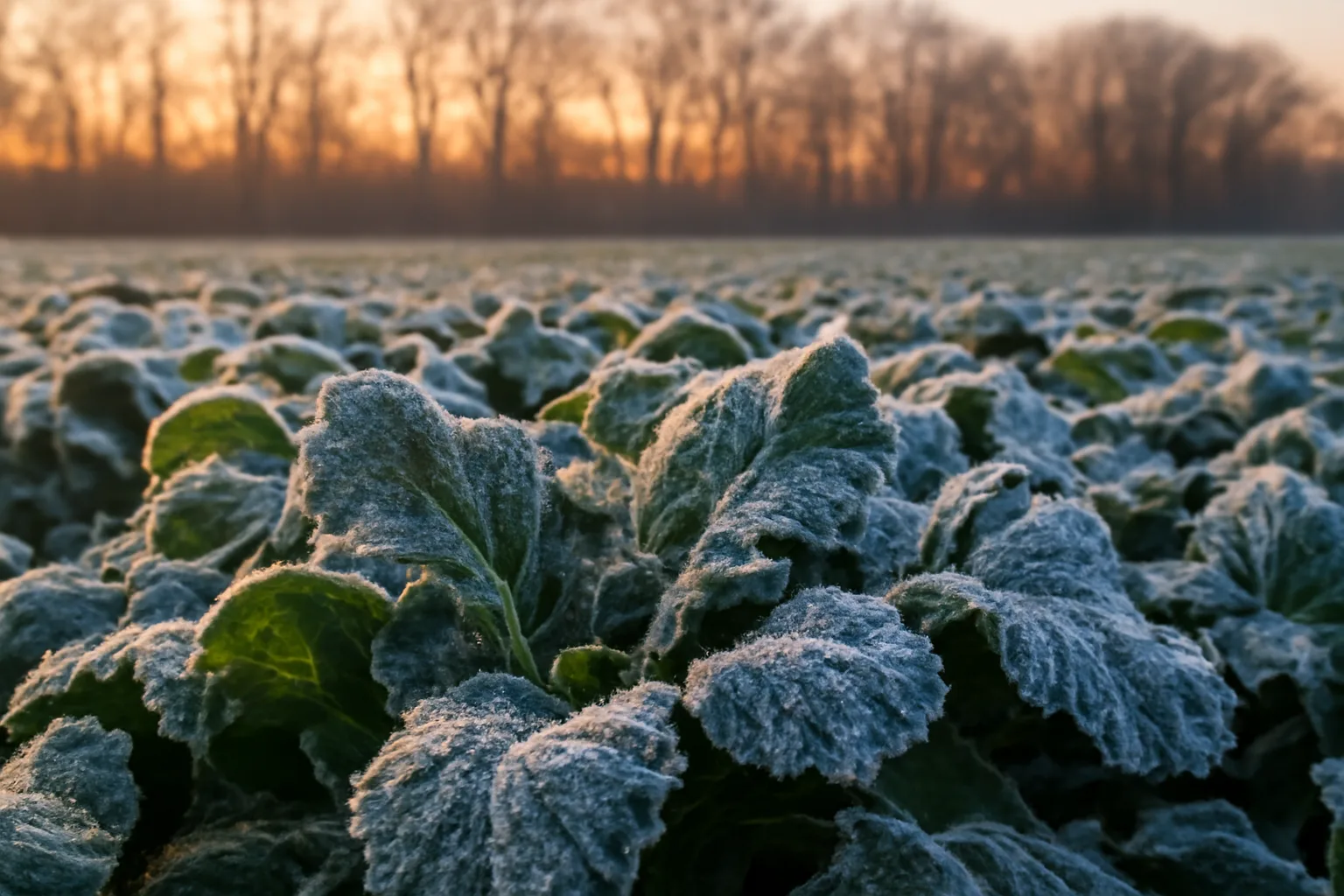
For most of the whitetail's range, a brassica blend (turnips, forage radish, and rape mixed with a cereal grain like oats or winter wheat) is the most reliable late-season plot. Brassicas produce huge amounts of biomass per acre, both leafy top growth and bulb, and they get sweeter after a hard frost because the plant converts stored starches to sugars as a cold-tolerance mechanism [1]. That sugar conversion is the whole trick. Deer often walk past a brassica plot in October, then hammer it in December once a few frosts have hit. Purdue Extension notes that brassica forage quality actually improves through the fall as sugar content rises with cold exposure [1]. If you can only plant one thing for late season and your soil and season length support it, a brassica-and-cereal-grain mix is the honest answer. If your property already leans heavily on standing corn or soybeans left unharvested nearby, brassicas become less necessary since deer will hit that first. For a property-specific mix (soil type, frost date, and acreage all change the right ratio), a Custom Food Plot Plan built from your soil test is a faster path than guessing at bag ratios.
Do deer eat sorghum?
Yes, deer eat grain sorghum (milo), and it can work as a late-season food source, especially in the southern Plains and parts of the Midwest where it's already a common row crop. Sorghum produces a seed head that stands above snow, which matters when other forages get buried. It isn't the first choice most food plot managers reach for, though. Sorghum takes a full growing season (roughly 100 to 120 days to maturity depending on variety), needs warm soil to germinate, and doesn't get the same 'improves with frost' sugar boost that brassicas do. It's more of a standing-grain option, similar in function to corn, just a bit shorter and often more drought tolerant. If you're in a drier region where corn struggles, sorghum is a reasonable substitute for a late-season energy source.
Do deer eat clover, and do deer like clover?
Deer eat clover readily and it's one of the most consistent early-to-mid season forages available, but it isn't the top late-season pick everywhere. Clover is a legume, high in protein, and a widely cited resource among food plot managers for how palatable and productive it is across much of the whitetail's range [2]. The issue in late season is dormancy. In the northern half of the country, clover goes dormant and gets covered by snow right when deer need it most. Clover keeps producing later into fall in the Southeast and mid-South, where winters are milder, and it can still pull weight as a late-season food source there. In colder zones, think of clover as your spring-through-fall workhorse and pair it with brassicas or cereal grains for the December-January stretch. A lot of the best plot rotations use clover in one plot and brassicas or grain in another, so deer have something green most of the year.
When to plant food plots for deer, generally?
| Brassicas (turnip, radish, rape) | Late July to early September | High, improves after frost | |
|---|---|---|---|
| Cereal grains (oats, wheat, rye) | Late August to mid-September | Wheat and rye very high, oats moderate | |
| Clover (perennial) | Spring (Apr-May) or late summer (Aug-Sep) | Dormant in cold winters | |
| Soybeans | May to June | Low, killed by first hard frost | |
| Corn | Late April to June depending on region | Low for green forage, standing grain holds through winter | For a full breakdown of planting windows by region, see food plot whitetail planning basics. |
Timing splits into two windows: spring plantings for warm-season annuals and perennials (May through June in most of the whitetail's range), and late-summer plantings for fall and winter annuals (roughly late July through early September). Which window you use depends entirely on what you're planting and your local frost dates. The rule that matters most for late-season specifically: brassicas and cereal grains need 60 to 90 days of growth before your first killing frost to reach good size and maturity. Count backward from your average first frost date, which you can find through your state's Cooperative Extension office or NOAA's freeze and frost occurrence data by weather station, and that's your planting window. Here's a rough seasonal breakdown by plot type: | Plot type | Typical planting window | Frost tolerance |
When to plant turnips for deer?
Plant turnips 60 to 90 days before your area's first hard frost, which for most of the whitetail's range means late July through early September. Turnips need that window to bulb up properly and build the sugar reserves that make them attractive after frost. Plant too early in hot, dry August soil and you risk poor germination. Plant too late and the bulbs won't size up before growth stops. If you're not sure of your first frost date, your state's land-grant Extension office publishes county-level frost date tables, and NOAA's National Centers for Environmental Information maintains freeze and frost occurrence data by weather station. Seeding rate for pure turnip is typically 4 to 6 pounds per acre, planted a quarter inch deep into a firm, well-limed seedbed. Turnips like a soil pH close to 6.0 to 6.5 and respond hard to phosphorus and potassium, which is exactly why a current soil test matters more here than for almost any other plot type. Your soil test lab's lime and fertilizer recommendation is the real authority, not a bag label.
When to plant oats for deer?
Plant oats 6 to 8 weeks before your first expected frost, which lands most properties in the late August to mid-September window. Oats germinate fast, often showing green in 5 to 7 days, which makes them a good nurse crop mixed with slower brassicas or clover. Oats aren't as frost-hardy as winter wheat or cereal rye. A hard freeze in the teens or lower will usually kill oat forage outright, while wheat and rye keep growing (or go dormant and green back up) through much colder temperatures. That's why a lot of late-season blends use oats for quick fall attraction and wheat or rye as the backup that survives into January and February. Seed oats at 2 to 3 bushels per acre (roughly 64 to 96 pounds) if planting a pure stand, less if blending with other species. Oats also tolerate a wider pH range than brassicas, which makes them forgiving on plots where lime hasn't fully kicked in yet.
What are deer's favorite food, and does that change in winter?
Deer are opportunistic browsers, and their favorite food shifts by season and region more than most hunters expect. In fall, acorns are usually the top preference where oaks are present, since they're calorie-dense and abundant. Ag fields (soybeans, corn) are next in line during summer and early fall. In winter, when acorns and standing beans are gone, deer shift hard toward woody browse, remaining standing grain, and whatever green forage (brassica tops, winter wheat, rye) is still available. There's no single 'favorite food' that holds true everywhere. Research on white-tailed deer diet composition, published in the Journal of Wildlife Management, has documented that seasonal shifts track forage availability and quality, with energy needs rising as fat reserves and native browse quality both decline through winter [3]. What's consistent is this: deer chase energy in winter. Fat and carbohydrate content matters more than protein once temperatures drop and does are done lactating. That's the whole reason brassicas, corn, and cereal grains outperform clover and soybeans for the December-through-February stretch.
Do deer like honey (honey locust, honeysuckle, or literal honey)?
If the question is about honey the food, deer aren't drawn to it in any meaningful way as forage; that's not how their digestive system or foraging behavior works, and it's also worth checking your state's baiting laws before using any sweet attractant, since honey-based products can fall under baiting restrictions depending on the state. If the question is really about honey locust trees or Japanese honeysuckle, that's a different story. Deer do browse honey locust pods and foliage, and honeysuckle is a well-documented preferred browse species in a lot of whitetail range, sometimes so preferred that heavy deer browsing suppresses honeysuckle regeneration in forest understories, according to multiple university forestry studies. Neither is something you'd plant as a food plot, though. If you're food plotting for late season, put your acreage into brassicas, cereal grains, or standing corn instead.
How do brassicas, cereal grains, and standing corn compare for late season?
| Brassica blend | Sugar spike after frost, huge biomass | Can be cleaned out by January in high deer density | $25-45 | |
|---|---|---|---|---|
| Winter wheat/rye | Cold-hardy green forage into February | Lower tonnage than brassicas | $20-35 | |
| Standing corn | Highest calorie density, cover plus food | Highest establishment cost, vulnerable early | $100-150+ | Seed costs vary a lot by region, dealer, and blend, so treat those figures as a rough planning range, not a quote. If you're weighing which combination fits your acreage and budget, the deer food plot seed guide breaks down blend options in more detail, and food plot seed covers straight species pricing. |
Each of the three main late-season options has a different strength, and most solid plot plans use two of the three together rather than betting on just one. Brassicas bring the most tonnage per acre and the frost-driven sugar spike, but they're gone by late winter in a hard year once deer clean out the bulbs. Cereal grains (wheat and rye especially) are the most cold-hardy green forage available and will keep producing new growth through mild winter days even under snow cover, but they don't have the raw tonnage of a brassica plot. Standing corn holds the most calories per acre and the standing structure gives deer cover along with food, but it costs the most to establish and needs to survive to maturity without herbicide or deer damage taking it out early. | Plot type | Peak late-season value | Main weakness | Rough cost per acre (seed only) |
How do I plan planting dates for my specific property?
Start with your average first frost date, then count backward. That single number drives almost every other decision for late-season plots. Your state Cooperative Extension office publishes county-level frost date averages, and NOAA's National Centers for Environmental Information maintains freeze and frost occurrence data by weather station that's more precise than a statewide average. From there, match the plant to the window. Brassicas want 60 to 90 days before frost. Winter wheat and rye can go in later, sometimes right up to 30 days before frost, since they're bred to establish quickly and overwinter as a green plant. Oats need the same 60 to 90 day window as brassicas but won't survive as deep into winter. Soil test results change the picture too. A pH below 6.0 will choke brassica and clover performance no matter how well you time the planting, so lime lead time (which can take months to fully adjust soil pH) needs to factor into your calendar as much as frost dates do. Your soil test lab's specific lime and fertilizer recommendation for your field is the real number to follow, not a generic rate off a bag. If you'd rather not build the calendar from scratch, a $99 one-time Custom Food Plot Plan takes your soil test and location and builds a planting schedule and species mix around it. It's general guidance built for your zone and soil, not a site visit or a guarantee of deer activity, but it saves the trial and error most people go through in year one.
What about equipment and acreage for a late-season plot?
You don't need a tractor to grow a good brassica or cereal grain plot. A lot of successful late-season plots get planted with an ATV, a small disc or cultipacker, and a broadcast spreader. Brassica and cereal grain seed is small enough to broadcast on a firm, prepared seedbed and lightly cultipack in, no drill required. Standing corn is the outlier. Corn needs a planter (or at least a decent drill) for proper seed spacing and depth, and it usually needs at least some herbicide program to keep weeds from choking it out before it gets tall enough to shade them. That's a bigger investment in both equipment and time, which is why a lot of smaller properties skip corn and lean on brassica and grain blends instead. Acreage matters less than people think. Half an acre of a good brassica-and-grain blend, properly limed and fertilized, will outperform two acres of the same mix planted into acidic, low-fertility soil. For more on matching plot size and layout to your land, deer food plots covers acreage planning, and domain food plot seed covers blend-specific seeding rates.
Frequently asked questions
Do deer eat sorghum?
Yes. Deer eat grain sorghum (milo), especially where it's already grown as a row crop in the southern Plains and Midwest. It stands above snow like corn does, but it doesn't get sweeter after frost the way brassicas do, so it's more of a standing-grain backup than a top late-season pick.
Do deer eat clover, and do deer like clover?
Deer readily eat clover and it's one of the most palatable forages available spring through fall [2]. In cold-winter regions, clover goes dormant right when late-season demand peaks, so it works better as a spring-through-fall plot paired with brassicas or grain for winter.
When should I plant food plots for deer?
It depends on the species. Warm-season plots (soybeans, corn) go in May-June. Late-season annuals (brassicas, oats, wheat) go in late July through early September, timed 60 to 90 days before your area's first frost. Check county frost dates through your state Extension office before locking in a date.
When to plant turnips for deer?
Plant turnips 60 to 90 days before your first hard frost, typically late July to early September across most of the whitetail's range. That window lets bulbs size up and lets cold weather convert starches to sugar, which is when deer really start hitting them.
When to plant oats for deer?
Plant oats 6 to 8 weeks before your first frost, usually late August through mid-September. Oats germinate fast (5 to 7 days) but aren't very frost-hardy, so pair them with winter wheat or rye if you want green forage surviving into January and February.
What is a food plot?
A food plot is a planted patch of forage, usually a quarter acre to several acres, established on hunting land to feed deer and often to hunt over. Plots range from simple clover fields to multi-species blends of brassicas, grains, and legumes matched to the season and soil.
What are deer's favorite foods?
There's no single favorite; it shifts by season. Acorns lead in fall where oaks are present, ag crops (soybeans, corn) matter most in summer and early fall, and in winter deer shift to woody browse, standing grain, and any remaining green forage like brassica tops or winter wheat.
Do deer like honey?
No, honey isn't a meaningful deer attractant nutritionally, and sweet bait products can fall under state baiting restrictions, so check local rules first. If the question means honey locust or honeysuckle, deer do browse both, but neither is a food plot species you'd plant.
What's the best single food plot for late season?
A brassica blend (turnips, radish, rape) mixed with a cereal grain like winter wheat is the most reliable late-season combination for most of the whitetail's range. Brassicas get sweeter after frost due to starch-to-sugar conversion, per Purdue Extension [1], and the cereal grain keeps green forage available longer into winter.
How much does a late-season food plot cost to plant?
Seed alone typically runs $20-45 per acre for brassica or cereal grain blends, and over $100 per acre for standing corn, though prices vary by region and dealer. Add lime, fertilizer, and equipment time on top of seed cost when budgeting a plot for the first time.
Does soil pH matter for late-season plots?
Yes, a lot. Brassicas and clover both want soil pH around 6.0 to 6.5 to perform well; below that, nutrient uptake drops even with good fertilizer rates. Get a soil test before planting and follow your lab's specific lime recommendation, since lime can take months to fully adjust pH.
Will standing corn or soybeans work for late season?
Standing corn holds deer well into winter since the grain stays available above snow, but it costs more to establish and needs a real weed and pest program. Soybeans get killed by the first hard frost as a green plant, though leftover pods can still feed deer into early winter if not fully browsed out.
Sources
- Purdue University Extension, forage brassicas for deer: Brassica forage quality and palatability increase after frost due to starch-to-sugar conversion
- Oklahoma State University Extension, Establishing Clover for Wildlife Food Plots (PSS-2129): Clover is among the most palatable and widely planted forages for deer
- Weckerly, F.W. et al., seasonal variation in white-tailed deer diet composition, Journal of Wildlife Management: Whitetail diet composition shifts seasonally with forage availability and quality
- NOAA National Centers for Environmental Information, Freeze/Frost Occurrence Data: First frost dates vary by weather station and drive planting-window calculations
- USDA Natural Resources Conservation Service, Soil Quality Indicators: pH (Soil Quality Kit Information Sheet): Soil pH below 6.0 restricts nutrient uptake and requires lime correction, which takes months to adjust
- Iowa State University Extension and Outreach, Corn Growth and Development (PMR 1009): Standing corn requires proper planter seed spacing and depth and a weed control program to reach maturity