Last updated 2026-07-26
TL;DR
For early season (August through October depending on zone), the best food plot for deer is standing forage soybeans, cowpeas, or an established clover stand, all high in protein when deer need it most. Brassicas and cereal grains like oats work too, but they shine later once frost sweetens them. Match the plant to your calendar, more than your wish list.
what is a food plot, and why does timing matter this much
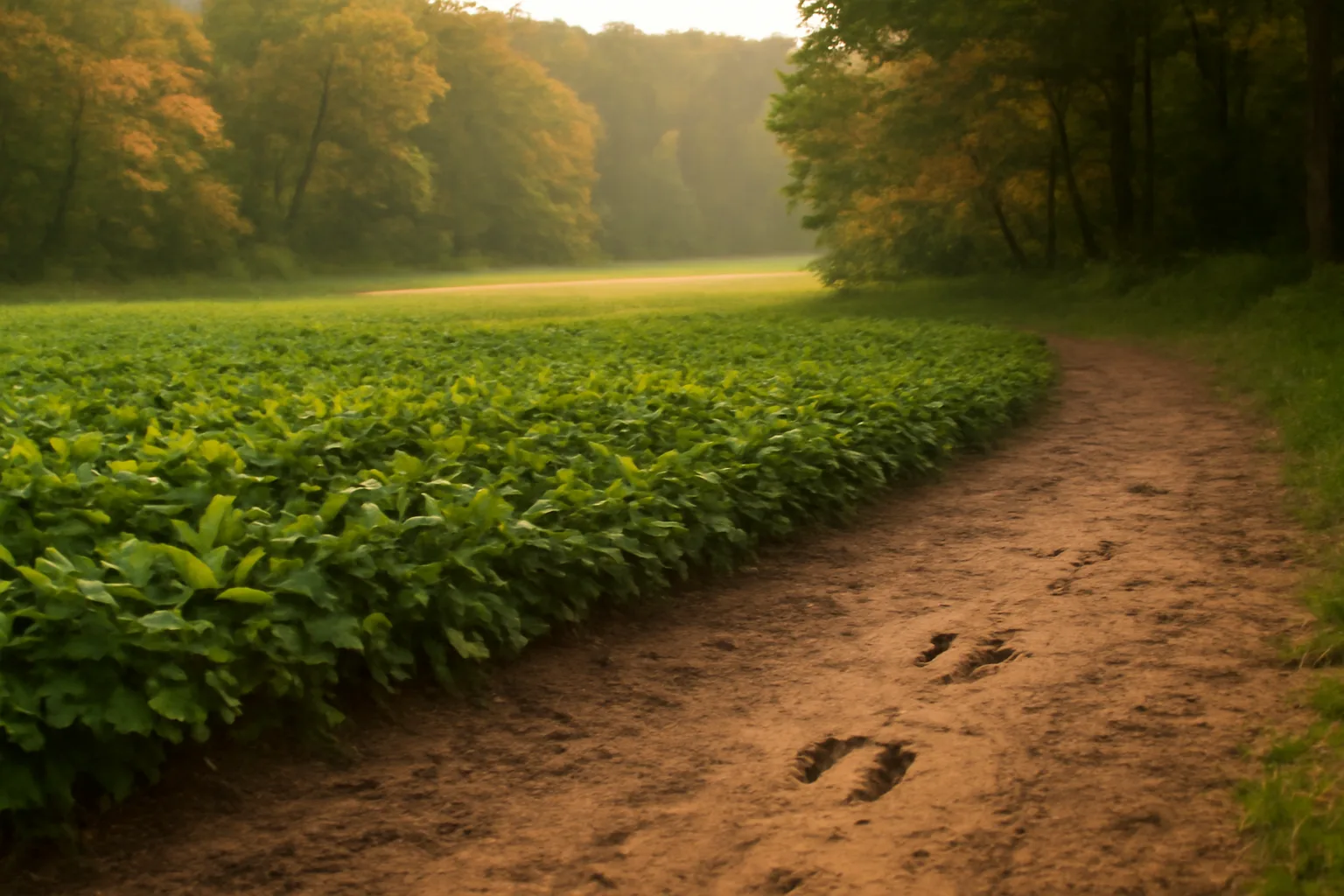
A food plot is a planted patch of ground, usually somewhere between a quarter acre and several acres, seeded with forage that deer will eat and that also gives you a reason to build a stand or blind nearby. It's not a garden and it's not a lawn. It's agriculture done on purpose for wildlife, and it lives or dies on the same variables row-crop farmers deal with: soil pH, fertility, rainfall, and planting date [1]. Early season plots have one job that late season plots don't: they need to be attractive and already growing before archery season opens, which in most states falls somewhere between early September and early October. That means your planting window isn't during hunting season, it's 60 to 90 days before it, depending on what you plant. Get the calendar wrong and you'll have a green field of nothing edible on opening day. The practical difference between an early season plot and a late season plot comes down to what's palatable and available when you need it. Beans and clover peak in late summer and early fall. Brassicas and cereal grains often need a hard frost to convert starches to sugars, which is why turnips planted in July can sit almost untouched in September and then get hammered in December [2].
when to plant food plots for deer, zone by zone
| Deep South (8-9) | April to June | Late Aug to Oct | |
|---|---|---|---|
| Mid-South/Transition (6-7) | May to June | Late Aug to mid-Sept | |
| North/Upper Midwest (3-5) | Late May to early June | Mid-Aug to early Sept | These are general windows, not guarantees. Your county extension agent or state forestry/wildlife agency almost always publishes a more specific local planting calendar, and that beats any national chart. |
Planting dates depend entirely on your frost dates and the crop's days-to-maturity, so "when to plant food plots for deer" doesn't have one national answer. What matters is counting backward from your average first fall frost date, which the NOAA National Centers for Environmental Information tracks by station [3]. As a rough framework: in the Deep South and lower Southeast (roughly USDA zones 8-9), summer annuals like soybeans and cowpeas can go in April through June, and fall brassica/cereal blends go in from late August into October. In the Mid-South and transition zone (zones 6-7), summer plantings run May into June, fall plantings run late August through mid-September. In the North and upper Midwest (zones 3-5), summer beans need to go in by late May to early June to have enough growing season, and fall plots (oats, brassicas, cereal rye) should go in by mid-August to early September so they establish before frost shuts things down. The safest method, and the one your local extension office will actually endorse, is to work backward from your first frost date and subtract the maturity window printed on the seed bag. Clover and cereal grains are more forgiving of a slightly late planting than brassicas, which need real leaf growth before a hard frost to build the sugar content deer key in on. | Region (rough USDA zone) | Summer annual planting window | Fall plot planting window |
do deer eat sorghum
Yes, deer eat grain sorghum, but it's a mixed bag as a primary food plot choice. Sorghum (milo) produces a seed head deer will feed on once it matures, and the standing stalks also give bedding and screening cover, which is a real, if secondary, benefit on open ground [4]. The catch is that sorghum isn't a preferred forage the way soybeans or clover are during the growing season; deer mostly ignore the plant itself until the grain heads mature and dry down, which often lines up more with late fall than early season. It's commonly planted as a component in a dove field or a wildlife blend rather than a standalone early season deer plot. If your goal is September and October attraction, sorghum shouldn't be your main crop. If you want late-season grain and some cover, it earns a spot in the mix.
do deer eat clover, and do deer actually like it
Yes, and it's one of the most consistent food plot performers there is. White clover and red clover are both high in protein (often 20-25% crude protein in vegetative growth) and stay palatable across spring, summer, and fall once established, which is exactly why extension programs across the whitetail range recommend it as a plot staple. Deer do like clover, and it's often ranked among the most consistently used food plot forages in browse studies because it regrows after grazing, unlike a brassica or bean plant that gets eaten down once. That regrowth is the real advantage: a well-maintained clover stand can feed deer from April through a hard freeze, which makes it one of the few true multi-season plots rather than a single-window planting. The tradeoff is establishment time and maintenance. Clover needs a clean seedbed, correct pH (most university guides target 6.0-7.0), and it's slow the first year. It also needs mowing and occasional herbicide to keep grass and weeds from choking it out. If you want a plot that's already producing when bow season opens without replanting every year, a mature clover stand is close to the best low-maintenance option available, but you have to put the establishment work in a year ahead of time, not the week before season.
so what actually is the best early season food plot for deer
For pure early season attraction, in late summer through October, the strongest choices are forage soybeans, cowpeas (iron and clay types especially), and lablab, all warm-season legumes that are still green, leafy, and high protein right when bow season opens in most states. Forage soybean varieties bred for deer plots (as opposed to grain soybeans) produce more leaf tonnage and can handle repeated browsing better, which matters because deer will often hit young soybean plots hard enough to wipe out a stand if it's small and the local deer density is high. Cowpeas mature faster than soybeans and tolerate poorer soil and drier conditions, which makes them a reasonable backup on marginal ground. Established clover, as covered above, is the other top-tier early season option, mainly because it requires zero new planting to be ready. If you already have a clover plot in its second or third year, it may out-perform a brand new bean plot simply because it's mature and undisturbed heading into September. What doesn't work well for early season: brassicas planted on their own. Turnips, radish, and rape are excellent late season food (more on that below) but are frequently ignored by deer in early fall before a frost sweetens the leaves and bulbs. If brassicas are your only early plot, you may find deer walking past a lush green field to browse a fence line of honeysuckle instead.
when to plant oats for deer
Oats are a fall planting, going in the ground roughly 6 to 8 weeks before your first expected frost, which lands most plantings from mid-August in the North to late September or even October in the Deep South [5]. Oats are attractive to deer almost immediately after emergence, unlike brassicas, because the young leaf blades are palatable right away without needing a frost to convert starches. That makes oats a genuinely good early-to-mid season food plot option in addition to being a strong late fall one, which is part of why oats show up in so many fall blend bags alongside wheat, rye, and clover. One practical note: oats are less winter-hardy than winter wheat or cereal rye in cold climates, so in zones 3-5 a hard winter can kill oats off entirely by December while wheat and rye keep growing. If you want a plot that carries food from September through the late season in a northern climate, blend oats with a cereal grain that survives the cold, rather than planting oats alone.
when to plant turnips for deer, and why timing is so unforgiving
Turnips need to go in the ground about 80 to 90 days before your first hard frost, which usually means late July through August in most of the whitetail range, and no later than early September even in the Deep South [2]. The reason the window is tight: turnips need time to build bulb size and leaf mass before frost, and they need that frost to convert stored starches into sugars, which is what triggers deer to start hitting them hard. Plant turnips too late and you get small, bitter bulbs and thin leaf growth that deer walk past. Plant them right, and a turnip plot can turn into one of the most heavily used plots on the property from November through the end of season, sometimes even getting torn up and rooted through by deer digging for the bulbs after several frosts. Because turnips are a genuine late season food and not an early season one, they're a poor stand-alone choice if your main goal is October bow hunting. Pair them with a summer legume plot for early season and let the turnips take over as the calendar moves into November.
what are deer's favorite foods, in order of what actually gets eaten
There's no single ranked list that holds true everywhere, because deer preference shifts by region, season, and what's already growing wild nearby, but browse studies and extension forage trials consistently put a few plants near the top: native forbs and soft mast (acorns especially) in the wild category, and soybeans, clover, and cowpeas in the planted food plot category [6]. Acorns deserve a mention because in a heavy mast year, deer will often ignore a food plot entirely in favor of white oak acorns, which are lower in tannins and more palatable than red oak acorns. This is one of the most common reasons a food plot that performed great last year seems dead this year, it's not the plot, it's the acorn crop. Within planted forages, most state wildlife agency and university plot guides rank legumes (soybeans, cowpeas, clover, alfalfa) above brassicas and grains for raw preference during the growing season, with brassicas moving up the list only after frost. If you're planning a single plot and want the best odds of consistent use across the season, a legume base with a brassica or grain component for late season covers both ends.
do deer like honey (and other odd attractant questions)
Deer don't seek out honey in the wild the way they browse forage plants, since honey isn't part of natural whitetail diet and there's no research or agency guidance treating it as deer food. Some hunters use sweet liquid attractants or mineral/molasses-based products near plots, but that's a different category from food plot planning and is regulated separately from crop planting in most states. More relevant to actual plot use: many states restrict or ban baiting and supplemental feeding, and the rules differ by whether it's a planted, standing crop (usually legal) versus a pile of feed, mineral, or sweet bait (often restricted or seasonal). Michigan, for example, has specific baiting regulations enforced by the Department of Natural Resources that differ from its food plot rules [7]. Before you add any mineral lick, feeder, or attractant near a food plot, check your state wildlife agency's current baiting and feeding regulations, since they change year to year and vary sharply by state.
how do I actually build an early season plot from bare ground to planted
Start with a soil test, not a seed bag. A basic soil test through your state land-grant extension office (often $10-20 per sample) tells you pH and nutrient levels, and it's the only way to know how much lime or fertilizer you actually need rather than guessing [8]. Your soil test lab is the real authority here, follow their specific lime and fertilizer recommendations over any general rule of thumb, including ours. Most food plot forages want a pH between 6.0 and 7.0. Below that, especially under 5.5, nutrient availability drops sharply and lime becomes the single highest-return input you can buy, often more impactful than the seed itself. Lime takes months to fully react in the soil, so if your test says you need it, apply it as early as possible, ideally a full season ahead of planting. For early season plots specifically, the sequence looks like this: pull soil samples in late winter or early spring, apply lime if needed, plant summer legumes (beans, cowpeas, lablab) in May or June depending on zone, then let them grow through summer into your bow opener. If you're starting clover, plant it in early spring or late summer with a nurse crop of oats to hold the soil, then manage it as a perennial for years two and beyond. If you'd rather not guess at species mix, planting rates, and timing for your specific region and soil result, that's exactly the gap a $99 one-time Custom Food Plot Plan is built to fill: you get a written plan matched to your zone, soil test numbers, and equipment, not a generic bag recommendation.
what equipment do I actually need for an early season plot
For a small plot (under an acre), you can get by with a hand spreader, a hand tiller or disc behind an ATV, and a cultipacker or drag to firm the seedbed after planting. For anything over an acre, a tractor with a disc, a broadcast spreader, and a cultipacker starts paying for itself in time saved. Brassica and clover seed is tiny and needs to be planted shallow, often just pressed into the surface, so a cultipacker or even driving over the plot with an ATV tire afterward matters more than people expect. Beans and cowpeas are drilled or planted deeper, around 1 to 1.5 inches, and a no-till drill is the gold standard if you have access to one, though a disc and cultipacker combo works fine on prepared ground. Don't over-invest in equipment before your first plot. A lot of hunters buy a disc, a drill, and a sprayer before they've pulled a single soil sample. Spend the first year's budget on the soil test, lime, and quality seed. Equipment upgrades matter more once you're managing multiple plots or fighting heavy weed pressure that a hand tool can't keep up with.
Frequently asked questions
Do deer eat sorghum?
Yes, but mainly the mature grain heads, not the growing plant. Sorghum is more useful as a late-season grain and screening cover than as a primary early season attractant. It's commonly planted in wildlife blends alongside other species rather than alone as a dedicated deer plot.
Do deer eat clover?
Yes, and clover is one of the most reliable food plot forages available, often testing at 20-25% crude protein in active growth. It regrows after grazing, unlike beans or brassicas, which makes an established stand one of the few true multi-season plots that feeds deer spring through fall.
When should I plant food plots for deer?
It depends on your frost dates and crop type. Summer legumes like soybeans and cowpeas go in spring to early summer; fall crops like brassicas, oats, and cereal grains go in roughly 60-90 days before your first fall frost. Check your NOAA station's average frost date and count backward from there.
Do deer like clover more than other food plot options?
Clover ranks near the top of most preference studies and extension guides, largely because it stays palatable and regrows for months rather than getting eaten out in one pass. Soybeans and cowpeas rival it during the growing season, but clover's multi-year persistence gives it an edge for low-maintenance, long-season attraction.
When should I plant oats for deer?
Plant oats about 6 to 8 weeks before your first fall frost, roughly mid-August in northern zones and into September or October in the Deep South. Oats are palatable soon after emergence, unlike brassicas, so they work as both an early fall and late season food source.
When is the best time to plant food plots overall?
There isn't one date; it's two windows. Summer annuals (beans, cowpeas) go in spring through early summer for early-to-mid season attraction. Fall plantings (brassicas, oats, cereal grains, clover) go in late summer, timed 60-90 days ahead of your area's first hard frost.
When should I plant turnips for deer?
Turnips need roughly 80 to 90 days before your first hard frost, which usually means late July through August across most of the whitetail range. Plant later than that and bulbs stay small and leaves stay bitter, since it's the frost that triggers sugar conversion and drives deer use.
What exactly is a food plot?
A food plot is a planted area of forage, anywhere from a quarter acre to several acres, grown specifically to feed and attract deer or other wildlife on hunted land. It's real agriculture: it needs soil testing, correct pH, fertilizer, and a planting calendar matched to the crop and region, more than scattered seed.
What are deer's favorite foods overall?
Preference shifts by region and season, but acorns (especially white oak) often outrank any planted crop in a heavy mast year. Among planted forages, legumes like soybeans, cowpeas, and clover generally rank above brassicas and grains during the growing season, with brassicas gaining appeal only after a hard frost.
Do deer like honey?
No, honey isn't a natural part of a whitetail's diet, and no wildlife agency or extension guide treats it as deer food. Some sweet liquid attractants use similar sugars, but those fall under bait/attractant rules, which are regulated separately from planted food plots and vary significantly by state.
What's the single best early season food plot for deer?
For most hunters, a forage soybean or cowpea planting, or an already-established clover stand, is the best early season option because both stay green and high-protein right through bow season. Brassicas alone are a poor early choice since they need a frost before deer key in on them.
Can I plant a food plot without a soil test?
You can, but you're guessing on lime and fertilizer, which are the two inputs with the biggest effect on yield and palatability. A basic soil test through your state land-grant extension office usually costs $10-20 and tells you exactly what your ground needs before you spend money on seed.
Is it legal to use bait or mineral near a food plot?
It depends entirely on your state. Standing, planted crops are legal almost everywhere, but piled feed, mineral licks, and sweet attractants are restricted or banned in many states and regulations change by season. Always check your state wildlife agency's current baiting and feeding rules before adding anything beyond a planted crop.
Sources
- USDA NRCS, Plant Materials Program: Food plots function as managed agricultural plantings for wildlife and depend on soil, fertility, and timing like other crops
- Mississippi State University Extension, Brassica Food Plots: Brassica crops like turnips need a hard frost to convert starches to sugars, driving increased deer palatability
- NOAA National Centers for Environmental Information, Frost/Freeze Data: Average frost dates by station used to plan planting windows backward from first fall frost
- Mississippi State University Extension, Grain Sorghum for Wildlife: Sorghum grain heads are used by deer once mature and the standing crop provides cover, but the plant is not a preferred forage during growth
- University of Tennessee Extension, Wildlife Food Plots: Oats and other fall cereal grains are typically planted 6-8 weeks ahead of first frost and are palatable soon after emergence
- Auburn University/Alabama Extension, Deer Food Habits: Acorns, particularly white oak, are highly preferred mast that can draw deer away from planted food plots in heavy mast years
- Michigan Department of Natural Resources, Baiting and Feeding Regulations: State wildlife agencies regulate baiting and feeding separately from planted food plot crops, with rules varying by state
- University of Missouri Extension, Soil Testing for Lawns and Gardens/Food Plots: Basic soil tests through university labs typically cost around $10-20 per sample and determine pH and nutrient needs before planting