Last updated 2026-07-25
TL;DR
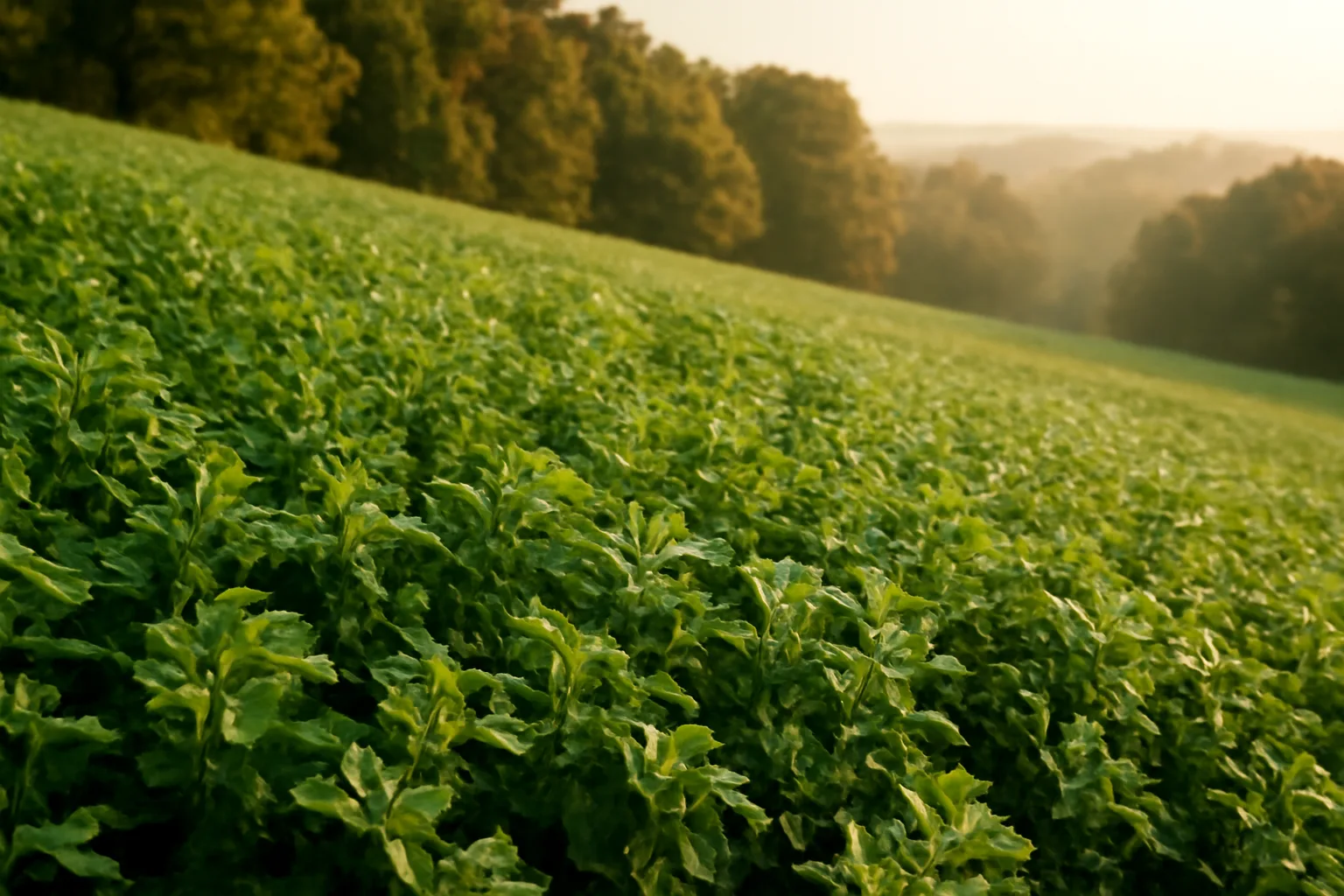
Alfalfa is a high-protein perennial forage deer eat all season, but it demands a pH near 6.8, good drainage, and 3-4 years to pay off. For most food plotters, clover establishes faster and tolerates more mistakes. Alfalfa makes sense on well-drained ground with a long-term lease and a soil test showing near-neutral pH already.
What is a food plot, and where does alfalfa fit in?
A food plot is a planted area on hunting land, usually somewhere between a quarter acre and several acres, designed to feed deer and other wildlife and to draw them into range of a stand or blind. Plots split into two broad categories: annuals you replant every year (brassicas, cereal grains, soybeans) and perennials that come back on their own for three to five years or more (clover, alfalfa, chicory). Alfalfa sits in the perennial camp, alongside clover. It's a legume, meaning it fixes nitrogen from the air with help from rhizobium bacteria in the soil, so it needs less nitrogen fertilizer than a corn or brassica plot. The USDA Natural Resources Conservation Service lists alfalfa as a top forage choice for wildlife plantings because of its protein content and regrowth after cutting or grazing [1]. The tradeoff is patience and soil quality. Alfalfa is pickier than clover about drainage and pH, and it takes a full growing season, sometimes two, before it's really productive. If you want something in the ground fast with fewer inputs, clover or a brassica blend is the easier call. If you've got years on a lease and soil that's already close to neutral, alfalfa can out-produce almost anything else you can plant.
Do deer actually like alfalfa?
Yes. Alfalfa is one of the most palatable and highest-protein forages available to whitetails, often tested at 20-25% crude protein in vegetative growth stages, which is why dairy farmers grow it by the hundreds of thousands of acres. Deer will hit alfalfa hard in spring and summer when protein demands are highest, during antler growth and lactation. It tends to see less pressure in late fall once frost knocks growth back, compared to brassicas or cereal grains that get sweeter after a freeze. So alfalfa's strongest season is spring through early fall, not the December rut hunt. One real-world catch: a thin, new alfalfa stand next to heavy deer pressure can get grazed into the ground before it ever establishes roots. That's a genuine risk on small plots surrounded by high deer densities. Bigger acreage, or a nurse crop of oats mixed in for the first year, helps take grazing pressure off young plants long enough for them to root in.
What soil does alfalfa need, and how do I know if mine qualifies?
Alfalfa wants a soil pH between 6.5 and 7.0, and performance drops sharply below pH 6.0 because the rhizobium bacteria that fix nitrogen struggle in acidic soil [2]. It also needs well-drained ground. Alfalfa roots can run 15 feet deep in good soil, but the plant will not tolerate standing water or waterlogged clay for more than a day or two before crown rot sets in. A soil test is not optional here. It's the whole ballgame. Pull a sample, send it to your state land-grant lab or a private ag lab, and read the pH and phosphorus/potassium numbers before you buy a bag of seed. If your test comes back at pH 5.5, you're looking at applying lime and waiting months, sometimes a full season, for it to raise pH enough to plant. Your soil test lab is the authority on how much lime and fertilizer your specific dirt needs; a general article like this one can tell you the target range, not your exact rate. Drainage matters as much as pH. Low spots that hold water after rain are bad news for alfalfa but fine for clover, which tolerates wetter soils better. If your plot has a wet corner, plan on clover or a different perennial there and save alfalfa for the well-drained high ground.
How does alfalfa compare to clover for food plots?
| Ideal soil pH | 6.5-7.0 [2] | 6.0-6.5, tolerates down to ~5.5 | |
|---|---|---|---|
| Drainage needs | Well-drained, no standing water | Tolerates wetter soils | |
| Establishment time | 1-2 seasons to full production | Weeks to a few months | |
| Stand life | 3-5 years with good management | 3-5 years (white), 2-3 (red) | |
| Crude protein | ~20-25% vegetative | ~20-30% vegetative | |
| Drought tolerance | Strong once established | Moderate | |
| Seed cost per acre (rough) | Higher, denser seeding rate | Lower | If you're planting your first perennial plot ever, start with clover. If you already run a productive clover plot and want to add tonnage and drought resilience on your best-drained field, alfalfa is worth the upgrade. For more on clover species and blends, see deer food plot seed. |
Clover is the more forgiving, more popular choice for most food plotters, and for good reason. It germinates faster, tolerates a wider pH range, handles wetter soil, and costs less per acre in seed. Alfalfa can out-yield clover in total tonnage on good ground, and it holds up better to summer drought once its taproot is established, but it takes longer to get there and punishes soil mistakes harder. | Factor | Alfalfa | Clover (white/red) |
When should I plant alfalfa (and other food plot species) for deer?
Alfalfa is planted in spring or late summer, depending on your region, and timing follows the same general logic as clover. In northern states, spring planting (April through May, after last frost risk) gives the plant a full season to establish roots before winter. In transition and southern zones, late summer plantings (August into early September) work because there's less weed competition and cooler fall temperatures help seedlings root without heat stress. Food plot timing in general breaks into three rough windows that shift by state and hardiness zone: - Spring plots (perennials like alfalfa and clover, plus soybeans): after soil hits 50-55°F and frost danger passes, typically April-May in the North, March-April in the South.
- Late summer/early fall plots (brassicas, cereal grains, more clover): 6-8 weeks before your average first frost date, so this often lands in August in northern states and September in the mid-South.
- Winter cereal grain overseeding (oats, wheat, rye into existing plots): early fall alongside the brassica window. Your state extension office publishes frost date maps and regional planting calendars that beat any generic date range. Check your state's land-grant extension site before you buy seed, because a date that works in Minnesota can be a month off from Alabama.
When should I plant oats for deer, and how do they fit with alfalfa?
Oats go in the ground in late summer to early fall, roughly 60-90 days before your first hard frost, which lines up with brassica planting windows in most of the whitetail range. Oats germinate fast, often within a week in warm, moist soil, and deer hit them hard in fall because oats stay green and palatable right up until temperatures drop into the teens. Oats also work as a nurse crop for new alfalfa or clover seedings. A light rate of oats mixed with alfalfa seed in a late-summer planting gives the plot some quick cover and above-ground growth while the alfalfa's slower root system develops, and it takes some grazing pressure off the tender new legume seedlings [3]. The oats die out with hard frost or the following year, leaving a clean alfalfa or clover stand. One caution: don't overseed oats too heavy in a nurse crop role, or they'll shade out and out-compete the alfalfa seedlings for light and water. A rate of 1-2 bushels per acre of oats mixed with a full alfalfa seeding rate is a common approach in extension nurse-crop guidance for legume establishment.
When should I plant turnips for deer, and how do they compare to alfalfa?
Turnips are planted in mid to late summer, generally 90-120 days before your first expected hard frost, since they need that runway to bulb up before the ground freezes. That puts turnip planting in July through early August across most of the whitetail's range, with southern states pushing into late August. Turnips are annual brassicas, completely different from alfalfa in how they work. Deer often ignore turnip tops and bulbs early in the season, then switch hard to them after a few frosts convert starches to sugars, making them a genuine late-season food source. Alfalfa does the opposite: heaviest use in spring and summer, tapering off in late fall. A lot of experienced plotters run both: alfalfa or clover as the perennial backbone plot, and a brassica/turnip mix as the annual late-season plot nearby. That gives deer high-protein forage in the growing season and a sugar-rich food source right when the rut and late season hunts happen. For more on species selection and mixing strategy, see food plot whitetail.
What are deer's favorite foods, and how does alfalfa rank?
There's no single universal favorite; it shifts by season, region, and what's locally available. Deer are opportunistic browsers, and agricultural crops like soybeans, corn, and alfalfa rank among the most heavily used foods where they're available, alongside acorns and other hard mast in fall, according to forage research summarized by university extension programs [4]. Alfalfa consistently shows up on preference lists for spring and summer forage because of its protein content and how quickly it regrows after grazing or cutting. In agricultural regions where alfalfa hay fields border timber, deer will bed in cover and feed in alfalfa daily through spring and summer, which is part of why standing alfalfa fields are a classic early-season pattern for hunters near farm country. Soybeans and corn tend to win out in late summer and fall when deer need to build fat reserves, and acorns often trump planted forage entirely in years with a heavy mast crop. So the honest answer is: alfalfa ranks near the top for spring/summer protein, but it's not the single best year-round food, because no one plant is. For a broader rundown on species options, see deer food plots.
Do deer eat sorghum, and does it work as an alfalfa companion plot?
Yes, deer eat grain sorghum, both the standing plant and dropped grain, and it's a common late-season and winter food source, especially in the South and Midwest where sorghum tolerates heat and drought better than corn. Grain sorghum heads mature in fall and often stand into winter, providing a high-energy carbohydrate source when deer need calories most. Sorghum doesn't overlap much with alfalfa in a rotation because it's a warm-season annual grass, not a legume, and it has completely different soil and planting needs (planted after soil warms past 60°F, typically late spring). But some plotters use sorghum or milo as a screening and late-season food plot bordering a perennial alfalfa or clover field, giving deer cover to approach the open perennial plot and a fall/winter energy source once the alfalfa's growth slows. It's a solid complementary planting, not a substitute.
Do deer like clover, and should I plant it instead of alfalfa?
Deer like clover a lot, and for most food plotters it's the better first perennial to plant. Clover establishes in weeks rather than a full season, tolerates a wider pH range (extension guidance generally puts optimal clover pH at 6.0-6.5, though established stands tolerate more acidic soil than alfalfa will), and it handles wetter or heavier soils that would kill alfalfa's root system. White clover varieties like Durana and Ladino are the standard for food plots because they spread by stolons and fill in bare spots, are more shade-tolerant than alfalfa, and hold up under heavier grazing pressure from a dense deer herd. Red clover offers more tonnage per cutting but has a shorter stand life, usually 2-3 years versus white clover's 3-5. If you're deciding between the two: pick clover if your soil test comes back acidic, if you have partial shade, if you have wetter ground, or if you want faster results in year one. Pick alfalfa if your pH already tests 6.5+, drainage is excellent, and you're planning a multi-year plot on your best field. A lot of plotters run both in different fields rather than picking one forever.
Do deer like honey, and other odd food plot questions worth clearing up
Deer don't eat honey in any meaningful, documented way as part of natural foraging behavior; they're herbivores built to digest plant fiber, not the concentrated sugar in a beehive, and there's no wildlife agency or extension guidance recommending it as bait or attractant. Some hunters have tried sweet liquid attractants marketed with sugar or molasses bases, but that's a different product category from raw honey, and it has nothing to do with food plot planting. Worth a real caution here: many states regulate or outright ban baiting and supplemental feeding of deer, separate from food plot planting, which is generally legal because it's an agricultural practice tied to the land rather than a pile of feed. Rules vary a lot by state and sometimes by county due to chronic wasting disease concerns. Michigan, for example, restricts baiting and feeding of deer statewide through its Wildlife Conservation Order, and the rules get stricter inside designated CWD management zones . Always check your state wildlife agency's current regulations before adding any supplemental feed, mineral, or attractant near a plot, because food plots and bait piles are treated very differently under most state law.
How do I plan an alfalfa plot: seeding rate, fertilizer, and equipment basics?
Alfalfa is typically seeded at 15-20 pounds per acre broadcast, or 12-15 pounds per acre drilled, with drilling generally preferred because it gives more consistent seed depth (a quarter to half inch) than broadcasting [2]. Broadcasting works fine on a smaller food plot budget if you cultipack afterward to firm up seed-to-soil contact, which alfalfa's small seed needs to germinate reliably. Because alfalfa fixes its own nitrogen once inoculated rhizobium bacteria colonize the roots, you generally don't need heavy nitrogen fertilizer. Most alfalfa seed sold for food plots comes pre-inoculated, but check the bag. Phosphorus and potassium are the nutrients alfalfa pulls hardest from the soil, and a soil test will tell you exact rates; a common range in extension guidance for new alfalfa seedings is well above corn or soybean requirements for P and K, so don't skip the test and guess. Lime, if your pH is below 6.5, needs to go down months ahead of planting because it takes time to react with the soil. Equipment-wise, a basic setup is a tractor or ATV, a disc or tiller to prep a clean seedbed, a broadcast spreader or no-till drill, and a cultipacker or roller to press seed in. If you're new to plot equipment decisions in general, equipment and methods content on soil prep and seeders is worth reading before you buy anything. And if you'd rather skip the guesswork on species mix and rates for your specific soil test and region, a $99 one-time Custom Food Plot Plan from PlotSeason turns your soil test and location into a straightforward planting plan, though your soil lab remains the authority on exact lime and fertilizer rates for your dirt.
What are the realistic downsides of planting alfalfa on hunting land?
Alfalfa is not low-maintenance, and that's the honest tradeoff for its yield and protein numbers. It's sensitive to close, frequent grazing during establishment, meaning a small plot on high-density deer ground can get hammered before the stand ever roots in well. It also doesn't like acidic or poorly drained soil at all, so a bad soil test result means real work (and real cost in lime) before you plant, more than a quick pH tweak. Weed pressure and alfalfa weevil or potato leafhopper can be issues in some regions, particularly for plotters who don't want to manage a spray program the way a commercial hay farmer would. Most food plotters aren't spraying insecticide on a half-acre plot, so a bad weevil year can set a stand back. Finally, alfalfa stands thin out over time, typically needing renovation or replanting after 4-5 years even with good management, similar to clover's productive lifespan. It's a long-term investment, not a plant-it-and-forget-it forage, and it rewards plotters who are willing to soil test, lime ahead of time, and pick well-drained ground rather than fighting the plant's preferences.
Frequently asked questions
Do deer eat sorghum in food plots?
Yes, deer readily eat grain sorghum, both the standing plant and dropped seed heads, especially in fall and winter when it's a high-energy carbohydrate source. It's common in the South and Midwest as a late-season and screening planting, though it's a warm-season annual grass with different needs than a perennial like alfalfa or clover.
Do deer eat clover?
Yes, clover is one of the most heavily used food plot forages for whitetails, offering roughly 20-30% crude protein during active growth. White clover varieties like Ladino and Durana are standard food plot choices because they establish fast, spread by stolons, and tolerate grazing pressure better than most other perennial options.
When should I plant food plots for deer?
Timing splits into two main windows: spring (April-May in the North, March-April in the South) for perennials like alfalfa, clover, and soybeans, and late summer to early fall (roughly 6-8 weeks before first frost) for brassicas, cereal grains, and turnips. Check your state land-grant extension's regional planting calendar for exact local dates.
When should I plant oats for deer food plots?
Plant oats in late summer to early fall, generally 60-90 days before your area's first hard frost. Oats germinate quickly and stay palatable well into fall, and they also work as a nurse crop mixed with new alfalfa or clover seedings to reduce grazing pressure on young legume seedlings.
When should I plant turnips for deer?
Plant turnips 90-120 days before your first expected hard frost, which lands in July through early August across most of the whitetail range. Deer often ignore turnips early and switch to them heavily after a few hard frosts convert starches to sugars, making them a strong late-season food source.
What is a food plot exactly?
A food plot is a planted area, usually a quarter acre to several acres, established on hunting land specifically to feed deer or other wildlife and draw them within range of a stand. Plots use either annual crops replanted yearly or perennials like clover and alfalfa that regrow for several years.
What is a deer's favorite food overall?
There's no single universal favorite; it shifts by season and region. Agricultural crops like soybeans, corn, and alfalfa rank among the most heavily used foods where available, alongside acorns and other hard mast in fall, based on forage studies summarized by university extension programs.
Do deer like honey or sweet attractants?
No, deer don't eat honey as part of natural foraging behavior; they're built to digest plant fiber, not concentrated sugar. Sweet liquid attractants marketed separately are a different product, and many states regulate or ban baiting and supplemental feeding outright, so check your state wildlife agency's current rules before using any attractant.
How long does it take alfalfa to establish in a food plot?
Alfalfa typically takes a full growing season, sometimes closer to two, to reach full production, compared to clover's few weeks to a few months. A nurse crop of oats mixed in at planting can provide quicker cover while the alfalfa's root system develops underground.
What soil pH does alfalfa need for a food plot?
Alfalfa performs best at soil pH 6.5 to 7.0, and yields drop sharply below pH 6.0 because the nitrogen-fixing rhizobium bacteria on alfalfa roots struggle in acidic soil. A current soil test is the only reliable way to know your plot's actual pH.
Is alfalfa better than clover for deer food plots?
Neither is strictly better; they suit different situations. Alfalfa can out-yield clover on well-drained, near-neutral soil and holds up better in drought, but it's pickier about pH and drainage and takes longer to establish. Clover is more forgiving, faster to plant, and the better choice for a first perennial plot or imperfect soil.
Can I plant alfalfa and clover together in the same food plot?
Yes, alfalfa-clover mixes are common in both agricultural and food plot settings, and they can extend stand productivity since the two legumes have slightly different growth patterns and root depths. Just make sure your soil test supports alfalfa's higher pH requirement, since planting it on acidic soil wastes the seed cost.
Does baiting or feeding deer near a food plot break the law?
Food plot planting is generally legal everywhere as an agricultural practice, but supplemental feeding and baiting (piling corn, minerals, or other feed) is separately regulated and sometimes banned, particularly in states managing chronic wasting disease. Michigan restricts baiting and feeding statewide under its Wildlife Conservation Order, with tighter rules in CWD management zones, so check your specific state agency's current rules.
Sources
- USDA Natural Resources Conservation Service, Plant Guide: Alfalfa: Alfalfa is a top forage choice for wildlife plantings due to its protein content and regrowth ability
- University of Wisconsin-Madison, Forage Information System, Alfalfa: Alfalfa provides high quality forage through the growing season and sees heavy use where stands are well established
- Penn State Extension, "Soil Fertility in Alfalfa Production": Alfalfa requires soil pH between 6.5 and 7.0 and recommended seeding rates and depth
- University of Wisconsin-Madison Extension, Forage Information System, Companion/Nurse Crop guidance: Oats used as a nurse crop for new alfalfa seedings at reduced seeding rates
- Michigan Department of Natural Resources, Wildlife Conservation Order, Baiting and Feeding of Deer and Elk: Michigan enforces baiting and feeding restrictions tied to CWD management zones under its Wildlife Conservation Order