Last updated 2026-07-25
TL;DR
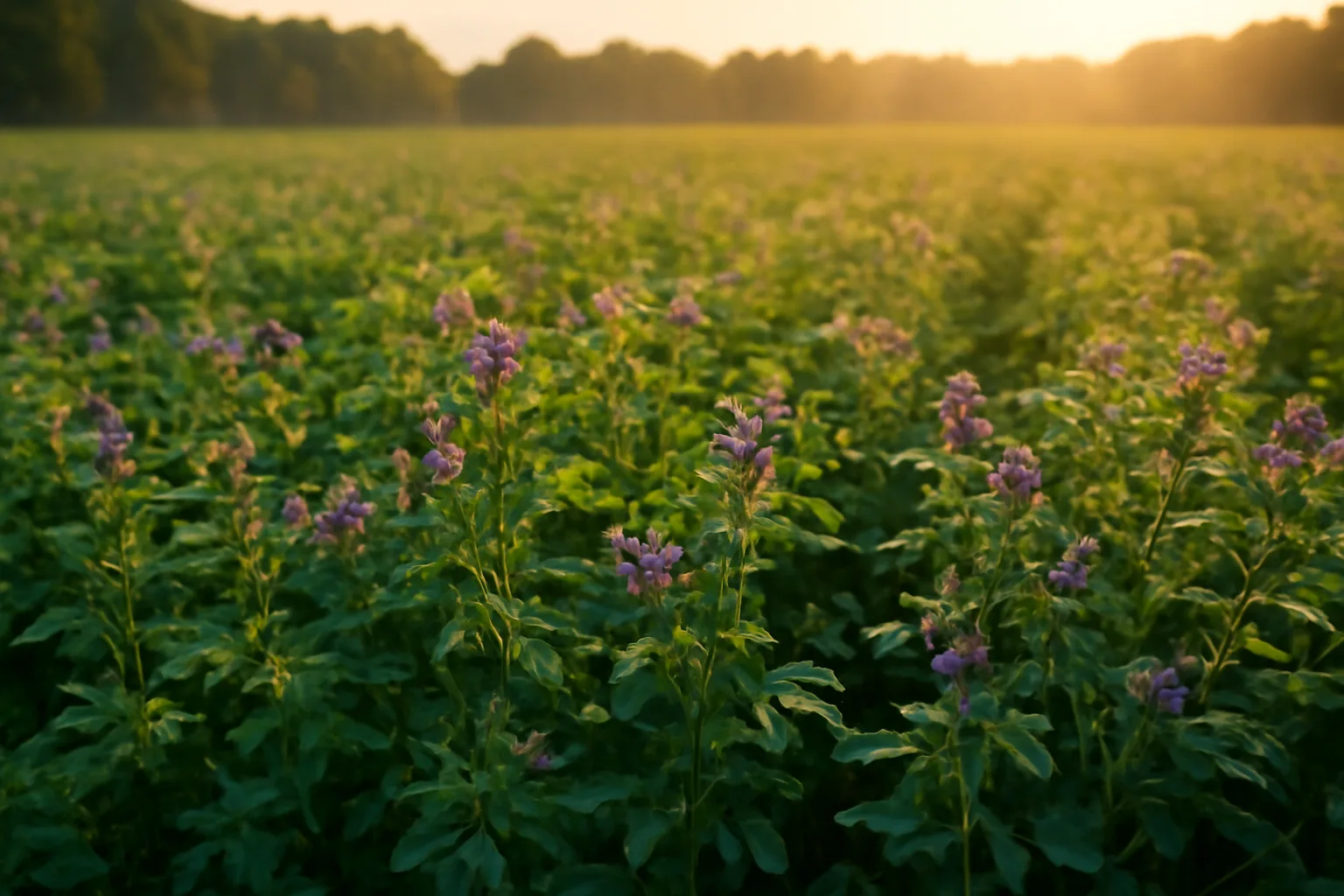
Alfalfa is a perennial legume that can produce deer forage for 3 to 5 years off a single planting, but it demands good drainage, pH near 6.8, and full sun. It's slower to establish and pickier about soil than clover, and it won't tolerate wet feet or heavy shade. Plant in early spring or late summer, test soil first, and expect real tonnage by year two.
What is a food plot, and where does alfalfa fit in?
A food plot is a planted area, usually somewhere between a quarter acre and several acres, managed specifically to feed deer and other wildlife rather than to produce a cash crop. Hunters plant them on owned or leased ground to improve nutrition, hold deer on the property, and create predictable feeding patterns near stand locations. Some plots are annual (planted fresh every year), some are perennial (they come back on their own for several seasons), and most serious plot programs run a mix of both. Alfalfa falls into the perennial camp, alongside clover and chicory. It's a legume. That means it fixes nitrogen out of the air with help from soil bacteria (Rhizobium meliloti, specifically), so it needs less nitrogen fertilizer than a grass like corn or a grain like oats. Once alfalfa is established, a stand can produce forage for three to five years or longer before you need to replant, per USDA plant guidance on the species [1]. Where alfalfa earns its place in a plot rotation is tonnage and protein. Extension forage data puts alfalfa crude protein in the 18 to 22 percent range depending on cutting and maturity, which rivals or beats most clover blends [2]. That protein matters most in late spring through summer, when does are lactating and bucks are growing antlers. If you're weighing alfalfa against other perennial options, it helps to look at the broader picture on food plot whitetail strategy before committing acreage. The tradeoff is that alfalfa is fussier than clover. It wants well-drained soil, a pH close to neutral, and it sulks in shade or standing water. If your ground is heavy clay that holds water in spring, or if you're working a shaded field edge, clover or chicory will probably outperform alfalfa with less babysitting.
When to plant food plots for deer, generally?
| Deep South | March to early April | September to early October | |
|---|---|---|---|
| Mid-South / Transition | April | Mid-August to mid-September | |
| Upper Midwest / Northeast | Late April to May | Early to mid-August | |
| Northern tier / Canada border states | May | Late July to mid-August | These are starting points, not gospel. Your county extension office or state land-grant university's ag calendar is the best free resource for pinning your local windows down. If you want a plan tailored to your zip code, soil test, and equipment, that's exactly what our $99 Custom Food Plot Plan is built for, but the general timing above will get most of the way there on its own. |
Timing depends on what you're planting and what region you're in, but the two big windows are spring (April through May in most of the whitetail range) and late summer (mid-August through early September). Spring plantings suit warm-season annuals and perennials like alfalfa and clover. Late summer plantings suit cool-season annuals like brassicas, cereal grains, and winter wheat that deer hit hard in fall and winter. For alfalfa specifically, USDA plant guidance and university forage programs recommend spring seeding once soil temperatures reach the mid-50s Fahrenheit, or a late-summer seeding six to eight weeks before your first killing frost so seedlings have time to establish a root system before winter dormancy [1]. Spring seeding is generally the safer bet for alfalfa because it gives the plant a full growing season to build reserves before facing its first winter, and it sidesteps the risk of a dry August that can kill a late-summer seeding before it roots in. A rough framework, adjusted for your local frost dates: | Region | Spring window | Late-summer window |
When should you plant alfalfa specifically?
Alfalfa is best seeded in spring once soil hits roughly 55 to 65°F, or in late summer at least 6 to 8 weeks before your area's average first frost date, based on USDA and university forage program guidance across the alfalfa belt [1]. Spring seeding is generally more forgiving for food plotters because it avoids drought stress during establishment. Seeding depth matters more with alfalfa than most food plot species because the seed is small. University forage guides call for a seeding depth of one quarter to one half inch, no deeper, into a firm, well-prepared seedbed [3]. Too deep and the seedling runs out of stored energy before it reaches sunlight. Too shallow and the seed dries out before it germinates. A cultipacker before and after seeding, if you have access to one, does more for alfalfa establishment than almost any other single step. Seeding rate for a straight alfalfa food plot typically runs 15 to 20 pounds of seed per acre broadcast, or 12 to 15 pounds per acre drilled, per university forage recommendations [3]. Drilling uses less seed because it places seed at a consistent depth instead of relying on broadcast-and-hope. If you're broadcasting, plan on the higher end of that range and don't skip the cultipacking step. Once established, alfalfa needs to be mowed or grazed down periodically, both to keep it in a vegetative, high-protein growth stage and to knock back weed competition. A mowing height of 3 to 4 inches, done when the stand reaches 12 to 16 inches, keeps regrowth tender and appealing rather than letting it go to stem and flower, which drops palatability fast.
Do deer like clover, and how does it compare to alfalfa?
Yes, deer readily eat clover, and it's arguably the most planted perennial food plot species in North America because it's cheaper, easier to establish, and more tolerant of imperfect soil and moisture conditions than alfalfa. White clover (Trifolium repens) and red clover (Trifolium pratense) both show up constantly in food plot mixes, and university extension trials consistently rank clover among the most preferred forages in browse surveys [4]. The practical difference between clover and alfalfa comes down to soil tolerance and management effort. Clover handles a wider pH range, tolerates wetter soils and partial shade better, and generally establishes faster and cheaper per acre. Alfalfa demands better drainage, a pH closer to 6.5 to 7.0, and more attention to weed and insect pressure (potato leafhopper and alfalfa weevil are real problems that clover mostly avoids). In exchange, alfalfa typically produces more total tonnage per acre and holds up better under heavy grazing pressure once established, which matters if you're running a lot of deer on a small acreage. A lot of experienced plotters run both: clover on the marginal, wetter, or shadier ground, and alfalfa on the best-drained, highest-pH field they've got. If you're deciding which perennial fits your ground, our guide to deer food plots breaks down site selection in more depth, and deer food plot seed covers blend options if you'd rather not run a monoculture.
Do deer eat sorghum, and does it belong near an alfalfa plot?
Yes, deer eat grain sorghum (milo), particularly the seed heads in fall and winter, and it also works as cover and a trap crop for other wildlife, but it's a different tool than alfalfa. Sorghum is a warm-season annual grass grown for its grain, not a perennial legume grown for its leaf protein. It's drought-tolerant and cheap, which makes it a decent choice on sandy or marginal ground that won't support alfalfa at all. Where sorghum makes sense alongside an alfalfa program is as a screening or bedding-adjacent planting, or as a fall/winter energy source once your alfalfa has gone dormant for the season. Alfalfa's growing season ends with the first hard frosts, and deer will still browse the crown and any late regrowth, but it's not a fall food source in the way brassicas or standing grain are. Some plotters plant a sorghum or milo strip on the edge of an alfalfa field specifically to give deer a source of carbohydrate and cover once the alfalfa goes dormant. Sorghum isn't a substitute for alfalfa's protein contribution, though. If your goal is spring and summer nutrition for lactating does and antler-growing bucks, sorghum doesn't do that job. Think of it as a separate plot with a separate purpose, not a rotation partner in the same field.
When to plant oats for deer, and how do they fit a plot rotation?
Oats are typically planted in late summer, roughly August through early September in most of the whitetail range, for fall and early winter grazing, based on standard cool-season annual planting windows used by extension forage programs [1]. Oats germinate fast, tolerate cooler soil than warm-season crops, and deer hit young oat shoots hard, especially in September and October when they're one of the few tender green options left in the woods. Oats are an annual, so they don't persist like alfalfa. Most plotters use them as a fast-establishing fall food source, often mixed with brassicas like turnips or radishes, or as a nurse crop planted alongside a new perennial seeding (a light rate of oats can help shade out weeds while a slow-establishing alfalfa or clover stand gets going, though heavy oat competition can also choke out young alfalfa if you overdo the rate). A spring oat planting is possible too, mainly as a quick cover crop or early-season grazing option, but it won't survive summer heat in most of the country, so fall is the dominant window for deer plot purposes.
When to plant turnips for deer, and how do brassicas complement alfalfa?
Turnips are planted in late summer, generally 60 to 90 days before your first expected frost, which lands most of the whitetail range somewhere between late July and early September. Turnips need that runway because they're grown partly for the bulb, and bulb development takes time plus a frost or two to convert starches to sugars, which is what makes them taste sweet and palatable to deer late in the season. Brassicas and alfalfa serve different windows in a full-season program. Alfalfa carries spring and summer nutrition. Turnips, along with other brassicas like radishes and rape, carry the late fall and winter window, often becoming most attractive to deer after the first hard frost converts starch to sugar in the leaves and bulb. Deer will often ignore a turnip plot in September and hammer the same field in December once a freeze has sweetened it up. A lot of food plot programs run alfalfa or clover as the perennial base on their best ground, then rotate a portion of annual acreage between brassicas, cereal grains, and sometimes soybeans or sorghum depending on soil and goals. That kind of rotation spreads out your nutrition calendar instead of leaving deer with nothing new to eat for half the year.
What are deer's favorite foods, and where does alfalfa rank?
Deer are opportunistic browsers, and their preferences shift by season, region, and what's available, so there's no single ranked list that holds everywhere. That said, browse studies and extension forage-preference research consistently put legumes (clover, alfalfa, soybeans), acorns, and agricultural crops like corn and soybeans near the top of the preference list, with legumes especially favored during spring and summer growth [4] [2]. Alfalfa specifically ranks high on most preference surveys because of its protein content and because deer can browse it repeatedly through the growing season without killing the plant, unlike a lot of natural browse. In agricultural regions where alfalfa hay fields sit next to woodlots, it's common knowledge among farmers that deer will hit a fresh-cut or regrowing alfalfa field harder than almost anything else nearby, which is part of why it's earned a reputation as one of the most attractive food plot legumes available. Acorns deserve a mention too. In fall, a good white oak acorn drop will pull deer off almost any planted food plot, alfalfa included, because acorns pack more fat and are essentially free. That's not a strike against alfalfa, it's just a reminder that plot attractiveness is relative to what else is on the landscape that week.
Do deer like honey, and does it matter for food plots?
There's no real evidence deer seek out honey in the wild or that it's a meaningful part of natural deer diet, and it has no legitimate place in a food plot program. Deer are herbivores built to digest plant fiber through a four-chambered rumen; honey is a concentrated sugar product from bees, not a forage crop, and it isn't something you'd plant, spray, or otherwise use to attract deer to a plot. Where this question usually comes from is confusion with commercial mineral or attractant products that sometimes include sweeteners, molasses, or sugar-based additives marketed as deer attractants. Those are a separate category from food plots entirely, and in a lot of states, using bait or heavily concentrated attractants to hunt over is regulated or banned outright. Michigan, for example, restricts baiting and feeding of deer, with a statewide baiting ban tied to chronic wasting disease management in the Lower Peninsula, per Michigan's Natural Resources and Environmental Protection Act provisions on deer baiting and feeding, MCL 324.40111a [5]. If you're curious about any attractant product, check your state wildlife agency's baiting and feeding regulations before you use it, because rules vary a lot state to state and even by management unit. For an actual food plot, skip the honey question entirely and focus on what deer are built to eat: legumes like alfalfa and clover, brassicas, cereal grains, and browse. That's where the real nutrition and the real attraction come from.
How do you prepare soil and fertility for an alfalfa plot?
Alfalfa is the least forgiving food plot species for soil pH and fertility, and skipping a soil test before planting alfalfa is one of the more expensive mistakes a plotter can make. USDA plant guidance and university extension recommendations consistently point to a target pH of 6.5 to 7.0 for alfalfa, because the Rhizobium bacteria that fix nitrogen in alfalfa's root nodules function poorly in acidic soil, and yields drop sharply below pH 6.0 [1] [1]. Your soil test results, from a university or state ag lab, are the real authority here, not a generic chart. Lime doesn't work overnight either. Depending on your existing pH and the lime rate needed, it can take several months to a full year for lime to fully react and move soil pH into range, which is why fall soil testing ahead of a spring planting (or a full season ahead of any planting) gives lime time to work before seed goes in the ground. Phosphorus and potassium matter more for alfalfa than nitrogen does, because a properly nodulated alfalfa stand fixes most of its own nitrogen. University fertility guides commonly recommend potassium applications based on soil test levels, since alfalfa is a heavy potassium feeder, especially in stands being cut or grazed repeatedly through a season [2]. Skipping potash on a hungry field is a common way alfalfa stands thin out by year two. Inoculation is the other piece people skip. Alfalfa seed should be inoculated with the correct Rhizobium meliloti strain before planting unless it comes pre-inoculated, especially on ground that hasn't grown alfalfa before. Without the right bacteria present in the soil, the plant can't fix nitrogen efficiently and will look pale and stunted even with decent soil test numbers otherwise.
What equipment do you need to plant and maintain alfalfa?
At minimum, you need a way to prepare a firm seedbed, a way to place small seed at a shallow, consistent depth, and a way to mow the stand a few times a season. A disk or field cultivator to break ground, a cultipacker or roller to firm the seedbed before and after seeding, and a broadcast spreader (ATV-mounted or hand-crank for small plots) covers the planting side for most food plotters who don't own a no-till drill. A no-till drill is the upgrade if you're planting more than a couple of acres regularly. It places seed at the correct quarter- to half-inch depth automatically, which improves germination consistency a lot over broadcasting, and it lets you seed into standing residue without a full tillage pass, saving a step and reducing erosion risk on sloped ground. For upkeep, a bush hog or rotary mower sized to your tractor, or a smaller flail mower for tighter food plot acreage, handles the periodic mowing alfalfa needs to stay in vegetative growth. Mowing 3 to 4 times a season, once the stand reaches 12 to 16 inches, is typical for a food-plot-purpose alfalfa stand (a hay farmer cutting for bales runs a tighter schedule, but you don't need hay-farm precision for deer forage). If you're building out a full plot program across multiple fields and species, it's worth reading up on equipment and methods more broadly before buying anything, since a lot of the gear crosses over between alfalfa, clover, and annual grain plots.
What are the most common alfalfa food plot mistakes?
The single biggest mistake is planting alfalfa on ground that can't support it. Wet, poorly drained soil kills alfalfa stands through root rot within a season or two, no matter how good your fertility program is. If a field holds standing water for more than a day or two after a normal rain, that's clover or brassica ground, not alfalfa ground. The second most common mistake is skipping the soil test and guessing on lime and fertilizer. Alfalfa's nitrogen-fixing bacteria need a pH close to neutral to function, and generic "food plot lime" rates without a test often under- or over-shoot what a specific field actually needs. Your soil test lab's recommendation is the authority here, not a bag label or a forum post. Third is seeding too deep. Because alfalfa seed is small, broadcasting it and then running a disk over it to "bury" the seed almost always plants it too deep to emerge well. A light cultipacking pass, not tillage, is what you want after broadcasting. Fourth is letting weeds win in year one. Alfalfa establishes slowly compared to annual grains, and a weedy first-year stand rarely recovers to become a productive perennial plot. Mowing at a height that tops weeds without scalping young alfalfa seedlings (generally not below 3 inches) through the first summer keeps competition down while the stand roots in.
Frequently asked questions
Do deer eat sorghum?
Yes, deer eat grain sorghum (milo), especially the seed heads in fall and winter, and they'll also browse young sorghum shoots. It's a warm-season annual grain crop, not a perennial legume, so it works best as a drought-tolerant fall/winter energy source or cover planting rather than a spring-summer protein source like alfalfa or clover.
Do deer eat clover?
Yes, clover is one of the most consistently preferred food plot forages for deer, according to university extension browse research, and white and red clover are both widely planted across the whitetail range. It's cheaper and more tolerant of imperfect soil and moisture than alfalfa, though it typically produces less total tonnage per acre once established.
When should you plant deer food plots?
Most food plot species fall into two windows: spring (April to May in much of the whitetail range) for warm-season annuals and perennials like alfalfa and clover, and late summer (mid-August to early September) for cool-season annuals like brassicas, oats, and cereal grains. Exact dates shift by region, so check your local frost dates and extension calendar.
Do deer like clover more than alfalfa?
There's no definitive ranking; both are legumes deer readily eat, and preference often comes down to what's available and how tender the growth is. Alfalfa tends to run slightly higher in crude protein (18-22 percent) and produces more tonnage, while clover establishes easier and tolerates a wider range of soil and moisture conditions.
When should you plant oats for deer?
Oats are typically planted in late summer, roughly August through early September in most whitetail range, for fall and early winter grazing. They germinate fast and tolerate cool soil, making them a common companion planting with brassicas or a nurse crop for slower-establishing perennials like alfalfa or clover.
When should you plant turnips for deer?
Plant turnips 60 to 90 days before your area's first expected frost, generally late July through early September depending on region. Turnips need that time to develop bulbs, and they become most attractive to deer after a frost converts starches to sugars in the leaves and bulb, often making a December plot more popular than the same field in September.
What is a food plot?
A food plot is a planted area, usually a quarter acre to several acres, managed specifically to feed deer and other wildlife rather than for cash-crop harvest. Plots can be annual (replanted each year) or perennial (persisting several seasons), and a well-designed program usually mixes both to cover spring, summer, fall, and winter nutrition needs.
What are deer's favorite foods?
There's no single universal list since preference shifts by season and region, but browse studies and extension forage research consistently rank legumes (clover, alfalfa, soybeans), acorns, and standing agricultural crops like corn near the top, especially legumes during spring and summer growth. Acorns often pull deer off any planted food source when they're dropping heavily in fall.
Do deer like honey?
There's no evidence honey is part of natural deer diet or that deer seek it out; it's not a forage crop and has no real place in food plot planning. This question usually stems from confusion with sugar or molasses-based commercial attractant products, which are a separate category from planted food plots and are regulated or banned in some states as bait.
How long does an alfalfa food plot last before you need to replant?
A well-established alfalfa stand can produce forage for three to five years or longer before it thins out enough to need replanting, according to USDA and university forage program guidance. Stand life depends heavily on soil drainage, fertility maintenance, and how hard it's grazed or mowed each season.
What soil pH does alfalfa need for a deer food plot?
Alfalfa needs a soil pH of roughly 6.5 to 7.0 for its nitrogen-fixing root bacteria to function well, per USDA and university extension forage guidance. Yields and stand persistence drop sharply below pH 6.0, so a soil test and lime application ahead of planting matters more for alfalfa than almost any other food plot species.
Can you plant alfalfa and clover together in the same food plot?
Yes, alfalfa-clover blends are common and can work well, combining alfalfa's tonnage and drought tolerance with clover's ability to fill in thin spots and tolerate wetter microsites within the same field. Just make sure the field overall meets alfalfa's pH and drainage needs, since clover will survive there but alfalfa won't tolerate the reverse.
Sources
- USDA NRCS Plant Guide, Alfalfa (Medicago sativa L.): Alfalfa establishment requirements including pH, potassium needs, and stand longevity of 3-5+ years
- University of Wisconsin-Madison Extension, Nutritive Value of Alfalfa and Alfalfa-Grass Mixtures (A3600): Alfalfa crude protein range of 18-22 percent depending on cutting and maturity, and potassium fertility needs
- Oklahoma State University Extension, Alfalfa Stand Establishment (PSS-2098): Alfalfa seeding rate of 15-20 lb/acre broadcast or 12-15 lb/acre drilled at 1/4 to 1/2 inch depth
- Mississippi State University Extension, Establishing Wildlife Food Plots (Publication 2111): Clover and legumes rank among the most preferred food plot forages in browse preference surveys
- Michigan Legislature, Natural Resources and Environmental Protection Act, Baiting and Feeding of Deer, MCL 324.40111a: Baiting and feeding regulations for deer vary by state and are regulated in Michigan