Last updated 2026-07-25
TL;DR
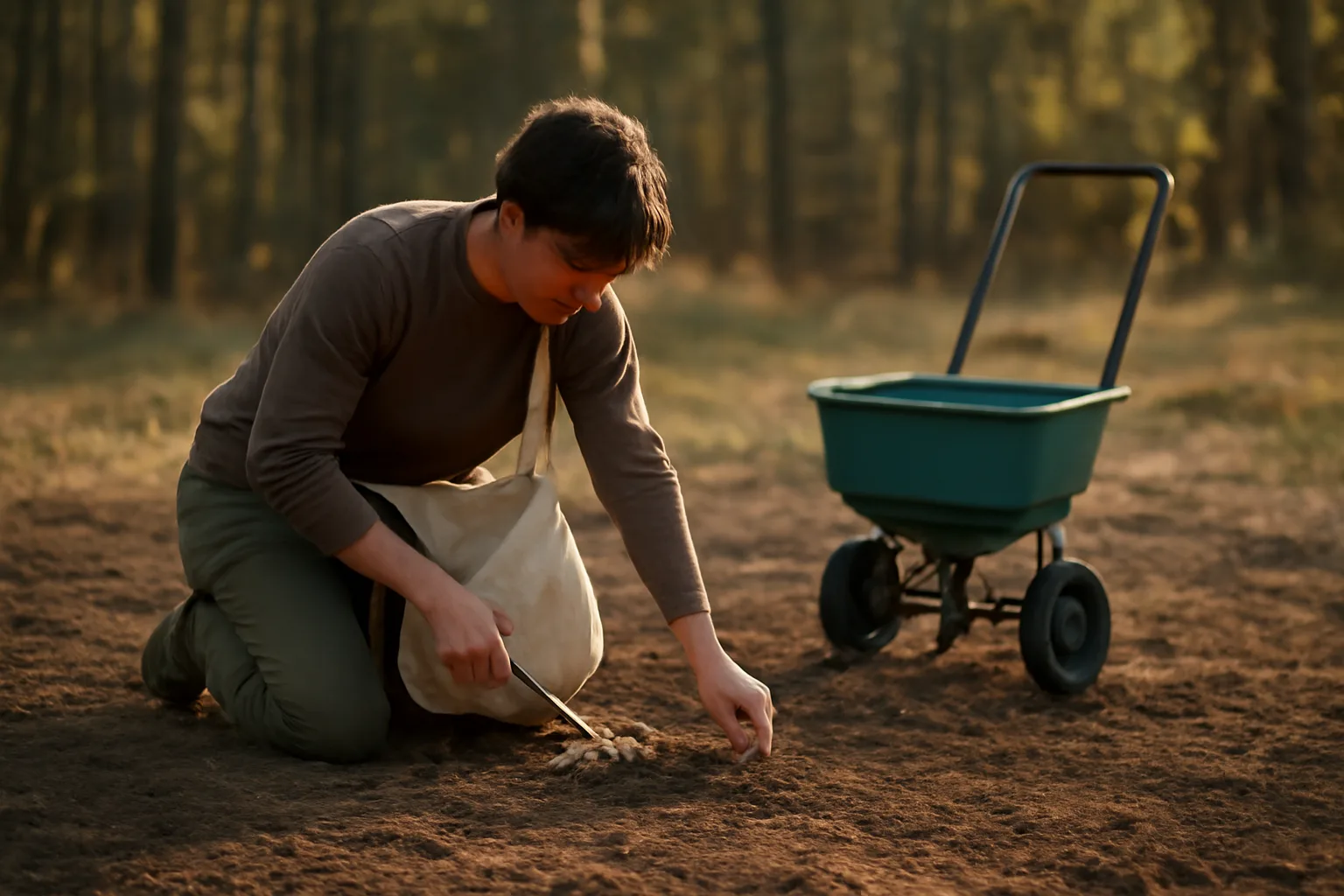
You can plant a solid deer food plot with hand tools alone: a rake, a hand spreader, a backpack sprayer, and a soil test. Kill existing growth, break the top inch of soil, broadcast seed at the right depth and rate, and pack it in. Clover, oats, and brassicas all work fine with zero heavy equipment.
Can you actually plant a food plot without a tractor or ATV?
Yes. Hunters have been doing it for decades on small hidden plots that a tractor can't reach anyway. A quarter-acre or half-acre kill plot tucked into timber is often easier to plant by hand than to drag equipment into. The real requirements are a way to kill or suppress existing vegetation, a way to get seed-to-soil contact, and a way to spread seed evenly. None of that requires a drill or a disc. A hand-held rotary spreader (the kind used for yard fertilizer, roughly $20 to $40), a rake, and a backpack sprayer cover most of it. What you give up without equipment is scale. Hand planting a half-acre takes maybe an hour of labor once the ground is prepped. Hand planting three acres is a different weekend. Most hunters without machinery keep plots small (a quarter acre to one acre) and put them in spots where secrecy matters more than square footage, which is often exactly where a mature buck wants to feed anyway. If you want a plan sized to your actual ground and soil test before you buy seed, PlotSeason's $99 Custom Food Plot Plan will spec species and rates for your specific site instead of a generic bag rate.
What is a food plot, exactly?
A food plot is a planted area, usually a fraction of an acre to a few acres, established specifically to grow forage that attracts and feeds deer or other wildlife. It's different from a farm field in purpose: the goal is attraction, nutrition, and huntability, not yield per bushel. State wildlife agencies generally treat food plots as a normal habitat and land management practice, separate from baiting. The distinction matters because baiting rules (piling corn, minerals, or feed) are regulated differently from planted, rooted vegetation in most states. Check your state wildlife agency's baiting and feeding regulation page before you plant near a stand, because rules vary and some states restrict supplemental feeding or baiting even though a planted crop is legal. A plot can be as simple as a 20-foot by 20-foot clover patch in a logging opening. Or it can run a few acres of soybeans. Cover crops, brassicas, cereal grains, legumes, and perennial clover blends are the most common species groups used across the whitetail range.
When to plant food plots for deer
Timing splits into two windows: spring/summer plantings for warm-season annuals and perennials, and late summer/fall plantings for cool-season annuals. Which window you use depends on the species and your USDA hardiness zone. Spring plots (soybeans, corn, clover establishment, chicory) generally go in after your last frost date, typically April through June depending on latitude. Fall plots (brassicas, cereal grains, winter peas) are timed backward from your first frost, because most of these species are planted 6 to 10 weeks before that date so they can establish before cold shuts down growth. USDA hardiness zone maps and land-grant extension offices publish frost date guidance by region, and that's a more reliable source for your specific ground than a bag label written for the whole country. As a rough national range: northern zones (Minnesota, Wisconsin, northern Michigan) plant fall brassicas in late July through early August, while southern zones (Alabama, Georgia, the Gulf Coast) can wait until September or even October. The single biggest planting mistake without equipment is planting fall brassicas too late because the ground finally 'felt right' for hand work. Brassicas need that 60 to 90 day runway. Don't wait for cool weather to plant them; plant while it's still hot so they have time to bulb and leaf out before frost sweetens them up.
When to plant oats for deer
Oats are a fall-planted cereal grain in most whitetail country, going in the ground roughly 45 to 60 days before your average first frost date. That usually lands in late August through mid-September across most of the Midwest and Northeast, and can push into October in the Deep South. Oats germinate fast, often visible in 5 to 7 days with decent moisture, and deer will hit them hard as soon as they emerge. That makes oats a good no-equipment choice because you don't need a drill to get germination. Broadcast the seed on a raked or disturbed seedbed and press it in with a lawn roller, ATV tire, or even foot traffic if the plot is small. Oats also winterkill in the coldest zones (typically below 0 to 10 degrees F for sustained periods), so northern hunters often pair oats with a hardier cereal like winter rye or wheat if they want green forage into late winter. In the South, oats can persist and even head out in spring if temperatures stay mild.
When to plant turnips for deer
Turnips are planted in late summer, generally 60 to 90 days before your first expected frost, which puts most of the country in a late July to early September window. They're a brassica, so they follow the same clock as other fall brassica blends. Turnips need that long runway because deer usually ignore the bulbs and leaves until after a hard frost converts starches to sugars, which is typically 4 to 6 weeks after the first freeze. Plant too late and you get small bulbs and thin leaf mass right when deer finally start eating them. Seeding rate for turnips alone runs about 4 to 6 pounds per acre broadcast, and they want a shallow planting depth, a quarter inch or less. That shallow depth is actually a point in favor of hand planting: you can broadcast turnip seed and lightly drag a rake or chain over it. No drill required, because the seed is too small to need deep coverage anyway.
Do deer eat clover, and do deer actually like it?
Yes. Clover is one of the most consistently preferred food plot forages across the whitetail range, and it's also one of the easiest species to establish and maintain without heavy equipment. Both white clover (Ladino types) and red clover show up repeatedly in university forage trials as high-preference, high-protein deer forage. Vegetative-stage clover commonly tests in the mid-20s to low-30s percent crude protein range in forage quality analyses, well above most grasses and many other plot species [1]. Clover is a perennial, which means one good planting can produce forage for several years with proper mowing and fertility upkeep, based on university forage management guidance for grazed and wildlife clover stands. That makes it a strong pick for hand planting because you're not redoing the whole plot every season, just maintaining it. Plant clover in early spring (as soon as soil is workable) or late summer, depending on your region, at roughly 6 to 8 pounds per acre for Ladino white clover broadcast rates. Clover seed is tiny and needs firm, shallow seed-to-soil contact, planting depth of one quarter inch or less. That again favors hand methods: broadcast, then cultipack or drag, then walk it in if you have to.
Do deer eat sorghum?
Yes, deer will eat grain sorghum (milo) and browse the leaves, but it's not typically a top-tier preference forage compared to soybeans, clover, or brassicas. Sorghum shows up more often as a cover crop, a screening or security crop, or a component of wildlife blends meant to provide standing winter grain and bedding structure rather than a primary attraction species. Where sorghum earns its keep is drought tolerance and biomass. It handles poor soil and dry summers better than corn or soybeans, and standing sorghum through winter gives deer both a grain source and cover in the same footprint, which many food plot managers value for late-season bow hunting. For a no-equipment plot, sorghum is plantable by hand broadcast, but germination and stand quality improve a lot with actual seed-to-soil contact at about half an inch to one inch depth. A raked-in planting works better than a scattered one left on bare, uncovered ground.
What do deer like to eat most, and do they like honey?
Deer preference research and field observation consistently rank a handful of species at the top: soybeans and other legumes, clover, chicory, and quality brassica blends after a frost. Acorns, especially white oak acorns, are often preferred over almost any planted forage when they're dropping. Deer are also opportunistic browsers on natural forbs and woody browse for most of the year, meaning your food plot competes with, and supplements, a much larger natural diet. As for honey: there's no wildlife agency or extension research supporting honey as a deer attractant or food source, and it's not part of any standard food plot forage discussion. Deer are herbivores built around a rumen system for digesting plant fiber, not a species that seeks out honey in the wild. If you've seen a hunting product marketed around honey or molasses scent, that's a scent or mineral attractant claim, not a food plot species question. It has nothing to do with the sorghum, clover, oats, or brassica planting decisions covered here. If you're picking species for a first plot with no equipment, clover and brassicas are the two easiest wins: clover for season-long draw and perennial return, brassicas for a big fall pulse of tonnage deer will hammer after frost.
How do you kill existing vegetation without a sprayer rig or tiller?
A backpack sprayer (2 to 4 gallon, roughly $30 to $60) and a glyphosate herbicide labeled for your use are the standard no-equipment method. Spray existing grass and weeds 10 to 14 days before you plan to plant, let it die back completely, then work the dead residue into the top inch or two of soil with a hard rake or a hand cultivator. On very small plots (under a quarter acre), some hunters skip herbicide entirely and just till or rake repeatedly over 2 to 3 weeks to physically exhaust weed regrowth. This takes more labor, though, and it controls perennial weeds and grasses less completely than a glyphosate kill. Always read and follow the herbicide label rate and any grazing or replanting interval listed on it. A land-grant extension weed control guide for wildlife plots is a good second check on timing and rate, since bag instructions are sometimes generic.
What hand tools actually get seed in the ground correctly?
| Backpack sprayer | Kill existing vegetation before planting | $30 to $60 | |
|---|---|---|---|
| Hard rake or garden rake | Break up dead residue, work soil, cover seed | $15 to $30 | |
| Hand-crank broadcast spreader | Even seed distribution over the plot | $20 to $40 | |
| Lawn roller or ATV tire drag | Firm the seedbed for seed-to-soil contact | $40 to $80 (or improvised with a drag mat) | |
| Soil test kit / mail-in test | Determine lime and fertilizer need | $10 to $20 through your state land-grant extension lab | A soil test is the one item on this list that isn't optional if you want the plot to actually produce. Most state extension soil labs run a standard test for $10 to $20 and return lime and fertilizer recommendations in pounds per acre for your target crop [2]. Follow your lab's recommendation over any generic bag rate; your soil test is the authority on your specific dirt, not a national average printed on seed packaging. For packing the seedbed, an ATV tire (drive over the plot slowly in a grid pattern) or a homemade drag made from a section of chain-link fence or a pallet weighted with cinder blocks works fine if you don't own a roller. The goal is just firm contact, not perfection. |
Here's the realistic no-equipment tool kit and what each one does. | Tool | Job | Rough cost |
How do you get the seeding rate and depth right by hand?
Broadcasting seed evenly by hand takes practice, but the fix is simple: split your total seed in half, walk the plot once north to south spreading half the seed, then walk it again east to west spreading the second half. That cross-pattern catches the gaps a single pass always leaves. Depth control without a drill comes down to matching your covering method to seed size. Tiny seeds (clover, chicory, most brassicas) want a quarter inch of soil or less; a light rake pass or a drag is enough, and some broadcast plantings of tiny seed do fine with no covering at all if rain follows within a day or two. Larger seeds (oats, wheat, soybeans, sorghum) want a half inch to one and a half inches, so rake them in more aggressively or lightly till them under before you firm the surface. Overseeding rate slightly, planting toward the high end of the labeled rate, is a common hand-planting adjustment. Broadcast coverage is never as uniform as drilled rows, and thin spots are more likely.
What's the easiest realistic no-equipment plot plan for a beginner?
If you're starting from bare or weedy ground with nothing but hand tools, this sequence works reliably across most of the whitetail range. Step one: soil test 4 to 6 weeks ahead, through your state extension lab, and follow their lime and fertilizer recommendation [2]. Step two: spray existing vegetation with glyphosate 10 to 14 days before your planting date. Step three: rake dead residue into the top inch of soil, working in any lime or starter fertilizer your soil test called for. Step four: broadcast seed in a cross pattern at the labeled rate (clover at 6 to 8 pounds per acre, oats at roughly 80 to 100 pounds per acre broadcast, brassica blends per label, usually 4 to 6 pounds per acre). Step five: drag or roll the plot to firm seed-to-soil contact, then let rain do the rest. A quarter-acre to half-acre plot done this way, with basic hand tools, generally takes a single weekend from spray to seed, spread across the two visits ten days apart. For help matching species, rates, and timing to your specific soil test and zone instead of guessing off a bag label, PlotSeason's Custom Food Plot Plan is a $99 one-time report built around your actual dirt. From there, related reading on food plot seed selection and deer food plot seed blends can help you decide what to put in that raked, packed seedbed.
Frequently asked questions
Do deer eat sorghum?
Yes, deer browse sorghum leaves and eat the grain, but it's usually planted as a cover crop or winter standing grain rather than a top preference forage. Soybeans, clover, and brassicas typically outrank sorghum in deer preference studies and field observation.
Do deer eat clover?
Yes, clover is one of the most consistently preferred food plot species for whitetails. University forage testing commonly measures clover crude protein in the mid-20s to low-30s percent range during vegetative growth, which is a major reason it's a top pick for hand-planted plots.
When to plant deer food plots?
It depends on species. Warm-season plants (soybeans, corn, clover establishment) go in after your last spring frost. Cool-season fall plants (brassicas, oats, cereal grains) go in 6 to 10 weeks before your first fall frost. Check your county extension office for exact local frost dates.
Do deer like clover?
Yes, clover ranks among the top preferred forages in wildlife food plot research, alongside soybeans and chicory. It's also a perennial, so a well-maintained clover plot can keep producing for several years without replanting.
When to plant oats for deer?
Plant oats roughly 45 to 60 days before your area's average first frost, generally late August through mid-September in the Midwest and Northeast, later into September or October in the Deep South. Oats germinate quickly, often within 5 to 7 days given moisture.
When to plant food plots for deer?
Fall annuals (oats, brassicas, cereal grains) are planted in late summer, 6 to 10 weeks before first frost. Spring and summer plantings (clover establishment, soybeans, corn) go in after your last frost date, typically April through June depending on latitude.
When to plant turnips for deer?
Plant turnips 60 to 90 days before your area's first expected frost, generally late July through early September across most of the country. That long runway lets bulbs and leaf mass build before a hard frost sweetens the plant and triggers heavy deer feeding.
What is a food plot?
A food plot is a small planted area, from a fraction of an acre up to several acres, established specifically to attract and feed deer or other wildlife. It differs from farming in purpose: the goal is attraction and nutrition for hunting, not maximum crop yield.
What are deer's favorite foods?
Preference research and field observation consistently point to soybeans, clover, chicory, and quality fall brassicas after frost as top choices, with acorns (especially white oak) often outranking any planted forage when they're actively dropping.
Do deer like honey?
No credible wildlife research or extension source lists honey as a deer food or attractant. Deer are herbivores adapted to digest plant fiber through a rumen system, and honey isn't part of any standard food plot species or forage discussion.
Can you plant a food plot with just a rake and a hand spreader?
Yes, for plots up to about a half acre this is a completely standard method. Kill vegetation with a backpack sprayer, rake in the dead residue, broadcast seed in a cross pattern with a hand spreader, then firm the seedbed with a roller, ATV tire, or foot traffic.
Is baiting deer with a food plot legal?
A properly planted, rooted food plot is generally treated as legal habitat management, separate from baiting rules that cover piled feed like corn or minerals. Regulations vary by state, so check your state wildlife agency's baiting and feeding page before hunting over any plot or feed source.
How much does it cost to plant a food plot without equipment?
A basic hand-tool kit (backpack sprayer, rake, hand spreader, and something to firm the seedbed) runs roughly $100 to $200 total, most of it reusable for years. Seed and herbicide costs are on top of that and scale with plot size and species chosen.
What size food plot can realistically be planted by hand?
Most hunters planting entirely by hand keep plots between a quarter acre and one acre, since broadcasting and raking larger areas becomes a multi-day labor project. Small hidden plots in timber openings are often easier to plant by hand than to reach with a tractor anyway.
Sources
- Michigan Department of Natural Resources, deer baiting and feeding law summary (Baiting and Feeding of Deer, Act 451 of 1994, Part 435): Baiting and feeding regulations for deer are set and enforced by state wildlife agencies and vary by state
- Oklahoma State University Extension, 'Oat Production Guide' (PSS-2142): Oats are a fall-seeded cereal grain planted several weeks before first frost and germinate quickly with adequate moisture
- University of Kentucky Cooperative Extension, 'Red Clover' publication (AGR-197): White and red clover test at high crude protein percentages during vegetative growth stages, making them strong wildlife forage
- Pennsylvania Game Commission, deer management program overview: Acorns, especially white oak, are frequently preferred by deer over planted forages when actively dropping
- NC State Extension, 'Soil Testing' service overview, NC Department of Agriculture Agronomic Division: State land-grant extension soil labs provide lime and fertilizer recommendations based on a submitted soil sample, typically for a low fee