Last updated 2026-07-25
TL;DR
Planting a food plot means testing soil, clearing and prepping ground, liming/fertilizing per that test, then drilling or broadcasting seed at the right depth and calendar window for your zone (spring for warm-season forages, late summer for brassicas and cereal grains). Success hinges more on soil pH and timing than on seed brand.
what is a food plot?
A food plot is a planted patch of forage on hunting land, usually somewhere between a quarter acre and a few acres, grown specifically to feed and attract deer or other wildlife. It's not a lawn and it's not a farm field, though it borrows techniques from both. Most plots run clover, brassicas (turnips, radishes, rape), cereal grains (oats, wheat, rye), or a soybean/corn mix, planted in openings, old logging decks, or strips cut into timber. The point of a plot is twofold: nutrition and hunting access. A good clover plot feeds deer through spring green-up and summer antler growth. A brassica plot timed right can pull deer in hard during the late season when natural browse is thin and a hard frost sweetens the leaves. Cooperative extension programs treat food plots as a wildlife habitat management tool, not a guarantee of more deer or bigger antlers. The USDA's National Agroforestry Center and state extension services both frame plots as one piece of a broader habitat plan that includes cover, water, and adjacent ag land [1]. Before you plant anything, know your state's baiting and supplemental feeding rules. A food plot is legal to hunt over in nearly every state, but the line between a plot and a bait pile (a dumped pile of corn or minerals) is regulated differently state to state, and some states restrict feeding entirely during parts of the year for chronic wasting disease reasons. Check your state wildlife agency's regulations before you plant near a stand you plan to hunt this fall.
when to plant food plots for deer?
Timing splits into two windows: spring/early summer for warm-season plots (clover, soybeans, corn, chicory) and late summer to early fall for cool-season plots (brassicas, cereal grains, most clover interseeding). The exact dates depend on your first and last frost, which varies by hundreds of miles across whitetail range. As a rough framework, USDA plant hardiness zone data can help you translate general planting advice into your local frost dates. In zone 3-4 country (northern Minnesota, Wisconsin, Maine), spring plots go in mid-May to early June and fall plots need to be in the ground by mid-August. In zone 6-7 (Kentucky, Virginia, southern Missouri), spring planting can start in April and fall plots have until mid-September. In zone 8-9 (Deep South), you have more flexibility but summer heat and drought stress become the bigger risk factor than frost. The single most common mistake is planting fall brassicas too early or too late. Plant too early and deer browse them into the ground before the frost-driven sugar conversion that makes them attractive in December. Plant too late and they never bulb out before frost. Most extension guides recommend counting backward from your average first hard frost: 80-90 days for turnips, 60-90 days for most brassica blends [2].
when to plant turnips for deer?
Plant deer turnips 80 to 90 days before your area's average first hard frost, which for most whitetail range lands the planting window between late July and early September. Turnips need that long runway to bulb out and the leaves need a frost or two to convert starches to sugars, which is what makes them palatable late in the season. If you're in zone 5-6 (much of the Midwest and mid-South), late July through mid-August is the sweet spot. Further north, aim for late July. Further south, you can push into early September. Land-grant extension programs note that brassicas planted after that window often fail to bulb properly before growth stops [2]. Seeding rate for turnips alone runs about 4-5 lbs per acre if broadcast, less if drilled since drilling gives better seed-to-soil contact. Turnips are almost always sold in blends with radish and rape rather than planted solo, because a monoculture brassica plot can get hammered to bare dirt by mid-October in high deer density areas, leaving nothing for the late season.
when to plant oats for deer?
Oats go in the ground in early fall for most of whitetail country, typically 4-6 weeks before your first frost, which usually lands from late August through mid-September depending on latitude. Oats germinate fast (5-10 days in warm soil) and deer often hit them within two to three weeks of emergence, which makes oats one of the fastest plots you can put up for early bow season attraction. Oats can also go in as a spring plot in northern climates, planted as soon as the ground can be worked, but they're mainly a fall play for hunters because oats are frost-tolerant down to about 20°F before top growth dies, according to agronomy guidance from university extension row-crop programs [3]. That cold tolerance is actually less than wheat or rye, so in harsh winters oats will die back sooner, which is fine if your goal is fall and early winter attraction rather than a plot that lasts to spring. A typical drilled rate is 2-3 bushels (roughly 64-96 lbs) per acre; broadcast rates run higher, up to 110 lbs per acre, to compensate for poor seed-to-soil contact. Oats are cheap, forgiving of mediocre seedbeds, and a good choice for a first-time plotter who wants a fast, visible win.
do deer like clover, and do deer eat sorghum?
Yes, deer like clover, and it's one of the most consistently used food plot forages across whitetail range. White clover (ladino types) and red clover both show up repeatedly in state wildlife agency plot guides as reliable, high-protein forage that regrows after grazing, unlike a lot of annuals that get grazed out. Clover crude protein content commonly runs 25-30% in vegetative growth stages, which is well above most native browse [4]. Clover's real advantage is that it's a perennial (typically lasting 3-5 years per stand with good management), so once established it keeps producing through spring, summer, and fall without replanting every year. It does need mowing 2-3 times a season to keep it from getting stemmy and to knock back weed competition, and it wants a soil pH close to 6.0-6.5, which almost never happens without lime. Sorghum is a different story. Deer will eat grain sorghum and its cousins in a pinch, and sorghum shows up in some Southern food plot mixes and in wildlife seed blends aimed more at dove and quail. But it's not a preferred deer forage compared to soybeans, clover, or brassicas, and it's more commonly grown as a grain crop for upland birds and turkey than as a whitetail attractant. If you're planting specifically for deer, sorghum isn't a top pick; there are better uses of the acre.
what are deer's favorite foods, and do deer like honey?
Deer preference studies and state agency browse surveys consistently rank a handful of foods at the top: acorns (especially white oak family acorns, which are lower in tannins and more palatable than red oak acorns), soybeans, clover, and agricultural crops like corn and alfalfa when available. Preference shifts by season, region, and what's locally abundant, so there's no single universal answer, but acorns repeatedly come up as a preferred fall food across multiple state deer management publications because of their fat and carbohydrate content [5]. As for honey, no, deer are not attracted to honey in any meaningful way documented in wildlife literature. Honey shows up occasionally in hunting forums and some commercial attractant marketing, but there's no research base showing deer seek it out the way they do salt, minerals, or high-sugar browse. If you see a product claiming deer love honey, treat that as a marketing claim, not a documented feeding behavior. Deer are drawn to sugar and carbohydrates in general (which is part of why frosted brassicas and standing corn pull deer hard), but that's a different thing than an attraction to honey specifically.
how do you pick a food plot location before you plant anything?
Start with sunlight and access, not seed catalogs. Most food plot forages need at least 4-6 hours of direct sun; clover and brassicas tolerate a bit of shade but yields drop fast in full canopy. Look for old logging decks, utility right-of-ways, agricultural field edges, or natural openings first before you consider clearing timber. Think about wind and entry/exit routes at the same time you're picking the spot. A food plot in the perfect soil is worthless if you can't get to your stand without blowing your scent across it. Kill plots (small, quarter-acre plots tucked near bedding, meant to be hunted rather than just to feed deer) and larger destination plots (bigger, further from bedding, meant to hold deer and grow them through the off-season) serve different jobs on the same property, and most serious plotters run both. Soil drainage matters more than people think. A low spot that holds water in spring will drown out clover and beans before they establish. Walk the ground after a hard rain if you can, before you commit to clearing it.
how do you prep the ground for planting?
Ground prep is where most food plots succeed or fail, and it happens well before seed touches dirt. The steps, roughly in order: clear existing vegetation, test the soil, apply lime and fertilizer according to that test, work the seedbed, then plant. For small plots (under an acre), a combination of mowing, spraying with a glyphosate-based herbicide to kill existing sod, and light disking or tilling works. For food plots carved out of woods, you may need to deal with stumps and roots first, which is where a lot of new plotters underestimate the labor and equipment involved. A soil test, run through your state land-grant university's extension soil lab, tells you exact lime and fertilizer needs; guessing on lime is one of the most expensive mistakes in food plotting because a low pH can cut nutrient availability so much that fertilizer money is largely wasted. Most extension soil test reports recommend lime in tons per acre, and it can take several months to fully react in the soil, which is why fall soil sampling for a spring plot (or spring sampling for a fall plot) works better than testing right before you plant. If your test comes back needing 2 tons of lime per acre and you only put down half a ton, don't expect full results; agricultural lime works slowly and cumulatively, not as a one-time fix. Your soil test lab is the real authority here, more than any generic online chart, because pH and nutrient levels vary field to field.
what equipment do you need to plant a food plot?
| Hand tools + ATV spreader | under 1/2 acre | $200-600 | Good for kill plots, tight access spots | |
|---|---|---|---|---|
| ATV/UTV + disk + spreader | 1/2 to 3 acres | $2,000-6,000 used | Most common setup for lease hunters | |
| Compact tractor + implements | 2-10+ acres | $10,000-25,000+ | Needed for larger destination plots, food plot roads | |
| No-till drill (shared/rented) | any size | $30-60/acre rental | Best seed-to-soil contact, works through residue | A no-till drill is the single biggest upgrade for germination rates because it puts seed at a controlled depth instead of leaving it on the surface where birds, drought, or poor contact kill a chunk of it. Many co-ops and conservation districts rent drills by the day, which is a smarter first move than buying one before you know your acreage plans. If you want a plan tailored to your specific acreage, soil test results, and region before you buy anything, PlotSeason's Custom Food Plot Plan is a $99 one-time report that maps species, seeding rates, and a planting calendar to your property instead of a generic national chart. |
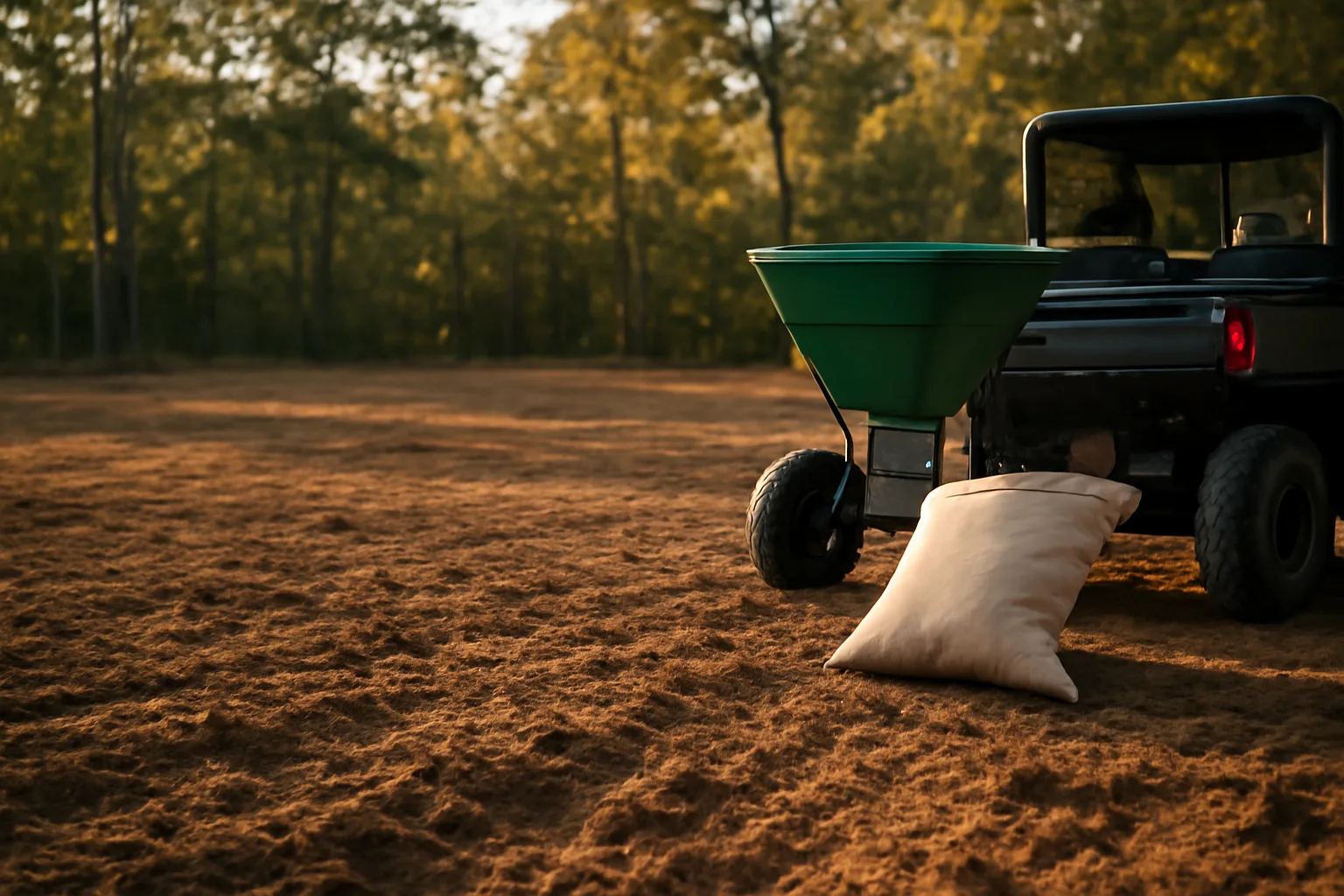
The honest answer is you need less than the catalogs suggest. A soil test kit or extension test box, a way to spray herbicide (backpack sprayer for small plots, boom sprayer on an ATV or tractor for bigger ones), something to work the seedbed (disk, tiller, or a no-till drill), a way to spread seed (hand-crank spreader for small plots, broadcast spreader or drill for larger ones), and a way to cover seed (drag harrow, chain-link section, or cultipacker) covers 90% of situations. Here's a rough comparison of common setups: | Setup | Best plot size | Approx. equipment cost | Notes |
how deep and how much seed do you actually plant?
| White clover | 6-8 | 4-6 | 1/4 inch or less | |
|---|---|---|---|---|
| Brassica blend (turnip/radish/rape) | 5-8 | 3-5 | 1/4-1/2 inch | |
| Oats | 100-110 | 64-96 | 1-1.5 inches | |
| Winter wheat | 120-150 | 90-120 | 1-1.5 inches | |
| Soybeans (forage type) | n/a, drill preferred | 50-60 | 1.5-2 inches | These are general starting points pulled from common extension and seed-industry recommendations; always check the tag on the specific bag you bought, since blends and cultivars vary rate by a fair amount [2] [3]. |
Seeding depth is one of the most-ignored details in food plotting, and it's usually the difference between a thick stand and a thin, weedy one. Small seeds like clover and brassicas want to be barely covered, about 1/4 inch, sometimes just pressed into the soil with a cultipacker and not covered at all. Cereal grains like oats, wheat, and rye want 1-1.5 inches. Soybeans and corn want 1.5-2 inches. Broadcasting works fine for small seed on a worked seedbed, especially clover and brassica blends, as long as you drag or cultipack afterward to firm the seed into contact with soil. Drilling gives more consistent depth and better stands, especially for cereal grains and beans, and it lets you plant into standing residue with less prep work (a true no-till approach), which saves a disking pass and reduces erosion. Here's a quick seeding rate reference for common food plot species: | Species | Broadcast rate (lbs/acre) | Drilled rate (lbs/acre) | Planting depth |
what do you do after the seed is in the ground?
Planting day is maybe 20% of the work. After that, you're managing weeds, watching moisture, and mowing. Clover needs mowing 2-3 times through the growing season, cut to about 4-6 inches, to keep weeds down and stop it from going stemmy. Brassicas and cereal grains generally don't need mowing since they're annuals grown to be grazed off or to winterkill. If weeds get ahead of a clover stand, a grass-selective or broadleaf-selective herbicide (matched to what's actually growing in the plot, and matched to your clover's tolerance) can save a stand that would otherwise get shaded out. Watch rainfall in the first two to three weeks after planting more than anything else. A seed sitting in dry soil for two weeks past its expected germination window is often a lost seed, especially surface-broadcast brassica and clover seed. If you're planting into a serious dry spell, it's worth delaying a week or two and watching a weather forecast rather than planting on the calendar date out of habit. For a broader look at species selection once your ground is ready, see food plot whitetail and deer food plot seed for how different seed types stack up by region and goal.
Frequently asked questions
Do deer eat sorghum?
Deer will eat grain sorghum if it's available, but it isn't a preferred whitetail forage compared to soybeans, clover, or brassicas. Sorghum shows up more often in dove and quail wildlife mixes than in dedicated deer food plot blends. If your acre is for deer specifically, put it into clover, beans, or brassicas instead.
Do deer eat clover, and do deer like clover?
Yes. Clover is one of the most reliable food plot forages for whitetail, offering 25-30% crude protein in vegetative growth [5]. White and red clover both regrow after grazing, unlike most annuals, which is why perennial clover stands are a staple of spring and summer deer nutrition programs across whitetail range.
When should you plant food plots for deer?
Split your planting into two seasons: warm-season forages (clover, beans, corn) go in spring after your last frost, while cool-season forages (brassicas, cereal grains) go in late summer, 60-90 days before your area's first hard frost. Exact dates shift by hundreds of miles across whitetail range, so use your local extension office's frost dates as the anchor.
When should you plant turnips for deer food plots?
Plant turnips 80-90 days before your average first hard frost, which lands between late July and early September for most whitetail range. That runway lets the bulbs form and gives frost time to sweeten the leaves, which is what draws deer hard in the late season.
When should you plant oats for deer?
Plant oats 4-6 weeks before your first frost, usually late August through mid-September depending on latitude. Oats germinate in 5-10 days and deer often hit them within two to three weeks, making them one of the fastest fall attraction plots you can plant.
What is a food plot?
A food plot is a planted area, usually a quarter acre to several acres, grown to feed and attract deer or other wildlife on hunting land. Common plantings include clover, brassicas, cereal grains, and soybeans, chosen for the season and the hunting or nutrition goal on that piece of ground.
What are deer's favorite foods?
Preference shifts by season and region, but acorns (especially white oak family), soybeans, clover, and standing agricultural crops repeatedly rank as top whitetail foods in state deer management literature. White oak acorns are typically preferred over red oak acorns because of lower tannin content.
Do deer like honey?
No documented wildlife research shows deer are attracted to honey. Claims about honey as a deer attractant are marketing, not established feeding behavior. Deer respond strongly to sugar and carbohydrates generally, which is part of why frosted brassicas and corn pull deer, but that's not the same as an attraction to honey specifically.
How big should a food plot be?
Kill plots meant to be hunted directly often run a quarter acre to half an acre, tucked near bedding cover. Destination or nutrition plots meant to hold and grow deer through spring and summer usually run 1 to 5 acres or more. Size depends on your goal, available open ground, and equipment.
Can you plant a food plot without a tractor?
Yes, for smaller plots. An ATV or UTV with a small disk, a hand-crank or tow-behind spreader, and a drag harrow or cultipacker can handle a plot under an acre or two. Larger acreage or heavier ground usually benefits from a compact tractor or a rented no-till drill.
How do you know how much lime and fertilizer to put down?
Only a soil test tells you for certain. Pull samples with a soil probe, send them to your state land-grant university's extension soil lab, and follow the lime and fertilizer recommendations on the report. Your soil test lab is the real authority here, not a generic online rate chart, since needs vary field to field.
Is it legal to hunt over a food plot?
In nearly every state, yes, a planted and growing food plot is legal to hunt over, but rules on baiting, feeding, and supplemental attractants vary by state and sometimes by county due to chronic wasting disease concerns. Check your state wildlife agency's current regulations before hunting near any plot or feeder.
What's the difference between a kill plot and a destination plot?
A kill plot is small, usually under an acre, placed close to bedding cover, and meant to be hunted directly during daylight movement. A destination plot is larger, farther from bedding, and meant to hold and feed deer through spring and summer, functioning more like a nutrition center than a stand location.
Sources
- USDA National Agroforestry Center, Working Trees for Wildlife: Food plots function as one piece of a broader wildlife habitat management plan alongside cover and water
- Oklahoma State University Extension, Brassicas for Deer Food Plots (PSS-2913): Brassicas need roughly 80-90 days before frost to bulb properly and require correct planting windows
- Iowa State University Extension and Outreach, Oat Production (PM 1041): Oats have lower cold tolerance than wheat or rye and top growth is damaged around 20°F
- University of Georgia Extension, Wildlife Food Plot Establishment (Circular 1027): Clover in vegetative growth stages commonly runs 25-30% crude protein
- Pennsylvania Game Commission, Deer Management and Food Habits: Acorns, particularly white oak family, are consistently ranked among preferred fall whitetail foods