Last updated 2026-07-25
TL;DR
Whitetail oats are a fast, cheap, high-attraction annual grain that deer hit hard from germination through the first hard frosts. Plant 6 to 8 weeks before your first fall frost date, at 100 to 130 lbs/acre broadcast, into a soil-tested and limed seedbed. Oats winterkill in most of the whitetail range, so they work best as an early-season draw mixed with brassicas or clover, not a standalone winter plan.
What is a food plot, and where do oats fit in?
A food plot is a planted patch of forage, usually a fraction of an acre to a few acres, put in on hunting land specifically to feed and attract deer or to hold them on a property longer than they'd otherwise stay. Food plots aren't hunting over bait in most states; they're a standing crop, planted and left to grow, and the legal line between the two matters a lot. Baiting laws (piling corn, minerals, or other feed to draw deer to a stand) are regulated separately from food plots in nearly every state, and the rules differ sharply. Michigan, for example, prohibits baiting and feeding of deer in the Lower Peninsula under its Wildlife Conservation Order, while planted food plots are not treated as bait under that same order [1]. Always check your state wildlife agency's current baiting and feeding regulations before you plant or hunt near a plot, because some states also restrict plots within a certain distance of a stand or property line. Oats are one of the oldest, cheapest tools in the food plot box. They're a cereal grain, cool-season annual, and they germinate faster than almost anything else you'll plant, often in 5 to 7 days under good moisture and soil temps in the 50 to 85degF range [2]. That speed is the whole appeal: oats green up a plot before brassicas even think about bulking, and deer will hit young oat shoots almost as soon as they break the surface. Where oats don't fit: as a stand-alone winter food source in cold climates. They winterkill at temperatures in the low 20s degF for sustained periods, which means in most of the whitetail range north of Kansas and Missouri, your oat plot is dead and brown by January. Farther south, oats can hold through winter and even head out to seed. That regional split drives almost every planting decision below. If you want a broader primer on how oats compare to other annuals and perennials for your specific acreage, food plot whitetail covers plot sizing and species selection in more depth.
When to plant oats for deer
Plant oats 6 to 8 weeks before your area's average first fall frost date. That timing lets the plants reach 6 to 10 inches of growth and build a root system before the killing freeze that stops the winterkill clock. In most of the whitetail's core range that puts oat planting somewhere between mid-August and mid-September. In the Deep South and lower Southeast, growers often plant oats in September or October and again in late winter, because oats there can act more like a cool-season perennial forage than a true annual [3]. Use your local NOAA Climate Prediction Center frost data or your state land-grant extension's planting calendar to nail the date for your county rather than a national rule of thumb. Frost timing varies by three to five weeks across latitude and elevation even within a single state. A spring planting window exists too, mainly in the northern tier and in agricultural rotations, but spring-planted oats mature and set seed heads by early summer, past the point where deer find them attractive as a leafy forage. For hunting-season attraction, fall planting is almost always the better call. Soil temperature matters as much as the calendar date. Oats germinate reliably once soil temps hold above 45degF, but growth accelerates a lot once you're in the 50s and 60s [2]. If you're planting into hot, dry late-August ground, a light irrigation or a planting timed just ahead of a forecast rain will get you a faster, more even stand than dry broadcast alone.
When to plant food plots for deer overall
| Deep South (zones 8-9) | Sept-Nov | Feb-Mar | |
|---|---|---|---|
| Mid-South / Transition (zones 7) | Aug 15-Sept 30 | Mar-Apr | |
| Midwest / Mid-Atlantic (zones 5-6) | Aug 1-Sept 15 | Apr-May | |
| Upper Midwest / Northeast (zones 3-4) | Jul 15-Aug 31 | May-Jun | These windows are approximate and drawn from typical land-grant extension guidance for cool-season annuals and perennial legumes; always cross-check against your local frost dates. If you're planning your whole rotation rather than just an oat patch, deer food plots walks through a full-season plot calendar across multiple species. |
Food plot timing splits into two seasons: spring plots (planted April through June depending on latitude) for warm-season perennials like clover and chicory, and fall plots (planted August through October) for cool-season annuals like oats, brassicas, wheat, and rye. Oats belong almost entirely in the fall camp. A simple way to think about it: perennial clover and chicory plots go in when soil temps are warming and frost risk has passed in spring, because they need a full growing season to establish a root crown that survives the following winter. Annual grains and brassicas go in 45 to 75 days before your first frost, timed backward from that frost date rather than forward from a fixed calendar day. Here's a rough national framework, though your state extension's own calendar is the better source for your county: | Region | Fall plot planting window | Spring plot planting window |
Do deer like oats, and how do oats compare to other favorites?
Yes, deer readily eat oats, especially in the first 4 to 6 weeks after emergence when the plant is soft, high in soluble carbohydrates, and low in fiber. Preference studies and long-running food plot trials consistently put oats among the top cereal grains for deer attraction, often outperforming wheat and rye for early palatability, though rye tends to stay attractive longer into cold weather because it's more cold-tolerant and keeps growing after oats have browned off. Deer don't have a single 'favorite' food. Preference shifts by season, by what's regionally available, and by what a deer's rumen microbes are currently adapted to digest. That said, several forages show up again and again at the top of attraction studies and hunter reports: soybeans and cowpeas in summer, acorns in early fall (deer will often abandon a plot entirely during a good acorn drop), oats and brassicas in early to mid fall, and standing corn or clover for winter and early spring when little else is green. Clover deserves its own mention because it's the most widely planted perennial food plot forage in North America, and for good reason. White clover and red clover both offer 25 to 30% crude protein in vegetative growth stages according to USDA plant guide data . They're palatable across nearly the whole growing season, and a well-maintained stand can produce for 3 to 5 years before you need to reseed. Deer like clover a lot, arguably more consistently across a whole season than any single annual, which is why most serious plot programs pair a clover perennial with an oat or brassica annual rather than choosing one or the other. For more on clover specifically and how to pair it with annuals, see deer food plot seed. Do deer eat sorghum? Yes, deer will eat grain sorghum (milo) heads and browse the plant some in summer, and standing sorghum is a solid winter cover and grain source in the Midwest and South, but it's a warm-season crop planted in late spring, not a fall attractant, and it's more commonly grown as a grain/cover combo than a primary attraction plot. Do deer like honey? This one's a myth mix-up. Deer don't eat honey and aren't drawn to it as a food source; what people are usually thinking of is using sweet feed, molasses-based mineral licks, or apple-scented attractants, which raises the same baiting-law questions covered above. There's no research base showing honey itself functions as a deer attractant, and it's not a food plot input in any practical sense.
Do deer eat sorghum, and should you plant it for them?
Deer do eat sorghum, both the grain heads once they mature and the young plant tissue earlier in the growing season, though it's generally a lower-preference forage compared to soybeans, corn, or fall annuals. Grain sorghum's real value in a deer program is as a standing winter food source and screening cover in regions too dry or too deer-dense to reliably grow corn, since sorghum tolerates drought better and deer pressure less severely damages a stand than it does young corn . Sorghum is a warm-season annual planted after soil temps hit 60 to 65degF, typically May through June depending on latitude, the same general window as corn and soybeans. It's not an oats substitute and it's not planted in the fall oats window. Think of it as a different tool for a different season and a different problem (standing winter grain and cover in tough growing conditions) rather than a competitor to oats for early-season attraction.
When to plant turnips for deer, and how do they pair with oats?
Plant turnips 60 to 90 days before your first killing frost, which in most of the whitetail range lands in the same August-to-September window as oats, making the two an easy tank-mix. Turnips need that longer runway because the bulb (the part deer often ignore until after a hard frost sweetens it) takes real time to size up, while the leafy top is attractive to deer almost immediately. Here's the sequence that makes turnip/oat combos work so well: oats germinate in under a week and give deer something green to eat almost immediately, buying time for the slower-establishing turnip to get a foothold without being grazed out before it's established. By late fall, the oats have often browned off or winterkilled, and that's exactly when frost-sweetened turnip bulbs and tops become the main draw, since a hard freeze converts starches in the bulb to sugars and makes them noticeably more palatable. A common blend ratio is 2 to 3 lbs/acre of turnip seed with 60 to 100 lbs/acre of oats, broadcast together or drilled shallow (turnips need only 1/4 to 1/2 inch of soil coverage; oats can go a bit deeper at 1 to 1.5 inches). If you're building a full brassica-and-grain mix, deer food plot seed breaks down blend ratios by region.
How do you actually plant an oat plot, step by step?
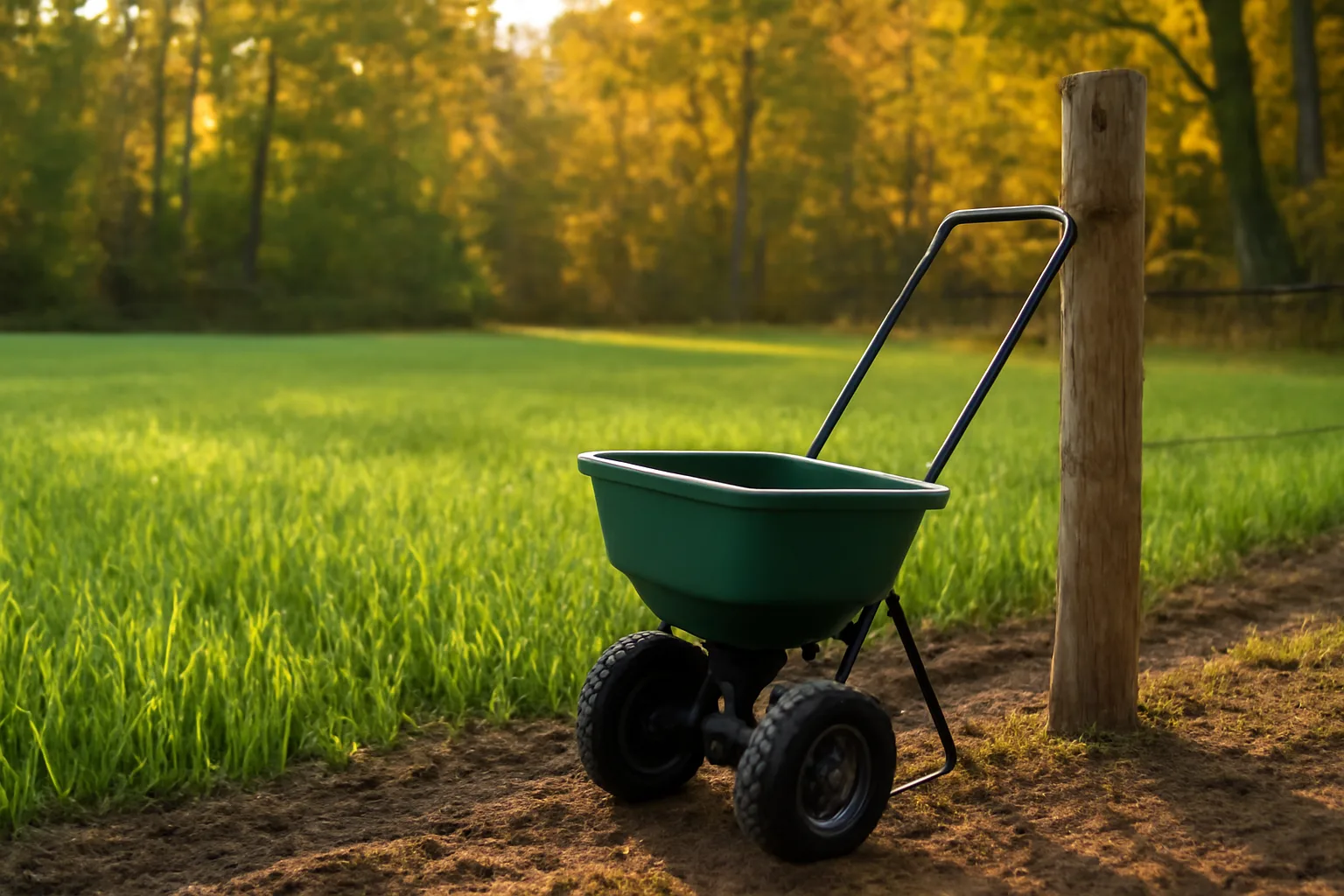
Start with a soil test 60 to 90 days before planting, not the week of. County extension offices and most state land-grant soil labs run tests for $10 to $20 and turn results around in 1 to 2 weeks, giving you a pH reading and lime/fertilizer recommendation specific to your soil, not a generic guess. Oats tolerate a wider pH range than clover or alfalfa, doing fine from about 5.5 to 7.0, but yield and tonnage climb noticeably once pH is corrected into the 6.0 to 6.5 range with lime, since lime takes months to fully react in the soil and can't be a last-minute fix. Here's a basic oat-planting sequence: 1. Test soil 2 to 3 months ahead; apply any recommended lime as early as your schedule allows. 2. Kill existing weeds/sod with glyphosate 2 to 3 weeks before planting, or till the seedbed clean. 3. Broadcast oats at 100 to 130 lbs/acre (drilled rates run lower, 60 to 90 lbs/acre, since drilling gets better seed-to-soil contact). 4. Cover seed 1 to 1.5 inches deep with a light disking, cultipacker, or drag; oats broadcast on bare, uncovered soil germinate poorly and are vulnerable to birds. 5. Apply starter fertilizer per your soil test, commonly a nitrogen-containing blend since oats (unlike clover) don't fix their own nitrogen and respond strongly to it. 6. Plant 6 to 8 weeks ahead of your first frost so plants reach a mature-enough stage before cold shuts growth down. Equipment-wise, oats are forgiving. A tow-behind broadcast spreader and a drag harrow off an ATV or side-by-side handles a plot up to a few acres just fine. You don't need a no-till drill, though a drill improves germination rates in dry falls. For more on matching gear to plot size, food plot seed has an equipment rundown by acreage.
How long do oats last in a plot, and what happens after frost?
Oats stay green and grazeable through several light frosts (mild frosts of 28 to 32degF), but a hard freeze holding in the low 20s degF or below for a sustained period kills the plant outright, typically turning a stand brown within days [2]. In the northern two-thirds of the whitetail range, that means an oat plot's productive life runs roughly 8 to 12 weeks from planting to winterkill, which is exactly why oats are planted as an early-to-mid season attractant, not a January food source. In the Deep South, hard freezes are less reliable or absent some winters, so oats can persist and even head out (produce seed) by late winter or early spring, effectively behaving like a short-lived perennial in those climates. This winterkill timeline is the single biggest reason experienced plotters rarely plant a pure oat monoculture. Pairing oats with a frost-tolerant brassica (turnips, radishes) or a winter cereal like winter rye extends a plot's usable window well past the point oats give out, since rye in particular can stay green and grazeable through much of winter in USDA hardiness zones 4 through 7 .
What's the difference between oats and other cereal grain plot options?
| Oats | Fastest (5-7 days) | Low, winterkills in low 20s degF | Early-season attraction | |
|---|---|---|---|---|
| Winter wheat | Moderate | Good, survives most northern winters | Mid-to-late season, some spring regrowth | |
| Winter rye (cereal rye) | Moderate | Best of the three, grows in near-freezing soil | Latest-season and early spring green-up | Oats win on speed and early palatability. Winter rye wins on cold tolerance and is often the last green thing standing in a February plot. Winter wheat sits in between on both counts. A lot of experienced plotters run all three in a blend precisely so the plot transitions smoothly from oats' fast early growth to rye's late-season persistence, rather than betting the whole plot on one grain's weaknesses. |
Oats, winter wheat, and winter rye are the three cereal grains most commonly planted in whitetail food plots, and they're not interchangeable despite looking similar in the bag. | Grain | Germination speed | Cold tolerance | Best use |
Is planting oats worth the cost, and what's a realistic budget?
Oats are one of the cheapest seeds in the food plot aisle, typically running $15 to $25 per 50 lb bag depending on region and whether it's bin-run (cleaned but ungraded, cheaper) or a certified variety, which puts seed cost for a 1-acre plot at 100 to 130 lbs/acre somewhere around $30 to $65 . Add lime and fertilizer per your soil test (lime often runs $30 to $50 per ton delivered and spread, and most plots need 1 to 2 tons/acre if pH is low) and total input cost for a modest oat plot often lands under $150 to $200 per acre, cheaper than almost any brassica blend or perennial clover establishment cost. The tradeoff is duration. A clover plot can produce for 3 to 5 years off one seeding and lime application; an oat plot needs replanting every single fall. Over a 5-year span, straight cost-per-year math often favors clover once establishment costs are averaged out, but oats offer something clover can't: fast, cheap, low-commitment attraction on ground you're not sure you'll have access to next year, or as an early-season complement to a longer-term clover or alfalfa plot elsewhere on the property. If you're trying to figure out which mix of annuals and perennials actually makes sense for your acreage, soil, and season, a $99 one-time Custom Food Plot Plan gives you a written planting plan built around your specific soil test and property instead of guessing off a seed bag label.
What mistakes do people make planting oats for deer?
The most common mistake is planting too early or too late relative to frost date, either burning out the stand in late-summer heat and drought or planting so late the oats never reach a useful growth stage before winterkill. Backing the planting date off your area's actual first frost date, not a generic 'Labor Day' rule, fixes most of this. The second most common mistake is skipping the soil test and guessing on lime and fertilizer. Oats aren't as pH-picky as clover, but a stand planted into soil at pH 5.0 with no lime correction still underperforms noticeably against one limed to 6.0 to 6.5, and you won't know your actual number without a test. Most state land-grant extension offices run these for under $20. Third: broadcasting seed onto bare soil and walking away without covering it. Oats need 1 to 1.5 inches of soil coverage to germinate well and avoid becoming bird food. A cultipacker, light disk pass, or even dragging a section of chain-link fence behind an ATV solves this cheaply. Finally, treating oats as a stand-alone winter plan when your climate reliably kills them by December. If you're hunting a northern property into late season, oats alone leave you with a brown, dead plot right when you need forage most. Pair them with brassicas or rye, or plan a separate winter food source.
Frequently asked questions
Do deer eat sorghum?
Yes, deer eat both the grain heads and young plant tissue of sorghum, though it's generally a lower-preference forage than soybeans or corn. Sorghum works best as a drought-tolerant standing winter grain and cover crop, planted in late spring like corn, not as a fall attractant plot.
Do deer eat clover?
Yes, clover is one of deer's most consistently preferred forages, offering 25 to 30% crude protein in vegetative growth according to agronomic data compiled by USDA plant guides. White and red clover stay palatable across most of the growing season and a good stand can last 3 to 5 years.
When to plant deer food plots?
Fall annuals (oats, brassicas, wheat, rye) go in 6 to 8 weeks before your first frost date, typically August into September in most of the whitetail range. Perennials like clover and chicory are planted in spring, April through June depending on latitude, after frost risk has passed.
Do deer like clover?
Yes, clover ranks among the most preferred food plot forages for whitetails, valued for high protein content and long season of availability. Most established plot programs use clover as a perennial base and pair it with fall annuals like oats or brassicas for early-season variety.
When to plant oats for deer?
Plant oats 6 to 8 weeks before your area's average first frost date, generally mid-August through mid-September in most of the whitetail range, later in the Deep South. This timing lets oats reach 6 to 10 inches of growth before cold weather slows or stops growth.
When to plant food plots for deer?
Fall plots go in roughly 45 to 75 days before first frost; spring plots go in after your last frost date once soil has warmed. Exact windows shift by 3 to 5 weeks across latitude, so check your state land-grant extension's local planting calendar rather than a national date.
When to plant turnips for deer?
Plant turnips 60 to 90 days before your first killing frost, generally the same August-to-September window as oats. Turnips need that longer runway for the bulb to size up; a hard frost afterward sweetens the bulb and greatly increases deer interest in it.
What is a food plot?
A food plot is a planted area of forage on hunting land, ranging from a fraction of an acre to several acres, established specifically to feed and attract deer or extend how long they stay on a property. It's distinct from baiting, which most states regulate under separate, often much stricter rules.
What are deer's favorite foods?
Deer don't have one universal favorite; preference shifts by season and region. Acorns often dominate in early fall when available, soybeans and cowpeas are favorites in summer, oats and brassicas draw heavily in early-to-mid fall, and clover and standing corn matter most in winter and early spring.
Do deer like honey?
No, honey isn't a natural deer food and there's no research supporting it as an attractant. People are usually thinking of molasses-based mineral licks or sweet feed, both of which raise the same legal baiting questions as corn piles and should be checked against your state's specific regulations first.
Will oats survive winter in my food plot?
It depends on your climate. Oats winterkill once sustained temperatures drop into the low 20s degF, which happens by December or January across most of the northern and central whitetail range. In the Deep South, oats can persist through a mild winter and even head out to seed by spring.
Should I plant oats alone or mix them with something else?
Mixing is almost always the better call. Oats germinate fast and draw deer early but winterkill quickly in cold climates, so pairing them with turnips, radishes, or winter rye extends the plot's usable season well past the point oats alone would brown off and quit.
How much does it cost to plant an oat food plot?
Oat seed runs about $15 to $25 per 50 lb bag, and a 1-acre plot at 100 to 130 lbs/acre costs roughly $30 to $65 in seed. Add lime and fertilizer per a soil test, and total input cost for a modest oat plot often lands under $150 to $200 per acre.
Do I need special equipment to plant oats?
No. A broadcast spreader towed behind an ATV or side-by-side plus a drag harrow or cultipacker to cover seed handles most plots up to a few acres. A no-till drill improves germination in dry conditions but isn't required for a basic, successful oat planting.
Sources
- North Dakota State University Extension, oat production guide (NDSU publication A-1234): Oat germination and growth temperature ranges, and winterkill threshold in low 20s degF
- University of Georgia Extension, oats for forage and cover crops: Deep South oat planting windows and behavior as a cool-season forage through winter
- USDA NRCS, plant guide for white clover: Crude protein content of white clover in vegetative growth stages
- USDA NRCS, grain sorghum plant fact sheet: Grain sorghum drought tolerance and use as standing winter forage and cover
- USDA NRCS, cereal rye plant guide: Cereal rye cold tolerance and growth in near-freezing soil conditions across USDA hardiness zones
- Oklahoma State University Extension, wildlife food plot establishment costs: Typical seed cost ranges for cereal grain food plot plantings