Last updated 2026-07-24
TL;DR
A good spring food plot mix pairs a perennial clover or alfalfa base with warm-season annuals like soybeans, cowpeas, and sorghum, planted after your last frost date once soil hits 55-65°F. Deer favor the tender, high-protein new growth over hard-stem summer forage, so timing your planting to soil temperature matters more than the calendar date.
What is a food plot, exactly?
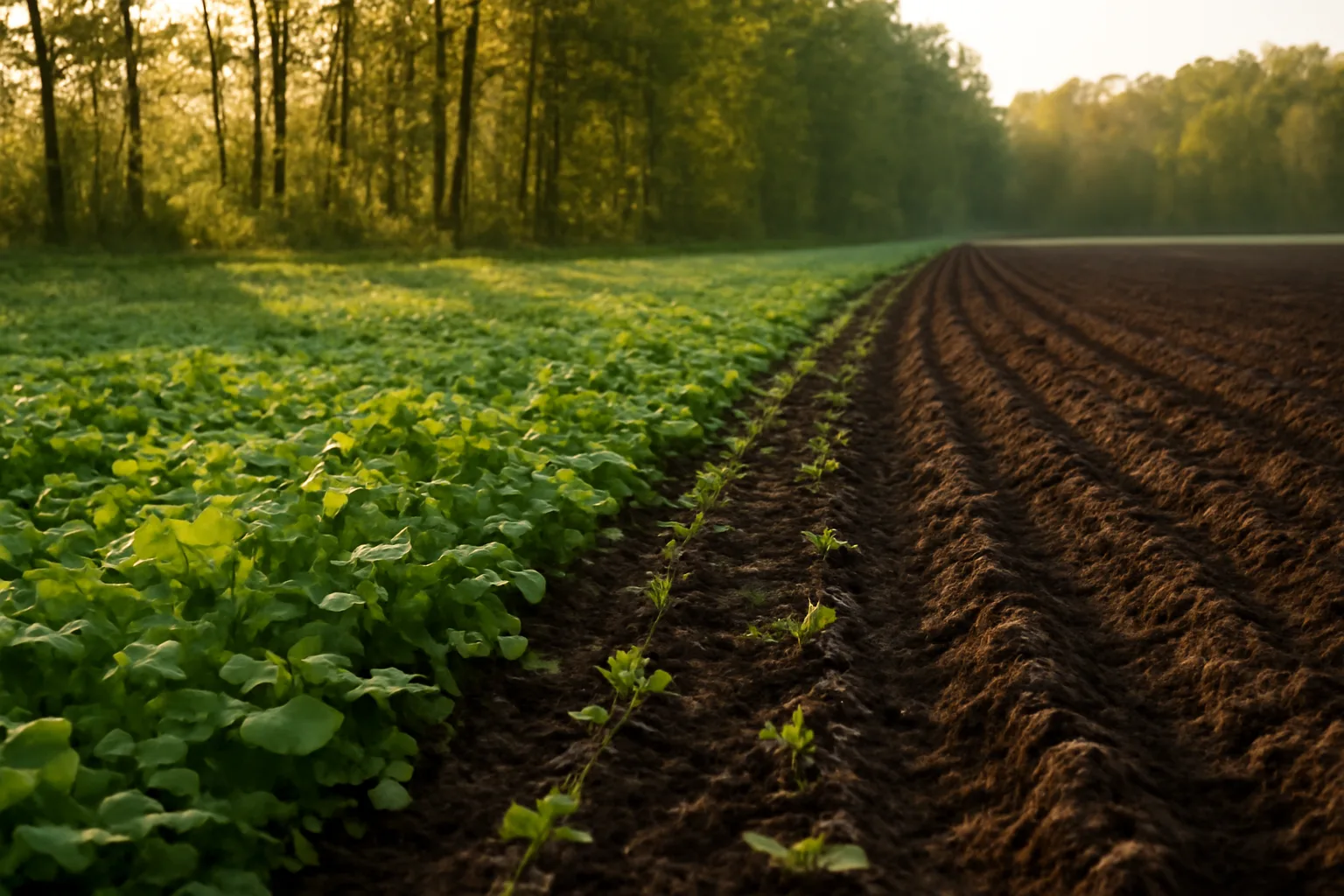
A food plot is a planted patch of forage on hunting land, meant to give deer (and often turkeys, rabbits, and other wildlife) a reliable food source through part or all of the year. That's it. No mystery. Most plots run somewhere between a quarter acre and a few acres, though plenty of hunters work smaller kill plots tucked into timber and larger destination fields nearer bedding. USDA's NRCS treats food plot style plantings as part of its wildlife habitat conservation practice work, describing plans that establish "food and cover for fish and wildlife" through planted vegetation as part of its Conservation Practice Standard for Upland Wildlife Habitat Management (Code 645) [1]. Plots generally fall into two buckets: perennials that come back for two to five years (clover, chicory, alfalfa) and annuals you replant each season (soybeans, brassicas, cereal grains, sorghum). A spring food plot mix usually leans on both, using a perennial legume as the backbone and warm-season annuals to add tonnage and variety during the growing season. If you're new to the whole concept, our food plot whitetail guide covers the basics of picking a spot and sizing a plot before you get into seed selection.
When to plant food plots for deer in spring?
| Deep South (Zone 8-9) | Late March - April | Mid-March avg last frost | |
|---|---|---|---|
| Mid-South / Transition (Zone 7) | Mid-April - early May | Early-mid April | |
| Upper Midwest / Northeast (Zone 5-6) | Mid-May - early June | Early-mid May | |
| Northern tier (Zone 3-4) | Late May - mid June | Late May | These are generalized ranges built from USDA Plant Hardiness Zone data and typical last-frost averages, not a guarantee for your specific county. Check your local NOAA climate normals or your state extension's frost date tables before you commit seed to ground, because a two-week miss on timing can mean the difference between a stand that fills in and one that rots in cold, wet soil. Soil temperature is the better indicator than a date on a calendar. Soybeans and cowpeas want soil around 60°F and rising; sorghum and millet like it closer to 65°F. A cheap soil thermometer, checked at planting depth in the morning, tells you more than the Farmer's Almanac ever will. |
Spring plots go in after your last frost date, once soil temperature reaches roughly 55-65°F depending on the seed. That's the short answer. The long answer depends on your zone, your seed mix, and how wet your ground is that particular year. Cool-season legumes like clover can be frost-seeded or drilled in very early spring, sometimes while there's still frost in the ground overnight, because they tolerate cold snaps fine once established. Warm-season annuals (soybeans, cowpeas, sorghum, sunn hemp) need warmer soil and won't germinate well, or at all, if you jump the gun. A rough zone breakdown for warm-season spring plantings: | Region | Typical spring planting window | Last frost reference |
When to plant oats for deer?
Oats are a cool-season cereal, so despite showing up in some spring blends, they actually perform best as a fall planting, typically 60-90 days before your first fall frost, per land-grant extension guidance on forage oat management [2]. Fall-planted oats put out fast, leafy growth that deer hit hard through early winter until a hard freeze finally kills the plant. A spring planting of oats is possible in northern climates with a long cool season before summer heat arrives, but the plants tend to head out and get less palatable once temperatures climb into the 80s. If you want a spring cereal grain option, many hunters have better luck with spring oats planted as a quick nurse crop alongside clover, giving the clover some shade and weed suppression while it establishes, then letting the oats die back on their own. Bottom line: oats belong in your fall mix more than your spring mix. If oats are what you have on hand in spring, use them as a nurse crop, not the main event.
When to plant turnips for deer?
Turnips are also a fall brassica, not a spring plant. They need 80-90 days to bulb up and hit peak sugar content after a few hard frosts convert starches to sugar, which is exactly why deer often ignore turnip tops in September and then hammer the bulbs in December and January. Extension guidance on brassica forage crops generally recommends planting turnips and related brassicas 80-90 days before the first expected killing frost, which lands roughly late July through August across most of the whitetail range depending on latitude [3]. Planting turnips in spring wastes the seed. They'll bolt to flower in the long summer days and never develop the sweet bulb deer are actually after. If turnips are part of your rotation, save them for your late-summer planting and build your spring mix around species that actually thrive in rising temperatures instead.
What should go in a spring food plot mix?
A solid spring mix usually combines one perennial legume with one or two warm-season annuals, giving you both season-long tonnage and a fast-growing component that fills in before the perennial matures. Common spring/summer combinations: - Soybeans + cowpeas: high protein, both handle heavy grazing pressure, though young soybean plants can get grazed to death before they establish on smaller plots or in areas with heavy deer density.
- Forage sorghum or grain sorghum + cowpeas: sorghum adds bulk, height, and drought tolerance; cowpeas fill the gap with tender, high-protein leaves deer prefer early.
- Clover (red or white) as a standalone perennial base, frost-seeded in earliest spring, then supplemented with an annual in a separate plot or in strips.
- Sunn hemp or lablab in the Deep South, both of which tolerate heat and poor soil better than soybeans. For plots under an acre or in high deer-density areas, mixing several species (a "buffet blend") spreads out grazing pressure so no single plant gets wiped out before it matures. This lines up with general forage establishment guidance from land-grant extension wildlife food plot programs [4]. If you want seed already blended for this purpose rather than building your own combination from bulk bags, our deer food plot seed breakdown compares off-the-shelf mixes against building your own from straight species.
Do deer eat sorghum?
Yes, deer eat sorghum, though it's more of a supporting player than a headline species. Grain sorghum heads are a strong late-season energy source once they mature and dry down, and deer will browse the leaves of forage-type sorghum through summer, but it's not usually their first choice when better forage is available nearby. Sorghum earns its place in spring mixes for a different reason: it's tough. It handles heat, drought, and poor soil better than soybeans or clover, and its height and stem structure prop up climbing plants like cowpeas or a companion legume. Many hunters plant it as the backbone of a summer plot specifically because it survives conditions that would wipe out a pure clover or bean stand. Expect deer to hit sorghum leaves and heads harder in late summer and fall, once other tender forage starts to decline, rather than in the first few weeks after planting.
Do deer eat clover, and do deer like clover?
Deer eat clover readily, and most wildlife biologists and extension agronomists rank it among the top food plot perennials for whitetail because of its protein content and long growing season. Crude protein in well-managed white clover commonly runs 25-30%, a range consistent with forage legume quality data published by university extension forage programs [5], which puts it in the same range as high-quality alfalfa. Do deer like clover? By every measurable grazing preference study and by the sheer volume of extension literature recommending it, yes, clover ranks near the top of deer preference lists, especially in spring when new growth is tender and other browse is still greening up. It's also one of the most forgiving plots to establish: clover tolerates repeated close grazing better than almost anything else you can plant, regrowing from its crown rather than needing to be reseeded. The tradeoff is establishment patience. Clover takes a full season to really thicken up, and in the first year it can get grazed down faster than it grows back, especially on small plots. That's why many hunters plant a nurse crop of oats or wheat alongside spring clover seedings, giving the clover some cover while its root system develops.
What are deer's favorite foods?
There's no single universal answer, because deer preference shifts by season, region, and what's available on the landscape at that moment. That said, several themes show up consistently across forage preference research and state wildlife agency guidance. In spring and summer, deer favor high-protein forbs and legumes: clover, soybeans, cowpeas, and natural browse like greenbrier and honeysuckle. In fall, acorns often out-compete anything you plant, and deer will abandon a food plot entirely during a heavy acorn drop, a pattern documented in whitetail food habits research from southern universities [6]. In winter, energy-dense foods like standing corn, soybeans, and brassica bulbs matter more, since deer are managing fat reserves rather than chasing protein for antler or fawn growth. Soybeans consistently rank at or near the top of preference trials during the growing season because of their protein content (commonly 30-40% crude protein in the leaf) and palatability, a range reported across multiple forage legume evaluations [7]. Clover isn't far behind and has the advantage of being available earlier in spring and later into fall than soybeans, which die at first frost. Generic "deer's favorite food" lists that circulate online often lump in things like apples, corn, and acorns, and while deer absolutely eat all three, they're better described as seasonal attractants and mast, not season-long food plot species. For a broader rundown of species options by category, deer food plots covers the full lineup from annuals to perennials to mast trees.
Do deer like honey, and does it belong in a food plot?
Deer are not drawn to honey the way people assume from folklore and the occasional bait-pile story. Deer are herbivores with a rumen built to process plant fiber, not the concentrated sugar of honey, and there's no research or extension guidance recommending it as an attractant. What people are usually thinking of is honeysuckle, specifically Japanese honeysuckle and native honeysuckle vines, which deer do browse heavily and which shows up constantly in deer diet studies as a preferred natural browse plant, particularly in the Southeast. If you've heard "deer like honey" secondhand, honeysuckle vine is almost certainly the actual answer being described. Honey itself has no place in a legitimate food plot program. It's also worth knowing that many states regulate baiting and supplemental feeding of deer separately from food plots, with some states banning bait piles (including sugar-based attractants) outright while still allowing planted forage. Michigan, for example, prohibits feeding and baiting of deer in the Lower Peninsula outside of narrow exceptions under its Wildlife Conservation Order, while food plots planted in the ground are treated differently under that same order [8]. Rules vary widely by state, so check your own wildlife agency's regulations before using any concentrated attractant, sweet feed, or mineral supplement near a stand.
How do soil test results shape a spring mix?
Your soil test result, not a bag label, should decide your lime and fertilizer rates. Most soybean and clover blends want soil pH between 6.0 and 6.8, and a lot of hunting ground runs more acidic than that, sometimes down in the 5.0-5.5 range on wooded or long-neglected fields. Lime takes time to react in soil, often several months to fully adjust pH depending on how finely ground it is, how much you apply, and how well it's incorporated, a point standard university soil fertility guidance on agricultural liming makes clearly . That means a fall soil test that showed you needed two tons of lime per acre should have gotten lime down back in fall or very early spring, not the week before you plant. If you're planting spring seed on soil that hasn't been limed and your test called for it, don't expect full yield potential this season. Plant anyway if you have to, but budget for it next year. Your soil test lab, not this article, is the authority on your specific lime and fertilizer recommendation. Labs calibrate their recommendations to your regional soil type and the crop you tell them you're planting, and that's a level of precision no general guide can replicate. If you haven't pulled a sample yet, most state land-grant extension offices offer soil testing for a modest fee, often somewhere in the $10-20 range per sample depending on the state and the panel requested.
How much seed and what equipment do you actually need?
| Soybeans (forage type) | 50-90 | 1-1.5 in | |
|---|---|---|---|
| Cowpeas | 30-60 | 1-1.5 in | |
| Grain/forage sorghum | 8-12 | 0.5-1 in | |
| White clover | 4-8 (broadcast) | 1/4 in or less | |
| Red clover | 8-12 | 1/4 in or less | These ranges reflect common land-grant extension forage planting guidance [2] [4] and can shift depending on whether you're broadcasting versus drilling, and whether you're mixing species (which usually means cutting each component's rate). Equipment-wise, you don't need much to get a workable spring plot in the ground. A disc or tiller to break ground, a way to broadcast or drill seed, a cultipacker or drag to firm seed-to-soil contact, and a sprayer for burndown herbicide before planting covers most small to mid-size plots. ATV and UTV-mounted implements handle plots up to a few acres fine; anything bigger starts to justify a tractor. For a full rundown of gear options at different budget levels, see deer for food and domain food plot seed for seed-buying specifics. |
Seeding rates vary a lot by species, so read the bag, but rough per-acre benchmarks for common spring plot components look like this: | Species | Typical seeding rate (lb/acre) | Planting depth |
Spring mix vs. fall mix: what actually changes?
The core difference between spring and fall food plot mixes comes down to what temperature range the plants need to thrive, not which one deer "like more." Spring/summer mixes lean on warm-season species (soybeans, cowpeas, sorghum, sunn hemp, lablab) plus perennial clover, all of which need warm soil and a long frost-free window to produce tonnage. Fall mixes lean on cool-season species (oats, wheat, rye, brassicas like turnips and radishes) that actually improve in palatability after a frost converts starches to sugars. Many experienced plotters run both: a spring/summer planting for antler growth and fawn-rearing season, then a fall planting timed 60-90 days ahead of first frost for hunting season attraction and late-season energy. If you're only able to plant once a year, most whitetail managers lean toward prioritizing the fall plot since it lines up with hunting season, but a spring plot does more for herd health and body condition heading into summer stress and antler growth. Building a full-year rotation gets complicated fast between species selection, soil amendments, and timing across multiple plots. That's the exact gap a $99 one-time Custom Food Plot Plan at /plot-plan-builder is built to fill, giving you species and timing recommendations based on your zone and soil test results rather than guessing off a bag label.
What mistakes wreck spring food plots most often?
Planting too early tops the list. Cold, wet soil rots seed before it germinates, and a warm week in March fools a lot of hunters into planting soybeans that then sit in 45°F dirt for two weeks doing nothing. Skipping the soil test is a close second. Planting a $60 bag of premium seed blend into soil sitting at pH 5.2 without lime is close to money down the drain; legumes especially struggle to fix nitrogen in acidic soil, consistent with standard agronomy guidance on legume nodulation and soil pH . Other recurring mistakes: planting too small a plot in a high deer-density area (the whole planting gets grazed to dirt before it can establish), not controlling weeds before planting (a summer plot fighting crabgrass and pigweed loses badly), and ignoring drainage (low spots that pond water in spring drown seed even in an otherwise good planting window). None of these are exotic problems. They're the same handful of mistakes extension agronomists and experienced plot managers flag every single spring, and fixing even two or three of them (soil test, correct timing, weed control) puts you ahead of most plots planted within ten miles of yours.
Frequently asked questions
Do deer eat sorghum?
Yes. Deer browse forage sorghum leaves through summer and eat mature grain heads in late season once they dry down. Sorghum isn't usually a deer's first pick when tender legumes are available, but it's valuable for its drought tolerance and the physical structure it gives climbing plants like cowpeas in a mixed plot.
Do deer eat clover and do deer like clover?
Yes, deer readily eat clover and it consistently ranks among the top preferred food plot perennials in extension research, largely because of its 25-30% crude protein content. It's also one of the most forgiving species to grow, tolerating repeated grazing better than almost any other plot forage.
When should I plant food plots for deer?
Plant cool-season plots (clover, oats, brassicas) roughly 60-90 days before your area's first fall frost. Plant warm-season spring/summer plots (soybeans, sorghum, cowpeas) after your last spring frost date once soil hits 55-65°F. Exact windows shift by USDA hardiness zone, so check your state extension's local frost date tables.
When should I plant oats for deer?
Oats perform best as a fall planting, about 60-90 days ahead of first frost, when cool weather keeps the leafy growth tender through early winter. A spring oat planting works mainly as a quick nurse crop for young clover, not as a standalone summer forage, since oats decline fast once summer heat sets in.
When should I plant turnips for deer?
Plant turnips in late summer, roughly 80-90 days before your first expected killing frost, generally late July through August across most of the whitetail range. Turnips planted in spring bolt to flower in long summer days and never develop the sweet, frost-converted bulb deer prefer in late fall and winter.
What is a food plot?
A food plot is a planted area of forage, usually somewhere between a quarter acre and several acres, established to provide deer and other wildlife a reliable food source. USDA's NRCS treats these plantings as part of its wildlife habitat conservation practice work under programs like Upland Wildlife Habitat Management.
What are deer's favorite foods?
It depends on season and region. In spring/summer, deer favor high-protein legumes like clover and soybeans plus natural browse. In fall, acorns often beat any planted forage. In winter, deer shift toward energy-dense foods like standing corn, soybeans, and brassica bulbs to manage fat reserves through cold weather.
Do deer like honey?
No. Deer are herbivores without any documented preference for honey, and it has no place in a legitimate food plot or attractant program. People who ask this are usually thinking of honeysuckle vine, which deer do browse heavily and which shows up constantly in whitetail diet studies, especially in the Southeast.
What's the best spring food plot mix for small plots under an acre?
A mixed blend of soybeans or cowpeas with a companion clover base spreads grazing pressure across multiple species so no single plant gets wiped out before maturity. On very small, high-pressure plots, cowpeas alone often hold up better than pure soybeans because deer can graze them harder without killing the stand.
Can I plant clover and soybeans together in spring?
Yes, but it takes planning. Clover is a slower-establishing perennial, so many hunters plant it in a separate plot or strip rather than mixing it directly with fast-growing soybeans, which can shade out young clover seedlings. A common approach is a clover plot next to, not blended into, a soybean/cowpea plot.
How do I know if my soil is ready for spring planting?
Check soil temperature at planting depth in the morning, not the calendar date. Soybeans and cowpeas want roughly 60°F and rising; sorghum prefers closer to 65°F. Also confirm the ground has dried enough to work without compacting into clumps, since planting into cold, saturated soil is a top cause of failed spring plots.
Do I need to lime before planting a spring food plot?
If your soil test recommends lime, yes, and ideally it should have gone down months before planting since lime takes time to fully adjust soil pH. Planting legumes like soybeans or clover into acidic soil below pH 6.0 without lime limits nitrogen fixation and cuts yield significantly.
Sources
- USDA NRCS, Conservation Practice Standard: Upland Wildlife Habitat Management (Code 645): Food plot style plantings are recognized as part of a wildlife habitat conservation practice using planted forage
- Oklahoma State University Extension, Oat Production Guide (PSS-2242): Fall-planted oats are seeded roughly 60-90 days before first frost for best forage performance
- Clemson Cooperative Extension, Brassicas for Wildlife Food Plots: Brassicas including turnips should be planted roughly 80-90 days before first killing frost
- University of Tennessee Extension, Wildlife Food Plots: Species Selection (SP731-A): Mixing multiple forage species in one plot spreads grazing pressure and improves establishment success
- University of Georgia Extension, Forage Legumes Bulletin 1348: White clover crude protein typically runs 25-30 percent
- University of Georgia, Warnell School of Forestry and Natural Resources, Deer Food Habits Research (Miller et al., acorn mast studies): Deer diet shifts heavily toward acorns during fall mast drops, reducing food plot use
- Michigan Department of Natural Resources, Wildlife Conservation Order, Baiting and Feeding of Deer (Order 2.101): States regulate baiting and supplemental feeding of deer separately from planted food plots and rules vary
- University of Missouri Extension, Soil Acidity and Liming (G9101): Lime can take several months to fully react and adjust soil pH after application