Last updated 2026-07-25
TL;DR
Spring and summer food plots for deer center on perennial clover, chicory, and warm-season annuals like soybeans, cowpeas, and sorghum, planted after your last frost date once soil hits about 65°F. Most of the US falls between mid-April and early June for planting. Soil testing first matters more than seed choice.
What is a food plot, exactly?
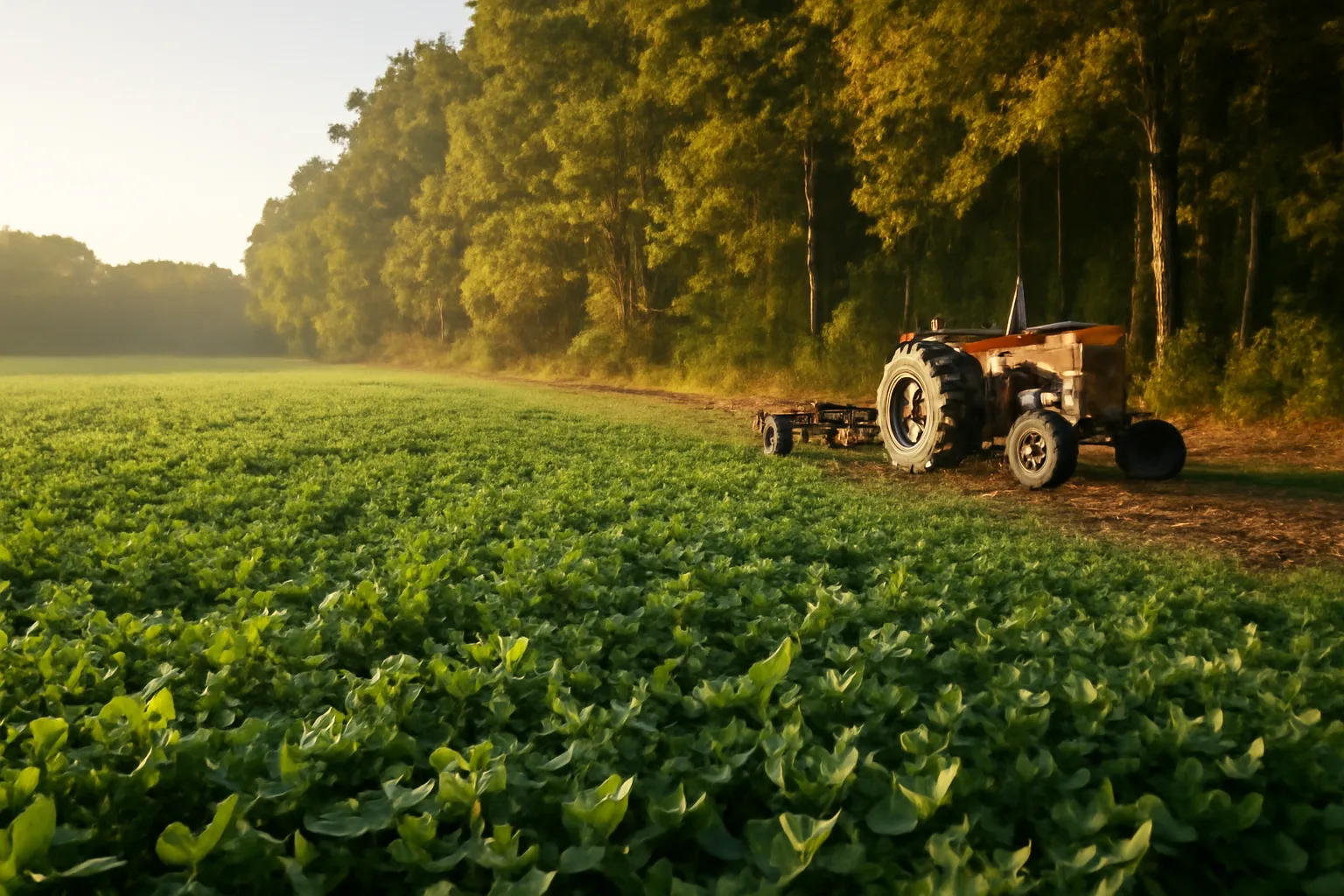
A food plot is a planted patch of forage or grain on your hunting property, put there to feed deer and other wildlife, and often to concentrate deer activity in a huntable spot. It's not complicated at its core: you're farming a small field, usually somewhere between a quarter acre and five acres, using the same basic steps a row-crop farmer uses on a much bigger scale. Plots generally fall into two buckets. Annual plots get replanted every year (brassicas, cereal grains, soybeans, sorghum) and often deliver a big pulse of tonnage in a short window. Perennial plots (clover, chicory, alfalfa) get planted once and, with mowing and fertility upkeep, can produce for three to five years or more. The USDA Natural Resources Conservation Service runs cost-share programs, including the Environmental Quality Incentives Program, that fund wildlife habitat practices on private land, and food plot type plantings can qualify under wildlife habitat components in some state EQIP allocations [1]. That tells you something: this isn't a fringe hobby, it's recognized habitat work with real agronomic rules behind it. More than something a guy with a disc harrow figured out on a Saturday. If you want a plan built around your specific dirt and property instead of guessing, that's the whole idea behind the food plot whitetail approach and behind PlotSeason's $99 Custom Food Plot Plan at /plot-plan-builder. More on that later. For now, let's get into timing, because spring and summer plots live and die on timing more than any other factor.
When to plant food plots for deer (spring and summer specifically)
| Deep South (Zone 8-9) | Early to mid-March | Late March - May | |
|---|---|---|---|
| Mid-South / Transition (Zone 7) | Early to mid-April | Mid-April - late May | |
| Midwest / Mid-Atlantic (Zone 6) | Late April | Early May - mid-June | |
| Upper Midwest / North (Zone 4-5) | Mid to late May | Late May - late June | Check your own county's frost data through your state extension office rather than trusting a national average. Microclimates and elevation shift these dates by two to three weeks even within one state. One more thing worth saying plainly: waiting an extra week for good soil moisture almost always beats planting into dust on the calendar date. Seed sitting in dry dirt doesn't germinate evenly, and you'll be back out there reseeding in three weeks anyway. |
The short answer: plant spring/summer annuals and perennials after your last expected frost, once soil temperature is reliably above 50 to 65°F depending on species, and while soil moisture is still decent. For most of the whitetail's range that lands somewhere between mid-April (Deep South) and early June (far North). University extension planting guides consistently anchor spring plot dates to local frost-free dates rather than a calendar date, because a fixed date is useless from Alabama to Minnesota. Clemson Cooperative Extension's food plot planting guidance recommends warm-season legumes and forages go in after the last frost date once soils have warmed, timing that mirrors normal row-crop soybean planting windows in the Southeast [2]. Here's a rough regional breakdown, built off USDA plant hardiness zones and typical last-frost dates, not a guarantee for your exact property: | Region (approx. USDA zone) | Typical last frost | Spring/summer plot window |
What are deer's favorite foods, really?
There's no single ranked list that holds true everywhere, because deer preference shifts by season, region, and what's already growing wild nearby. But research and decades of extension work point to a consistent short list: acorns (especially white oak group), soybeans, clover, and forbs top most preference studies during the growing season. Mississippi State University's deer nutrition research, published through its Deer Ecology and Management Lab, has documented that whitetail diet composition shifts heavily toward soft mast, forbs, and agricultural forages during spring and summer, and toward woody browse in winter when little else is available [3]. In other words: deer aren't picky eaters by nature, they're opportunistic ones. They'll hammer whatever combination of protein and digestibility is easiest to get to. During spring and summer specifically, does are lactating and bucks are growing antlers, so protein demand spikes. That's exactly why clover, soybeans, and cowpeas (all legumes, all high protein, often 20 to 30% crude protein in vegetative stage) dominate spring/summer plot recommendations rather than the brassicas and cereal grains that shine in fall. If you're choosing seed for a summer plot, lean toward legumes first. For a broader look at species options across the whole calendar, deer food plot seed breaks down more of the individual options.
Do deer like clover, and is it worth planting?
Yes, unquestionably. Clover is probably the single most planted perennial food plot forage in North America, and for good reason: it's high protein (often 25 to 30% crude protein in good stands), it regrows after grazing and mowing, and it comes back year after year with minimal replanting cost. Extension research backs this up directly. Mississippi State University Extension publication P2111 notes white clover and other perennial clovers commonly reach crude protein levels of 25 to 30 percent in vegetative growth, well above the roughly 16 percent minimum thought needed to support antler growth, and that clover holds up under repeated grazing pressure better than most other legume options [4]. That regrowth trait is the whole reason clover works as a spring/summer staple: deer can hit it hard in May and it's still green and growing in July. Clover does have real limits, and it's worth naming them plainly. It struggles in acidic soil (below pH 6.0, nodulation and nitrogen fixation drop off sharply), it can get out-competed by weeds in the first 60 to 90 days after planting, and in drought years it goes dormant and stops producing much tonnage. That's a soil test conversation, not a seed bag conversation. Get your pH and phosphorus/potassium levels checked before you plant, because lime takes months to adjust soil chemistry and you can't fix a pH 5.2 field with more clover seed. Frost seeding clover (broadcasting onto frozen or freeze-thaw ground in late winter) is a legitimate low-cost establishment method extension agronomists have documented for decades, and it works particularly well for red and white clover because the freeze-thaw cycle works seed into the soil surface. If you missed that window, a clean spring planting into a prepared seedbed works fine too.
When to plant oats for deer (and are oats a spring plot or a fall plot?)
Oats are overwhelmingly a fall and winter forage, not a spring/summer one, and that trips up a lot of first-time plotters. Oats are a cool-season cereal grain: they germinate fast, produce huge tonnage quickly, and stay attractive to deer especially after a light frost sweetens the sugars in the leaf tissue. Most extension guidance recommends planting oats six to eight weeks before your average first fall frost, so the plants have time to establish before cold shuts down growth. That typically lands in the August to September window depending on latitude. Some hunters do plant a small spring oat plot as a quick, cheap green-up or as a nurse crop for establishing clover, since oats germinate in days and give some early-season cover and grazing while slower perennials take root. But as a dedicated food source, oats are a fall play. If your goal is specifically a spring/summer plot, oats aren't the right tool. Save the oat seed for late summer planting and lean on clover, soybeans, or cowpeas for the warm months instead.
When to plant turnips for deer (and do they belong in a spring plot?)
Turnips, like oats, are a fall and winter brassica, not a spring crop. They need a long enough growing season to bulb up before hard frost, and their peak attractiveness to deer actually comes after several freezes convert starches to sugars in the leaves and bulbs, which is a fall/winter phenomenon, not a summer one. Cooperative extension planting calendars generally put turnip and other brassica seeding in the July to early September window, timed backward from the first expected killing frost, similar to the oat logic above. Plant too early in a hot summer and turnips can bolt or get hammered by insects before they ever bulb. So if you're planning your spring and summer acreage, turnips shouldn't be on that list at all. Think of your plot calendar as two separate projects: spring/summer plantings (clover, chicory, soybeans, cowpeas, sorghum) and late-summer plantings for fall/winter (brassicas, oats, wheat, rye). Trying to force a turnip planting into May just wastes seed and a planting window.
Do deer eat sorghum, and does it belong in a summer plot?
Yes, deer eat sorghum, both the grain heads and the young forage growth, and grain sorghum (milo) is a legitimate warm-season plot option in the right region. It's drought-tolerant, which makes it a smart pick for sandy or dry ground where soybeans and corn struggle without irrigation. That said, sorghum isn't usually a deer's first choice while it's standing and green. It becomes more attractive as a fall/winter grain source once the heads mature and dry down, similar to how corn works. As a summer standing crop it also functions as cover and browse for young plants, and turkeys and other wildlife use the seed heads too. Some plotters use grain sorghum specifically as a drought-insurance crop: plant it alongside or in rotation with soybeans so that in a dry year you've still got something standing when the beans wilt. One practical note: sorghum needs warm soil to germinate well, generally above 60°F, so it's a late-spring to early-summer planting in most regions, timed similarly to corn and well after your typical clover or oat dates.
Do deer like honey, or is that just a myth?
Deer don't eat honey and there's no wildlife research suggesting honey is a meaningful deer attractant. This one shows up in search because of confusion with commercial "deer honey" or molasses-based mineral and attractant products, which use sweet syrup as a carrier for salt, minerals, or scent, not because deer are out there raiding beehives. Deer are herbivores built to digest cellulose and plant material through a four-chambered rumen system. A concentrated sugar syrup isn't part of their natural diet and isn't something extension wildlife biologists recommend or study as a food plot input. If you see a product marketed with "honey" in the name for deer, it's almost always a molasses or syrup-based mineral lick additive, and its effectiveness as an attractant hasn't been rigorously tested the way forage plantings have. Bottom line: skip it. Put your money into soil amendments and real forage instead. A pound of clover seed does more for a deer herd over a season than any syrup product will.
How do you build a spring/summer plot from scratch, step by step?
Start with soil, not seed. A soil test costs somewhere in the $10 to $20 range through most university extension labs and takes two to four weeks to get results back. It tells you your pH and your phosphorus and potassium levels, which determines how much lime and fertilizer you actually need rather than guessing off a bag label [5]. Here's the general sequence extension agronomists recommend: 1. Pull soil samples 4 to 6 inches deep from multiple spots in the plot, mix them, and send a composite sample to your state extension lab or a private ag lab. 2. Apply lime if recommended, ideally months before planting since lime takes time to raise pH, though a spring application still helps for the following year. 3. Clear existing vegetation with a burndown herbicide, disking, or both, depending on your equipment and the site. 4. Broadcast or drill seed at the recommended rate for your species (clover is typically 6 to 8 lbs/acre broadcast for a straight white clover stand, per most extension seeding tables) [4]. 5. Apply starter fertilizer per your soil test recommendation, not a generic bag rate. 6. Cultipack or drag to ensure seed-to-soil contact, especially for small-seeded legumes and clover. 7. Mow perennial plots periodically through summer to knock back weeds and encourage clover regrowth. Your soil test lab is the real authority here, not a seed bag or a blog post. Lime and fertilizer recommendations are site-specific to your dirt's chemistry, and a general guide (including this one) can't replace that report. If you want help translating your soil test results and property goals into an actual planting plan, that's exactly what PlotSeason's $99 Custom Food Plot Plan is built for at /plot-plan-builder. It's general guidance based on your inputs, not a site visit or a substitute for your lab's specific lime and fertilizer numbers.
What equipment do you actually need for a spring/summer plot?
You don't need a full farm setup to plant a good plot, but you do need a few non-negotiables: some way to break or expose soil (disk, tiller, or a no-till drill), a way to spread seed and fertilizer (broadcast spreader, or a drill if you have one), and a way to firm the seedbed afterward (cultipacker, roller, or even a drag made from chain-link fence and cinder blocks). A lot of small-acreage plotters get by with an ATV or UTV, a pull-behind disk, a tow-behind broadcast spreader, and a cultipacker or drag. That combo handles most half-acre to two-acre plots fine. If you're working larger acreage or heavier clay soils, a compact tractor with a box blade, disk, and PTO spreader speeds things up considerably, but it's a big cost jump most weekend plotters don't need to make. No-till drills are worth mentioning separately. They let you plant directly into existing sod or a killed cover crop without full tillage, which saves a pass or two and helps with erosion on sloped ground. They cost more to buy but many state wildlife agencies and conservation districts rent them out cheap or free, so check your local NRCS office or conservation district before buying one outright.
How does spring/summer plot strategy differ by species goal?
If your main goal is antler growth and doe body condition through spring and summer, protein-heavy legumes (clover, soybeans, cowpeas, alfalfa) should be the backbone of your acreage, since crude protein in the 20 to 30% range during vegetative growth directly supports lactation and antler development [3] [4]. If your goal is drought resilience on marginal or sandy soil, lean toward sorghum, cowpeas, or forage soybeans bred for drought tolerance, and consider a mixed planting rather than a monoculture, so you've got a fallback if one species struggles. If you're planting for the first time and want low maintenance, clover is the easiest recommendation: plant it once, mow it a few times a summer, and it'll produce for several years with proper fertility upkeep. Annual warm-season plots (soybeans, cowpeas) need replanting every single year and more up-front seed cost, but they can produce more total tonnage per acre in a single season than clover does. For a wider comparison of specific seed options across both cool and warm season plantings, deer food plot seed and food plot seed both go deeper on individual species selection than this article can.
What state rules and baiting laws should you check before planting?
Food plots are legal planting activity in every US state, but the line between a food plot and illegal baiting gets blurry in a few states, and the rules genuinely vary. Some states classify any planted food plot as legal regardless of hunting over it, while others restrict hunting directly over certain planted areas or draw distinctions based on whether the crop was harvested versus left standing. Michigan is a good example of how granular this gets. Michigan's hunting regulations, administered by the Department of Natural Resources under the state's baiting and feeding rules in the Wildlife Conservation Order, treat standing food plots differently from bait piles, and the specific bait volume and area restrictions have changed multiple times in the last decade, so hunters need to check the current year's hunting digest rather than assume last year's rule still applies [6]. Pennsylvania takes a different regulatory approach. The Pennsylvania Game Commission's baiting regulation, 58 Pa. Code § 141.52, defines bait and specifically states that normal agricultural planting and management practices are not considered baiting, which is the legal backbone that makes standard food plot use over standing crops legal there [7]. Don't guess on this one. Pull up your state wildlife agency's current hunting digest or regulations page before you plant or before season, because baiting violations carry real fines and license consequences in most states, and the definitions change from year to year in some legislatures.
Frequently asked questions
Do deer eat sorghum?
Yes. Deer browse young sorghum forage and eat the grain heads once mature, and grain sorghum works as a drought-tolerant summer plot option, especially on sandy or dry ground. It's more of a fall/winter draw once heads dry down, similar to standing corn, than a top summer preference.
Do deer eat clover?
Yes, clover is one of deer's most preferred forages, especially in spring and summer. It's high in crude protein, often 25 to 30% in good stands, and regrows repeatedly after grazing, which is why it's the most commonly planted perennial food plot forage across the whitetail's range.
When should you plant deer food plots?
Spring/summer plots go in after your last frost date once soil hits roughly 50 to 65°F, generally mid-April to early June depending on region. Fall plots (brassicas, oats, wheat) go in six to eight weeks before your area's first fall frost, typically late July through September.
Do deer like clover more than other forages?
Preference studies and extension data consistently rank clover among deer's top forage choices during the growing season, largely because of its protein content and regrowth ability after grazing. It's not the only thing deer prefer, soybeans and natural forbs rank highly too, but clover's year-round availability gives it an edge in plot planning.
When should you plant oats for deer?
Oats are a cool-season fall crop, planted six to eight weeks before your area's average first fall frost, usually August to September depending on latitude. They're not a spring/summer plot choice; a light frost actually sweetens oat forage and increases deer use later in the season.
When is the best time to plant food plots for deer overall?
It depends on the crop type, not one single date. Spring/summer forages (clover, chicory, soybeans, cowpeas) go in after last frost, roughly April through June by region. Fall forages (brassicas, oats, wheat, rye) go in July through September, timed backward from first frost.
When should you plant turnips for deer?
Turnips are a fall/winter brassica, planted in the July to early-September window in most regions, timed so bulbs mature before hard frost. Planting them in spring wastes the seed, since their peak deer attractiveness comes after repeated freezes convert starches to sugars later in the season.
What exactly is a food plot?
A food plot is a planted area on hunting land, usually a quarter acre to several acres, seeded with forage or grain crops to feed deer and other wildlife and to concentrate animal activity for observation or hunting. Cost-share programs through USDA's Natural Resources Conservation Service can fund wildlife habitat plantings like this in some states.
What are deer's favorite foods?
Acorns, especially white oak group acorns, top most preference research, followed closely by soybeans, clover, and various native forbs during the growing season. Preference shifts seasonally: deer favor high-protein legumes and forbs in spring and summer and shift toward mast and woody browse in fall and winter.
Do deer like honey?
No, deer don't eat honey, and there's no wildlife research supporting it as an attractant. Products marketed as deer honey are typically molasses or syrup-based mineral additives, not actual honey, and they're not a substitute for real forage plantings like clover or soybeans.
Can you plant a food plot without a soil test?
You can, but you're guessing on lime and fertilizer rates, which usually costs more in wasted inputs and a weak stand than the $10 to $20 a soil test costs through most extension labs. Your soil test lab's specific pH and nutrient recommendations should always override generic seed bag rates.
Is it legal to hunt over a food plot?
In most states, yes, standing food plots planted using normal agricultural practice are treated differently from bait piles, but rules vary significantly by state. Always check your state wildlife agency's current regulations before hunting over a plot, since baiting definitions and enforcement differ from state to state and can change year to year.
What's the difference between a spring plot and a fall plot?
Spring/summer plots use warm-season species like clover, chicory, soybeans, cowpeas, and sorghum, planted after last frost to support antler growth and lactation. Fall plots use cool-season species like brassicas, oats, and cereal grains, planted in late summer to provide high-carb food heading into winter.
Sources
- USDA Natural Resources Conservation Service, Environmental Quality Incentives Program (EQIP): Food plot type plantings are recognized as a wildlife habitat conservation practice eligible for cost-share support in some states
- Clemson Cooperative Extension, Wildlife Food Plots for the Southeast: Warm-season food plots should be planted after the last frost date once soil temperatures warm consistently
- Mississippi State University Extension, White-tailed Deer Nutrition and Feeding, Publication 2568: Deer diet composition shifts toward forbs, soft mast, and agricultural forage in spring/summer versus woody browse in winter
- Mississippi State University Extension, Clover for Wildlife Food Plots, Publication 2111: White clover food plots provide crude protein levels around 25 to 30 percent supporting antler growth and lactation and tolerate repeated grazing
- University of Missouri Extension, Soil and Plant Testing Laboratory Fee Schedule: A basic soil test through a university extension lab costs roughly $10 to $20 and takes several weeks for results
- Michigan Department of Natural Resources, 2024 Hunting Digest, Baiting and Feeding Regulations: Michigan enforces specific baiting and feeding regulations that differ from standard food plot treatment and require checking current DNR guidance
- Pennsylvania Code, Title 58, Chapter 141.52, Definition of Bait: Pennsylvania's baiting definition specifically excludes normal agricultural and food plot practices from the definition of illegal baiting