Last updated 2026-07-26
TL;DR
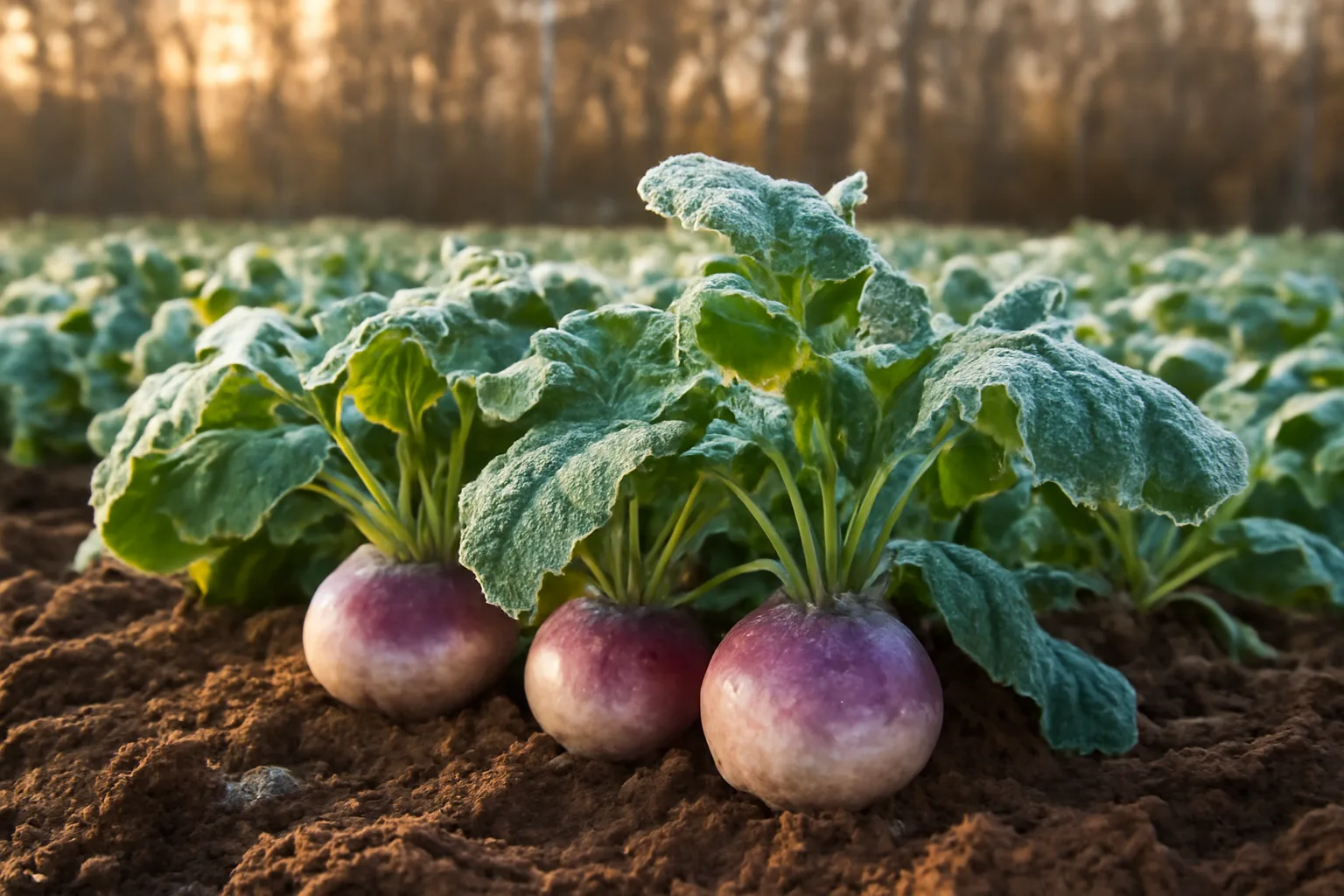
Plant turnips 60 to 90 days before your first hard frost, broadcast at 4-6 lbs per acre into a firm, lightly fertilized seedbed no deeper than 1/4 to 1/2 inch. Deer usually ignore the bulbs until after a few frosts sweeten the starches, so plan turnips as a late-season food source, not an early-fall draw.
What is a food plot, and where do turnips fit in?
A food plot is a planted patch of forage, usually somewhere between a tenth of an acre and several acres, put in specifically to feed and hold deer or other wildlife on a property. Most hunters split plots into two broad categories: annual plots (planted fresh each year, things like turnips, oats, soybeans) and perennial plots (clover, chicory, alfalfa, which come back for two to five years). Turnips are an annual brassica. They're cheap, they grow fast, and they produce two food sources in one plant: leafy tops that deer will nibble in early fall, and a bulb underground that becomes a starch bomb once frost hits. That makes them a classic late-season plot, the kind you hunt over in December and January rather than October. If you're building a plot rotation, turnips usually pair with something like clover or a cereal grain so you've got food across the whole season instead of a single window. For a broader look at species options and how they fit together, see food plot whitetail and deer food plot seed.
When to plant turnips for deer?
| Deep South (Zone 8-9) | Late Aug to mid-Sept | Late Nov to Dec | |
|---|---|---|---|
| Mid-South / Transition | Aug 1-20 | Late Oct to mid-Nov | |
| Midwest / Mid-Atlantic | Jul 15-Aug 10 | Mid to late Oct | |
| Upper Midwest / Northeast | Jul 1-25 | Late Sept to mid-Oct | |
| Canada border states | Late Jun to mid-Jul | Mid Sept | Check your county's average frost dates through your state's land-grant extension office before locking in a date. Local frost data beats any national chart. |
Turnips need roughly 60 to 90 days from seed to a mature bulb, and you want that maturity to land right around your first hard frost, which is when deer start actually eating them in volume. Cornell Cooperative Extension notes turnip and other brassica forage crops typically reach usable maturity in 60 to 90 days depending on variety and conditions [1]. Work backward from your average first fall frost date. If you're in a zone where the first hard frost hits around October 15, you want turnips in the ground by late July to mid-August. Plant too late and the bulbs never bulk up. Plant too early and they may bolt or get overwhelmed by weeds before fall. Here's a rough planting window by region. These are generalized zones, not precise dates, since frost timing varies year to year and by elevation. | Region | Typical planting window | First hard frost (avg) |
When to plant food plots for deer overall?
Timing depends entirely on whether you're planting a spring/summer plot or a fall plot. Spring plots (clover, chicory, soybeans, cowpeas) generally go in after your last frost date, once soil temps hit the mid-50s or warmer. Fall plots (brassicas, cereal grains, some clover blends) go in 60 to 120 days before your first fall frost, depending on species. Most food plot failures trace back to bad timing more than bad seed. Planting a brassica too early into hot, dry August ground means it germinates into a drought. Planting too late means it never matures before the ground freezes. Your state wildlife agency's habitat or private-lands biologist program can often point you to typical planting windows for your county; several state agencies (Missouri Department of Conservation, Pennsylvania Game Commission, and others) publish food plot planting guides with regional dates [2][3]. If you want species-specific dates rather than generalizations, run your zip code and frost dates through a plan. That's the entire premise behind the $99 one-time Custom Food Plot Plan we build here, matched to your soil test and your region instead of a national average.
How do you prepare the seedbed for turnips?
Turnip seed is tiny, roughly 130,000 to 150,000 seeds per pound depending on variety, and it only needs to go 1/4 to 1/2 inch deep. Planting too deep is the single most common mistake with brassicas. If you can't see a few seeds sitting on the surface after you drag or cultipack, you're probably too deep. Start with a soil test. Pull samples 4 to 6 inches deep from several spots in the plot, mix them, and send them to your state or a private ag lab. Turnips grow best in a pH range of about 6.0 to 6.8; most extension guidance for brassica forage crops calls for pH above 5.8, with lime added to correct anything more acidic [4]. Your soil test report is the actual authority here, not a blanket recommendation, since lime and fertilizer needs vary by field. Once pH and fertility are addressed (turnips respond well to nitrogen, with many extension guides recommending 40 to 60 lbs of actual nitrogen per acre for brassica forage plots [1]), work the ground into a firm, fine seedbed. A disk or light tillage pass followed by a cultipacker or roller works well. Broadcasting into a rough, cloddy field usually means poor seed-to-soil contact and spotty germination.
What seeding rate and method works best for turnips?
For a pure turnip plot, broadcast at 4 to 6 lbs of seed per acre. If you're drilling instead of broadcasting, you can drop that to around 2 to 4 lbs per acre since drilling gets better seed placement. Blends (turnip plus radish, rape, or a cereal grain) usually run lower turnip rates, often 2 to 3 lbs per acre mixed with the other components. Broadcasting is simplest: spread the seed with a hand-crank spreader or ATV spreader, then cultipack or drag lightly to press seed into the soil. Don't bury it. A light rain or irrigation within a few days of planting helps a lot with even germination. If you're mixing turnips into a broader blend, check out deer food plot seed and food plot seed for how brassicas pair with cereal grains and legumes in a single plot.
Do deer like clover, and how does it compare to turnips?
Yes, deer generally prefer clover over turnips for most of the growing season. Clover is a preferred forage almost everywhere it's planted; it's high in protein (often 25-30% crude protein in good stands) and deer will hit it hard from spring green-up through fall. Turnips, by contrast, often get ignored by deer for the first several weeks after planting, especially the bulb. The difference comes down to timing and plant chemistry. Turnip tops have a bitter, sulfur-compound taste that softens after a freeze converts starches to sugars, which is why deer typically don't dig into the bulbs hard until December in most whitetail range. Clover doesn't need that frost trigger; it's palatable the whole season. Think of them as complementary, not competing. Clover carries spring and summer traffic. Turnips carry you through the late season when other food is scarce and bedding pressure is high. For a deeper comparison of species and how to build a rotation around both, see deer for food and deer food plots.
Do deer eat sorghum, and does it belong in a turnip plot?
Yes, deer eat sorghum, particularly the grain heads once they mature, and sorghum is also used as a cover crop or screening component in food plots. It's not typically planted as a stand-alone deer attractant the way turnips or soybeans are; it's more common as a nurse crop, a wind screen around a plot, or a grain source for turkey and other wildlife alongside deer. Sorghum isn't a natural pairing with turnips in the same planting window, since sorghum is a warm-season crop planted in late spring, while turnips go in mid to late summer for a fall/winter finish. If you want a summer screen plus a fall food source on the same acreage, you'd plant sorghum in spring and follow with turnips after sorghum matures or gets knocked down, not plant them together.
When to plant oats for deer, and should you mix them with turnips?
Oats are typically planted in late summer to early fall for a fall/winter food plot, generally 6 to 8 weeks before your first hard frost, similar timing to turnips. Oats germinate fast (often 5 to 10 days) and provide immediate green forage that deer hit hard in September and October, before the brassica bulbs are ready. Mixing oats with turnips is one of the most common and effective food plot combos out there. The oats give you early fall attraction and tonnage while the turnip tops and bulbs develop underneath, then take over as the primary food source once the oats get grazed down or die back with hard freezes. A typical mix runs something like 50-60 lbs of oats per acre with 3-4 lbs of turnip seed per acre, broadcast together. Check your state wildlife agency's food plot guidance for oat variety recommendations suited to your winter hardiness zone; some states favor winter oat varieties that survive colder snaps better than spring oat varieties [3].
Do deer like honey, and does it matter for a plot?
There's no real evidence deer are drawn to honey specifically, and it's not used in any legitimate food plot planting practice. Deer are herbivores built around browsing plants, grasses, and mast, not sugary liquids; any anecdotal claim about honey attracting deer isn't backed by wildlife biology or extension research. Where this question usually comes from is confusion with mineral or attractant products that sometimes include molasses or sugar-based binders, which is a different thing entirely from a food plot. If you're building a plot, your energy is far better spent on soil fertility, seed selection, and timing than on flavoring anything with sweeteners. It's also worth noting that many states regulate or outright ban baiting and supplemental feeding for deer hunting, so check your state wildlife agency's regulations before adding any attractant, feed, or mineral station near a hunting area [5].
What are deer's favorite foods, and where do turnips rank?
There's no single universal favorite, since deer preference shifts by season, region, and what's naturally available. That said, several forages show up consistently as high-preference foods across whitetail research and extension literature: white clover and other legumes, soybeans, acorns (especially white oak family acorns, which are lower in tannins than red oak acorns), and standing corn or soybean grain in winter. Brassicas like turnips typically rank lower in preference during the growing season but climb sharply in late fall and winter once frost sweetens them and other food sources thin out. A widely cited whitetail forage preference study from the University of Georgia and similar regional work consistently places legumes and mast (acorns) above brassicas for overall preference, with brassicas becoming a strong late-season option specifically because of reduced competition from other food at that time of year [6]. So turnips aren't a deer's favorite food in July. They can become one of the only good options in a hard January, which is exactly the role they're meant to play.
How much does it cost to plant a turnip food plot?
Turnip seed typically runs $3 to $8 per pound depending on brand and whether it's a pure variety or a proprietary blend, so a 1-acre plot at 5 lbs per acre costs roughly $15 to $40 in seed alone. Add fertilizer (often $30 to $80 per acre depending on your soil test recommendation and current fertilizer prices) and lime if your pH needs correcting (lime often runs $30 to $50 per ton delivered and spread, with typical applications of 1 to 2 tons per acre on acidic soil). Equipment cost is the bigger variable. If you already have a disk, a cultipacker, and a spreader, per-acre cost for a turnip plot is genuinely cheap, often under $100 all-in for seed, lime, and fertilizer on a small plot. If you're renting or buying tillage equipment for the first time, costs go up fast. Check [equipment-and-methods] resources or your local co-op for rental options before buying a disk or drill you'll use twice a year.
What mistakes should you avoid when planting turnips?
Planting too deep is the top mistake. Turnip seed is small and needs light, so anything beyond a half inch of soil coverage kills germination rates. Skipping the soil test is the second most common mistake. Turnips can tolerate a wider pH range than clover, but they still perform poorly in strongly acidic soil, and guessing on lime and fertilizer wastes money either way. Pull a real test. Planting too late for your frost date is third. If your bulbs don't mature before a hard freeze locks the ground, you've grown leaves and not much else. Back-planning from your county's average first frost date, not a national calendar, solves most of this. Last one: expecting deer to hit turnips hard in September. They usually won't. Don't judge the plot as a failure in early fall; the payoff comes in December and January after a few freezes.
Frequently asked questions
Do deer eat sorghum?
Yes, deer eat sorghum grain, especially mature heads in fall and winter, though it's more commonly planted as a cover crop, wind screen, or grain source for multiple wildlife species rather than a primary deer attractant like turnips or soybeans.
Do deer eat clover?
Yes, and it's one of their most consistently preferred forages. White and red clover offer 25-30% crude protein in good stands and deer will browse them from spring through fall, making clover a strong complement to a late-season turnip plot.
When should you plant deer food plots?
Spring plots like clover and soybeans go in after your last frost date. Fall plots like turnips, oats, and other brassicas go in 60 to 120 days before your first fall frost, depending on species, so timing runs backward from your local frost date, not a fixed calendar month.
Do deer like clover more than turnips?
Generally yes, especially during the growing season. Clover is palatable immediately and holds up all season, while turnip tops and bulbs are often ignored until after a few hard frosts sweeten the plant's starches, typically in late fall or winter.
When should you plant oats for deer?
Plant oats about 6 to 8 weeks before your first hard frost, similar timing to turnips. Oats germinate in 5 to 10 days and give you fast fall forage, often mixed alongside turnips at roughly 50-60 lbs of oats per acre with 3-4 lbs of turnip seed.
When should you plant turnips for deer?
Plant turnips 60 to 90 days before your area's average first hard frost date. In much of the Midwest that lands between mid-July and mid-August; in the Deep South it can be as late as September, since first frost arrives much later.
What exactly is a food plot?
A food plot is a planted area, usually a fraction of an acre to a few acres, seeded specifically to provide forage for deer or other wildlife. Plots are typically annual (replanted yearly, like turnips or oats) or perennial (clover, chicory) and used to supplement natural food and hold animals on a property.
What are deer's favorite foods overall?
Preference shifts by season, but legumes (clover, soybeans), white oak acorns, and standing corn or soybean grain consistently rank as high-preference foods in whitetail research. Brassicas like turnips rank lower in summer but become a top late-season option once frost sweetens them and competing food thins out.
Do deer like honey?
There's no credible evidence deer are drawn to honey. They're herbivores adapted to browsing plants, mast, and grasses, not sugary substances, and no legitimate food plot or wildlife management practice uses honey as an attractant.
How deep should turnip seed be planted?
No deeper than 1/4 to 1/2 inch. Turnip seed is tiny (roughly 130,000-150,000 seeds per pound) and needs light and shallow soil contact to germinate well; broadcasting followed by a light cultipacking or dragging pass usually works better than drilling deep.
What seeding rate should you use for turnips in a food plot?
Broadcast pure turnip seed at 4 to 6 lbs per acre. If drilling, drop to 2 to 4 lbs per acre. In blends with oats, rape, or radish, turnip rates typically run 2 to 3 lbs per acre mixed with the other species.
Can you plant turnips and oats together?
Yes, it's one of the most common food plot combinations. Oats germinate fast and give early fall forage while turnip tops and bulbs mature underneath; oats get grazed down or killed by frost while turnips take over as the primary late-season food source.
Why won't deer touch my turnip plot in early fall?
That's normal, not a failure. Turnip tops and bulbs contain bitter compounds that soften after repeated hard frosts convert starches to sugar, so deer typically don't hit turnips hard until December or later in most whitetail range, depending on your region's frost timing.
Sources
- Cornell Cooperative Extension, Brassica Forage Crops guidance: turnip and brassica forage crops reach usable maturity in roughly 60 to 90 days and respond to 40-60 lbs N/acre
- Missouri Department of Conservation, Food Plot Establishment guidance: state wildlife agencies publish regional food plot planting date guidance
- Pennsylvania Game Commission, Food and Cover guidance: state agencies provide guidance on winter-hardy oat varieties and fall plot timing
- University of Kentucky Cooperative Extension, soil pH for forage brassicas: brassica forage crops perform best above pH 5.8, ideally 6.0-6.8
- Example: check your specific state wildlife agency baiting/feeding regulation page: many states regulate or restrict baiting and supplemental feeding of deer
- University of Georgia, Deer Forage Preference and management research: legumes and mast rank above brassicas in overall whitetail forage preference, with brassicas gaining preference in late season