Last updated 2026-07-26
TL;DR
The best food plot layout uses a mix of small 1/4 to 1-acre kill plots tucked in cover and larger 1 to 5-acre destination plots, oriented so afternoon thermals and prevailing wind carry your scent away from bedding, with staggered planting dates so something is always green or standing.
what is a food plot, exactly?
A food plot is a planted patch of forage or grain, usually somewhere between a quarter acre and several acres, put in specifically to feed and hold deer (or attract them for observation and hunting) rather than to produce a farm crop for sale. It's not a garden and it's not a commercial ag field, though it borrows equipment and agronomy from both. The USDA and state wildlife agencies generally treat food plots as a wildlife habitat practice, not agriculture, which matters for cost-share programs. The USDA Natural Resources Conservation Service funds wildlife habitat practices, including food plot seedings, under its Environmental Quality Incentives Program in many states, treating them as a habitat management tool for species like white-tailed deer, turkey, and quail [1]. Most plots fall into two rough categories: annual plots (planted fresh every year, usually clover, brassicas, cereal grains, or beans) and perennial plots (clover or chicory stands that come back for 3 to 5 years with proper mowing and fertility). The layout question, meaning shape, size, and placement, matters just as much as what you plant. A great seed blend in the wrong spot gets you nothing but a pretty field nobody hunts.
what's the best food plot layout for hunting, more than growing deer feed?
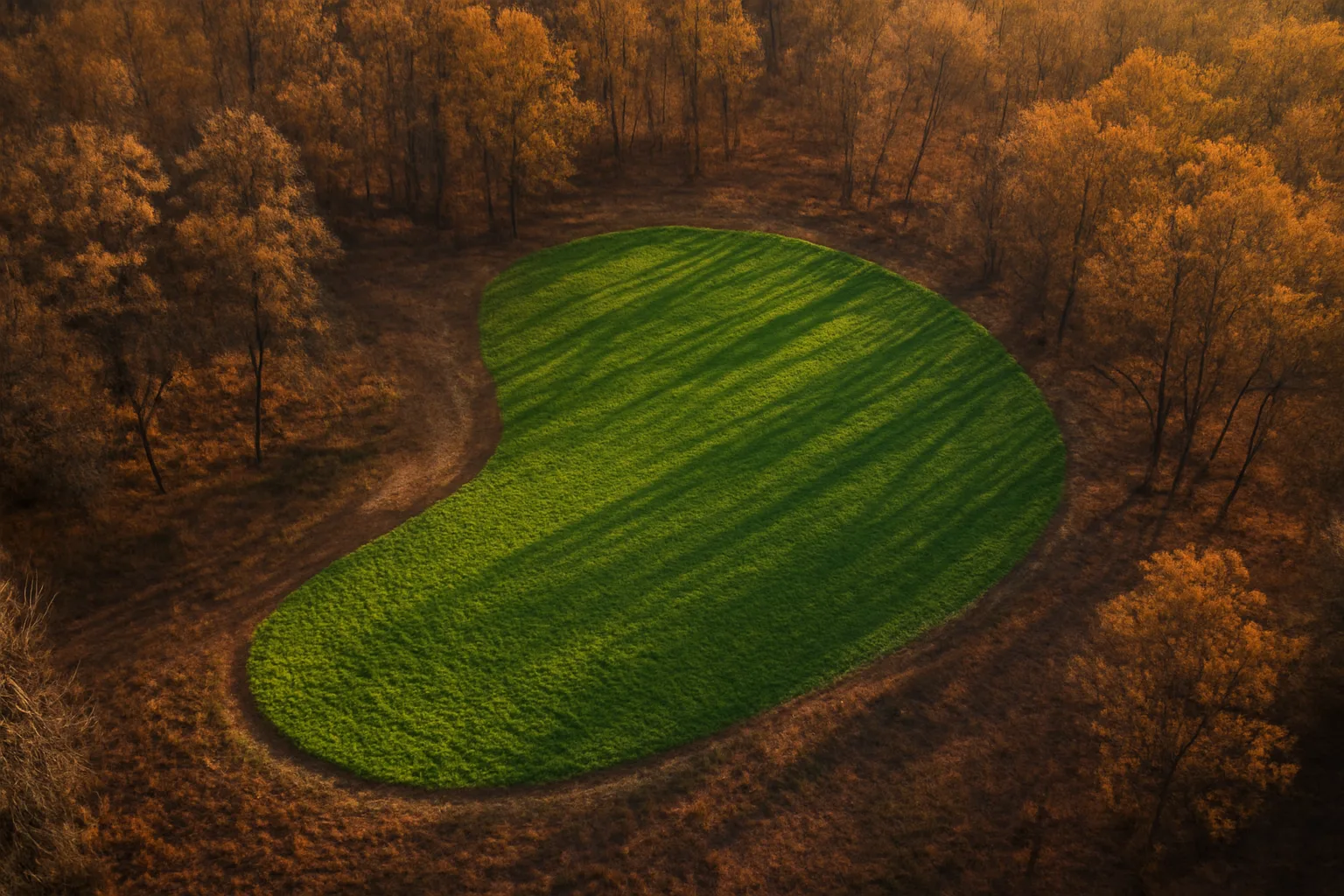
The best layout for hunting separates plots into two jobs: destination plots that pull deer from a distance, and kill plots that let you actually get a shot without blowing your access. Trying to make one field do both jobs is the most common design mistake. Destination or field plots run 1 to 5 acres or more, sit in open areas, and are meant to be visible and attractive from a distance, often food sources deer already know about from summer scouting cameras. You don't hunt these on the field edge in daylight if you can help it, because deer feel exposed in big open plots and tend to enter late. Kill plots (also called hunting plots or hidey-hole plots) run a quarter acre to half an acre, tucked inside timber or brush, shaped like a kidney bean or hourglass rather than a square. The point is a small, intimate feeding area within easy bow range of one or two stand or blind locations, positioned so a deer walking in during last light offers a shot before full dark. Narrow, curved shapes with cover on three sides work better than open rectangles because deer feel comfortable entering earlier. A lot of hunters do best with one bigger plot deer already know from summer, plus two or three small kill plots scattered through the interior timber near bedding, each with its own access route and wind consideration. This is the layout logic behind most whitetail food plot systems you'll read about in food plot whitetail planning guides.
how big should a food plot be?
There's no single right size. It depends on your hunting pressure, deer density, and whether the plot's job is to hold deer or just funnel them past a stand. As a rough range: kill plots run 1/4 to 3/4 acre. Destination or feeding plots run 1 to 5 acres. Larger properties sometimes plant 5 to 10-acre fields, but those start functioning more like farm fields than huntable plots unless you have elevated box blinds or long-range setups. Extension guidance from land-grant universities generally recommends sizing plots relative to deer density and browse pressure rather than a fixed acreage. Heavily browsed small plots, under a quarter acre, can get grazed down to nothing before they mature, especially with brassicas or soybeans that deer hit hard early, which is a well-documented pattern in wildlife food plot management extension literature [2]. A practical rule some managers use: if you're seeing plots get hammered to the dirt within 2 to 3 weeks of emergence, you need either more acreage, more plots, or a sturdier forage. Cereal grains and mature clover tolerate pressure better than young soybeans or brassicas.
how do wind and access shape the best layout?
Wind direction and your entry/exit route matter more than plot shape or species choice. A perfectly designed kidney-bean plot is worthless if you have to walk past bedding cover to reach your stand. Plan each plot around a dominant wind direction for the time of day you expect to hunt it. A stand you'll hunt in the evening usually needs a different wind plan than a morning-only plot. Position stands so your scent blows away from where deer are likely to approach, more than away from the plot itself, since deer often circle downwind of a field before committing. Access trails should approach from the downwind or crosswind side and use terrain or vegetation to break your silhouette. If you can only get to a stand by walking through the middle of the plot or straight through a bedding area, that plot's layout has failed regardless of what's planted in it. A lot of experienced plotters use two or three small plots on different aspects of a property specifically so they always have a huntable wind option, rather than one big plot that's only good on one wind direction.
what shapes actually work best for food plots?
Curved, irregular shapes beat straight-edged rectangles for hunting plots, almost across the board. Deer are edge animals. They like feeling cover close by while feeding. An hourglass or dogbone shape (two open bulges connected by a narrower pinch point) lets you put a stand at the pinch and cover both halves of the plot with one setup. A kidney or boomerang shape does something similar by keeping every point in the plot within easy bow range of an edge. Long, narrow plots (sometimes called finger plots) work well in timber because they mimic natural clearings and let more edge-loving forage species get sunlight while staying enclosed. Square or perfectly rectangular plots are the easiest to plant with a tractor and disc, but they're the least natural-feeling to deer and the hardest to hunt without deer feeling like they're standing in the open. If you're stuck with an existing rectangular field (common on leased farm ground), you can soften it by planting a screen of tall sorghum, sunflowers, or standing corn along one or two edges to break the open sightline and create a pinch point.
when to plant food plots for deer (by region)?
Planting dates depend on your USDA cold hardiness zone, your target forage, and whether you're planting a spring/summer plot or a fall plot. There's no single national date; extension services publish planting windows by state and region because frost dates vary by weeks even within one state. As a rough national framework: spring plots (clover, chicory, soybeans, cowpeas) go in after the last frost, generally April through June depending on latitude. Fall plots (brassicas, cereal grains, cereal grain and clover blends) go in 60 to 90 days before your first expected fall frost, which for most of the whitetail's range lands somewhere between late July and mid-September. The USDA Plant Hardiness Zone Map is the standard reference for matching planting windows to your specific location. Zones range from 1a (coldest) to 13b (warmest) based on average annual extreme minimum temperature. Southern zones (7 to 9) can plant fall brassicas into early October. Northern zones (3 to 4) often need to be in the ground by mid-August to get full maturity before hard frost. Check your local extension office's specific planting calendar, since they publish frost-date-based charts for your county, more than your state.
when to plant clover for deer, and do deer like clover?
Yes, deer like clover, and it's one of the most consistently used food plot forages nationwide. Clover is planted in spring (March through May in most zones) or late summer/early fall (August through September), and it's a perennial, meaning a well-maintained stand can produce for 3 to 5 years. White clover (including ladino types) and red clover are the two most common food plot clovers. Clover is highly palatable to white-tailed deer and, during active growth, commonly provides crude protein in the 25 to 30 percent range, which matters for antler growth and lactation in early summer, a pattern well established in forage quality research on legumes used in wildlife plantings [3]. Fall-planted clover has an advantage: less competition from summer annual weeds, and it establishes through fall and winter to be ready for heavy spring browsing. Spring-planted clover establishes faster in warm soil but faces more weed pressure. Clover needs a soil pH close to neutral, generally 6.0 to 7.0, to nodulate properly with the nitrogen-fixing bacteria that make it worthwhile as a low-input forage. That's exactly the kind of number your soil test will confirm or correct. Your soil-test lab is the final word on lime and fertilizer for your specific dirt, not any generic planting guide.
when to plant turnips for deer?
Turnips (a brassica) are planted in mid to late summer for fall and winter browsing, generally 80 to 90 days before your first hard frost. For most of the whitetail range that lands between mid-July (northern zones) and early September (southern zones). Turnips need that long runway because deer often ignore the leaves early and don't hit the bulbs hard until after the first hard frost converts starches to sugars, making them sweeter and more palatable. This is why turnip plots that look totally untouched in October can get hammered in December. Brassica plots, including turnips, rape, and radish blends, are commonly planted alongside cereal grains like oats or wheat, which gives deer a green, growing food source earlier in the fall while the brassica bulbs mature underground. Turnips tolerate a fairly wide pH range but do best in the 5.5 to 6.8 range per most extension brassica planting guides. Again, your soil test result is the deciding factor on lime rate, not a blanket number.
when to plant oats for deer, and do deer eat sorghum?
Oats are typically planted in late summer to early fall, usually 45 to 60 days before your first frost, so the same general window as brassicas but with more flexibility since oats grow fast and can be planted a bit later if needed. Oats are a cool-season cereal grain, extremely palatable to deer especially in the first 30 to 45 days after emergence when they're tender and high in sugar. Sorghum is different. Deer do eat sorghum, particularly grain sorghum heads once they mature, and standing sorghum is commonly used as both a food source and a screening/cover crop because it grows 5 to 8 feet tall and holds up well into winter. Grain sorghum is planted in late spring to early summer (after soil temperatures reach around 60°F), the same general window as corn, not the fall window used for oats or brassicas. Sorghum works especially well as a border planting around a kill plot: it screens the plot from view, breaks the wind, and still gives deer (and turkey, and other wildlife) something to eat through winter after the seed heads mature.
what are deer's favorite foods, and do deer like honey?
There's no single scientifically ranked 'favorite food' list for deer nationwide, because preference shifts by season, region, and what's locally available. But wildlife browse research consistently points to a short list of high-preference foods: acorns (especially white oak acorns), soybeans, clover, and other legumes rank at or near the top almost everywhere deer are studied. Whitetail food habits research finds that deer diets shift heavily toward acorns in fall when they're available, because of the high fat and carbohydrate content, then shift back to browse, forbs, and planted forages when acorns run out [4]. Soybeans, in both standing and forage form, are also consistently rated among the highest-preference food plot crops in regional forage preference trials. As for honey: there's no credible wildlife research showing deer seek out honey as a food source, and it's not a recognized food plot or attractant ingredient in any extension or state wildlife agency guidance. Deer are herbivores built to digest fibrous plant material through a four-chambered rumen. Honey isn't part of their natural diet or foraging behavior. Some commercial deer attractant sprays include sweet scents marketed loosely around 'honey' or sugar-based ingredients, but that's a scent-based curiosity product, not a food plot planting or forage strategy, and it has nothing to do with layout or agronomy.
how do you lay out multiple food plots across a whole property?
On a multi-plot property, the goal is coverage across wind directions, seasons, and deer travel patterns, more than planting every open field you have. Start by mapping bedding areas (thick cover, ridgetops, swamp edges) and travel corridors between bedding and known feeding areas, then place plots to intercept that movement rather than forcing deer to find a plot dropped in an arbitrary open spot. A common approach on a 40 to 200-acre property: one larger destination plot (1 to 3 acres) somewhere central or on a field edge that's visible from a distance, two or three small kill plots (a quarter acre or less) tucked into interior timber within 100 to 150 yards of bedding, and staggered species so something is attractive at different points in the season. Clover and cereal grain in one plot, brassicas in another, beans in a third. Stagger your planting dates too where your season length allows it. If every plot matures and peaks in palatability at the exact same time, you lose the ability to shift hunting pressure between plots as deer patterns change through the season. If you want a property-specific version of this kind of layout, that's the exact gap a $99 Custom Food Plot Plan is built to fill: it takes your acreage, region, and soil test and turns it into an actual plot map and species/timing plan rather than generic advice. It's general planning guidance based on what you provide, not a substitute for your soil-test lab's specific lime and fertilizer recommendations, and no plan can promise deer will show up on a given evening.
what mistakes ruin an otherwise good food plot layout?
The most common mistake is planting the plot where it's easiest to get equipment in, not where it's easiest to hunt without spooking deer. A flat, accessible field edge is convenient for the tractor and terrible for a bow stand. Second is ignoring soil test results and guessing on lime and fertilizer. Extension soil fertility guidance commonly notes that soil pH below about 5.5 can cut nutrient availability enough that even a well-fertilized plot underperforms, since low pH locks up nitrogen, phosphorus, and potassium regardless of how much you apply [5]. A basic soil test through your local extension office typically costs $6 to $20 and tells you exactly what your specific ground needs. Skipping it and guessing on lime is one of the most expensive mistakes a food plot budget can make. Third is planting one species in one plot and calling it done. Deer nutrition and preference shift through the season. A property with only clover has nothing extra to offer in late fall when brassicas or standing beans would still be feeding deer. Fourth, and this trips up a lot of new plotters, is forgetting legal limits. Some states classify certain food plot practices (standing crops harvested and piled, or supplemental feed placed near a plot) differently under baiting and feeding regulations, and rules vary significantly by state. Michigan's Department of Natural Resources, for example, regulates baiting and feeding of deer separately from standing food plots under its own state rules . Always check your state wildlife agency's current baiting and feeding regulations before combining a food plot with any supplemental feeding, since a legal food plot in one state can cross into an illegal baiting violation in another depending on how it's managed.
what equipment do you actually need to build these layouts?
For a quarter-acre to 2-acre plot, you can get by with an ATV or UTV, a small disc or tiller, a broadcast spreader, and a cultipacker or drag to firm the seedbed. A tractor with a box blade and disc harrow speeds things up significantly on bigger plots but isn't required for kill plots under an acre. Soil testing is the one piece of gear that isn't optional if you want the layout to actually perform. Most state land-grant universities run soil test labs for a small fee. A basic university soil test commonly runs somewhere around $9 to $20 depending on the panel and state, with results including pH, lime recommendation, and macronutrient levels . If you're planning multiple plots with different species and different soil conditions across the property, that's where a written plan pays for itself instead of guessing at fertilizer rates plot by plot. For seed selection specifically, guides like deer food plot seed and food plot seed break down which blends fit which layout role (kill plot vs. destination plot).
Frequently asked questions
Do deer eat sorghum?
Yes. Deer eat grain sorghum heads once they mature, and sorghum is also commonly planted as a tall screening crop around food plots since it grows 5 to 8 feet high. It's planted in late spring to early summer, the same general window as corn, not the fall window used for brassicas or oats.
Do deer eat clover, and do deer like clover?
Deer eat and generally prefer clover, especially white and ladino clover, which is a staple perennial food plot forage nationwide. Clover often runs 25 to 30 percent crude protein during active growth periods, making it valuable during antler growth and lactation in spring and summer.
When to plant deer food plots?
Timing depends on species and your USDA hardiness zone. Spring plots (clover, soybeans, cowpeas) go in after last frost, generally April through June. Fall plots (brassicas, cereal grains) go in 60 to 90 days before first frost, roughly late July through mid-September depending on latitude.
When to plant oats for deer?
Oats are planted 45 to 60 days before your first expected frost, usually late summer to early fall. Oats grow fast and are highly palatable to deer in the first 30 to 45 days after emergence, so they're often paired with slower-maturing brassicas in the same plot.
When to plant turnips for deer?
Turnips need 80 to 90 days before your first hard frost, so plant them mid-July (northern zones) through early September (southern zones). Deer often ignore turnip tops early and don't hit the bulbs hard until after a hard frost sweetens them, so don't judge the plot before winter.
What is a food plot?
A food plot is a planted area, typically a quarter acre to several acres, of forage or grain established specifically to feed and attract deer or other wildlife rather than as a commercial crop. The USDA NRCS funds food plot seedings in many states as a wildlife habitat conservation practice through programs like EQIP.
What are deer's favorite foods?
There's no single ranked list nationwide, but research consistently shows acorns (especially white oak), soybeans, and clover rank among the highest-preference foods across most of the whitetail's range. Preference shifts seasonally; deer often switch heavily to acorns in fall when available, then back to browse and planted forages.
Do deer like honey?
No credible wildlife research shows deer seek out honey as a food source, and it isn't used in any recognized food plot planting strategy. Deer are herbivores adapted to digest fibrous plants through a four-chambered rumen. Some scent-based attractant sprays reference honey or sugar, but that's unrelated to plot layout or agronomy.
How big should a kill plot be versus a destination plot?
Kill plots (hunted at close range from a stand or blind) generally run 1/4 to 3/4 acre. Destination or field plots meant to pull deer from a distance run 1 to 5 acres or more. Mixing both types across a property gives you more hunting options across different wind directions.
What shape food plot is best for bowhunting?
Curved shapes like a kidney bean, hourglass, or dogbone work better than straight rectangles because they keep every point in bow range of an edge and feel more enclosed to deer entering at dusk. A narrow pinch point in the middle is a good spot for a single stand covering both halves.
Do I need a soil test before planting a food plot?
Yes, strongly recommended. A basic soil test through your state land-grant extension lab typically costs $6 to $20 and tells you your exact pH and nutrient levels. Soil pH below about 5.5 can lock up nutrients regardless of fertilizer applied, so skipping the test risks wasting your fertilizer budget.
Is baiting or supplemental feeding near a food plot legal?
It depends entirely on your state. Some states, like Michigan, draw a legal line between a standing planted food plot and piled or spread supplemental feed, treating them very differently under baiting regulations. Always check your specific state wildlife agency's current baiting and feeding rules before combining the two practices.
Sources
- USDA Natural Resources Conservation Service, Environmental Quality Incentives Program: USDA NRCS funds food plots and wildlife habitat practices through EQIP in many states
- USDA Natural Resources Conservation Service Plant Guide, White Clover (Trifolium repens): clover crude protein commonly runs in the 25 to 30 percent range during active growth
- University of Tennessee Extension Publication W346, Soil Fertility Recommendations for Wildlife Food Plots: soil pH below about 5.5 can significantly reduce nutrient availability in food plots
- Michigan Department of Natural Resources, Wildlife Conservation Order baiting and feeding provisions: baiting and supplemental feeding rules vary significantly by state and can differ from food plot rules
- Penn State Agricultural Analytical Services Laboratory, Standard Soil Test Fee Schedule: a basic soil test through a land-grant extension lab runs roughly $9 to $20