Last updated 2026-07-26
TL;DR
Cereal grains (oats, winter rye), clover, and brassicas like turnips do best on rocky soil because their roots handle thin, shallow ground and they need less tillage. Skip corn and soybeans on rocky sites; they need deep, workable soil and heavy equipment that rock ledges will wreck. Soil test first, then match species to what your test says you're working with [1].
why is rocky soil so hard for food plots
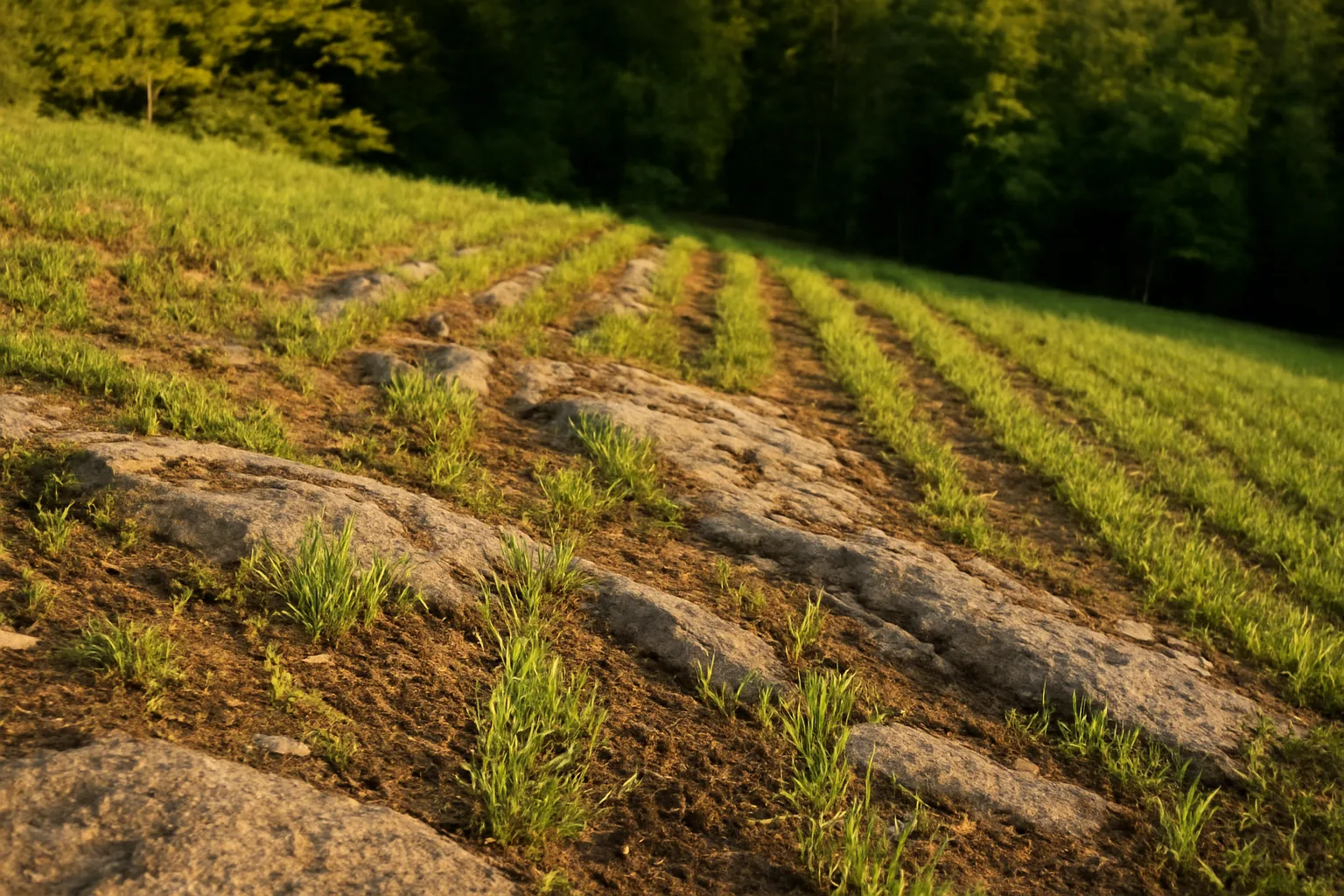
Rocky ground fights you in three ways: it wrecks equipment, it holds less water, and it usually has less organic matter and a lower cation exchange capacity than deep bottomland soil. That last part matters more than people think. Soil with lots of rock fragments and shallow topsoil can't hold nutrients or moisture the way a loam or clay-loam field can, so whatever fertility you add tends to leach or wash off faster [1]. Equipment is the obvious problem. Disc harrows, plows, and no-till drills all take a beating on ledge rock or fields full of glacial till. A lot of guys find out the hard way that a $3,000 no-till drill doesn't love hitting granite six inches down. This is why so many rocky-soil plots end up planted with hand broadcasters, ATV spreaders, or light disc work instead of full tillage. Water is the other issue. Rocky soil, especially on slopes or ridges, drains fast and dries out fast. That's a problem for anything with a deep taproot that needs consistent moisture to get established, like soybeans in their first few weeks. It's less of a problem for species that germinate quick and don't need deep, uniform seed placement. None of this means you can't grow a good plot on rocky ground. It means you pick species that work with shallow, fast-draining soil instead of fighting it, and you get a soil test before you spend a dime on seed or lime.
what is a food plot, and does rocky soil change the goal
A food plot is a planted area, usually somewhere between a quarter acre and several acres, that's seeded with forage or grain specifically to feed and hold deer (and often turkey, elk, or other wildlife) on a property. Cooperative extension programs describe them as a wildlife management tool used alongside habitat work like timber stand improvement and native browse management, not a replacement for it [2]. On rocky ground, the goal doesn't change, but the expectations should. You're not trying to grow a 4-acre soybean field that looks like Iowa. You're trying to get consistent, low-maintenance tonnage out of ground that will always be tougher to work. That usually means smaller plots, more of them, and species picked for resilience over yield ceiling. A lot of rocky-soil landowners do better with several half-acre to one-acre plots tucked into pockets of decent dirt (old logging landings, ridge saddles, benches) than one big plot forced onto a field that's 40% exposed rock. Read the ground first. Walk it. Rock content isn't always uniform across a field.
what's the best food plot mix for rocky soil
| Winter rye / cereal rye | Minimal, can broadcast into rock | High | Most forgiving grain for thin soil | |
|---|---|---|---|---|
| Oats | Minimal | High | Fast germination, winterkills in cold zones | |
| Clover (white, red) | Low once established | Moderate-high | Needs decent lime/pH, spreads to fill gaps | |
| Turnips / brassicas | Low-moderate | Moderate-high | Shallow-rooted types do fine, deep-taproot varieties struggle in shallow ledge soil | |
| Soybeans | High (needs seed-to-soil contact, deep prep) | Low | Needs deeper, workable soil and consistent moisture | |
| Corn | Very high | Very low | Needs deep tillage and fertility most rocky sites can't support economically | If you're planting your first rocky-ground plot, start with an oat/clover or rye/clover mix. It's cheap, it's forgiving of a bad seedbed, and it gives you both a fast fall food source and a perennial base for years two and three. |
For most rocky-soil situations, a mix of a cereal grain (oats or winter rye) with a brassica (turnip or radish) and a perennial clover blend covers your bases better than any single species. Cereal grains germinate fast, tolerate shallow soil, and give you quick tonnage. Brassicas add fall attraction and don't need deep tillage since a lot of the nutrition (leaves, and eventually bulbs) sits at or near the surface. Clover, once established, spreads and fills in thin spots that grain alone would leave bare. Here's how the common species stack up on rocky, shallow-soil ground specifically: | Species | Tillage need | Rocky soil tolerance | Notes |
do deer like clover, and is it worth planting on rocky ground
Yes. Clover is one of the most consistently preferred forages in whitetail diet research, and it holds up reasonably well on rocky soil once it's established. The catch with clover on rocky ground is establishment, not survival. Clover seed is tiny and needs good seed-to-soil contact plus a pH close to 6.0 to 6.5 to nodulate well and fix nitrogen. Rocky, thin soils are often more acidic and lower in calcium than deep loam, so a lime application based on your soil test is usually non-negotiable here, not optional [3]. Once clover is established (usually the second growing season), its root system does fine working around rock fragments, and it out-competes a lot of weeds on marginal ground. If you're planting a perennial plot in rocky soil, clover paired with a little chicory is a solid, low-cost long-term option. Just budget for lime up front.
do deer eat sorghum, and does it work in rocky soil
Yes, deer eat grain sorghum, and it's used both as a food plot component and as a standing winter food source in some regions, particularly in the South and parts of the Midwest. It's more drought-tolerant than corn, which sounds like a fit for thin, fast-draining rocky ground. But sorghum still wants a reasonably worked seedbed and warm soil temperatures (generally above 60 degrees F) to germinate well, and it doesn't tolerate heavy rock content in the top few inches the way oats or rye does. In practice, most rocky-soil landowners get better return from cereal grains and brassicas than from sorghum, which tends to perform best on the same deep, tillable ground that corn and soybeans want. If you've got a pocket of deeper soil within a rocky property, sorghum is a reasonable warm-season option, especially as summer cover and a fall/winter grain source. On the ledge-rock sections, skip it.
when to plant food plots for deer
Timing depends on your region and whether you're planting a warm-season or cool-season plot, and rocky soil doesn't change the calendar much, just the prep work leading up to it. As a general framework, cool-season plots (clover, brassicas, cereal grains) go in from late summer into early fall, roughly six to eight weeks before your area's first hard frost, so plants establish before growth slows. Warm-season plots (soybeans, sorghum, some annual clovers) go in after your last frost date in spring, once soil temperatures are consistently warm enough for germination. Because exact frost dates vary by 4 to 6 weeks across latitude and elevation, check your state's cooperative extension planting calendar or your local NOAA frost date data rather than relying on a generic national calendar. A plot planted right on a Tennessee date will fail badly if you're on a Minnesota calendar.
when to plant oats for deer
Oats are typically planted in late summer to early fall for a fall food plot, generally 6 to 8 weeks before your first expected frost, which gives plants time to establish a root system and put on leaf growth before cold weather slows them down. In many whitetail range states that lands somewhere between mid-August and mid-September, but check your local extension office for your specific date range. Oats can also be planted in early spring in some regions for a short-season spring/summer plot, but fall planting for fall and early-winter attraction is by far the more common use in food plot programs. On rocky soil specifically, oats are one of the most forgiving grains you can plant because they germinate fast, don't need deep seed placement, and tolerate a rough, rocky seedbed better than almost anything else on this list. A light disc pass or even just a drag-and-cultipack after broadcasting is often enough.
when to plant turnips for deer
Turnips are a fall/winter brassica, planted in late summer, typically 60 to 90 days before your first expected fall frost so the plant has time to grow leaves and bulb before it's needed as a cold-season food source. In much of the whitetail's range that means a planting window from late July through early September, adjusted for your latitude. Turnips get sweeter and more attractive to deer after a couple of hard frosts convert starches to sugars, which is why they're often at their best in November and December rather than right after planting. On rocky ground, turnips generally do fine as long as there's at least a few inches of workable soil at the surface. The bulb doesn't need to go deep, and a lot of the plant's food value to deer is in the leafy top growth anyway, which doesn't care much about rock underneath it.
do deer like turnips, brassicas, and what's their real preference order
Deer preference for brassicas is highly seasonal and regional, and it's one of the more misunderstood parts of food plot planning. Early in the season, deer often ignore turnips and other brassicas almost entirely, then switch to hammering them hard after the first couple of frosts once sugar content rises. That's a normal pattern, not a sign of a failed plot. There's no single definitive ranked list of deer's absolute favorite foods, because preference shifts by region, season, and what else is available (acorn crops in a given year change everything). Cooperative extension research generally groups high-preference whitetail foods into a few categories: agricultural crops like soybeans and corn, browse like honeysuckle and greenbrier, forbs like clover and alfalfa, and, seasonally, mast like acorns [2]. Clover and soybeans consistently rank as high-preference cultivated forages in most of these studies, with brassicas rated as moderate-to-high, especially in the late season. If you're planning a rocky-ground property, don't chase a single 'best food' species. Build a mix that covers early season (clover, soybeans if soil allows), mid to late season (brassicas), and understand that acorn availability in a heavy mast year will pull deer off your plot no matter what you planted.
do deer like honey, and is it worth using in a food plot
There's no research support for deer being drawn to honey specifically, and it's not a practical or, in many states, legal food plot input anyway. Deer are drawn to sugar and carbohydrate-dense foods generally (which is part of why frost-sweetened brassicas and corn are attractive), but honey itself isn't a documented attractant in wildlife management literature, and pouring it out or using it as bait crosses into feeding and baiting regulations in a lot of states. Many states restrict or fully prohibit baiting and supplemental feeding of deer, particularly during hunting season, and the rules vary a lot state to state, sometimes even by county due to chronic wasting disease management zones. Before you use any attractant product, mineral lick, or supplemental feed, check your state wildlife agency's current baiting and feeding regulations, since violating them can carry real penalties and jeopardize your hunting privileges. Skip the honey. Put that effort into a clover or brassica plot instead; it'll do more for deer nutrition and it won't put you at risk of a citation.
how do you actually prep and plant rocky ground without breaking equipment
The trick on rocky soil is minimizing tillage, not maximizing it. A lot of guys assume they need to plow or deep-till rocky ground to break it up, but that's exactly what tears up equipment and exposes more rock to the surface. Extension guidance on food plot establishment generally favors reduced tillage or no-till approaches on marginal or rocky sites specifically because they preserve what topsoil structure exists and reduce erosion risk [1]. A realistic rocky-ground planting sequence looks like this: spray or mow existing vegetation, broadcast your seed (don't try to drill it into ledge rock), then run a light drag, cultipacker, or ATV chain harrow over the top to get seed-to-soil contact without digging deep. For small seeds like clover, a cultipacker pass before and after broadcasting helps a lot. For grains like oats and rye, seed-to-soil contact matters less; they'll germinate reasonably well even with a rough broadcast-and-drag approach. If you've got a spot with genuinely too much exposed rock to work at all, don't force it. Move the plot boundary to the adjacent pocket of deeper soil, even if that shrinks the plot by half an acre. A smaller plot that actually establishes beats a bigger one that's 30% bare rock by October. For a full breakdown of species options across plot types, food plot whitetail covers the broader picture, and deer food plot seed goes deeper on specific seed blends worth considering.
how does soil testing change your plan on rocky ground
A soil test is more important on rocky ground than on good bottomland, not less, because thin, rocky soils are more likely to be acidic, low in organic matter, and low in phosphorus and potassium, and you need real numbers before you spend money on lime or fertilizer. Cooperative extension soil testing labs typically report pH, phosphorus, potassium, and organic matter, along with lime and fertilizer recommendations specific to the crop you plan to plant [3]. Most food plot species, including clover, want a pH in the 6.0 to 7.0 range for good nutrient uptake. If your rocky soil comes back at 5.0 or 5.2, which isn't unusual on ridge and upland sites, you're not going to get a good clover stand no matter how good the seed is until you address that with lime, and lime takes months to fully react in the soil, so it needs to go down well ahead of planting, ideally the season before. Your soil test lab's specific lime and fertilizer recommendation is the authority here, not a generic online chart. Different labs calibrate recommendations differently based on your regional soil type and the crop you list on the test form, so follow what your test actually says rather than a rule of thumb from a forum post. This is also where a general planning tool has real limits. A $99 Custom Food Plot Plan (available at /plot-plan-builder) can help you turn a soil test and your property's basics into a species and seeding plan, but it's general guidance built from your inputs, not a substitute for your lab's site-specific agronomy recommendation, and no plan can promise deer activity or a harvest.
what should your rocky-soil planting calendar actually look like
Because rocky ground often sits on ridges, upland benches, or thinner-soil pockets that warm and cool differently than bottomland, it helps to build your calendar around your specific site's frost dates rather than a one-size-fits-all national chart. A general rocky-soil food plot calendar looks like this: - Late spring (soil test season): pull a soil sample as soon as ground is workable, send it in, get your lime and fertilizer numbers back before summer.
- Early to mid-summer: apply lime if recommended (it needs lead time to raise pH before fall planting).
- Late summer (6-8 weeks pre-frost): plant oats, winter rye, clover, and brassicas for the fall/winter plot.
- Fall: monitor brassica sweetening after first frosts, spot-check clover establishment.
- Following spring: if you're adding a warm-season component on a deeper-soil pocket, plant after last frost. For species-specific blends built around this kind of calendar, deer food plots and food plot seed walk through mix options in more depth.
Frequently asked questions
Do deer eat sorghum in food plots?
Yes. Deer readily eat grain sorghum, and it's used as both a plot crop and standing winter forage, especially in the South. It's more drought-tolerant than corn but still needs decent tillable soil and warm temperatures to germinate, so it's less reliable than oats or rye on genuinely rocky ground.
Do deer eat clover, and is it a good rocky-soil choice?
Yes, clover is a preferred, high-protein forage deer use spring through fall. It handles rocky soil fine once established, but needs a pH near 6.0-6.5 and good seed-to-soil contact to get started, so lime application based on a soil test matters a lot on acidic rocky ground.
When should you plant food plots for deer?
Cool-season plots (clover, oats, brassicas) go in roughly 6-8 weeks before your area's first hard frost. Warm-season plots (soybeans, sorghum) go in after your last spring frost. Exact dates vary by 4-6 weeks depending on latitude and elevation, so check your state cooperative extension's planting calendar for your specific zone.
Do deer like clover more than other food plot forages?
Clover consistently ranks as a high-preference forage in extension research, alongside soybeans and alfalfa, but 'favorite' shifts by season and region. Deer often prefer clover in spring and summer, then shift toward mast (acorns) and brassicas in fall, so preference isn't fixed across the year.
When do you plant oats for deer food plots?
Oats are typically planted in late summer to early fall, about 6-8 weeks before the first expected frost, giving them time to establish before cold weather. Some regions also support a spring oat planting for a short-season summer plot, but fall planting is far more common in whitetail food plot programs.
When should you plant turnips for deer?
Turnips go in the ground roughly 60-90 days before your first expected fall frost, usually late July through early September depending on latitude. They get sweeter and more attractive after a couple of hard frosts convert starches to sugar, so peak deer use often comes in November and December, not right after planting.
What exactly is a food plot?
A food plot is a planted area, typically a quarter acre to several acres, seeded with forage or grain crops specifically to feed and hold deer or other wildlife on a property. It's used alongside broader habitat management like timber stand improvement, not as a standalone substitute for good habitat work.
What are deer's favorite foods overall?
There's no single fixed 'favorite food' list; preference shifts by season, region, and mast availability. Extension research groups high-preference foods into agricultural crops (soybeans, corn), browse (honeysuckle, greenbrier), forbs (clover, alfalfa), and seasonal mast (acorns), with clover and soybeans consistently ranking high among cultivated options.
Do deer like honey or sugar-based attractants?
There's no research support for honey specifically as a deer attractant, and pouring it out often crosses into baiting or feeding regulations, which vary widely by state and sometimes by county due to CWD management zones. Check your state wildlife agency's current rules before using any attractant or supplemental feed product.
What's the best food plot seed for rocky, thin soil?
Cereal grains like oats and winter rye are the most forgiving for rocky soil because they germinate fast and don't need deep seed placement. Pair them with clover for a perennial base and brassicas like turnips for late-season attraction. Corn and soybeans generally struggle on genuinely rocky ground.
Do you need to till rocky soil before planting a food plot?
No, and you usually shouldn't try to deep-till it. Extension guidance favors reduced or no-till approaches on rocky, marginal ground: spray or mow existing growth, broadcast seed, then run a light drag or cultipacker over the top rather than plowing, which risks equipment damage and more exposed rock.
How much lime does rocky soil usually need for a food plot?
It depends entirely on your soil test results; rocky, upland soils are often more acidic than bottomland, sometimes testing in the 5.0-5.5 pH range, well below the 6.0-7.0 most food plot species want. Your soil test lab's specific lime recommendation is the authority here, since rates vary by soil type and target crop.
Sources
- University of Tennessee Extension, Soil Sampling for Fields and Gardens: Soil testing provides pH, nutrient levels, and lime/fertilizer recommendations specific to the planned crop
- USDA NRCS Soil Health Technical Note, Soil Organic Matter: Soil organic matter and structure affect water and nutrient holding capacity, which is lower in thin, rocky soils
- Mississippi State University Extension Publication 2111, Wildlife Food Plots for Deer and Turkey: Food plots are a wildlife management tool used alongside habitat practices, not a replacement for habitat management
- USDA NRCS Plant Guide, Cereal Rye (Secale cereale): Cereal rye establishes well on marginal soils with minimal tillage
- University of Tennessee Extension, Establishing Wildlife Food Plots: Clover is a preferred, high-protein forage used by deer through spring, summer, and fall