Last updated 2026-07-26
TL;DR
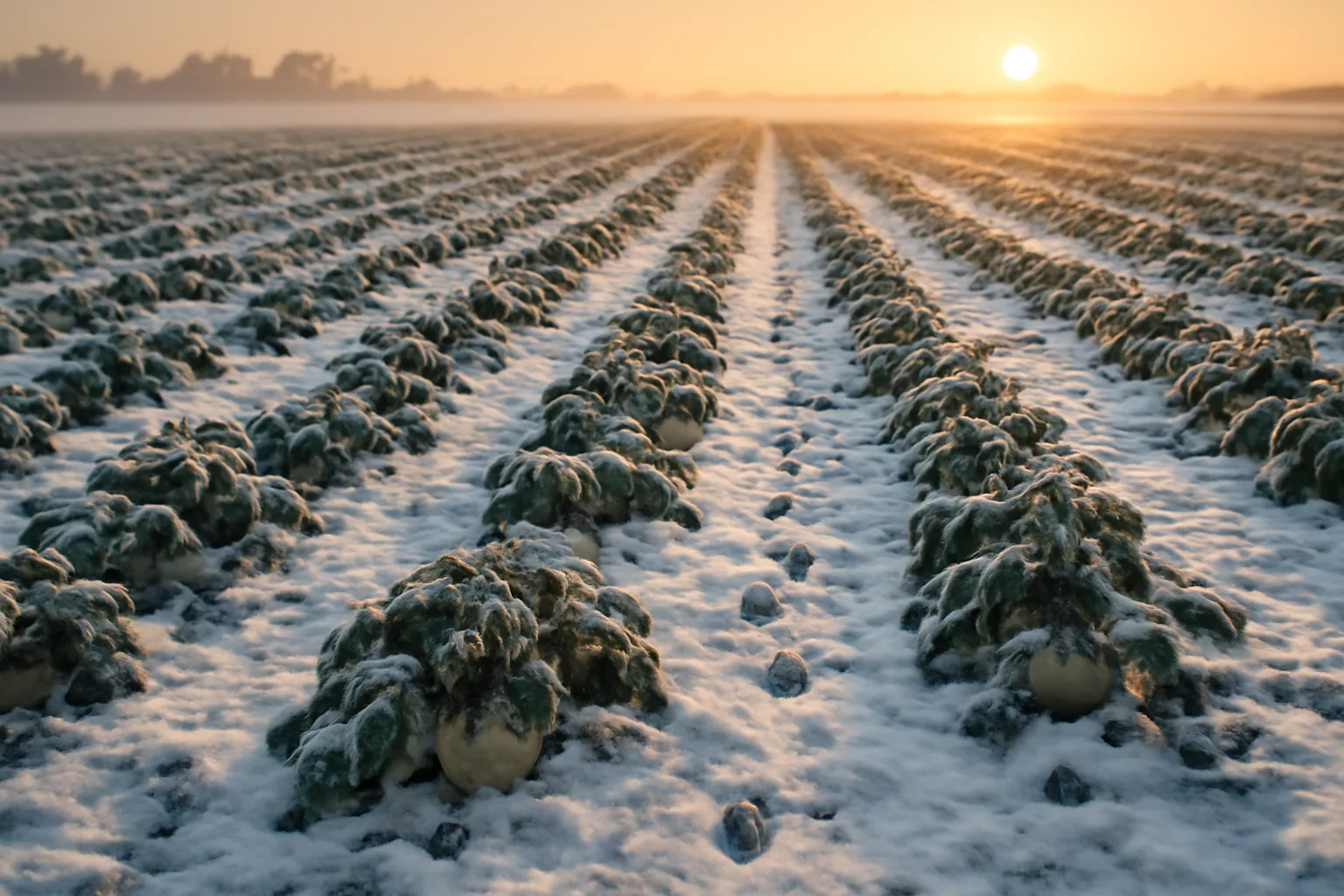
The best winter food plot combines brassicas (turnips, radish) with cereal grains (oats, wheat, winter rye) and a perennial clover base. Brassicas get sweeter after hard frost as starches convert to sugar, cereal grains stay green under snow, and clover regrows in early spring. Plant 60 to 90 days before your first killing frost for peak winter draw.
What actually makes a food plot good for winter deer?
A winter food plot has to do two things at once: stay palatable after repeated hard frosts, and keep producing tonnage late into the season when deer need calories most. That rules out a lot of warm-season options. Soybeans and cowpeas get hammered by the first frost and turn to mush. Corn holds up structurally but offers mostly starch, not the sugar spike deer key in on during cold snaps. Brassicas (turnips, radishes, kale) are the classic winter answer because freezing temperatures trigger the plant to convert starches into simple sugars, a survival mechanism for the plant that happens to make the leaves and bulbs taste sweeter to deer. Cereal grains like oats, wheat, and winter rye do something similar with sugars in the leaf blade, and they also stay green and accessible under a few inches of snow, which brassicas can struggle with once bulbs freeze solid. The honest answer for "best" is a blend, not a single species. A plot that's 60 percent brassica and 40 percent cereal grain, or a three-way mix with clover worked in as a perennial base, gives you a fall attraction phase, a post-frost sugar phase, and green groceries into December or later depending on your zone. For a broader rundown of species and how they stack up against each other, see food plot whitetail.
Do deer eat sorghum?
Yes, deer eat sorghum, particularly grain sorghum (milo) heads, but it's a secondary or filler species rather than a top winter draw. Deer will browse young sorghum leaves and will eat the grain heads once they mature and dry down. Sorghum is more drought-tolerant than corn in dry regions, which is one reason it shows up in some Midwest and southern blends. Where sorghum earns its keep is as cover and a slow-release food source standing through winter. The stalks stay upright longer than corn in some conditions, and deer and turkey both work the dropped grain through late winter. Compared to a brassica or cereal grain plot, sorghum isn't a preferred, high-sugar attractant in cold weather. Treat it as a supplement to a corn or grain sorghum block meant for winter cover and slow-drip calories, not your primary winter attraction plot.
Do deer eat clover, and do deer like clover?
Deer eat clover heavily, and yes, deer like clover. It's consistently one of the most preferred forages in food plot research and one of the most planted perennial species in the country. Clover is high in protein (often 25 to 30 percent crude protein in vegetative growth) which matters most in spring and summer for antler growth and lactation, less so as a winter attractant once growth slows and goes dormant in cold climates. In the Deep South and parts of the transition zone, clover keeps growing through winter and stays a strong food source all season. Further north, clover goes dormant under freezing temperatures and snow cover, so it's not doing much work in a January cold snap in Minnesota or Wisconsin. That's why most winter-specific plot plans pair clover (as the perennial backbone) with an annual brassica or grain overseed for the coldest months. White clover varieties like Durana and Ladino are the most common perennial choices. If you want a plot that pulls double duty, spring/summer protein and fall attraction, clover interseeded with a fall grain is a common combination worth reading up on in deer food plots.
When to plant food plots for deer (and when to plant for winter specifically)?
Timing depends entirely on what you're planting and your first frost date, not a fixed calendar date. As a rule of thumb, most fall/winter annuals (brassicas, cereal grains) go in the ground 60 to 90 days before your area's average first killing frost, which gives plants enough time to establish a root system and put on leaf mass before growth slows. In the Upper Midwest and northern tier states, that often means planting brassicas and cereal grains from mid-July through mid-August. In the transition zone (Kentucky, Tennessee, southern Missouri), late August through mid-September is typical. In the Deep South, growers can often wait until September or even into October since frost comes much later or not at all in some areas. Perennial clover and alfalfa plantings are more flexible and can go in spring or late summer/early fall, as long as you avoid the hottest, driest stretch of summer for germination. Purdue Extension's food plot guidance recommends checking soil temperature and moisture before any planting date, since a technically "on time" planting into dry, hot soil will underperform a slightly late planting that catches a rain window [1]. The best move is working backward from your local first frost date, which you can find from NOAA's Climate Normals data or your state Extension office, then counting back 60 to 90 days depending on species.
When to plant oats for deer?
Plant oats for deer 60 to 75 days before your area's first hard frost, which for most of the whitetail range falls between mid-August and mid-September. Oats germinate fast (often within 7 to 10 days in warm soil) and put on rapid leaf growth, which is exactly what you want for a plot that needs to be attractive and grazeable within a few weeks of planting. Oats are one of the least frost-hardy cereal grains, generally losing palatability and dying back around 10 to 20 degrees Fahrenheit depending on growth stage, which is a real limitation compared to winter wheat or winter rye. That makes oats a great early-to-mid fall attractant and a poor choice if your goal is a plot that survives a hard January freeze on its own. Many growers blend oats with wheat or triticale specifically so the oats provide early fall pull and the more cold-hardy grain takes over once temperatures crash.
When to plant turnips for deer?
Turnips need roughly 80 to 90 days from planting to reach a mature bulb, and growers typically time planting so that maturity lines up with the first hard frosts of fall, since freezing temperatures are what sweeten the leaves and bulbs. For most of the Midwest and Northeast, that puts planting dates in the last two weeks of July through mid-August. In the transition zone, growers usually plant turnips in August. In the Deep South, growers can wait until September. One mistake shows up constantly: planting turnips too late. If turnips don't have those 80 to 90 days before a hard freeze locks up growth, you end up with small bulbs and thin leaf mass, exactly when you need tonnage most. If you're planting a turnip-heavy blend, err on the early side of your window rather than the late side. Turnip leaves get browsed hardest in fall, right after the first frosts hit. The bulbs themselves often don't get eaten until later in winter, sometimes not until after several freeze-thaw cycles have fully converted the starches, and in snow country deer will paw through several inches of snow to get at bulbs once other food is scarce.
What is a food plot?
A food plot is a planted area, usually somewhere between a quarter acre and several acres, established specifically to provide supplemental forage for deer or other wildlife on hunted or managed land. Food plots aren't a natural feature; they're an agricultural planting, typically annual grains, brassicas, or legumes, put in specifically to concentrate deer activity, improve nutrition, or both. Food plots serve two overlapping goals depending on who's planting them: nutrition plots (usually clover, alfalfa, or soybeans planted in larger acreages to support herd health through spring and summer) and hunting plots (smaller, strategically placed plots, often brassica or grain, meant to draw deer into bow or gun range during hunting season). Many properties run both, with a big clover field for summer nutrition and a scattering of small brassica plots tucked near stand locations for fall and winter hunting. State wildlife agencies generally regulate food plots differently from baiting or feeding, since a planted, rooted crop is treated as normal agriculture rather than an artificial feed pile, but the specifics vary by state. Some states draw a hard legal line between a growing food plot (legal) and a plot that's been mowed down and left as loose grain on the ground (which some states classify as baiting). Check your state wildlife agency's regulations before hunting over any plot that's been cut, mowed, or otherwise manipulated, since rules differ significantly state to state [2].
What are deer's favorite foods, ranked for winter?
| Brassicas (turnip, radish, kale) | High | Sugar content spikes after hard frost | |
|---|---|---|---|
| Winter wheat / cereal rye | High | Stays green under snow, cold-hardy | |
| Standing corn/soybeans | Moderate-high | High energy, but often depleted by winter | |
| Clover (dormant in cold zones) | Low-moderate | Great spring/summer, weak in deep winter cold | |
| Acorns (mast) | High where available | Natural fall/winter staple, unpredictable year to year | |
| Sorghum/milo | Moderate | Secondary grain source, slow-release | Acorns deserve a special mention. In years with a strong mast crop, deer will often bypass planted plots entirely in favor of white oak and red oak acorns, which are calorie-dense and require zero planting. Mast crops are inconsistent year to year though, and a poor acorn year is often when your food plot gets hit hardest, which is part of why plot planning has to account for what the surrounding woods are (or aren't) producing. For species comparisons and how to build a rotation across your whole property, deer food plot seed covers blend options in more depth. |
There's no single universal "favorite." Deer preference shifts by season, region, and what's available, but research and decades of plot data point to a fairly consistent winter hierarchy. Below is a rough ranking based on typical winter attraction and known nutritional value, not a promise for your specific property. | Food source | Winter attraction | Why |
Do deer like honey?
Deer don't seek out honey in the wild and it isn't a realistic food plot or attractant ingredient. Deer are herbivores built to digest cellulose and plant sugars through a four-chambered rumen, not concentrated sugar syrups. Some commercial deer attractant products use sweet scents or syrups (including molasses-based products) as a scent lure rather than a nutritional food source, and anecdotally deer will sometimes investigate or lick a sweet scent, but this is fundamentally different from a food plot planting. If you're looking for something that delivers a genuine sugar draw the way people assume honey might, that's exactly the role brassicas play after a hard frost, or molasses-treated mineral products where legal. Check your state's regulations on minerals and attractants before using any product in the field, since several states restrict or ban supplemental feeding and mineral use, especially in areas managing Chronic Wasting Disease [3].
Which single species wins if you can only plant one thing?
If forced to choose exactly one species for a winter-focused plot, most experienced plot managers land on a brassica, usually a forage turnip or a turnip/radish blend, because of the combination of tonnage per acre, frost-triggered sugar conversion, and the fact that bulbs stay available even after leaves are stripped. A well-established brassica plot can produce several tons of forage per acre under good conditions, though yields vary hugely with soil fertility, rainfall, and variety. But "one species" is rarely the right real-world answer. A pure brassica stand that gets hit hard in October can be picked clean of leaves by December, leaving only bulbs, which some deer herds are slower to key in on, especially in areas without a strong brassica-feeding tradition in the local herd. That's the practical argument for blending in a cereal grain: it's an insurance policy against a single-species plot getting wiped out early. Soil test results matter more here than species choice. Brassicas are heavy nitrogen feeders and respond dramatically to proper fertility, and a soil test through your state Extension service or a private ag lab will tell you exactly what your specific field needs in terms of lime and NPK, information a generic planting guide can't give you. Your soil test lab is the real authority on your field's lime and fertilizer needs. Treat any blanket recommendation, including this one, as a starting point.
How do you actually build a winter plot plan for your property?
Start with your frost date and work backward, then layer in a soil test, then pick a blend that matches your region and your goals (attraction vs. nutrition vs. both). Skipping the soil test is probably the single most common mistake. A $99 field-specific lab test tells you your exact pH and nutrient levels, and pH below about 6.0 will meaningfully suppress nutrient uptake for both brassicas and clover regardless of how much fertilizer you put down, according to Extension guidance on food plot soil management. Once you have a soil test back and a target planting window, a lot of the guesswork disappears. This is the exact gap a $99 one-time Custom Food Plot Plan is built to close: you plug in your location, your soil test numbers, and your goals, and get a specific seed blend, planting date window, and fertility recommendation back, instead of guessing from a generic bag-of-seed label. It's general guidance built around your inputs, not a substitute for your soil lab's specific lime and fertilizer recommendations, and nobody can promise deer activity or a harvest. For a walkthrough of the full plot-building process from seed selection to equipment needs, deer for food and food plot seed are worth reading alongside your soil test results.
Frequently asked questions
Do deer eat sorghum?
Yes. Deer browse young sorghum leaves and eat mature grain heads, and sorghum is more drought-tolerant than corn. It's usually a secondary winter food source though, not a top attractant like brassicas or cereal grains, and works best as standing cover with slow-release grain through late winter.
Do deer eat clover, and do deer actually like it?
Deer eat clover heavily and prefer it strongly during spring and summer, when its 25 to 30 percent crude protein content supports antler growth and lactation. In cold northern climates clover goes dormant in winter, so it's a weaker winter draw there than in southern regions where it keeps growing.
When should you plant food plots for deer?
Time planting to your first frost date: most fall annuals like brassicas and cereal grains go in 60 to 90 days before that date, meaning mid-July to mid-September across most of the whitetail range. Perennials like clover are more flexible and can go in spring or late summer.
When do you plant oats for deer?
Plant oats 60 to 75 days before your first hard frost, typically mid-August to mid-September for most regions. Oats germinate fast but aren't very cold-hardy, dying back once temperatures drop into the teens or single digits, so many growers blend oats with wheat or triticale for late-season durability.
When do you plant turnips for deer food plots?
Turnips need 80 to 90 days from planting to bulb maturity, so plant in late July through mid-August in the Midwest and Northeast, August in the transition zone, and up to September in the Deep South, timing maturity to line up with your area's first hard frosts.
What exactly is a food plot?
A food plot is a planted area, often a quarter acre to several acres, established to grow supplemental forage for deer or other wildlife. It's typically annual grains, brassicas, or legumes planted specifically to boost nutrition and concentrate deer activity for hunting or herd management.
What is a deer's favorite food overall?
There's no single universal favorite; preference shifts by season and region. Acorns are a top natural draw where available, brassicas and cereal grains lead planted winter forages, and clover and soybeans are preferred in spring and summer for their higher protein content.
Do deer like honey?
No, honey isn't a natural or practical deer food. Deer are herbivores with a rumen built for plant cellulose and sugars, not concentrated honey. Some scent attractants use sweet syrups like molasses, but that's a scent lure, not a nutritional food source or food plot planting.
What's the best single food plot species for winter deer?
Forage brassicas, particularly turnips or turnip/radish blends, are usually the top pick because frost converts their starches to sugar and bulbs stay available under light snow. Most experienced growers still blend brassicas with a cereal grain like winter wheat for insurance if the brassica leaves get stripped early.
Do brassicas really taste better after a frost?
Yes. Cold temperatures trigger brassica plants to convert stored starches into simple sugars as a natural antifreeze response, which measurably increases sweetness and palatability. This is a well-documented plant physiology response, which is why brassica plots often get ignored in early fall and hammered after the first hard freeze.
Can you plant a winter food plot without a soil test?
You can, but you're guessing on lime and fertilizer needs, and pH below roughly 6.0 significantly limits nutrient uptake for both brassicas and clover. A soil test from your state Extension lab or a private ag lab costs relatively little and removes most of the guesswork.
Is hunting over a food plot considered baiting?
Generally no, a standing, rooted planted crop is treated as normal agriculture in most states, unlike a pile of loose grain or minerals. But some states classify mowed-down or manipulated plots differently, so check your specific state wildlife agency's regulations before hunting a plot that's been cut or altered.
Sources
- University of Georgia Extension, Wildlife Food Plots (Bulletin 1309): White clover stands can persist multiple years with proper mowing and fertility management
- Purdue University Extension, Food Plots for Wildlife: Soil temperature and moisture should be checked before planting rather than relying strictly on calendar dates
- Michigan Legislature, Natural Resources and Environmental Protection Act 451 of 1994, Section 324.40111c (baiting and feeding of deer): States regulate standing food plots differently from baiting or feeding piles, and rules vary by state
- Pennsylvania Game Commission, Feeding and Baiting Wildlife: Some states restrict feeding and mineral supplementation, particularly in areas managing Chronic Wasting Disease
- NOAA National Centers for Environmental Information, Climate Normals: Average first frost dates by location, used to time fall food plot planting windows
- USDA Natural Resources Conservation Service, Plant Fact Sheet: Forage Turnip: Forage turnip growth and maturity characteristics relevant to fall planting timing