Last updated 2026-07-26
TL;DR
Ladino (white) clover and red clover are the two best choices for turkey food plots. Turkeys eat some clover leaf but mostly work these plots for the insects clover attracts, especially for poults needing protein. Plant late summer to early fall or early spring, keep soil pH near 6.0 to 6.5, and expect a stand that lasts 3 to 5 years with good management.
what's the best clover for turkey food plots
Ladino white clover is the best single choice for turkey plots in most of the country. It grows low and dense, tolerates close grazing and mowing, and holds up in shade better than most legumes, which matters near timber edges where turkeys like to feed. Red clover is a strong second choice, especially on heavier or wetter soils where ladino struggles, and it handles acidic soil a little better without lime correction. Both are perennials that come back year after year if you manage them right, which is a real cost advantage over annual blends. The University of Tennessee Extension notes that ladino clover "is well adapted to fertile, moist soils" and is one of the most common clovers planted in wildlife food plots across the Southeast [1]. A turkey-specific plot doesn't need to look different from a good deer clover plot. Turkeys and deer both use ladino and red clover heavily, so if you already have a whitetail plot going, you likely already have a turkey plot. The difference is more about placement (open, sunny areas turkeys can see across) than seed choice. If you want variety, a blend of ladino and a bit of red clover with a small amount of chicory gives you a longer season of green growth and slightly better drought tolerance than a single-species stand.
do turkeys actually eat clover, or is it about the bugs
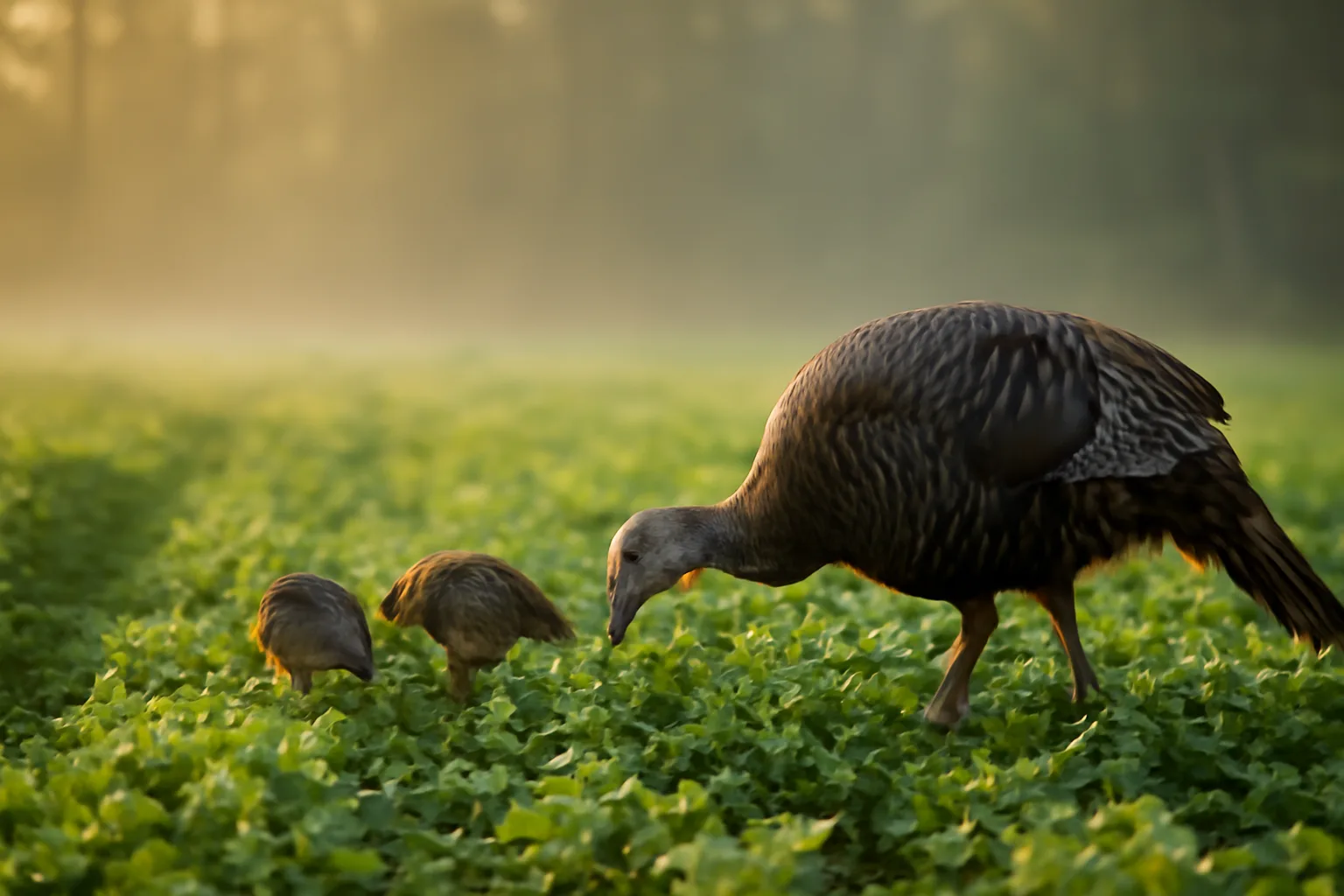
Turkeys eat clover leaf and clover seed heads, but the bigger draw is what lives in a clover field: insects. Wild turkey poults need a diet extremely high in protein for the first several weeks of life, and clover fields are some of the best bug habitat you can plant. The National Wild Turkey Federation states that poults "require a diet of 70 to 90 percent insects and other invertebrates during their first few weeks of life" before shifting toward more plant material as adults [2]. A thick clover stand hosts grasshoppers, crickets, beetles, and other insects at much higher densities than short-mown grass or bare ground, which is exactly why hens bring broods to clover fields to feed. Adult turkeys do eat clover greens directly, along with clover seed, and will use a plot through fall and into winter when other green forage is scarce. So it's not either-or. Clover feeds turkeys two ways: as forage itself and as an insect factory. That second function is the one most hunters underestimate.
do deer eat clover too, and does that matter for a turkey plot
Yes, deer eat clover heavily, and on most properties a clover plot gets used by both species without much conflict. Clover is one of the most palatable, most digestible forages available to whitetails, which is why it shows up in nearly every extension publication on deer food plots. The Mississippi State University Extension Deer Lab lists ladino and red clover among the top perennial forage choices for deer, citing high protein content (often 25 to 30 percent crude protein in vegetative clover) and season-long availability [3]. That overlap is a feature, not a bug, if you're managing a property for both species. A 2 to 5 acre clover field near timber cover can carry deer through spring green-up and carry turkey broods through the same window. The only real conflict shows up on very small plots (under a half acre) where heavy deer browsing pressure can keep clover clipped so short that it never produces the seed heads or bug cover turkeys want. If turkeys are the priority and deer numbers are high, plant a bit larger than you think you need, or fence a portion to let it get some height.
when should you plant clover for turkey food plots
Plant clover in late summer to early fall (roughly August through September in the North, September through October in the South) or in early spring (March through April) once soil temperatures warm. Fall plantings generally establish better because there's less weed competition and more consistent rainfall in most regions. The Penn State Extension guide on food plots for wildlife recommends seeding clover in late summer into a firm, weed-free seedbed, noting that fall-seeded clover has time to develop a root system before winter dormancy, which gives it a head start the following spring. Spring seeding works too, and it's the better option in far northern states where fall seeding windows close too early for clover to establish before frost. The tradeoff is more weed pressure in spring since warm-season weeds germinate right alongside your clover. Don't plant clover into standing residue or thatch. It's a small-seeded legume and needs good seed-to-soil contact, so a clean, firm seedbed (think 'you can see your bootprint but not sink into it') matters more than almost any other single factor in getting a stand to establish.
when to plant food plots for deer and turkey on the same calendar
| Deep South (zones 8-9) | Sept-Nov or Feb-Mar | Fall preferred, avoid summer heat | |
|---|---|---|---|
| Mid-South (zones 7) | Aug-Oct or Mar-Apr | Wide window both seasons | |
| Midwest/Northeast (zones 5-6) | Aug-Sept or Apr-May | Fall seeding needs 6+ weeks before frost | |
| Upper Midwest/North (zones 3-4) | Aug (early) or May | Fall window is tight, spring often safer | If you're planning a whole-property rotation rather than a single clover field, it helps to map plot types against your specific zone and soil test before buying seed. That's a big part of what a food plot whitetail plan should account for, since a plot that works great in Georgia can fail outright if planted on the same calendar date in Michigan. |
Most food plot calendars split into two windows: spring/summer plantings (perennial clover, chicory, alfalfa) and late summer/fall plantings (brassicas, cereal grains, annual clover blends). Turkey-focused clover plots fit best in the spring or late-summer window, timed to soil temperature and rainfall in your zone rather than a fixed date. The USDA Natural Resources Conservation Service publishes plant hardiness zone maps that many extension programs use as a baseline for seeding date recommendations by region. As a rough national guide: | Region | Clover seeding window | Notes |
what soil pH and fertility does clover need
Clover wants soil pH between 6.0 and 6.5, and it will struggle badly below 5.5 because acidic soil locks up nutrients and interferes with the nitrogen-fixing bacteria clover depends on. This is the single most common reason clover plots fail: nobody limed, or they limed too late. The Virginia Cooperative Extension food plot guide states that clover "performs best in soils with a pH of 6.0 to 7.0" and recommends applying lime based on soil test results months before planting, since lime takes time to move through the soil profile and correct pH [4]. A soil test is the only honest way to know where you stand. Home pH meters and "eyeball it" guesses are unreliable enough that extension programs specifically recommend lab testing every 2 to 3 years for established plots and before any new planting. Your soil test report, not a blog post, is the final word on how much lime and fertilizer your specific field needs, because pH, buffer index, and existing nutrient levels vary field to field even on the same farm. Once pH is corrected, clover generally needs modest phosphorus and potassium and little to no nitrogen, since it fixes its own nitrogen from the air through root bacteria (assuming you've inoculated the seed, which most bagged clover already comes pre-inoculated for).
do deer eat sorghum, and should it go in a turkey plot
Deer do eat grain sorghum, particularly the seed heads in fall and winter, though it's generally considered a lower first-choice forage compared to soybeans, corn, or clover. Turkeys use sorghum too, mostly for the grain itself once it matures and for the insects that gather around a standing grain plot. Sorghum's real value in a turkey-oriented plot isn't nutrition, it's structure. Standing sorghum gives poults some overhead screening cover from hawks while they feed on bugs at ground level, similar to how grain sorghum or milo is used in dove field and quail habitat plans. If you're building a plot specifically to raise poult survival, a strip of sorghum on the edge of a clover field can do more good than a monoculture of either. It's not a clover substitute, though. If you only have room for one species and turkeys are the priority, clover beats sorghum for both bug production and season-long green forage.
when to plant oats for deer and turkey plots
Oats are typically planted in late summer to early fall, roughly August through September in northern and transition zones, and into October in the South, timed so they germinate and put on 6 to 8 inches of growth before frost slows them down. Oats are a cool-season annual, not a perennial, so they're usually mixed with clover or brassicas rather than planted alone. Oats germinate fast (often 5 to 7 days in warm soil) and provide quick, tender green forage that deer hit hard in the first few weeks after a fall rain, and turkeys will pick through the same field for waste grain and the insects it draws. Oats winterkill in most of the North once temperatures drop into the teens for extended periods, while in milder Southern zones they can hang on through winter and even head out in spring. A common combo, oats plus ladino clover, gives you fast fall cover from the oats while the clover establishes underneath. The following year the oats are gone and you're left with a clean perennial clover stand, which is a good way to get double duty out of one planting.
when to plant turnips for deer, and do they help turkey plots
why turnips are mostly a deer play, not a turkey one
Turnips are planted in mid to late summer, generally July through August depending on zone, so they have 80 to 90 days to bulb up before the first hard frost triggers the starch conversion that makes the tops and bulbs sweet and highly attractive to deer. Turnips are a brassica, and they're planted almost exclusively with deer in mind. Turkeys get little direct benefit from a turnip plot. They don't eat the bulbs, and the broad-leafed canopy that makes turnips great deer forage actually shades out the ground-level insect activity turkeys are looking for. If you're managing a single field for both species, turnips work fine as a rotational crop (planting brassicas one year, clover the next) but they shouldn't be the main plot if turkeys are your focus. The Ohio State University Extension notes that brassica forage quality "improves dramatically after a hard frost" as the plant converts starches to sugars, which is why turnip plots get hit hardest in late fall and early winter rather than right after planting [5].
what is a food plot, exactly
the basic definition every plotter should know
A food plot is a planted area of forage, grain, or browse established specifically to feed wildlife and, usually, to concentrate or hold animals for observation and hunting. It's not a farm field in the agricultural sense, even though the equipment and techniques (tillage, liming, seeding, mowing) are borrowed straight from row-crop agriculture. Most food plots fall into one of a few categories: annual plots (brassicas, cereal grains, annual clover blends replanted yearly), perennial plots (ladino clover, red clover, alfalfa, chicory that persist 3 to 5 years), and destination or throw-and-mow plots for hunters with limited equipment. State wildlife agencies generally treat food plots differently from bait piles under supplemental feeding law, since a growing plot is considered part of normal habitat management rather than an artificial feed source, but the legal line varies a lot by state. Some states restrict hunting over food plots during certain seasons, or have specific rules about what counts as "baiting" versus a planted crop. It's worth checking your state wildlife agency's regulations directly before you plant near a stand you intend to hunt, since a plot that's perfectly legal in one state can cross into a baiting violation in another depending on how it's planted, mowed, or supplemented.
what are deer's favorite foods, and how does that compare to turkey preference
deer vs. turkey food preference, side by side
| Whitetail deer | Soybeans, clover, acorns, brassicas (post-frost) | High protein, high digestibility, seasonal availability | |
|---|---|---|---|
| Wild turkey | Insects (poults), acorns/mast, clover greens, waste grain | Protein needs shift hard from insect-based to plant/seed-based with age | If your goal is a property that works for both, clover is the one planting that shows up near the top of both lists, which is exactly why it's the default answer to "best clover for turkey food plots." |
Deer preference studies consistently rank soybeans, clover, and acorns near the top, with corn and brassicas following depending on season. The Mississippi State University Deer Lab lists soybeans and clover among the highest-preference, highest-protein forages available to whitetails, often testing at 20 to 35 percent crude protein in the vegetative stage [3]. Turkeys don't have the same kind of ranked preference data because so much of their diet is opportunistic and seasonal: insects and green forage in spring and summer, mast (acorns, beechnuts) and seeds in fall and winter, and waste grain wherever it's available. Clover is a genuine turkey food, but calling any single plant a turkey "favorite" oversells how the birds actually forage. They're generalists that follow bug density and mast availability more than any single crop. | Species | Top forage picks | Why |
do deer like honey, and is that a real food plot question
clearing up the honey question
Deer don't eat honey, and it's not a food plot ingredient or attractant in any legitimate sense. This question shows up in search results mostly from confusion with commercial deer attractant products (some branded scent or mineral licks use the word "honey" or sweet-smelling additives) or from mixing up deer with bears, which genuinely do raid honeybee hives for both the honey and the larvae. There's no extension publication, wildlife agency guidance, or credible field research suggesting honey has any role in deer nutrition or attraction. If you see a product marketed around a "honey" scent for deer, treat it as a curiosity product, not a food plot strategy. Your money is far better spent on lime, fertilizer, and clean seed than on any liquid attractant.
how do you actually plant and maintain a turkey clover plot
seedbed prep, seeding rate, and upkeep
Start with a soil test 3 to 4 months before planting so you have time to apply lime, since lime needs time to react with soil and raise pH. Broadcast or drill ladino clover at 6 to 8 pounds per acre alone, or 4 to 6 pounds per acre in a mix with red clover or chicory. Seed depth matters a lot: clover seed is tiny and should be planted no deeper than a quarter inch, often just pressed into the surface with a cultipacker rather than buried. Mow clover 2 to 3 times during the growing season, keeping it to 4 to 6 inches, which controls weeds, encourages new tender growth, and (important for turkeys) keeps the canopy open enough for poults to move through and hunt bugs at ground level. Letting clover grow tall and rank cuts against the exact insect-access benefit that makes it a turkey plot in the first place. A well-managed ladino clover stand typically lasts 3 to 5 years before it thins out enough to need renovation or replanting, according to general extension guidance on perennial forage stand life [1]. Budget for an annual soil test and a light nitrogen-free maintenance fertilizer application (based on that test) rather than assuming one planting will carry you five years with zero inputs. If you're mapping out plot locations, species, and a planting calendar across a whole property rather than one field, that's exactly the kind of planning a Custom Food Plot Plan is built for, a one-time $99 plan based on your zone, soil, and equipment rather than a generic seed bag label. Your soil test lab remains the final authority on lime and fertilizer amounts; any plan is general guidance layered on top of that lab result, not a replacement for it.
what to plant near your clover field for turkeys
pairing clover with cover and grain edges
A single clover field does more for turkeys when it sits next to something else: a grain strip, a dusting area, or open timber turkeys can walk into for shade and predator visibility. Hens especially want to move poults from roost to feeding area through some type of edge cover, not across wide open ground. Consider a simple layout: clover as the main body of the plot, a narrow strip of sorghum or a cereal grain like oats along one edge, and a mowed path or two through the clover so poults (and you, checking cameras) can move without wading through wet vegetation. This kind of layered plot design shows up across most state wildlife agency turkey habitat guides, and it costs almost nothing extra beyond a bit of planning. If you're deciding between straight clover, a deer-focused blend, or a full turkey-and-deer layout, it helps to compare a few deer food plot seed options against a dedicated food plot seed blend built with both species in mind before you commit acreage.
Frequently asked questions
Do deer eat sorghum?
Yes. Deer eat grain sorghum seed heads, mostly in fall and winter, though it ranks below soybeans, corn, and clover as a first-choice forage. It's more valuable as cover and as an insect draw for turkeys than as a top deer food, and it works well as an edge planting alongside a clover field.
Do deer eat clover?
Yes, heavily. Clover is one of the most palatable and digestible forages available to whitetails, often testing 20 to 35 percent crude protein in the vegetative stage according to Mississippi State University's Deer Lab. It's a top pick for both deer and turkey plots, which is why it's such a common dual-purpose planting.
When to plant deer food plots?
Perennial clover and chicory go in late summer to early fall or early spring, depending on your zone. Annual brassicas like turnips go in mid to late summer (July-August) to bulb before frost. Cereal grains like oats go in late summer to early fall. Always check your local frost dates and soil temperature rather than a fixed calendar date.
Do deer like clover?
Yes, clover is one of the most preferred forages for whitetail deer, valued for its high protein content and season-long availability. Ladino (white) and red clover are the two most commonly planted types in wildlife food plots across the U.S., according to University of Tennessee Extension guidance.
When to plant oats for deer?
Plant oats in late summer to early fall, roughly August through September in the North and into October in the South, so they germinate and grow before frost slows them. Oats are a fast-growing cool-season annual, often mixed with clover for quick fall cover while the perennial clover establishes underneath.
When to plant food plots for deer?
There are two main windows: spring/summer (March-May) for perennials like clover and chicory, and late summer/fall (August-October) for brassicas, cereal grains, and fall-seeded clover. The exact dates shift by USDA plant hardiness zone, with northern states needing earlier fall seeding to beat frost.
When to plant turnips for deer?
Plant turnips in mid to late summer, generally July through August, giving them 80 to 90 days to bulb before the first hard frost. That frost triggers a starch-to-sugar conversion that makes turnip tops and bulbs much more palatable, per Ohio State University Extension guidance on brassica forage quality.
Do turkeys like clover?
Yes. Turkeys eat clover leaf and seed directly, but the bigger benefit is the insect population clover fields support. Poults need a diet that's 70 to 90 percent insects in their first weeks of life, according to the National Wild Turkey Federation, and thick clover stands are excellent insect habitat.
What is a food plot?
A food plot is a planted area of forage, grain, or browse established to feed wildlife and often to hold or concentrate animals for hunting or observation. It uses standard agricultural techniques (liming, tillage, seeding) but serves a wildlife management purpose rather than commercial crop production.
What are deer's favorite foods?
Soybeans, clover, and acorns typically rank as top preference foods for whitetail deer, based on protein content and digestibility data from university deer research programs. Brassicas like turnips become highly attractive after a hard frost, and corn is a strong seasonal draw, especially in late fall and winter.
Do deer like honey?
No. There's no credible research or extension guidance supporting honey as a deer food or attractant. Confusion likely comes from branded scent products using the word 'honey,' or from mixing up deer with black bears, which do raid beehives for honey and larvae.
Is ladino clover or red clover better for a turkey food plot?
Ladino clover is generally the better first choice: it grows lower and denser, handles mowing and grazing pressure well, and tolerates some shade near timber edges. Red clover is a solid alternative on heavier, wetter, or more acidic soils where ladino struggles, and it's often used in a mix with ladino for a longer growing season.
How big should a turkey clover food plot be?
There's no fixed rule, but plots under half an acre often get browsed too short by deer to develop the seed heads and bug cover turkeys want. A 1 to 3 acre clover field, ideally bordered by open timber or a grain strip, gives turkeys room to move poults while feeding and gives clover room to recover from grazing pressure.
Can you hunt turkeys over a food plot legally?
In most states, planted food plots are treated differently from bait piles under supplemental feeding law, but rules vary widely by state and can depend on how the plot is planted, mowed, or supplemented. Check your state wildlife agency's specific baiting and food plot regulations before hunting near a planted field.
Sources
- University of Tennessee Extension, Wildlife Food Plots publication: Ladino clover is well adapted to fertile, moist soils and is commonly planted in wildlife food plots
- National Wild Turkey Federation, wild turkey biology and diet information: Poults require a diet of 70 to 90 percent insects and invertebrates in their first weeks of life
- Mississippi State University Extension, Deer Lab forage guidance: Soybeans and clover rank among the highest-preference, highest-protein forages for whitetail deer
- Virginia Cooperative Extension, Wildlife Food Plots publication: Clover performs best in soils with a pH of 6.0 to 7.0, and lime should be applied based on soil test results
- Ohio State University Extension, brassica forage guidance: Brassica forage quality improves dramatically after a hard frost due to starch-to-sugar conversion