Last updated 2026-07-25
TL;DR
Evolve food plot seed is a branded category of multi-species blends (clover, brassica, cereal grain, chicory) sold for deer plots. There's no single 'Evolve' formula, brands vary, so check the bag for actual species and planting dates. Success depends more on your soil test, planting window, and site prep than on which bag you buy.
What is a food plot, and why does seed choice matter so much?
A food plot is a planted patch of ground, usually somewhere between a quarter acre and a few acres, established specifically to feed and attract deer or other wildlife. It's not a garden and it's not a lawn. It's a managed piece of farmland scaled down for a hunting property, and it lives or dies on the same basics row-crop farmers deal with: soil pH, fertility, moisture, and timing. Seed choice matters because different species do different jobs. Clover is a perennial that feeds deer for years off one planting. Brassicas like turnips and radishes are annuals that peak in late fall when a hard frost sweetens the leaves and bulbs. Cereal grains like oats and wheat germinate fast and give you green growth in two to three weeks, which is why they show up in almost every fall blend. A bag labeled 'Evolve' or any other brand name is really just a mix of these building blocks, packaged with a marketing story on the front. The USDA's Natural Resources Conservation Service treats food plots as a wildlife habitat practice (Practice Code 645, Upland Wildlife Habitat Management), and its guidance stresses matching plant species to soil and site conditions rather than picking a product off shelf appeal [1]. That's the mindset worth bringing to any bag of seed, branded or not. If you want a walkthrough of plot fundamentals before you buy anything, food plot whitetail covers the basics of siting and sizing a plot on real ground.
What's actually in Evolve food plot seed blends?
There is no single, universal 'Evolve' formula. It's used as a product line name by more than one seed company, and blends sold under similar branding change from year to year and region to region. What you'll typically find inside a fall blend marketed this way is some combination of brassicas (turnips, radishes, rape), a cereal grain (oats or winter wheat), and sometimes a clover or chicory component for a perennial base. The honest move here is to read the tag on the actual bag you're holding, not to trust the marketing copy. Seed bags sold for agricultural or wildlife planting are required to carry a label disclosing species, germination percentage, and purity, similar to rules under state seed laws that mirror the federal Federal Seed Act [2]. That label is the real spec sheet. Compare it against your goals: are you after tonnage of fall forage, a spring green-up, or a plot that lasts multiple seasons without replanting? If a blend leans heavy brassica with a small percentage of clover, treat it as an annual fall plot with a bonus perennial component that may or may not carpet the plot the following spring, depending on winterkill and competition from weeds. For comparison shopping across brands, deer food plot seed and food plot seed break down species by category in more depth.
Do deer eat sorghum?
Yes, deer will eat sorghum, particularly the grain heads and young shoots, but it's not a top-tier deer forage compared to soybeans, clover, or brassicas. Sorghum (grain sorghum or milo) is more commonly planted as a screening or standing-grain crop for winter cover and a late-season food source once the seed heads mature and dry down. Whitetail research out of land-grant universities generally ranks sorghum below legumes and brassicas in preference trials, though it holds up well agronomically in drought-prone soils where corn struggles. Mississippi State University Extension notes grain sorghum's main value in wildlife plantings is as a supplemental energy source and cover crop rather than a primary attractant [3]. If you're set on using sorghum, plan on it as one component in a mixed planting, maybe bordering a brassica or clover plot, rather than the whole show.
Do deer like clover, and do deer eat clover?
Deer eat clover readily and most managers consider it one of the best perennial food plot options available. Clover is high in protein (often 20 to 25 percent crude protein in vegetative growth), palatable, and it regrows after grazing, which is exactly what you want from a plot deer hit hard and often. White clover (Ladino types) and red clover are the two most planted species. White clover tends to hold up better under heavy grazing pressure because of its low, spreading growth habit, while red clover grows taller and can take more mowing but is somewhat less grazing-tolerant. University of Tennessee Extension recommends a soil pH of 6.0 to 6.5 for clover establishment and notes clover plots can persist three to five years with proper mowing and fertility maintenance [4]. The catch with clover is establishment. It's a small seed that needs good seed-to-soil contact and it competes poorly with weeds in the first year. A firm, clean seedbed and a light cultipacking pass after seeding make a bigger difference to clover success than which brand of seed you bought.
When to plant food plots for deer (by region)
| Upper Midwest / North (MN, WI, MI, ND) | Late July to mid-August | Mid-May to mid-June | |
|---|---|---|---|
| Mid-South / Transition (KY, TN, VA, MO) | Late August to mid-September | Late April to late May | |
| Deep South (MS, AL, GA, FL) | Mid-September to mid-October | Mid-March to April | These windows are general guidance, not a substitute for your local extension office's frost date data. Penn State Extension's food plot publication stresses backing fall planting dates off your area's average first frost so brassicas and grains have time to mature before growth stops. Check your state's average frost dates through the NOAA Climate Data Online tool or your land-grant extension office before locking in a date. |
Timing splits into two seasons: spring/summer plots (usually warm-season annuals or perennial establishment) and fall plots (cool-season annuals for hunting season forage). The right calendar depends heavily on your USDA Plant Hardiness Zone and your area's first frost date. As a general framework: cool-season fall plots (brassicas, cereal grains, clover) go in from late July through early September in northern states (Zones 3-5), and from late August through mid-October in the South (Zones 7-9), timed so plants have 45 to 90 days of growth before a killing frost. Spring/summer plots (soybeans, cowpeas, clover establishment) go in after your last frost date, generally April through June depending on latitude. | Region (example states) | Fall brassica/grain planting window | Spring/summer planting window |
When to plant oats for deer
Oats are a cool-season annual grain, and for deer plots they're almost always planted as a fall forage, not a spring crop, because deer prefer the tender young growth and oats put on fast, leafy growth in cool weather. Plant oats 45 to 60 days before your first expected frost, which lands roughly late August through mid-September across most of the whitetail's range, adjusting earlier for northern states and later for the Deep South. Oats germinate in 7 to 14 days under decent moisture and soil temperatures, faster than most brassicas, which makes them a common 'quick green-up' component in fall blends. They don't survive hard winters in most of the country the way winter wheat or rye can, so in colder zones oats function as a fall-only attractant rather than a plant that carries into spring. A blend of oats with a brassica like turnips is a classic combination: the oats give you food in September and October while the turnip bulbs and tops mature for late-season browsing after frost sweetens the starches into sugars.
When to plant turnips for deer
Turnips need roughly 80 to 90 days from planting to full maturity, and deer preference for turnips increases sharply after the first hard frost converts starches to sugars in the leaves and bulbs. Work backward from your area's first frost date and plant turnips 80 to 90 days ahead of it, which typically means late July to mid-August in northern states and mid-August to early September in the transition zone and mid-South. Turnips need a fine, firm seedbed because the seed is tiny, similar in size to clover seed, and needs to be planted no deeper than a quarter inch. Broadcasting onto a prepared seedbed and cultipacking afterward gives better results than drilling too deep. Soil pH matters here too; most brassicas do best in the 6.0 to 6.8 range, and a soil test is the only reliable way to know if you need lime before planting [4]. One planning note worth flagging: deer often ignore turnip bulbs and tops early in fall when other food is abundant, then hit the plot hard in November and December once acorns and ag crops thin out. Don't judge a turnip plot's success in October; give it until after a frost or two.
What are deer's favorite foods, and do deer like honey?
Deer preference studies and decades of extension research generally rank soybeans, clover, and standing corn near the top of preferred whitetail foods, with acorns (especially white oak acorns) often outcompeting almost anything planted when they're dropping in volume. Brassicas, chicory, and cowpeas round out a common list of high-preference food plot species. Deer are not attracted to honey in any meaningful sense as a food source. They're not naturally drawn to sugary syrups the way some marketing implies; whitetails are browsers and grazers built around forbs, woody browse, mast, and agricultural crops, not concentrated sugar sources. Some products marketed with 'honey' or sweet scents in their name are really about mineral or trace additive attractants, not a documented deer food preference, and there's no peer-reviewed wildlife research establishing honey as a preferred whitetail food. It's also worth knowing that many states restrict or ban baiting and supplemental feeding of deer, including sugar-based attractants, separately from food plot planting. Rules vary widely: check your state wildlife agency's regulations before using any bait or feed product, since a legitimate food plot (a planted crop in the ground) is treated very differently under most state laws than bait piles, feeders, or mineral/attractant products [5].
How do I pick a food plot seed if I have a soil test in hand?
A soil test tells you three things that matter more than brand name: current pH, phosphorus and potassium levels, and how much lime or fertilizer you need to hit the target range for the species you want to plant. Most extension labs report recommendations in pounds per acre of actual N-P-K, and lime needs are usually reported in tons per acre of agricultural limestone. Your soil test lab is the authority on your specific lime and fertilizer numbers. A general article (including this one) can tell you clover wants pH 6.0 to 6.5 and brassicas want something similar, but only your lab's recommendation, based on your actual soil chemistry, tells you how much lime your specific field needs to get there. Cooperative extension offices in nearly every state offer soil testing for a modest fee, often $6 to $15 per sample, through their state land-grant university lab . Once you know your pH and fertility numbers, seed selection gets simpler. Low pH ground that hasn't been limed yet is a bad candidate for clover this year; it might be a better fit for a cereal grain or brassica blend that tolerates a wider pH range while lime works into the soil over the following season. If you want a plan built around your specific soil test numbers, acreage, and region, PlotSeason's $99 one-time Custom Food Plot Plan turns that test into species picks, seeding rates, and a planting calendar without you having to cross-reference five extension bulletins yourself.
Site prep and equipment: what actually moves the needle
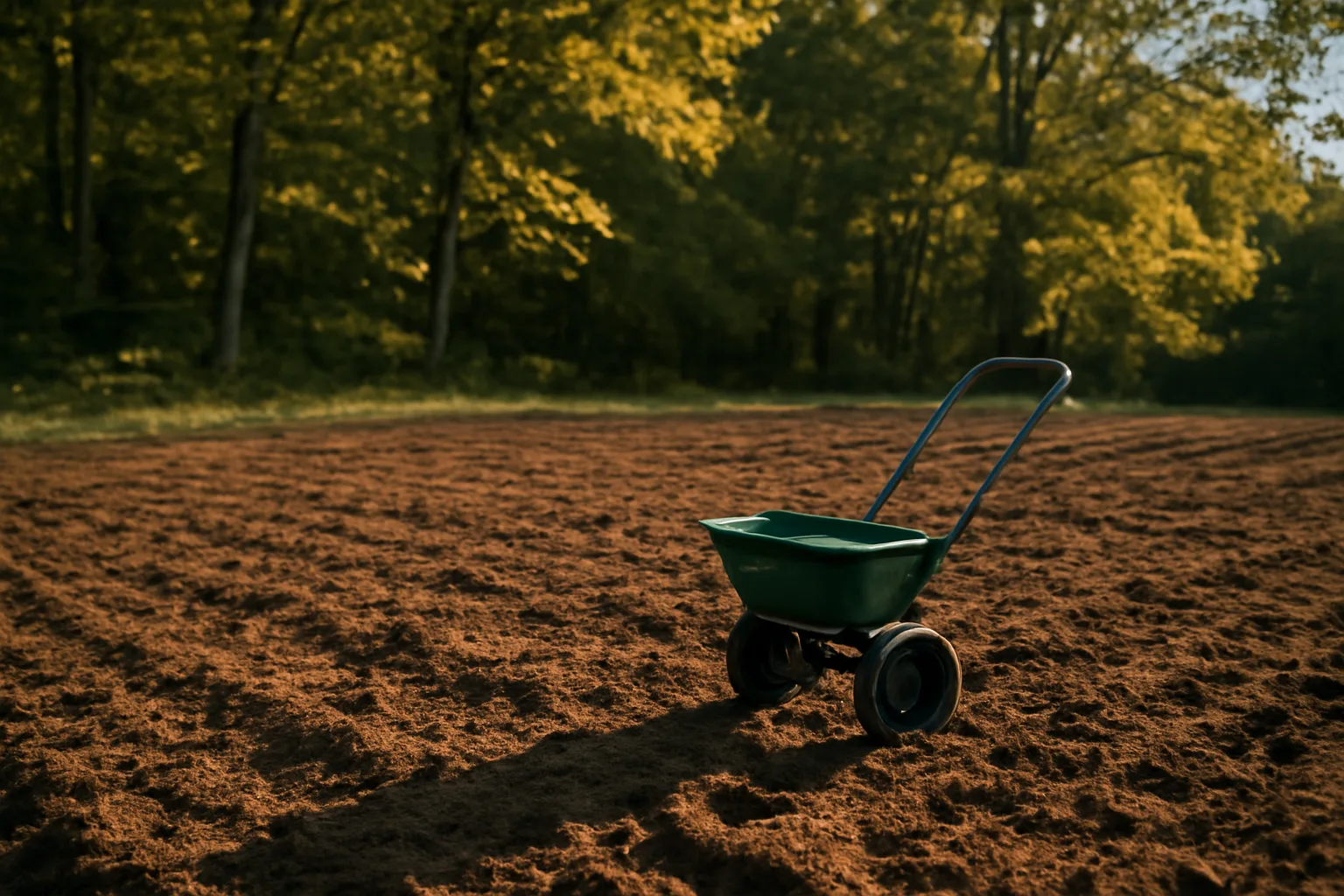
Seed bag choice gets a lot of attention online, but the biggest failures in food plots almost always trace back to site prep, not seed genetics. A clean, firm seedbed with good seed-to-soil contact beats an expensive blend planted into sod or thatch every time. Minimum viable equipment for a small plot: a way to kill or till existing vegetation (glyphosate spray or a disc), a way to spread seed (hand spreader is fine under an acre), and a way to firm the seedbed after planting (a cultipacker, drag, or even driving an ATV over it works in a pinch for small-seeded species like clover and brassicas). Larger operations benefit from a no-till drill, which handles crop residue and gets more consistent seed depth than broadcasting. Don't skip the firming step. Small seeds like clover, chicory, and brassica seed need to sit at or very near the surface, roughly 1/8 to 1/4 inch deep, and they dry out and fail to germinate if left exposed on loose, fluffy soil with no seed-to-soil contact. Cereal grains like oats and wheat can be drilled deeper, around 1 to 1.5 inches, and tolerate looser seedbeds better.
Single-species vs. blended bags: which is the better buy?
| Blended bag (Evolve-type) | Diversity hedges against one species failing; simpler for beginners | Species ratio often not disclosed in detail; harder to tailor seeding rate per species | |
|---|---|---|---|
| Single-species | Precise seeding rate; easier to match soil test and goals exactly | Requires more planning; no built-in hedge if that one species struggles | For a side-by-side on named products and categories, comparisons style breakdowns and domain food plot seed are worth checking against whatever bag you're considering. |
There's no universal right answer, but there are real tradeoffs. Blends like those sold under names such as Evolve give you diversity in one bag: something germinates fast (oats), something matures for late season (turnips or radish), and sometimes a perennial carryover (clover or chicory). That diversity hedges against one species failing due to weather, browse pressure, or a bad germination lot. Single-species plantings give you control. If you know your soil and goals, buying straight clover seed, straight oats, or straight turnip seed lets you set seeding rates precisely (clover: roughly 6-8 lbs/acre broadcast for Ladino types per most extension guides; brassicas: roughly 4-6 lbs/acre; oats: roughly 80-100 lbs/acre drilled) rather than relying on a bag's undisclosed species ratio [4]. | Approach | Pros | Cons |
Common mistakes that sink a plot regardless of seed brand
Planting too early or too late for the region is the single most common mistake, and it has nothing to do with seed quality. A bag of premium seed planted six weeks past the ideal window in the wrong zone still fails, because the plant simply doesn't have enough growing degree days left before frost or drought stress hits. Skipping the soil test is close behind. Planting clover or brassicas into soil at pH 5.0 without lime wastes money regardless of brand, since nutrient availability drops sharply in acidic soil and legumes in particular struggle to fix nitrogen. Overseeding into standing sod without killing competition first is another repeat offender; the existing grass and weeds simply outcompete new seedlings for light and moisture. Last one: treating a food plot planting date like a fixed calendar day instead of a frost-driven window. Weather varies year to year. Use your local extension office's average first and last frost dates as the anchor, then adjust a week or two based on that year's actual forecast. For more on matching plot type to your property and herd goals, deer food plots and deer for food cover planning at the property level.
Frequently asked questions
Do deer eat sorghum?
Yes, deer eat sorghum grain and young shoots, but it ranks below clover, soybeans, and brassicas in most preference studies. It's more useful as a drought-tolerant standing grain crop and winter cover than as a top attractant. Mississippi State Extension lists it as a supplemental wildlife planting rather than a primary forage choice.
Do deer like clover?
Yes, clover is one of the most preferred food plot species for whitetail deer, offering 20-25% crude protein in vegetative growth. White (Ladino) clover and red clover are the most common types planted, and a well-maintained clover plot can produce forage for three to five years off one planting, per University of Tennessee Extension guidance.
When should I plant food plots for deer?
Fall cool-season plots (brassicas, oats, clover) go in 45-90 days before your area's first frost, roughly late July to early September in northern states and late August to mid-October in the South. Spring/summer plots (soybeans, clover establishment) go in after your last frost date, generally April through June depending on latitude.
When should I plant oats for deer?
Plant oats 45 to 60 days before your area's average first frost date, which typically falls in late August to mid-September across most whitetail range. Oats germinate in 7-14 days and give fast fall green-up, but they winterkill easily and don't function as a spring crop in most regions.
When should I plant turnips for deer?
Plant turnips 80 to 90 days before your first expected frost, usually late July to early September depending on your zone. Turnip preference increases sharply after a hard frost sweetens the bulbs and leaves, so don't judge a turnip plot's success until November or December.
What is a food plot?
A food plot is a planted patch of ground, typically a quarter acre to a few acres, established to feed and attract deer or other wildlife. USDA's Natural Resources Conservation Service treats it as a habitat management practice (Practice Code 645) requiring species selection matched to soil and site conditions, more than a seed purchase.
What are deer's favorite foods?
Extension research and decades of field observation generally rank soybeans, clover, standing corn, and acorns (especially white oak) among whitetail deer's most preferred foods. Brassicas, chicory, and cowpeas are also high on most preference lists for planted food plots, though local availability and season shift these rankings.
Do deer like honey?
No, there's no wildlife research supporting honey as a preferred whitetail food. Deer are browsers and grazers built around forbs, mast, and crops, not sugar sources. Products marketed with honey or sweet scents are usually mineral or attractant products, not a documented food preference, and many states restrict sugar-based baiting separately from food plot rules.
What is Evolve food plot seed exactly?
Evolve is used as a product line name by more than one seed company for multi-species deer plot blends, usually combining brassicas, cereal grain, and sometimes clover or chicory. There's no single fixed formula; always read the actual seed tag on your bag for species, germination rate, and purity.
Is a blended bag better than buying single-species seed?
Blends hedge against one species failing and simplify planning for beginners, but they don't disclose exact species ratios in most cases. Single-species seed lets you set precise seeding rates matched to your soil test. Neither is objectively better; it depends on how much control you want over the plot.
How much lime does my food plot need?
Only a soil test from your state land-grant extension lab can answer that for your specific field; recommendations depend on current pH and target pH for your chosen species. Clover and brassicas generally want pH 6.0 to 6.8. Extension soil tests typically cost $6 to $15 per sample.
Can I use a food plot instead of a bait pile where baiting is illegal?
In most states, a planted crop in the ground is legally distinct from bait or feed placed on the ground, but rules vary significantly by state and sometimes by county. Check your state wildlife agency's current regulations before assuming a food plot exempts you from baiting restrictions in your hunting area.
Sources
- USDA NRCS, Conservation Practice Standard 645 Upland Wildlife Habitat Management: Food plots fall under NRCS wildlife habitat practice standards emphasizing species matched to site conditions
- USDA Federal Seed Act overview: Seed labeling requirements disclosing species, germination, and purity apply to agricultural and wildlife seed sales
- University of Tennessee Extension, Establishing and Managing Wildlife Food Plots: Clover establishment recommendations including target soil pH of 6.0-6.5 and multi-year plot persistence
- Association of Fish and Wildlife Agencies, state wildlife agency regulation resources: Baiting and supplemental feeding regulations for deer vary significantly by state
- USDA National Institute of Food and Agriculture, Soil Testing: Land-grant cooperative extension offices provide soil testing services through state labs