Last updated 2026-07-26
TL;DR
Most food plots for deer run from a quarter acre to 2 acres. Small hidden plots (1/4 to 1/2 acre) hold deer and work well for bowhunting. Larger plots (1 to 5 acres) support more deer through winter and survive grazing pressure. Aim for roughly 1 to 2 percent of your total property in food plots, adjusted for deer density and soil quality.
What is a food plot, exactly
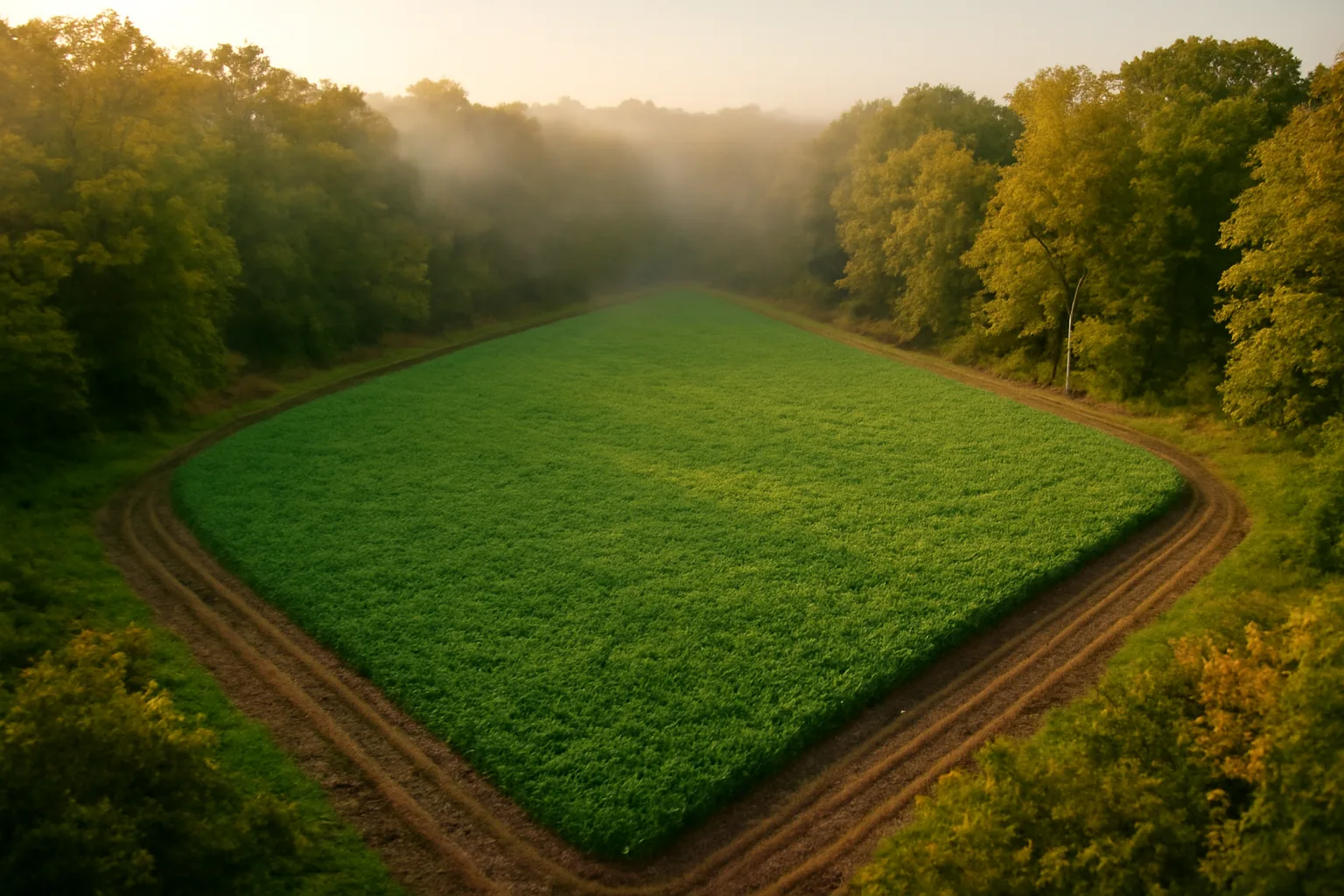
A food plot is a planted patch of ground, usually somewhere between a few hundred square feet and several acres, seeded with forage that deer (and often turkey, rabbits, and other wildlife) will eat. It's not a garden and it's not a lawn. Most plots get planted with annual grains and legumes like clover, brassicas, oats, soybeans, or corn, chosen for the season and the soil. The USDA Natural Resources Conservation Service treats food plots as a wildlife habitat practice, and its guidance for wildlife food plots is built around matching plant species to soil capability and to the wildlife you're targeting [1]. That's the whole game: right plant, right soil, right size, right time. People plant food plots for two basic reasons. One is to concentrate deer in a spot you can hunt (a hunting plot). The other is to add nutrition to the herd's diet over a season, especially late summer through winter when natural browse gets thin (a nutrition or destination plot). Size answers look different depending on which job you're asking the plot to do.
How big should a food plot be for deer
| 1/4 to 1/2 acre | Bowhunting, tucked in timber | Low to moderate; gets grazed out fast under heavy pressure | |
|---|---|---|---|
| 1/2 to 1 acre | Mixed hunting/nutrition plot | Moderate | |
| 1 to 3 acres | Destination/nutrition field | Moderate to high | |
| 3 to 5+ acres | High-density herds, food security through winter | High | If you're not sure where your land falls, a food plot whitetail strategy built around your specific acreage and deer density beats guessing off a chart. |
For most hunting properties, individual plots between a quarter acre and 2 acres do the job. Smaller plots (under half an acre) work best tucked into timber for bowhunting, because deer feel safe entering them and you can get close with the wind in your favor. Bigger plots (1 to 5 acres) work better as destination fields where you want deer to linger, feed heavily, and where the planting can survive real browsing pressure from a resident herd. Here's the tension nobody tells you up front: a tiny plot in a high deer density area gets hammered to dirt in two weeks. A half-acre clover plot can get grazed down before it ever reaches maturity if you're running 30+ deer per square mile. Extension specialists at Mississippi State University's deer program note that plot size needs to scale with deer density and with how much pressure the plot will take, more than with how much cleared ground you happen to have. A rough rule some wildlife biologists use: total food plot acreage should equal about 1 to 2 percent of the property's total acreage, with more needed in areas of high deer density or poor natural forage, and less needed where the surrounding habitat is already rich in native browse and mast. On a 200 acre farm, that's 2 to 4 acres spread across multiple smaller plots rather than one big field. | Plot size | Best use | Deer pressure tolerance |
How many acres of food plot per deer
There's no single number that works everywhere, and anyone who gives you one exact figure per deer is oversimplifying. But extension research gives usable ranges. A commonly cited planning figure from wildlife management literature is roughly 1 acre of quality food plot per 20 to 30 deer, assuming decent surrounding habitat with natural browse to supplement it. In poor habitat with high deer density, that ratio tightens up fast, meaning you need more plot acreage per deer. The Quality Deer Management Association (now the National Deer Association) has long recommended the 1 to 2 percent of total acreage benchmark mentioned above as a starting point for most whitetail properties [2]. So on a 100 acre lease with an estimated 15 to 20 deer using it regularly, something in the 1 to 2 acre range of total food plot, split across two or three plots, is a reasonable target. On a 500 acre farm with a strong resident herd, you might be looking at 5 to 10 acres total. Don't treat this as gospel math. Soil quality, rainfall, hunting pressure, and neighboring ag fields all shift the real number. A property surrounded by thousands of acres of soybeans doesn't need the same food plot acreage as an island of habitat in a sea of pine plantation.
When to plant food plots for deer
Timing splits into two windows: spring plots for summer nutrition, and late summer to fall plots for hunting season and winter feed. Get the window wrong and you either get outcompeted by weeds, hit by frost, or planted into soil too cold or too dry to germinate. Spring plots (soybeans, cowpeas, lablab, chicory) generally go in after the last frost date, once soil temperatures hit around 60°F, which lines up with regional last-frost dates tracked by NOAA and state extension frost maps [3]. In the Midwest that's typically late April through May. In the Deep South it can be as early as March. Fall plots (clover, brassicas, cereal grains) get planted 6 to 10 weeks before your area's first hard frost, so the plants establish before growth slows. In much of the whitetail range that lands somewhere between mid-August and early October, with northern states planting earlier and southern states planting later. Purdue University's forage extension guidance for brassica and cereal grain plots recommends planting brassicas 60 to 90 days before the first killing frost so they have time to bulb up or build leaf mass before deer start hammering them [4]. Check your specific zone rather than a national date. A seasonal calendar built around your USDA plant hardiness zone and first/last frost dates will get you a lot closer than a generic August 15 rule of thumb.
When to plant oats for deer
Oats get planted in late summer to early fall, generally 6 to 8 weeks before your first expected frost, so they have time to establish a leafy stand before hunting season starts and before hard freezes shut growth down. In much of the whitetail range that's late August through September. Oats are a cool-season annual cereal grain. They germinate fast, often within 5 to 10 days in warm, moist soil, and they're one of the most attractive early-season food plot plantings available because deer will hit young oat shoots hard as soon as they're a few inches tall. The tradeoff is that oats aren't very cold-hardy compared to wheat, rye, or triticale. A hard freeze in the teens can kill an oat stand outright, whereas winter rye will often green back up in spring. Some hunters plant oats specifically as an early-season bow attractant, accepting that the plot may burn out by late December in colder zones, then layering in a more winter-hardy grain or brassica nearby to carry deer through late season.
When to plant turnips for deer
Turnips go in the ground in late summer, generally 80 to 90 days before your first killing frost, because they need that runway to build both leaf mass and the root bulb deer eventually dig for in late fall and winter. In the northern half of the whitetail range that's roughly late July through mid-August. Further south, growers push planting into September. Turnips are a brassica, and brassicas go through a flavor change after a hard frost. Cold temperatures convert starches in the leaves and bulb into sugars, which is why turnip plots often get ignored in October and then get hit hard in December and January once several frosts have swept through. This is one of the most consistent and well-documented patterns in food plot brassica behavior, described repeatedly in university extension brassica forage guides. If you plant turnips too late, you get leaf growth but no real bulb, and less winter tonnage. Plant too early in warm climates and they can bolt or get overrun by weeds before frost even arrives. Turnips work well mixed with other brassicas or cereal grains rather than planted alone, since deer sometimes ignore standalone turnip leaves early in the season while grazing something more palatable nearby.
Do deer like clover, and do deer eat clover
Yes. Clover is one of the most consistently preferred food plot forages for whitetail deer, and it's also one of the most forgiving to grow. Both white clover (including ladino types) and red clover show up constantly in deer diet studies and extension forage trial rankings as high-preference, high-protein forage [5]. Clover's biggest advantage is season length. Planted correctly, a good clover stand can produce grazable forage from spring through fall for 3 to 5 years before it needs to be reseeded, which makes it one of the better costs-per-year options in a food plot program. Clover forage regularly tests in the 25 to 30 percent crude protein range during active growth, competitive with or exceeding alfalfa, according to forage quality data compiled by university extension forage testing labs [6]. The catch: clover needs decent soil pH (extension guidance generally recommends 6.0 to 6.5) and it does not tolerate standing water or heavy shade. A soil test is the only honest way to know if your dirt needs lime before clover will perform, and your soil test lab's recommendation should be the final word on lime and fertilizer rates for your specific field, not a generic online chart.
Do deer eat sorghum
Yes, deer will eat sorghum, both the grain heads and the green forage, but it's rarely anyone's first choice for a dedicated deer plot. Sorghum (grain sorghum or milo) is more commonly planted as a summer annual for cover and as a supplemental grain source, and it shows up in wildlife food plot mixes more often as a nurse crop or screening plant than as the primary attractant. Deer tend to prefer soybeans, cowpeas, and clover over sorghum when those options are available in the same field. Sorghum's real value on a deer property is often structural rather than nutritional: tall stalks provide screening cover for a plot edge or a walking trail, and the grain heads mature late enough to offer some food value into fall when other summer annuals have already been grazed out or gone to seed. If you're planting sorghum specifically to feed deer rather than to screen a trail, most food plot programs would put your seed dollars into soybeans or a brassica blend first.
What are deer's favorite foods
Deer are selective browsers, and their preferences shift by season, region, and what else is available. Across food plot species, soybeans and cowpeas during summer, clover nearly year-round where it stays green, and brassicas (turnips, radishes, rape) after a hard frost consistently rank as top preference forages in university deer forage trials [5]. Outside of planted plots, natural whitetail diets lean heavily on acorns and other hard mast in fall, along with forbs, browse from woody plants, and agricultural crops like corn and soybeans where available. State wildlife agencies that study deer diets, including work summarized by state agency deer programs, consistently find that acorn availability in a given fall can swing deer body condition and even food plot use, since deer will often bypass planted forage for a heavy acorn drop [7]. There's no single universal favorite. A clover plot that gets hit hard in a poor mast year might get almost ignored the following fall if oaks drop a bumper acorn crop nearby. That's normal, not a sign your plot failed.
Do deer like honey, and should you use it as an attractant
There's no real research showing deer seek out honey as a food source, and it isn't part of any documented natural whitetail diet. Deer are herbivores built around browse, forbs, mast, and agricultural forage. Honey shows up occasionally in hunting forums and product marketing as a scent or bait additive, but that's a different claim than deer actually favoring it as a food. More importantly, spraying or pouring any food substance, honey included, to attract deer may cross into baiting under your state's regulations. Baiting and feeding rules vary widely by state and even by county in some cases. Some states prohibit hunting over bait entirely, others allow feeding outside a hunting context but not while hunting, and some allow it with restrictions on distance or timing. Check your state wildlife agency's current regulations before using any attractant, sweetener, or feed product near a stand, since rules change and enforcement is real. State agency hunting digests are the authoritative source here, not forum advice [8]. If you want deer using a spot reliably, a planted, legal food plot does far more long term than any attractant, and it keeps you clean with the law.
How plot shape and location change the size you need
Two plots of the same acreage can perform completely differently based on shape and placement. A long, narrow plot (say 40 feet wide and 300 feet long) gives you more edge relative to its size, which deer generally prefer for security, but it's harder to spray, mow, and manage with standard equipment. A square or slightly irregular block plot is easier to farm but offers less edge cover per acre. Plots tucked inside timber, sometimes called kill plots or hidden plots, work at a quarter acre or even smaller because the surrounding cover does the work of making deer feel safe. Open destination fields need more size and usually more distance from roads and human activity to get the same comfort level from mature bucks. Slope, drainage, and sun exposure matter as much as raw acreage. A half-acre plot on flat, well-drained ground with 6+ hours of sun will often out-produce a full acre on a shaded north slope with poor drainage. Before deciding how many acres to clear, a walk of the property with a compass and a sense of prevailing wind will often change where you'd put the plot more than it changes the size.
How much does food plot size affect your seed and equipment costs
Bigger plots cost more, obviously, but the relationship isn't purely linear once you count equipment. A quarter-acre plot can be worked with a hand seeder, a small ATV disc, and a few bags of seed, often for under $200 all in. Once you're pushing 3 to 5 acres, you're usually looking at a tractor, a disc or no-till drill, a sprayer, and enough seed and fertilizer to run costs into four figures depending on species and whether lime is needed. Seed cost per acre varies hugely by species. Clover blends often run $20 to $40 per acre of seed at typical seeding rates, while brassica blends and cereal grains can run similarly or a bit higher depending on the mix. Fertilizer and lime costs depend entirely on what your soil test says you need, and that's the one number nobody can guess correctly without actually pulling a sample. This is where a lot of new plotters overspend: buying a bigger disc or drill than they need for a half-acre plot, or undersizing equipment for a 3 acre field and burning a whole weekend on a job that should take an afternoon. Matching your equipment to your actual planned acreage, not your someday acreage, saves real money. If you've got a soil test back and you're trying to figure out how many acres actually make sense for your deer density and your budget, a Custom Food Plot Plan for $99 lays out species, size, and layout for your specific ground, using your soil test as the baseline rather than generic charts. It won't replace your soil test lab's specific lime and fertilizer numbers, but it will tell you what to plant where and how much ground to put it on.
Frequently asked questions
How big of a food plot do I need for one deer stand?
For a single bowhunting stand tucked in timber, a quarter acre to half an acre is usually plenty. You're not trying to feed the whole herd, you're trying to pull a few deer into range with a wind you can hunt. Bigger plots at a single stand often push shot distances out past bow range.
Is a 1 acre food plot big enough for deer?
Yes, for most properties a 1 acre plot works well as either a hunting plot or a modest nutrition plot, especially if it's one of two or three plots on the property rather than the only one. In high deer density areas, 1 acre can still get grazed down fast, so plan for that.
How many acres of food plots per 100 acres of land?
A common starting benchmark from wildlife management guidance is 1 to 2 percent of total acreage in food plots, so roughly 1 to 2 acres on a 100 acre property. Adjust upward in high deer density areas or where natural browse is scarce, and downward where surrounding habitat is already rich.
What is a food plot in simple terms?
A food plot is a planted area, usually a fraction of an acre to a few acres, seeded with forage like clover, brassicas, or beans specifically to feed deer and other wildlife and often to concentrate them for hunting. It's a managed planting, not a wild patch of weeds.
When should I plant food plots for deer?
Spring plots (soybeans, cowpeas) go in after your last frost date, once soil hits about 60°F. Fall plots (clover, brassicas, cereal grains) go in 6 to 10 weeks before your area's first hard frost. Exact dates depend heavily on your region, so check your local extension office's frost date charts.
Do deer actually eat clover, and is it worth planting?
Yes, clover is one of the most preferred food plot forages for whitetail deer, and it's well worth planting on properties with decent soil pH and drainage. A good stand can produce forage for 3 to 5 years and often tests at 25 to 30 percent crude protein during active growth.
When is the right time to plant turnips for deer?
Plant turnips roughly 80 to 90 days before your area's first killing frost, generally late July to mid-August in northern regions and into September further south. They need that time to build leaf mass and bulb size before frost sweetens them up for late-season grazing.
When should oats be planted for a deer food plot?
Plant oats 6 to 8 weeks before your first expected frost, typically late August through September across most of the whitetail range. Oats germinate quickly and get hit hard early in the season, but they're less cold-hardy than wheat or rye and can die out after a hard freeze.
Do deer eat sorghum or prefer other grains?
Deer will eat sorghum grain and forage, but they generally prefer soybeans, cowpeas, and clover when given the choice. Sorghum is more often planted for screening cover or as a late-season supplemental grain than as a primary attractant plot.
Do deer like honey as bait or attractant?
There's no real evidence deer seek out honey as food, and it isn't part of a natural whitetail diet. More importantly, using it to attract deer may violate your state's baiting regulations, which vary by state, so check your state wildlife agency's current rules before using any food-based attractant.
What are deer's favorite foods overall?
It varies by season and region, but soybeans and cowpeas in summer, clover much of the year, brassicas after a hard frost, and acorns in fall consistently rank as top preferences in university forage trials and state deer diet studies. A heavy acorn year can pull deer off food plots entirely.
Should I plant one big food plot or several small ones?
Several smaller plots (a quarter acre to 1 acre each) spread across a property generally work better for hunting than one large field, since they give you more stand options and don't put all your eggs in one location. Reserve a larger destination plot, if you have the acreage, for nutrition and late-season food security.
Sources
- USDA Natural Resources Conservation Service, Wildlife Habitat Management practice guidance: Food plots are treated as a wildlife habitat practice matched to soil capability and target wildlife species
- National Deer Association (formerly Quality Deer Management Association), food plot management guidance: Recommended benchmark of roughly 1 to 2 percent of total property acreage devoted to food plots
- NOAA National Centers for Environmental Information, freeze/frost data: Regional last and first frost dates used to time spring and fall food plot planting
- Purdue University Extension, forage and cover crop planting guidance: Brassica food plots should be planted 60 to 90 days before first killing frost to build leaf and bulb mass
- University of Tennessee Extension, forage preference and deer food plot species trials: Clover and soybeans consistently rank as high-preference forages for whitetail deer in extension forage trials
- University of Georgia Extension, forage quality and crude protein testing data: Clover forage commonly tests in the 25 to 30 percent crude protein range during active growth
- Pennsylvania Game Commission, deer and acorn mast research summaries: Acorn mast availability influences deer body condition and use of planted food plots in a given fall
- State wildlife agency hunting digest baiting and feeding regulations (example: Michigan DNR): Baiting and feeding regulations for deer vary by state and must be checked before using attractants