Last updated 2026-07-26
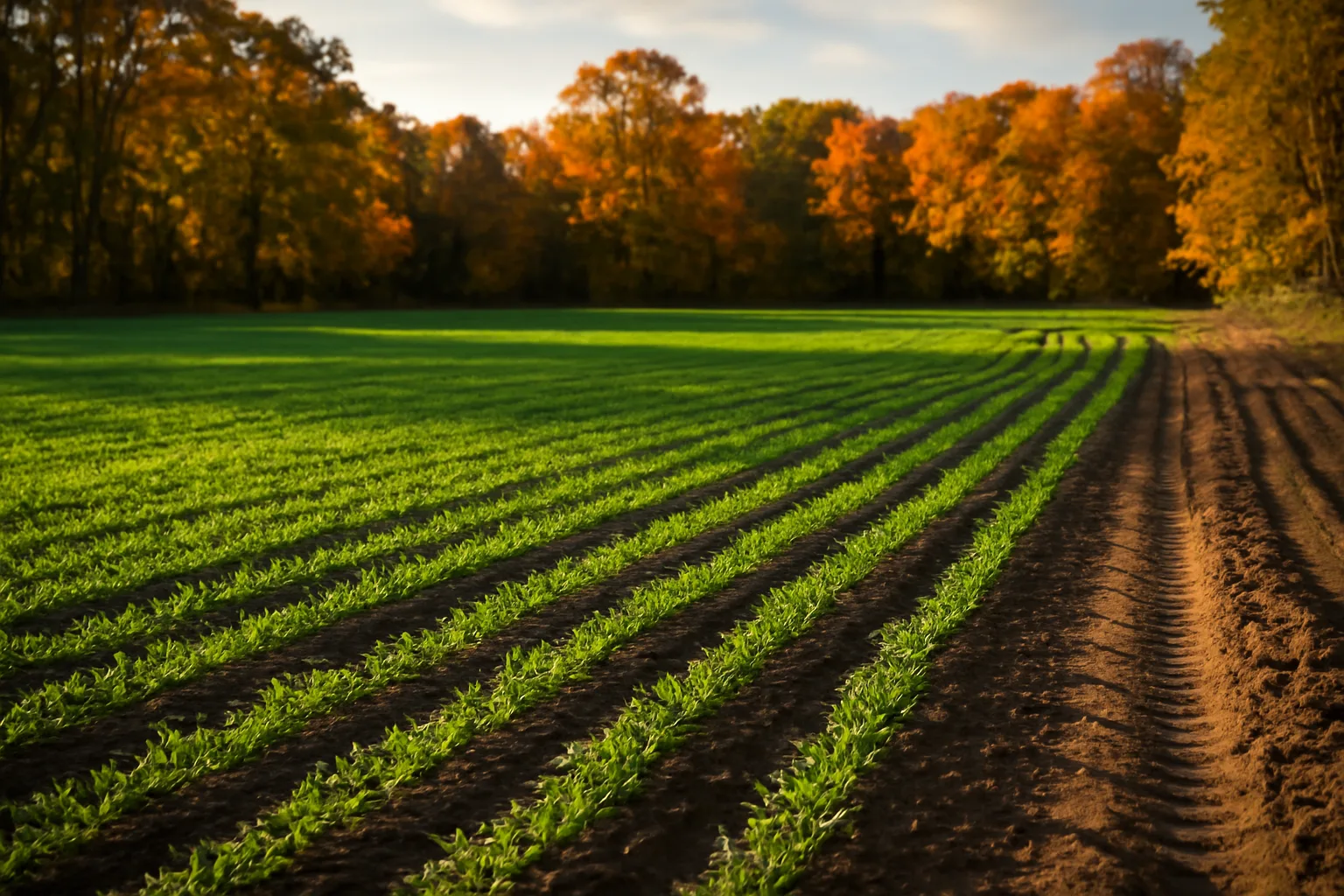
TL;DR
Plant food plots based on your first frost date, not the calendar. Spring plots (clover, chicory) go in 2-3 weeks before last frost; fall plots (brassicas, cereal grains) go in 60-90 days before first frost. Zone 5-6 hunters usually plant brassicas late July to mid-August and cereal grains late August through September.
What is a food plot?
A food plot is a planted patch of forage on hunting land, usually somewhere between a quarter acre and a few acres, put in to feed and hold deer and other wildlife on the property. It's not the same as a farm field, though the equipment and agronomy overlap a lot. Most plots fall into two rough categories: annuals you replant every year (brassicas, cereal grains, sorghum, some clovers) and perennials that you establish once and maintain for 3-5 years (clover, chicory, alfalfa). Annuals cost more in seed and labor over time but let you chase specific seasonal nutrition needs. Perennials cost more up front and need mowing and spot-spraying, but they're cheaper per year if you keep them alive. The USDA Natural Resources Conservation Service treats food plots as a wildlife habitat practice (Practice Code 645, Upland Wildlife Habitat Management) when cost-shared through conservation programs, which tells you it's viewed as a legitimate habitat tool, more than a hunting trick [1]. State wildlife agencies generally regulate food plots differently than bait piles. A planted, growing crop is legal to hunt over in nearly every state; piled corn or minerals often is not. Rules vary by state, so check your state wildlife agency's baiting and feeding regulations before you plant near a stand or assume a plot is treated the same as bait. If you want a plan built around your specific soil test, acreage, and region instead of guessing at species and dates, that's exactly what a food plot whitetail plan or the $99 Custom Food Plot Plan at /plot-plan-builder is for. Your soil test lab is still the authority on exact lime and fertilizer rates; a plan gives you the framework around it.
When to plant food plots for deer, in general terms
| Zone 3-4 (northern MN, WI, ME, MI UP) | Late May-early June | Late July-mid August | |
|---|---|---|---|
| Zone 5-6 (IA, southern WI/MI, PA, KY, VA) | Mid-April-mid May | Late July-mid September | |
| Zone 7 (NC, TN, AR, northern GA/AL) | Late March-April | Mid August-early October | |
| Zone 8+ (deep South, coastal plain) | March | September-October | These are windows, not exact dates. A wet spring or an early cold snap can shift things two weeks in either direction, and that's normal. When in doubt, extension agents in your county are the best free resource you have; most land-grant universities publish county-specific frost date tables. |
The single biggest factor in food plot timing isn't the calendar date, it's your average first and last frost dates. Extension agronomists and USDA climate data build every planting recommendation around those two dates, and you should too [2]. Spring plantings (clover, chicory, some brassica mixes meant for summer forage) go in roughly 2 to 3 weeks after your last expected frost, once soil temps hit about 50-55°F. Fall plantings (brassicas, cereal grains like oats, wheat, and rye) go in 60 to 90 days before your first fall frost, timed so the plants mature right as hunting season opens and cold weather sweetens the leaves. Here's the practical range across the whitetail's core range in the U.S., pulled from land-grant extension planting guides [3] [4] [5]: | Zone (approx. USDA hardiness) | Spring plot window | Fall plot window |
When should I plant clover for deer?
Plant perennial clover (white clover, red clover) in early spring, about 2 to 3 weeks before your last frost date, or in late summer/early fall roughly 6 to 8 weeks before your first frost. Both windows work; spring planting gives you a full growing season to establish roots, fall planting avoids competing with spring weed pressure. Clover seed is tiny and needs good seed-to-soil contact, planted no deeper than a quarter inch. The Noble Research Institute and multiple state extensions recommend broadcasting on a firm, prepared seedbed and cultipacking rather than deep drilling, because clover buried too deep just won't emerge [6]. Soil pH matters more for clover than almost any other food plot species. Most clover varieties want a pH between 6.0 and 6.5, and yields drop off hard below 6.0 because nitrogen-fixing rhizobia bacteria struggle in acidic soil. If your soil test comes back at 5.5 or lower, get lime down months before you plant, not the same week. Lime takes time to move through the soil profile; broadcast agricultural lime can take 6 months to a year to fully react. Your soil test lab's recommendation is the one to follow here, since regional soil types react to lime differently.
Do deer like clover, and is it worth planting?
Yes. Clover is consistently one of the most preferred food plot forages for whitetail deer, and it's also one of the most studied. Clover is high in crude protein, typically 25-30% in vegetative growth stages, which matters most in spring and summer when does are lactating and bucks are growing antlers [7]. The appeal of clover is duration, not novelty. A well-maintained perennial clover plot can produce grazeable forage from April through October or later in warmer zones, which is longer than almost any annual. The tradeoff is maintenance: clover needs mowing 3-4 times a season to keep it in a vegetative, high-protein state and to knock back weed competition, plus a broadleaf-safe herbicide program if grasses invade. If you want season-long attraction with one planting and don't mind mowing, clover is the highest-value perennial option for most of the whitetail's range. If you're not going to maintain it, don't plant it. Neglected clover plots get overrun by grass and broadleaf weeds within two growing seasons and turn into a waste of seed money.
When should I plant oats for deer food plots?
Plant oats for deer 60 to 90 days before your first fall frost, which lands most of the whitetail range somewhere between mid-August and mid-September. Oats are a cool-season annual cereal grain, and they germinate fast, often showing green in 5 to 7 days under good moisture. Oats have a real weakness: they're less cold-hardy than winter wheat or cereal rye, and a hard freeze in the low 20s (°F) can kill them outright, while wheat and rye keep growing after light frosts. That makes oats a great early-to-mid season fall attractant, particularly in the two to four weeks right after a frost sweetens the starches into sugar, but a poor choice if you're planning to hunt over the plot in late December in a northern climate. A lot of hunters blend oats with wheat, rye, or brassicas specifically to stagger the attraction window: oats peak early, brassicas and cereal rye carry it through the late season. Spring oat plantings also work as a quick cover crop or as a nurse crop for clover establishment, planted 2-3 weeks before last frost.
When should I plant turnips for deer food plots?
Plant turnips for deer 80 to 100 days before your first fall frost, which for most of the whitetail range means late July through mid-August. Turnips need a longer runway than oats because deer typically ignore the bulbs and leaves until after the first hard frost converts starches to sugars, and you want that frost to hit while the plant is already mature, not still developing. University of Tennessee and Mississippi State extension trial data both point to the same pattern: turnip forage quality and tonnage improve significantly after a frost, and plots planted too late (after mid-August in the Mid-South) often don't bulb out before hard frost stops growth [4] [5]. Turnips (and other brassicas like radishes and rape) also want a firm seedbed and shallow planting depth, about a quarter to half inch, similar to clover. One real caution: brassica plots can look completely untouched for the first 6 to 10 weeks after planting. That's normal, not a failure. Deer generally won't touch turnip tops and bulbs hard until after that first freeze, so don't judge a brassica plot's success in October if your first frost isn't until November.
Do deer eat sorghum?
Yes, deer eat grain sorghum (milo), both the seed heads and, to a lesser extent, the foliage, but it's not typically planted as a primary deer attractant on its own. Sorghum is more commonly used as a component of a wildlife blend, a screening/cover crop, or a late-season grain source in warm-season plots, especially in the South and Midwest where it tolerates heat and drought better than corn. Sorghum is planted in late spring after soil temps reach 65°F or so, generally May through June depending on zone, and it needs 90 to 120 frost-free days to mature grain heads [3]. Deer will browse young sorghum shoots some, but the real draw is the mature grain head in late summer and fall, which also brings in turkey, quail, and doves, so it doubles as a general wildlife planting. If your main goal is a dedicated deer attractant plot, sorghum isn't the first thing I'd plant. It works well as a standing cover strip on plot edges, or blended into a summer annual mix with cowpeas and soybeans for structure and screening as much as food.
What are deer's favorite foods, and does that change by season?
Deer preference shifts hard by season, and no single species is the favorite year-round. In spring and summer, deer favor high-protein forbs and legumes: clover, soybeans, cowpeas, and native forbs, because does are lactating and bucks are growing antlers, both processes that demand 16% or higher crude protein [7]. In fall, preference shifts toward energy-dense foods: acorns first if they're available, then brassicas, cereal grains, and standing corn or soybeans, because deer are shifting toward fat storage for winter. Acorns are worth calling out specifically. Multiple wildlife studies, including work summarized by the Quality Deer Management Association (now National Deer Association), show deer will preferentially hit a good acorn drop over a planted food plot almost every time in years when mast production is heavy. That's not a knock on food plots, it just means plot attraction is relative to what else is available on and around your property in a given year. Soybeans and corn, when deer have season-long access to standing crops (as in ag country), often out-attract a small food plot simply on volume and acreage. On smaller hunting-only tracts, clover, brassicas, and cereal grains do the heavy lifting because they're realistically what a landowner can plant and maintain on a few acres.
Do deer like honey, and is it worth using on food plots?
No credible wildlife research supports honey as a deer attractant, and it's not something any state wildlife agency, university extension, or deer researcher recommends as food plot or attractant strategy. Deer are herbivores with no evolved preference for honey, and there's no published study showing deer seek it out. The honey question usually comes up because of commercial "deer attractant" sprays that include sweet, sugary scents, sometimes marketed with names referencing honey, molasses, or apple. Those products are scent-based lures, not nutrition, and they're a completely different category from food plots. Some of these products also brush up against state baiting laws depending on how they're deployed (spray vs. pile vs. block), so check your state wildlife agency's regulations before using any scent or mineral attractant near a stand [8]. If you're trying to add sweetness or extra draw to a fall plot, a better use of money is a small patch of brassicas or a sugar beet variety, both of which convert starches to actual sugar after frost, something deer are proven to respond to.
How do I figure out my exact planting dates without guessing?
Start with your county's average first and last frost dates, which most state climatology offices and NOAA's National Weather Service publish by station . From there, count backward from your target frost date using the days-to-maturity window for whatever species you're planting: 60-90 days before first frost for oats and wheat, 80-100 days for brassicas, 2-3 weeks before last frost for spring clover and chicory. Your soil test is the second half of the equation, and it changes nothing about timing but everything about success. A $15-20 soil test through your county extension office or a private ag lab tells you your current pH and nutrient levels, and your lab's recommendation on lime and fertilizer rate should be treated as the final word, since regional soil chemistry varies and a generic online chart can't account for your specific dirt. If you'd rather not run all this math yourself, a Custom Food Plot Plan from PlotSeason takes your zip code, acreage, and soil test results and builds a species list and planting calendar around them for a one-time $99 fee. It's general regional guidance built from extension data, not a substitute for your soil lab's specific lime and fertilizer numbers, but it saves the trial-and-error most first-time planters go through. For species selection beyond timing, the deer food plot seed guide and food plot seed comparison break down which blends work in which soil and shade conditions.
What equipment do I actually need before planting?
At minimum: a way to test and amend soil (soil probe or send-in kit, plus a spreader for lime), a way to prepare a seedbed (disc, tiller, or even a heavy rake on small plots), a broadcast or drop spreader for seed, and a cultipacker or drag to firm the seedbed after broadcasting small seeds like clover or brassicas. You don't need a tractor to plant a good half-acre plot. A UTV with a tow-behind disc and spreader, or even hand tools on quarter-acre plots, works fine. Where people waste money is buying a no-till drill before they've planted anything, when a $150 hand-crank broadcast spreader and a rented disc will get a first-year plot in the ground just as well. Timing your equipment prep matters as much as timing the seed. Get soil test results back and lime applied at least a month, ideally several months, before your planting window opens, since lime reaction time is slow and you don't want to be broadcasting lime and seed the same week.
What's the single biggest mistake hunters make with plot timing?
Planting fall food plots too early, chasing green-up for early bow season instead of maturity for the meat of hunting season. A lot of first-time planters see a bag of brassica seed at the farm store in mid-July and rush it in the ground weeks before the recommended window, and end up with bolted, woody plants by November instead of sweet, frost-cured forage. The second most common mistake is the opposite: planting cereal grains so late that a hard freeze stops growth before the plants establish real root mass, leaving a thin, patchy stand that gets grazed out in two weeks. Both mistakes trace back to the same root cause: planting by the calendar date instead of counting backward from your actual frost dates. When in doubt, split the difference and stagger plantings. Put half your acreage in on the early end of the window and half two to three weeks later. That gives you a hedge against a weird weather year and spreads out peak attraction across more of the season.
Frequently asked questions
When is the best time to plant deer food plots overall?
There's no single best date nationally. Spring plots (clover, chicory) go in 2-3 weeks before your last frost; fall plots (brassicas, cereal grains) go in 60-100 days before your first frost, depending on species. Count backward from your local frost dates rather than using a fixed calendar date.
Do deer eat sorghum?
Yes, deer eat sorghum grain heads and browse some foliage, but it's rarely planted as a standalone attractant. It's more commonly used in wildlife blends or as a screening/cover crop, planted late spring after soil hits about 65°F, maturing in 90-120 days.
Do deer like clover?
Yes, clover is one of the most consistently preferred food plot forages for whitetail deer, largely because of its high crude protein content (often 25-30%) during spring and summer growth, exactly when does are lactating and bucks are growing antlers.
When should I plant oats for deer?
Plant oats 60-90 days before your first fall frost, generally mid-August to mid-September for most of the whitetail range. Oats germinate fast (5-7 days) but aren't very cold-hardy, so they work best as an early-to-mid fall attractant rather than a late-season food source.
When should I plant food plots for deer in general?
Time plots around your local frost dates, not a generic calendar date. Spring plantings go in a few weeks before last frost; fall plantings go in 60-100 days before first frost, with brassicas needing the longest runway and cereal grains needing the least.
When should I plant turnips for deer?
Plant turnips 80-100 days before your first fall frost, usually late July through mid-August across most of the whitetail range. Turnips need frost to sweeten before deer hit them hard, so plant early enough that the plant is mature by the time your first hard freeze arrives.
What exactly is a food plot?
A food plot is a planted area of forage crops, typically a quarter acre to several acres, established on hunting land to feed and hold deer and other wildlife. USDA treats food plots as a habitat management practice (NRCS Practice Code 645) rather than a form of baiting, though state baiting rules still apply to how you hunt near one.
What is a deer's favorite food?
There's no single favorite; preference shifts by season. Spring and summer favor high-protein legumes and forbs like clover and soybeans. Fall favors acorns first when available, then brassicas, cereal grains, and standing corn or soybeans as deer shift toward fat storage for winter.
Do deer like honey?
No research supports honey as a deer attractant. Deer are herbivores with no documented preference for honey, and no state wildlife agency or university extension recommends it. Commercial sweet-scent attractant sprays are a separate product category from actual food plot forage.
Can I plant a food plot without a soil test?
You can, but you're guessing at lime and fertilizer rates, which are the biggest lever on plot success, bigger than species choice. A $15-20 soil test through your county extension office tells you exact pH and nutrient needs; that lab's recommendation should override any generic online rate.
How late is too late to plant a fall food plot?
It depends on species and your first frost date. If you're inside 60 days of first frost for brassicas or inside 45 days for oats, germination and establishment risk goes up sharply. Cereal rye is the most forgiving late option since it tolerates cold better than oats or brassicas.
Is it legal to hunt over a food plot?
In nearly every state, yes, a planted and growing food plot is legal to hunt over, unlike a bait pile of loose corn or minerals. Rules differ by state though, so check your state wildlife agency's baiting and feeding regulations before hunting a new plot, especially regarding mineral or supplemental attractants used alongside it.
Sources
- USDA NRCS, Conservation Practice Standard 645 - Upland Wildlife Habitat Management: Food plots are recognized as a habitat management practice under NRCS Practice Code 645
- NOAA National Weather Service, Frost/Freeze Climatology: First and last frost dates are the standard basis for planting date recommendations
- University of Tennessee Extension, Establishing and Managing Wildlife Food Plots (PB1769): Regional planting windows and days-to-maturity guidance for food plot species including sorghum
- University of Tennessee Extension, Forage Brassicas publication: Brassica forage and bulb quality improves significantly after frost exposure
- Noble Research Institute, Establishing Food Plots for Deer: Small-seeded forages like clover need shallow planting depth and firm seedbed contact
- USDA Forest Service / National Deer Association research summary on whitetail nutrition: Deer require roughly 16% or higher crude protein during antler growth and lactation periods
- Example state wildlife agency baiting regulation reference (verify per state): Baiting and feeding rules for deer vary by state and differ from planted food plot regulations
- NOAA National Centers for Environmental Information, Climate Normals: County and station-level frost date data is published by NOAA climate normals