Last updated 2026-07-25
TL;DR
The best food plot planter depends on plot size and budget: hand spreaders work under an acre, ATV/UTV tow-behind spreaders and disc setups handle 1-5 acres, and no-till drills ($3,000-$15,000+ used) are worth it above 5 acres or on ground you can't till. Most hunters with small plots don't need a drill at all.
what is a food plot, and does the planter really matter?
A food plot is a planted opening on hunting land, usually somewhere between a quarter acre and several acres, grown to give deer and other wildlife a concentrated food source and, for hunters, a place to observe or intercept animals. State wildlife agencies generally treat food plots as normal agriculture, separate from baiting rules that restrict piles of grain or minerals [1]. Always check your state's specific definition though, because a few states draw the line differently between a planted crop and supplemental feeding. The planter matters less than people think, and more than people hope. Seed-to-soil contact is the single biggest driver of germination for almost every food plot species, more than variety choice or even fertility in a lot of cases. A $40 hand spreader used correctly, with a cultipacker pass or good rain timing, will outperform a $10,000 no-till drill run by someone who dumps seed on top of sod and walks away. So the honest answer is: buy the planter that matches your acreage, your soil, and your patience for prep work, not the one with the most horsepower behind it. We break down which category actually fits your situation below, and you can also run your specifics through a Custom Food Plot Plan if you want it matched to your soil test and region for $99 one time.
what are the main types of food plot planters?
| Hand/backpack spreader | Under 1 acre | $20-$80 | No |
|---|---|---|---|
| Tow-behind ATV spreader | 1-5 acres | $150-$600 | ATV/UTV only |
| Disc + cultipacker combo | 2-10 acres | $500-$3,000+ (used) | Yes |
| No-till drill | 5+ acres, or no-till ground | $2,500-$12,000+ | Yes (or heavy UTV for small units) |
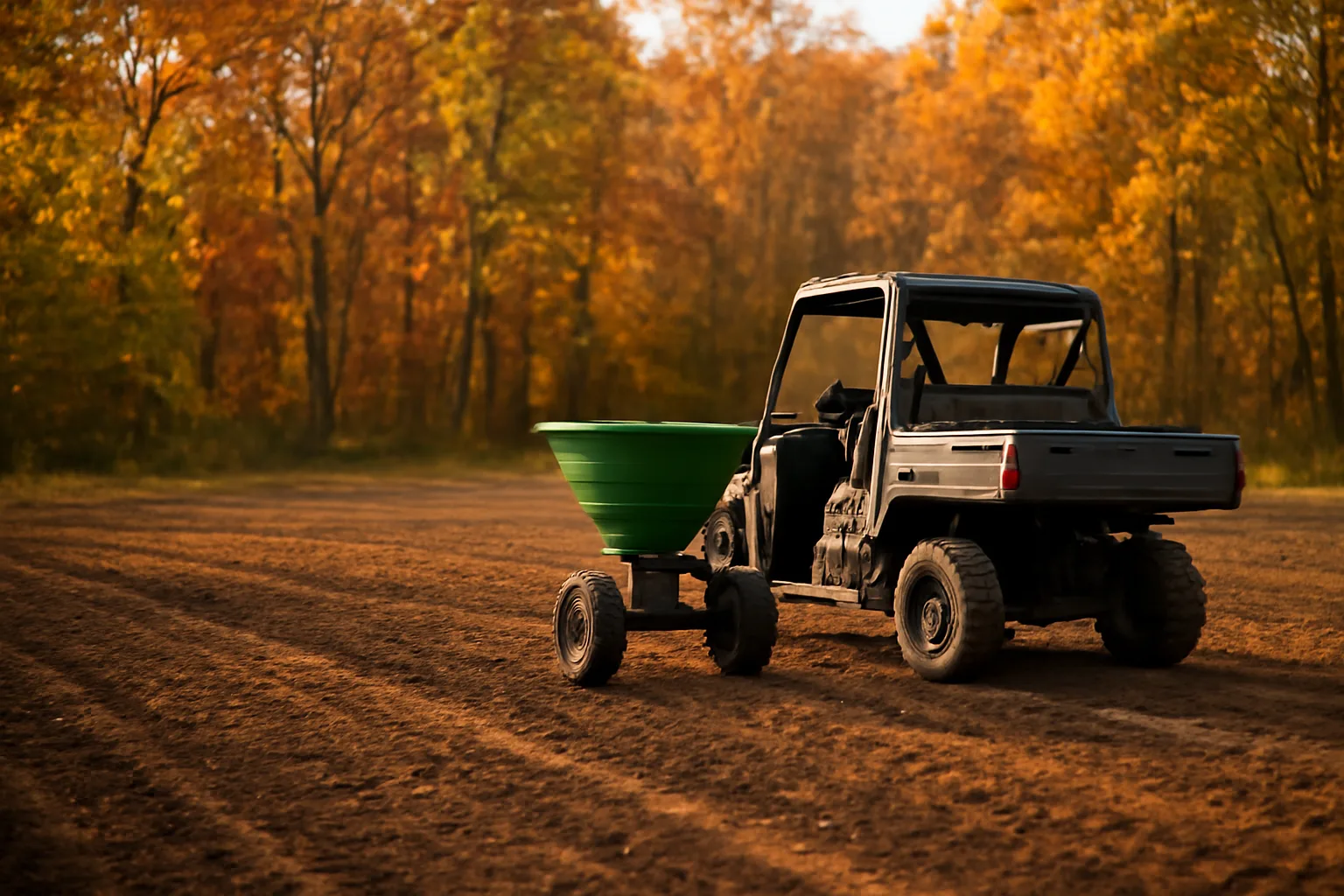
There are four real categories, and almost every product on the market falls into one of them. Hand-crank or backpack spreaders. Cyclone (broadcast) spreaders that you carry or push. Cost is $20 to $80 typically. Best for plots under an acre, small hidey-hole plots, or overseeding an existing plot. No tractor needed. Tow-behind ATV/UTV spreaders. Broadcast spreaders that hook to a hitch, often with their own small engine or ground-drive mechanism. Cost ranges roughly $150 to $600 for basic units, more for larger hoppers. Good for 1 to 5 acre plots when paired with some form of disc or drag for seed-to-soil contact. Disc, tiller, and cultipacker combos. These aren't planters by themselves, they're seedbed prep and seed-covering tools pulled behind a tractor or heavy ATV. A disc harrow breaks up soil, a cultipacker firms it after broadcasting seed. Used ag equipment in this category runs anywhere from a few hundred dollars for an old disc at auction to $3,000-plus for a decent cultipacker. No-till drills. These meter seed at a set depth and close the furrow in one pass, without needing to till first. Purpose-built food plot drills like the Firminator or Genesis systems cost roughly $4,000 to $12,000 new depending on width and options, while smaller ag drills (Great Plains, Tye, Brillion) show up used for $2,500 to $8,000 depending on age and condition [2]. Several state extension programs and conservation districts also rent no-till drills to landowners for wildlife plantings, often for $10 to $30 per acre, which is the cheapest way to try one before buying [3]. | Planter type | Best plot size | Typical cost | Needs a tractor? |
do i actually need a no-till drill?
Probably not, unless you're planting more than 5 acres a year or you're working ground you can't or don't want to till. No-till drills earn their keep in a few specific situations: erosion-prone hillsides where tillage invites washouts, clay soils that turn to concrete if worked wet, and any plot where you're planting into standing residue or a killed cover crop without disturbing the soil structure. The USDA Natural Resources Conservation Service notes that no-till systems can cut soil erosion substantially compared to conventional tillage while also preserving soil moisture and organic matter [4], which matters a lot on marginal hunting ground that never gets real ag-level attention. For the guy with two or three plots totaling under 3 acres, a drill is overkill. You'll spend more time hauling and maintaining it than you save in planting speed. A disc, a drag harrow (even an old bed frame works), and a cultipacker or ATV tires to pack the seed in will get you 90% of the results for a fraction of the cost. Where it gets worth it: guys managing 10, 20, 50-plus acres across multiple properties, or anyone doing custom work for other landowners. At that scale the labor savings and the ability to plant into tough ground without a full tillage pass pay for the machine over a few seasons.
when to plant food plots for deer
Timing splits into two windows almost everywhere in whitetail country: a spring/summer planting for warm-season annuals and perennials, and a late-summer/fall planting for cool-season annuals like brassicas, cereal grains, and clover. Spring plots (soybeans, corn, warm-season perennial clovers) generally go in after your last frost date, which your local cooperative extension office publishes county by county. Fall plots (brassicas, cereal grains, clover, oats) go in anywhere from late July through September depending on latitude, timed so the plants have 6 to 10 weeks of growth before a hard frost or hunting season pressure hits. The real driver isn't the calendar date, it's soil temperature and moisture. Extension guidance from Mississippi State and other land-grant programs consistently points to planting fall brassicas and cereal grains 60 to 90 days before your average first frost date, so the plants have time to establish a root system and enough leaf mass before growth slows [5]. In the Deep South that might mean planting as late as mid-September. In the Upper Midwest or Northeast, you're often planting by early August for the same crops. Check your zone specifics on our food plot whitetail guide and cross-reference with your county extension frost dates before locking in a date.
when to plant oats for deer
Plant oats in late summer to early fall, generally 6 to 8 weeks before your first expected frost, so they establish before growth slows in the cold. Oats are one of the most forgiving fall food plot crops because they germinate fast (often within 5 to 10 days in warm, moist soil) and tolerate a wider planting window than brassicas. Most of the whitetail range plants oats somewhere between mid-August and mid-September. Oats also work as a spring planting in northern climates for early-season forage, though fall is by far the more common use in food plot programs because deer hit them hard right as other food sources start drying up. One quirk worth knowing: oats aren't very frost-hardy compared to wheat or rye. A hard freeze will often kill oat forage back for the season, while winter wheat and cereal rye keep growing (or regrow) after freezes. If you want late-season food into December and January in colder zones, blend oats with wheat or rye rather than planting oats alone.
when to plant turnips for deer
Turnips go in the ground 75 to 90 days before your first fall frost, which for most of the whitetail range lands somewhere between late July and late August. Turnips need that long runway because the tuber (bulb) doesn't bulk up until later in the growth cycle, and a frost or two actually sweetens the leaves and bulb by converting starches to sugars, which is why deer often ignore turnip plots in September and hammer them in December. This is the single most common mistake with brassica plots: people plant too late, get decent leaf growth, and then wonder why deer aren't touching it during archery season. They're not supposed to yet. Turnip plots are a late-season strategy, planted in summer for hunting in December and January, not an October pattern plot. Seed brassica-family crops (turnips, radishes, kale) shallow, around a quarter inch, and pair them with a nitrogen source since brassicas are heavy feeders. A soil test through your state's land-grant lab will tell you exactly how much nitrogen, phosphorus, and potassium your specific ground needs rather than guessing off a bag label.
do deer eat sorghum?
Yes, deer eat sorghum, both the grain heads and the young forage growth, though it's rarely a first-choice food plot species on its own. Sorghum (grain sorghum, also called milo, along with forage sorghums and sorghum-sudangrass hybrids) is more commonly planted as a screening or cover crop, or as a companion in a summer blend with soybeans and cowpeas, than as a dedicated attractant. Deer will browse young sorghum shoots and will eat mature grain heads, particularly late in the season when the seed has dried down and other food is scarce. Turkeys and other wildlife also use standing sorghum heavily for the grain. Where sorghum earns its spot in a plot rotation is as a nurse crop, its fast, tall growth shades out weeds and gives slower-establishing perennials like clover a head start, and the standing stalks make good bedding cover and wind screening around a plot edge. If your main goal is deer attraction, sorghum is a supporting player, not the headline. Soybeans, clover, and brassicas all outperform it for pure deer draw in most regional studies and extension trial data.
do deer eat clover, and do they actually like it?
Yes, and it's not close. Clover is consistently ranked among the top food plot species for whitetail preference and use across nearly every state extension and wildlife agency publication on food plots. White clover, red clover, and alsike clover all get heavy use, with white clover varieties (Durana, Ladino, common white) being the most planted perennial clover in food plot mixes nationally. Clover's advantage is duration. Unlike an annual that gets planted, grazed hard, and dies off, a well-maintained perennial clover stand can produce quality forage for 3 to 5 years or more with proper mowing, weed control, and periodic fertilization based on soil test results. That's a lot of return on one planting and one seed cost. Clover also fixes its own nitrogen through rhizobium bacteria in the root nodules, which is why extension guidance typically calls for a phosphorus and potassium-heavy fertilizer rather than a high-nitrogen blend, plus lime if your soil test shows pH below the 6.0 to 6.5 range clover prefers. Get the pH right first. Clover struggles in acidic soil no matter how much fertilizer you throw at it, and that's the number one reason clover plots fail or thin out within a year or two. For species selection beyond clover, our deer food plot seed breakdown covers blends by region and goal.
what are deer's favorite foods, and does that change by season?
Deer preference shifts hard by season, and no single crop wins year-round. In spring and summer, deer key in on high-protein forage for antler growth and lactation, soybeans, cowpeas, and clover top most preference studies during this window. In fall, as energy needs shift toward fat storage for winter and the rut, deer favor high-carbohydrate foods, acorns first if they're available, then standing corn, soybeans left standing, and brassicas as they sweeten after frost. Regional mast crops (acorns especially) beat almost every planted food plot species when they're on the ground in a good mast year, which is a frustrating but well-documented reality for food plot managers. State wildlife agency deer research consistently shows acorns are preferred over agricultural crops when both are available in quantity, and food plots see their best use in years when the mast crop fails or is thin. So "favorite food" really means favorite food available right now, for the nutritional need right now. That's part of why most experienced plotters run a mix of plot types (clover for spring/summer, brassicas and cereal grains for late season, soybeans or corn where acreage allows) rather than betting on one crop to carry a whole property. See deer food plots for a fuller rundown on blending strategy by property size.
do deer like honey, and does that mean anything for food plots?
There's no research or wildlife agency guidance supporting honey as a deer attractant, and it isn't a food plot input at all. Deer are herbivores that browse plants, forbs, mast, and agricultural crops; nothing in state extension or wildlife agency literature lists honey, or any bee product, as part of natural whitetail diet or as an effective attractant additive. Where this question usually comes from is confusion with commercial deer attractant products that use sugar, molasses, or apple/corn-based scents, some of which are marketed with names or descriptions that reference sweetness. Those products occupy a different category entirely from food plots, and many states regulate or ban the use of scent and mineral attractants the same way they regulate baiting, so check your state wildlife agency's baiting and feeding rules before using any additive product, powder, or liquid attractant on your property [1]. If you want a sweet, high-draw food plot option that actually has research behind it, sugar beets and forage-type turnips both build sugar content post-frost and get heavy documented use in late season, which is the legitimate version of what people are usually chasing when they ask about honey.
how do i match a planter to my actual plot size and soil?
Start with acreage, then layer in soil type, because the two together tell you almost everything you need. Under half an acre: hand spreader, period. You don't need anything towed. Broadcast your seed, drag a section of chain-link fence or a bed frame behind an ATV to work it in, and pack it down by driving over it a few times or waiting for a good rain within 24 to 48 hours. Half acre to 3 acres: tow-behind broadcast spreader on an ATV or UTV, paired with a small disc or drag harrow for seedbed prep. This is the sweet spot for most weekend food plotters, and it's the range where a $300 to $800 total equipment investment (spreader plus a basic disc) covers you for years. 3 to 10 acres: this is where a compact disc, cultipacker, or entry-level no-till drill starts paying off in time saved, especially if you're managing multiple plots across a property or across leases. Clay-heavy or rocky soils push you toward a no-till drill sooner, since repeated tillage on those soils causes more erosion and compaction problems long-term, something the USDA NRCS specifically flags in its soil health guidance [4]. 10-plus acres, or custom work for others: full-size no-till drill or a tractor-mounted combo unit, no way around it at that scale. Get your soil tested first regardless of planter size. A soil test through your state land-grant extension lab, usually $10 to $20 per sample, tells you exact lime and fertilizer needs, and no planter fixes a pH problem. If you want a plan that matches species, seeding rate, and timing to your specific soil test and zone, a Custom Food Plot Plan does that for $99 one time; it's general guidance built around your numbers, not a replacement for your soil-test lab's specific lime and fertilizer recommendations.
what's the cheapest way to get good seed-to-soil contact without a drill?
Broadcast the seed, then drag it, then pack it. That three-step sequence, done with almost any equipment, beats an expensive planter run carelessly. Dragging can be a real cultipacker, or it can be a section of chain-link fence, a piece of carpet weighted with cinder blocks, or an old bedspring frame, all of which farmers and food plotters have used for decades to knock seed into loosened soil. Packing afterward, either with a roller/cultipacker or just by driving over the plot slowly with ATV tires at low pressure, closes the seed in and pulls moisture up around it. Rain timing matters more than any tool. Extension trial data and most experienced plotters agree that seed broadcast onto a prepared seedbed within a day or two of a forecasted rain will germinate close to as well as seed drilled to precise depth, especially for small-seeded species like clover and brassicas that don't need much soil coverage anyway. Where drills earn their cost is on larger-seeded crops like corn, soybeans, and cereal grains, where consistent planting depth matters more for even emergence.
Frequently asked questions
Do deer eat sorghum?
Yes, deer eat both young sorghum forage and mature grain heads, especially late season when other food is scarce. It's more often used as a screening cover crop or nurse crop for clover and other perennials than as a primary attractant, since soybeans, clover, and brassicas generally outperform it for pure deer draw.
Do deer eat clover?
Yes, clover is one of the most preferred food plot species for whitetail deer, used heavily in spring, summer, and fall. It also fixes its own nitrogen and, with proper pH (6.0-6.5) and mowing, can produce forage for 3 to 5 years or more from one planting.
When should I plant food plots for deer?
Spring/summer annuals like soybeans and corn go in after your last frost date. Fall plots (brassicas, cereal grains, clover) typically go in 60 to 90 days before your first fall frost, so timing varies widely by latitude, from early August in the Upper Midwest to mid-September in the Deep South.
When do I plant oats for deer food plots?
Plant oats 6 to 8 weeks before your area's first expected frost, usually mid-August to mid-September across most of the whitetail range. Oats germinate fast but aren't frost-hardy, so blend with wheat or rye if you want food that lasts into December and January.
When should I plant turnips for deer?
Plant turnips 75 to 90 days before your first fall frost, generally late July through late August depending on your zone. Turnips are a late-season crop; the bulb sweetens after frost, so deer often ignore them in early fall and hit them hard in December and January.
What is a food plot?
A food plot is a planted area on hunting land, often a quarter acre to several acres, grown specifically to provide concentrated forage for deer and other wildlife and to give hunters a predictable place to observe or hunt animals. It's generally regulated as agriculture rather than baiting, though state rules vary.
What are deer's favorite foods?
Preference shifts by season: soybeans, cowpeas, and clover in spring/summer for protein, and acorns, standing corn, soybeans, and frosted brassicas in fall for carbohydrates and fat storage. Acorns typically beat any planted food plot crop in a good mast year, which is well documented in state deer research.
Do deer like honey?
No wildlife agency or extension research supports honey as a deer food or attractant. Deer are herbivores that browse plants, forbs, and mast; the confusion likely comes from commercial scent or sugar-based attractant products, which are separate from food plots and often regulated the same as baiting.
Do I need a no-till drill for a small food plot?
Usually not. Under 3 acres, a hand or tow-behind spreader plus a drag harrow and some packing (cultipacker or ATV tires) gets you most of the germination benefit of a drill for a fraction of the cost. Drills pay off past 5 acres or on erosion-prone, no-till ground.
What's the best cheap food plot planter for a small plot under an acre?
A hand-crank or backpack cyclone spreader, $20 to $80, is the right tool. Broadcast seed onto a prepared seedbed, drag it in with a chain-link section or weighted carpet, and pack it down by driving over it or timing it ahead of rain.
How much does a no-till drill cost?
Purpose-built food plot drills (Firminator, Genesis) run roughly $4,000 to $12,000 new. Used ag drills (Great Plains, Tye, Brillion) show up for $2,500 to $8,000 depending on age and width. Many conservation districts and extension programs also rent drills for $10 to $30 per acre.
Can I plant a food plot without tilling the soil?
Yes, that's the entire purpose of a no-till drill: it cuts a slot, drops seed at a set depth, and closes the furrow without disturbing the whole seedbed. This works especially well on erosion-prone or clay soils where repeated tillage causes long-term compaction and washout problems.
How do I know how much lime or fertilizer my food plot needs?
Get a soil test through your state's land-grant extension lab, usually $10 to $20 per sample. Your soil-test lab is the authority on your specific lime and fertilizer recommendations; no planter or seed blend fixes a pH problem, and bag-label rates are only a rough starting guess.
Sources
- example state wildlife agency baiting/feeding regulation summary: food plots are generally treated as agriculture separate from baiting/feeding restrictions, which vary by state
- Great Plains Ag / used farm equipment market pricing (general no-till drill cost range): no-till drill cost ranges for new purpose-built and used ag equipment
- state conservation district / NRCS equipment rental program example: conservation programs and districts offer equipment rental including no-till drills to landowners
- USDA Natural Resources Conservation Service, Soil Health / No-till: no-till systems reduce soil erosion and preserve soil moisture and organic matter compared to conventional tillage
- Mississippi State University Extension, Fall Food Plot Establishment: fall brassica and cereal grain food plots should be planted 60 to 90 days before the average first frost date